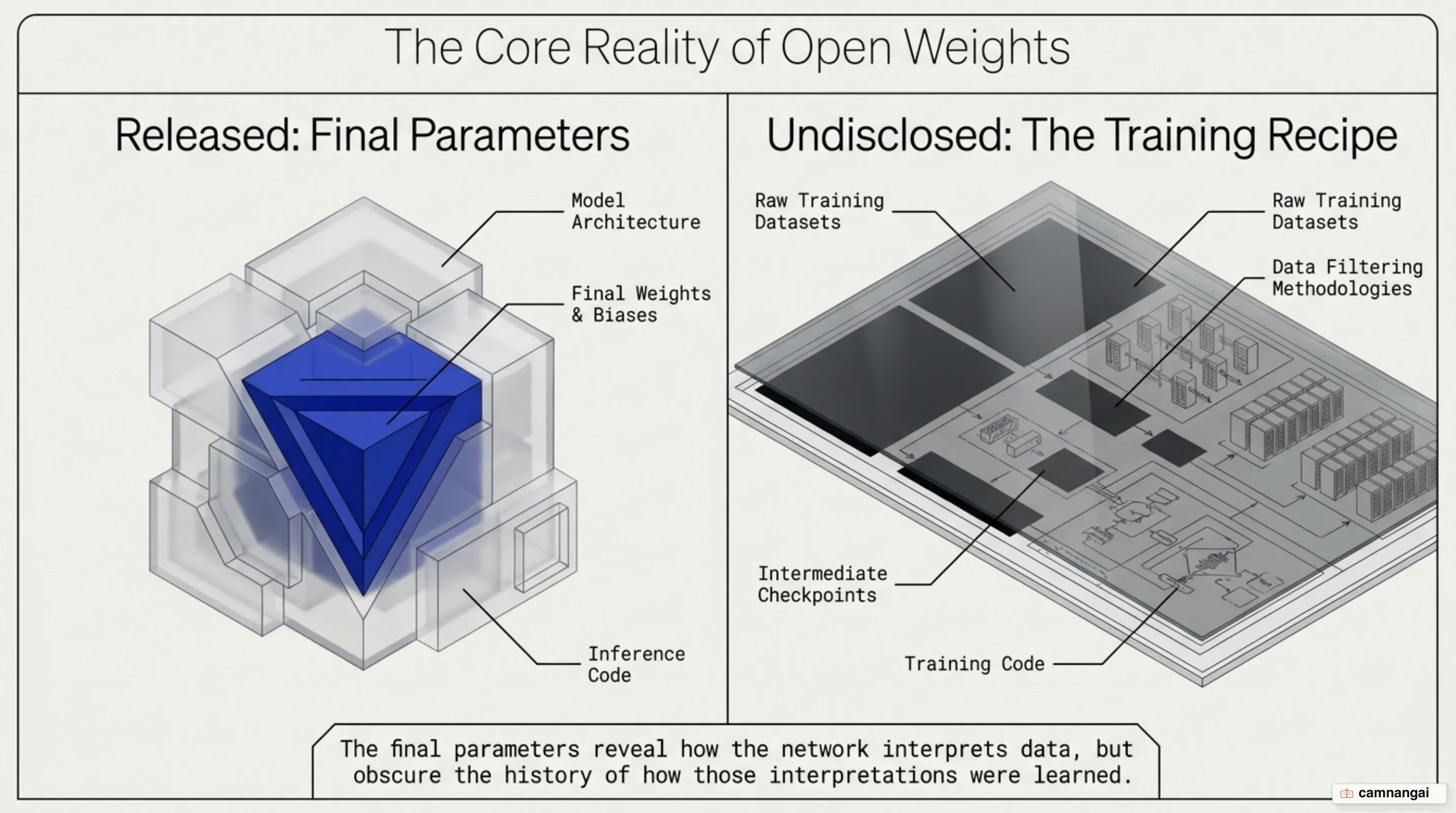
Open weights refers specifically to the released numerical parameters—the learned weights and biases—of a trained neural network that convert input data into predictions.
Once training is complete, these parameters define the internal network logic that transforms prompts into outputs.
While an open-weight release allows you to download, run, host, fine-tune, and quantize a model on your own infrastructure, it only exposes the final state of the network. It does not provide the complete pipeline, raw training datasets, or software stack used to create those weights from scratch.
Acquiring open weights grants you operational control over local inference, but it leaves the foundational training recipe undisclosed.
What are model weights, exactly?
Neural network weights are the learned numerical parameters—conceptually analogous to millions or billions of adjustable dials—that determine how an artificial intelligence (AI) system processes input data across its layers to generate predictions, text, or decisions. During training, an optimization algorithm continually adjusts these values until the network produces accurate outputs. When you inspect an individual weight value in isolation, it offers little intelligible context; however, when assembled into full tensor layers, these parameters collectively dictate the mathematical transformations applied to your prompts.
Model parameter counts span several orders of magnitude. Smaller dense architectures range from 0.6B to 27B parameters, which can often be loaded and executed on single workstations or modest GPU setups. On the opposite end of the spectrum, frontier-scale models reach up to 2.4T or 2.8T parameters. Because single files cannot easily store such massive parameter sets, creators distribute weights across multiple sharded files.
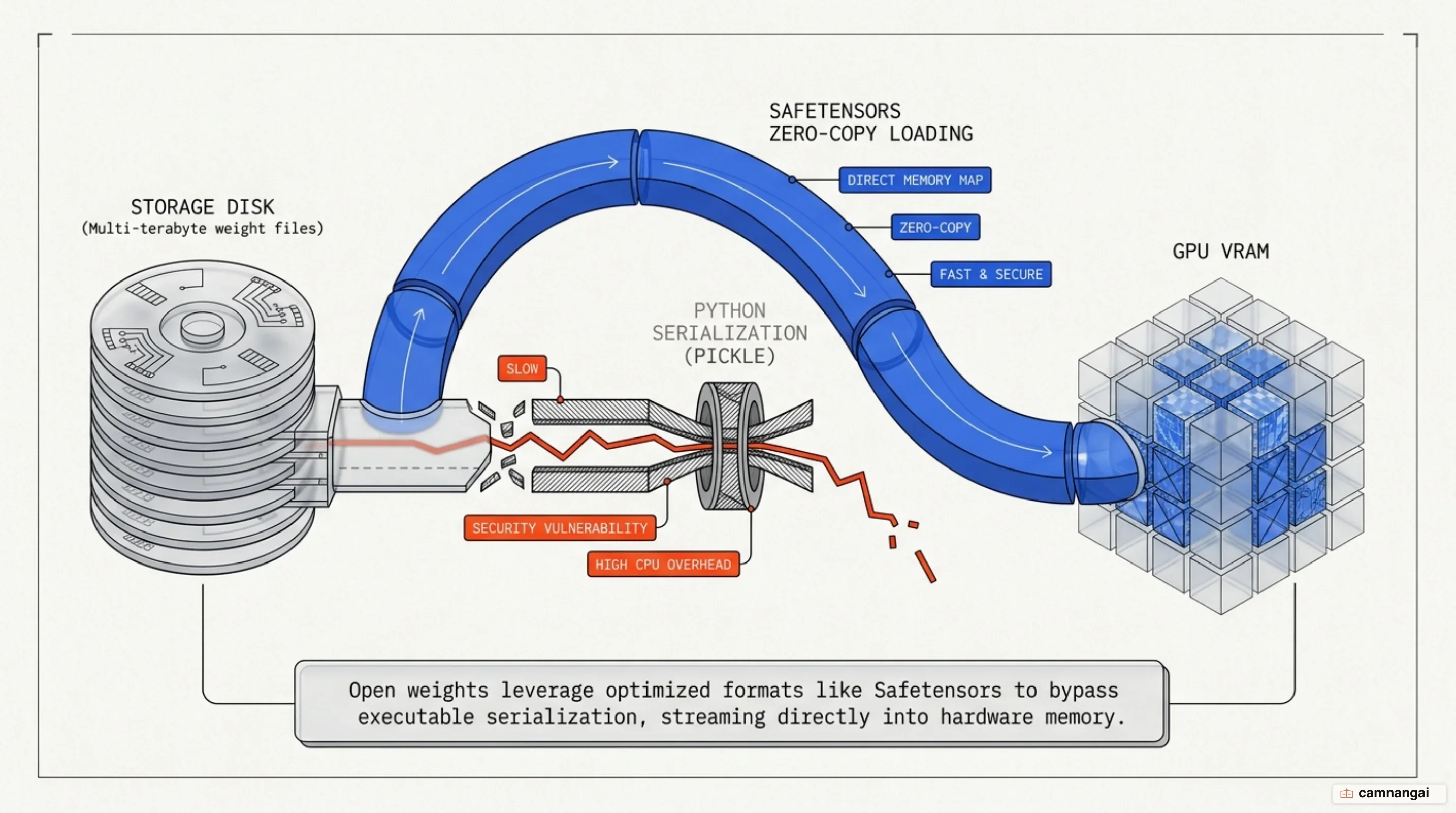
Modern releases rely heavily on the safetensors format, which enables rapid, zero-copy tensor loading directly into memory while eliminating the security risks associated with executing unsafe Python pickle files. To inspect or load tensors directly in Python using safetensors, you can use the zero-copy safe_open interface as demonstrated below:
from safetensors import safe_open

tensors = {}
with safe_open("model.safetensors", framework="pt", device=0) as f:
    for k in f.keys():
        tensors[k] = f.get_tensor(k)
How open weights differ from true open-source AI
Releasing model parameters is not equivalent to publishing open-source AI as defined by the Open Source Initiative's Open Source AI Definition 1.0 (OSAID). Under OSAID 1.0, a system must provide the preferred form to make modifications, which encompasses complete data information, source code, and parameters under OSI-approved terms. In particular, the "Parameters" requirement under OSAID encompasses not just the final model checkpoint, but also intermediate training stage checkpoints and full optimizer states where applicable. In contrast, standard open weights releases routinely withhold the complete training dataset, data preprocessing and filtering scripts, intermediate checkpoints, and the full training codebase required to reproduce the initial training run from scratch.
This missing training recipe leaves substantial operational and analytical blind spots. Without access to the original dataset composition, filtering scripts, and processing pipelines, you cannot audit where training data originated, verify copyright compliance, or inspect how safety alignment altered the model's behavior. You receive a functional binary artifact that you can steer at the edges through fine-tuning, but the foundational development recipe remains entirely with the original vendor.
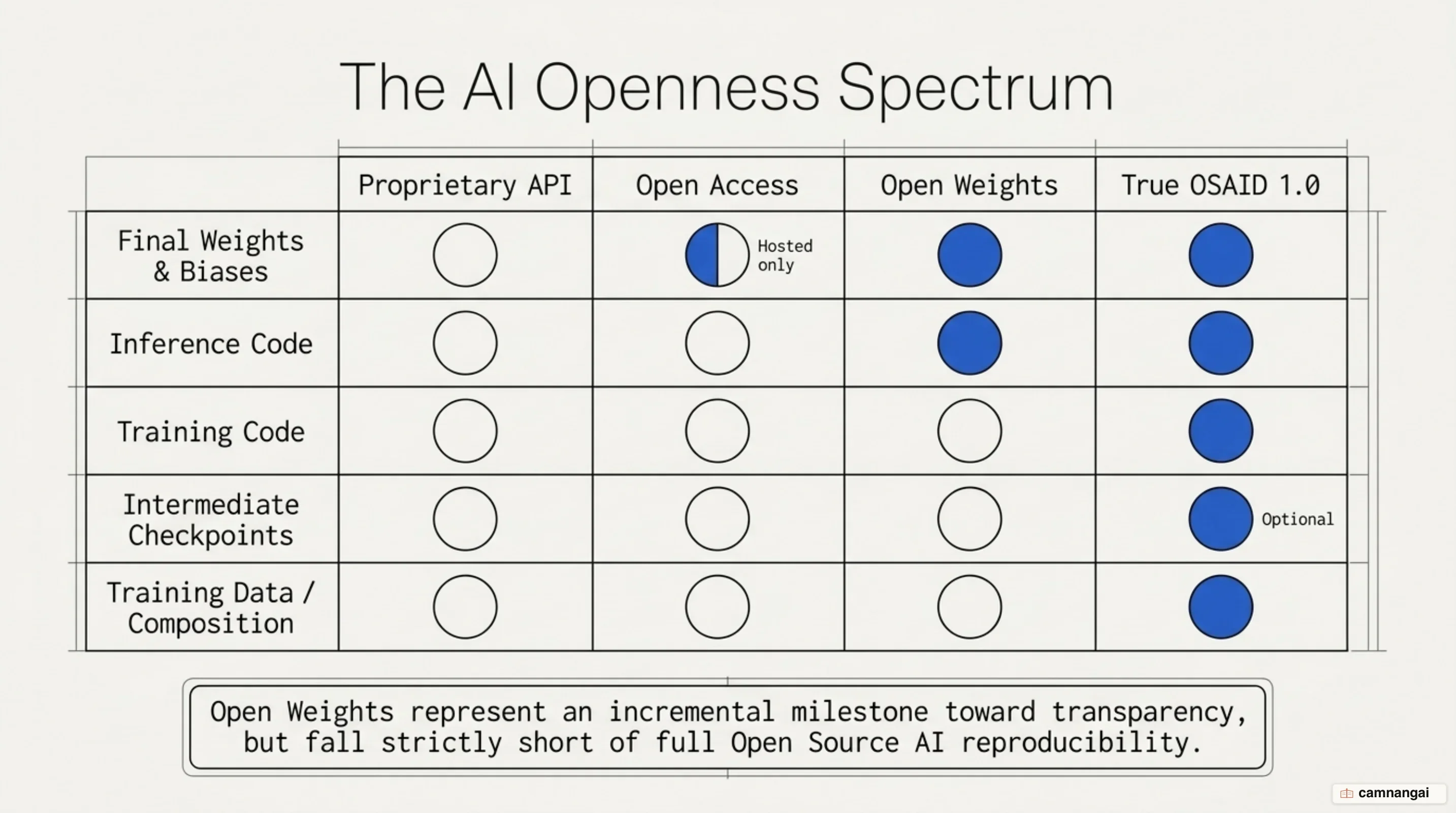
The structural distinctions between open weights and true open-source AI are summarized below:
| Feature / Artifact | Open Weights Release | Open Source AI (OSAID 1.0) |
|---|---|---|
| Model Parameters / Weights | Released (Final Checkpoint) | Released under OSI-approved terms |
| Training Source Code | Withheld or partial | Fully shared (processing, filtering, training) |
| Training Dataset | Withheld or undisclosed | Released or fully disclosed (Data Information) |
| Intermediate Checkpoints | Withheld | Optional / Provided where applicable |
| Reproducibility | Low / Non-reproducible | High / Complete specification |
What engineers can actually do with open weights
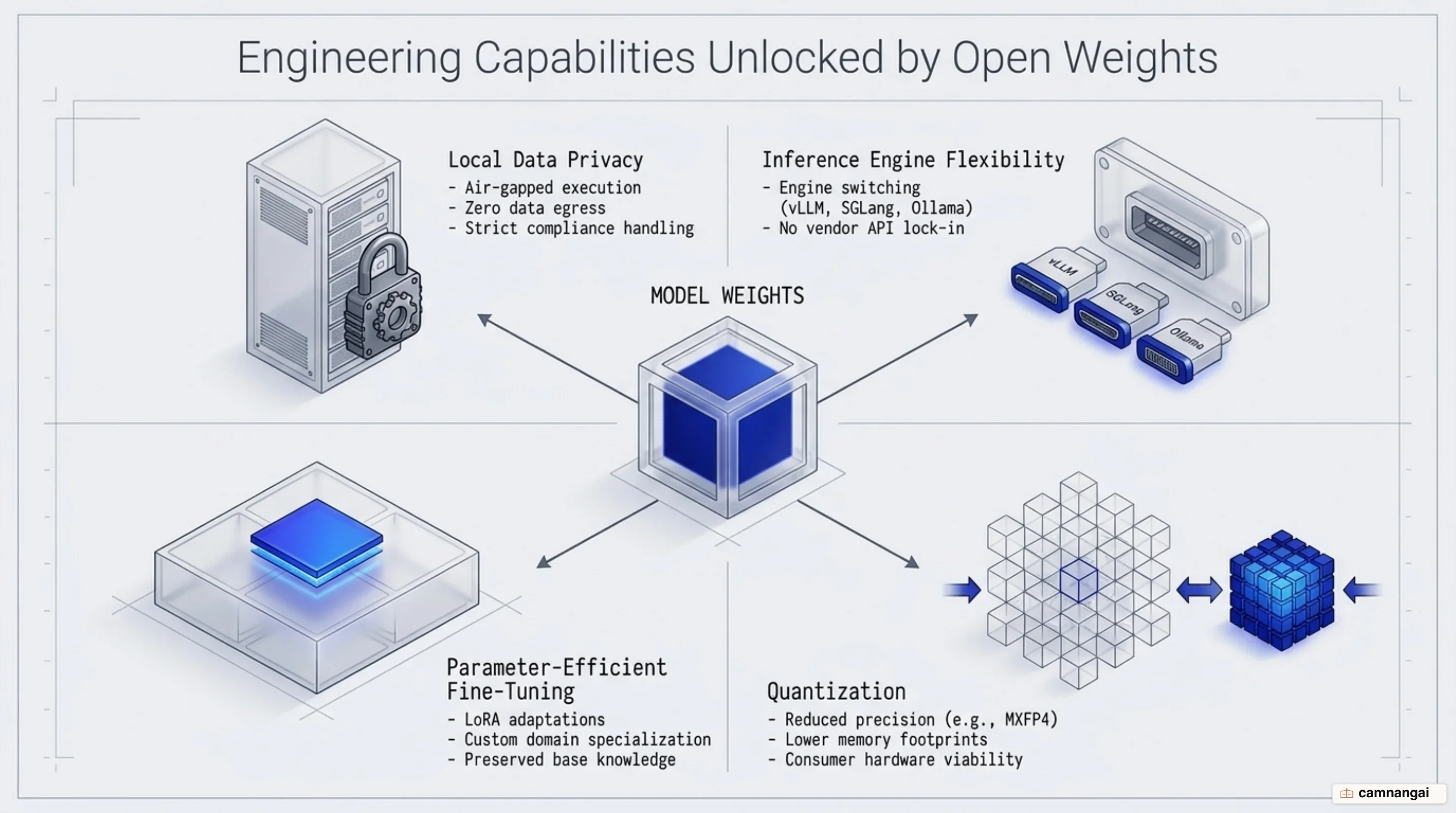
Securing local access to open weights gives engineering teams direct control over their stack in ways closed APIs intentionally restrict. First, you can execute local inference on self-hosted infrastructure, ensuring strict data privacy by keeping sensitive source code, internal documents, and customer records entirely within your secure network boundaries. Second, you are not locked into a single vendor's API; you can select from multiple third-party inference providers offering competitive pricing, latency, and geographic hosting, or switch between them without changing the underlying model logic. Third, you can lock exact model versions to prevent silent behavior drift or API deprecations that disrupt production pipelines.
Beyond deployment, open weights allow you to adapt and optimize models for specific domain workloads. You can perform parameter-efficient fine-tuning (PEFT), such as Low-Rank Adaptation (LoRA), to adapt a model to internal corporate terminology or custom task formats without incurring the expense of full-parameter training. You can also apply post-training quantization techniques to reduce precision, shrinking the model footprint to run on cost-effective hardware or edge devices with minimal accuracy loss.
Also, holding parameters locally enables deep mechanistic analysis and safety evaluations. Instead of treating the network as an opaque black box accessed via HTTP requests, researchers and engineers can inspect hidden layer activation states, test altered sampling routines, prune or replace layers, and systematically analyze failure modes without passing sensitive prompts through third-party monitoring filters.
The license is as critical as the weights download
Downloading model parameters does not automatically grant unrestricted legal or commercial rights. A model file is bound by its associated license or terms of use, which specify what you are permitted to do with the weights. While certain repositories adopt standard, permissive open-source software licenses such as Apache 2.0 or MIT, many prominent releases rely on custom community or restrictive licenses. Examples include the Llama community licenses, the Qwen3.8-Max license for large variants, and the Kimi K3 license.
Custom model licenses frequently enforce specific restriction clauses that you must evaluate prior to deployment. Common restrictions include monthly active user or commercial revenue thresholds, prohibitions against deploying models in designated restricted domains or high-risk industries, and explicit constraints on using model outputs for synthetic data distillation.
The clause regarding synthetic data distillation has sparked intense debate across the industry, highlighting divergent stakeholder positions. On one side, an open letter signed by 235 AI companies frames distillation—the practice of using outputs from a larger model to train or improve another—as a standard, legitimate technique essential for model evaluation, validation, and efficient development. Conversely, frontier labs taking defensive stances view distillation as competitive misappropriation. Engineering teams must carefully evaluate these legal terms, as violating distillation restrictions or commercial usage caps introduces significant legal liability.
Open weights does not mean accessible hardware
There is a sharp operational difference between technical openness and physical hardware accessibility. While an open weights release makes files public, hardware constraints determine whether your organization can practically run the model. Dense models with modest parameter counts (such as a 27B parameter dense model) can be hosted on single consumer GPUs or local workstations. However, frontier-scale mixture-of-experts (MoE) architectures demand massive enterprise infrastructure that exceeds the reach of individual developers or small teams.
Consider Moonshot AI's Kimi K3 release as a prime example of high openness paired with extreme hardware requirements. Kimi K3 features 2.8 trillion total parameters, using an MoE architecture with 896 total experts that activates 16 experts per token. Its raw weights comprise approximately 1.56 TB of MXFP4 formatted parameters distributed across 96 safetensors file shards. Even at 4-bit MXFP4 precision, keeping 1.56 TB of parameters resident in high-bandwidth VRAM requires allocating massive parallel GPU clusters; when accounting for KV cache overhead, tensor parallelism, and routing overhead, executing inference on Kimi K3 necessitates a dedicated footprint of 64 or more enterprise accelerators. Similarly, Alibaba's Qwen3.8 architecture released a 2.4-trillion-parameter MoE model with 95 billion active parameters under a custom license, alongside a dense 27-billion-parameter variant under Apache 2.0.
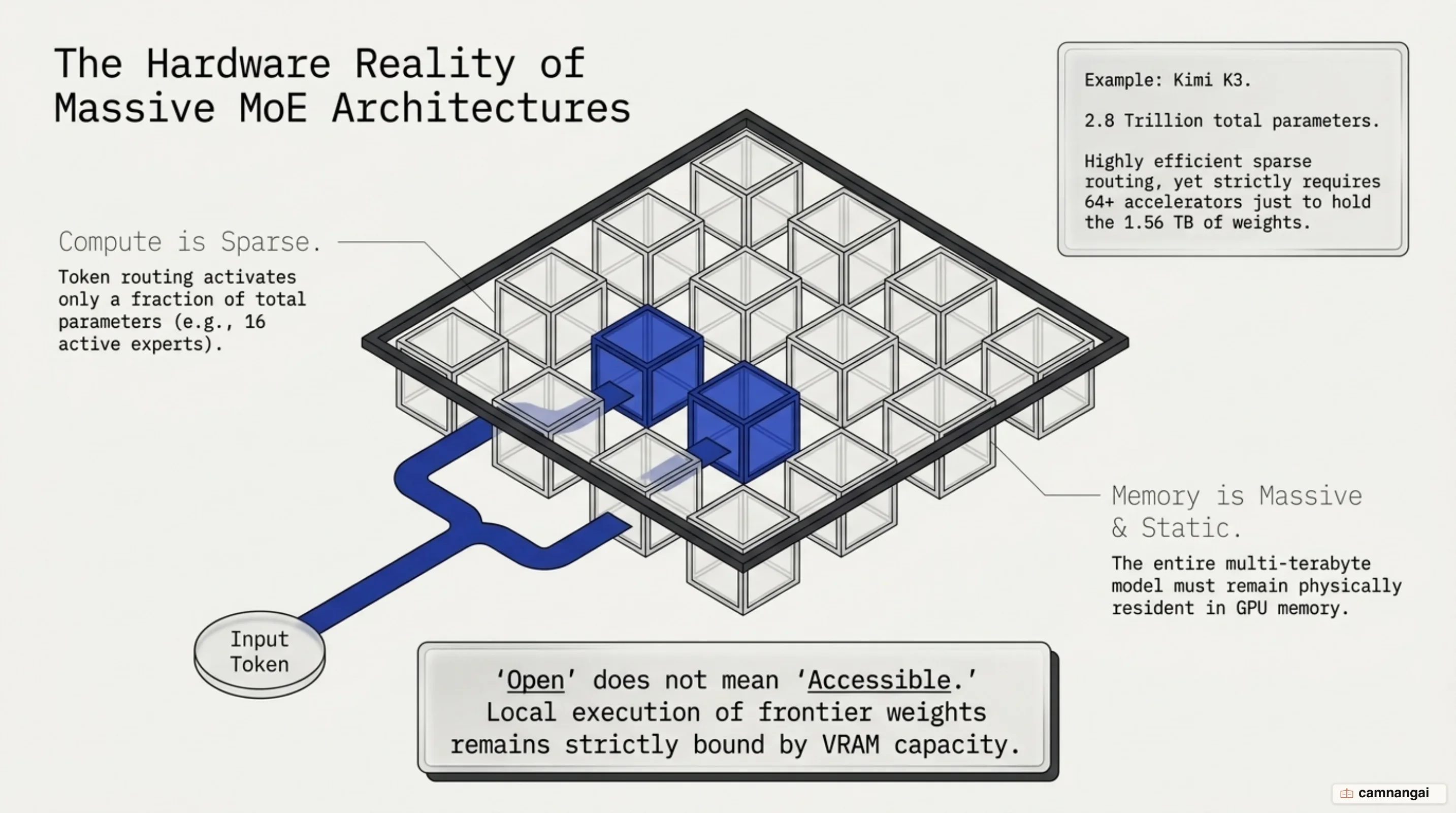
Parameter routing in MoE models improves per-token execution efficiency by evaluating only a fraction of the total network during any given forward pass. Nevertheless, because all parameters must remain simultaneously loaded in VRAM to execute dynamic routing decisions for incoming tokens, the overall physical memory footprint remains static and massive. Open access to parameters guarantees the legal right to download the weights, but physical execution still hinges on multi-terabyte VRAM capacity and enterprise accelerator availability.
When should you choose open weights over closed APIs?
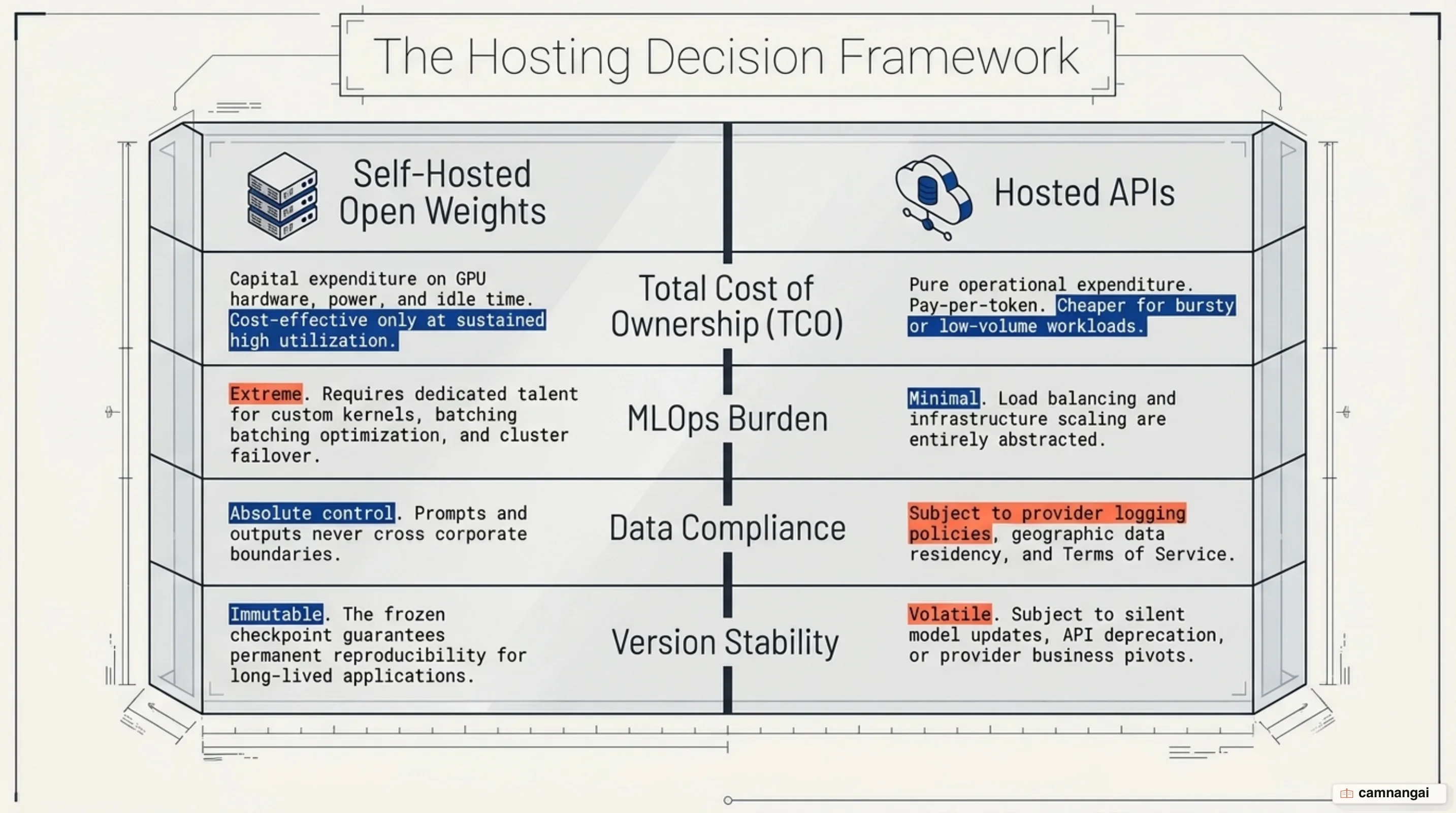
Deciding between hosting an open-weight model and consuming a closed, third-party API requires a rigorous analysis of total cost of ownership (TCO). Hosted APIs charge predictable, per-token fees with zero infrastructure management overhead. In contrast, self-hosting open weights requires upfront hardware acquisition or cloud accelerator provisioning, continuous electric power and cooling costs, massive VRAM capacity, ongoing maintenance, scaling logic, and dedicated engineering time. Many teams assume that because weights are free to download, running them locally is cheap; in reality, keeping frontier MoE models running on dedicated hardware easily outstrips an API bill for low-to-medium token volumes.
When comparing open-source and closed-source models, adopting open weights becomes imperative when specialized operational constraints outweigh raw token pricing. Self-hosting is necessary if you must comply with strict data sovereignty and privacy mandates, operate in offline or air-gapped environments, fine-tune models on proprietary terminology, or eliminate third-party vendor lock-in. Owning the model checkpoint guarantees that an external vendor cannot modify API behavior, alter pricing structures, or deprecate model endpoints unexpectedly.
Before adopting an open-weight model, your engineering team should evaluate the following technical verification checklist:
- Are the weight files, tokenizer, configuration, and inference code immediately available for download today?
- What specific commercial, user count, or domain restrictions are enforced by the license?
- What are the exact total VRAM and active parameter requirements for inference execution?
- Are optimized quantizations (such as INT4 or MXFP4) available, and do they preserve required task accuracy?
- Does your infrastructure team have the requisite tooling, deployment frameworks (such as vLLM or SGLang), and monitoring to maintain uptime?
- What level of training data transparency, filtering details, and safety evaluations are documented in the model card?
References
- What "Open Weights" Means for AI Models — Flavio Copes
- Open Weights: Not Quite What You've Been Told — Open Source Initiative
- The Open Source AI Definition 1.0 (OSAID) — Open Source Initiative
- Toward an Open Weights Definition — Copyleft Currents
- Safetensors: Fast and Safe Tensor Storage — Hugging Face
- Repository Licenses and Model Cards — Hugging Face
- On the Societal Impact of Open Foundation Models — Kapoor, Narayanan et al. (arXiv:2403.07918)
- Open Letters About AI Development — Simon Willison