An LLM API Gateway acts as a dedicated reverse proxy positioned between your application client code and upstream Large Language Model providers such as OpenAI, Anthropic, or Google Vertex AI.
When you integrate LLMs into production systems, standard API rate limiting fails because traditional gateway proxies assume a uniform, static resource cost per HTTP request.
In model architectures, request processing overhead is highly dynamic and non-deterministic. You cannot evaluate an LLM request on simple request counts alone; its latency, backend compute burden, memory utilization, and monetary cost depend on multi-dimensional variables including prompt input tokens, output tokens generated, prompt caching state, and execution pricing per model.
By sitting directly in the request path, an LLM API Gateway abstracts provider volatility away from your applications, shielding downstream microservices from HTTP 429 rate-limit errors, sudden spend cap exhaustion, and unexpected upstream provider outages.
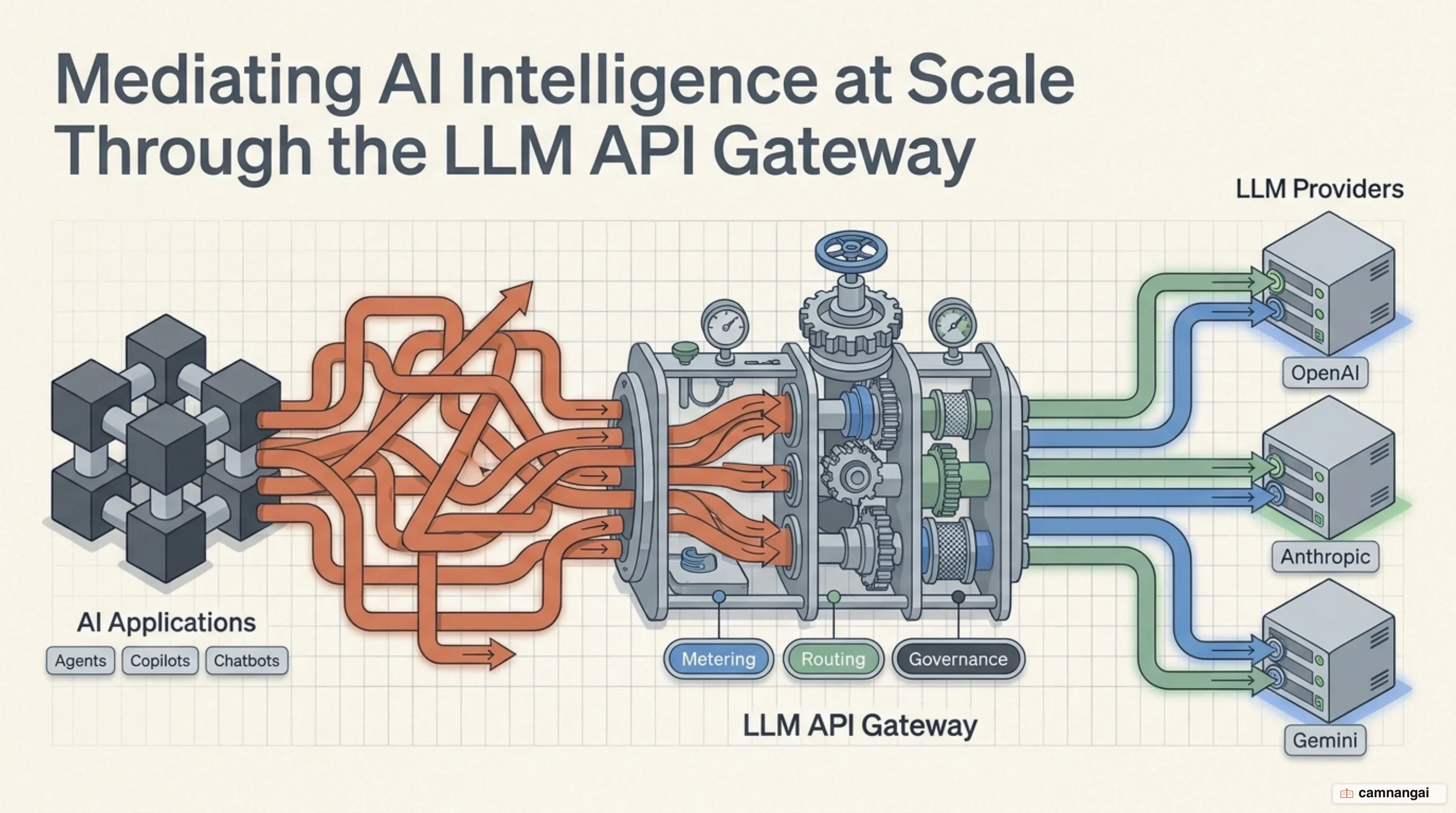
Why LLM Rate Limiting Differs From Traditional APIs
When you build traditional API architectures, your rate-limiting infrastructure relies on deterministic HTTP metrics, enforcing simple Requests Per Second (RPS) or Requests Per Minute (RPM) limits. In contrast, when managing LLM traffic, you must enforce multi-dimensional rate limiting across four concurrent axes: Requests Per Minute (RPM), Input Tokens Per Minute (ITPM), Output Tokens Per Minute (OTPM), and aggregated financial spend. A single incoming payload carrying a 100,000-token document prompt requires vastly more GPU memory and processing time than a short 20-token query, rendering single-dimensional request counts ineffective for safeguarding your upstream quotas or controlling cloud expenditures.
You must also account for the asynchronous token usage model inherent to generative models. Unlike static REST endpoints where you know the exact request payload size upon receipt, you cannot calculate an LLM request's total token consumption or financial cost until the model finishes response generation or completes streaming. When you utilize plugins like Kong's ai-rate-limiting-advanced, your gateway evaluates query costs asynchronously, either post-execution or by applying penalizations to subsequent calls. You can determine the precise financial footprint of completed requests across different provider endpoints using the standard token cost formula:
cost = ((prompt_tokens * input_cost) + (completion_tokens * output_cost)) / 1_000_000

Furthermore, you need to account for prompt caching mechanics when calculating your active ITPM state. Under Anthropic's rate-limiting model, for instance, cached input tokens read from storage (cache_read_input_tokens) do not count against your ITPM limits on most models, whereas newly written prompt tokens (input_tokens) and cache creation tokens (cache_creation_input_tokens) do count. Consequently, when you send a prompt containing 200,000 total input tokens that achieves an 80% cache hit rate, your gateway only charges 40,000 tokens against your active ITPM allowance, enabling you to significantly increase your effective throughput without breaching upstream rate thresholds.
To implement granular multi-tenant governance, you can configure policy-based rate limits that match requests across consumer IDs, consumer groups, client IP addresses, target models, and provider endpoints simultaneously. The following YAML snippet illustrates how you configure Kong's ai-rate-limiting-advanced plugin to partition multi-dimensional rate limits specifically for a developer consumer group accessing the gpt-4o model:
_format_version: "3.0"
plugins:
  - name: ai-rate-limiting-advanced
    config:
      policies:
        - match:
            - type: consumer
              key: id
              values:
                - "usr_dev_team_alpha"
            - type: model
              partition_by: true
              values:
                - gpt-4o
          limits:
            - limit: 100
              window_size: 60
            - limit: 1000
              window_size: 3600
Upstream Provider Constraints: OpenAI and Anthropic
When you establish direct integrations with upstream providers, your application encounters strict, multi-tiered quota enforcement models. Anthropic, for instance, assigns organizations to progressive usage tiers based on historical spend and account standing: the Start tier ($500 monthly spend cap), Build tier ($1,000 cap), and Scale tier ($200,000 cap). Each tier governs RPM, ITPM, and OTPM thresholds across distinct model families, including Claude Fable, Opus (e.g., 5.5, 5, 4.x), Sonnet (e.g., 5.5, 5, 4.x), and Haiku (e.g., 5.5, 4.5, 3.5).
You must recognize the operational distinction between hitting short-term rate limits versus exceeding organization spend limits. When your application exceeds short-term RPM or ITPM limits, the upstream provider responds with an HTTP 429 status code containing a retry-after header that tells you exactly how many seconds to pause before retrying. However, when you cross your organization's monthly spend cap, the provider returns an HTTP 429 error containing error.details.error_code: enforced_spend_limit_reached and omits the retry-after header entirely. In this state, your automated exponential backoff retries will fail continuously until access automatically resumes at 00:00 UTC on the first day of the next calendar month, or until you manually upgrade your organization's tier.
In addition to sustained rate limits, upstream providers enforce burst and acceleration limits to curb sudden traffic surges. To ensure your gateway correctly tracks your remaining ITPM capacity against these burst constraints, you must calculate total prompt token volume before sending the request:
total_input_tokens = cache_read_input_tokens + cache_creation_input_tokens + input_tokens
When you execute asynchronous batch workloads, your requests are governed by a completely separate set of provider queue limits. The Anthropic Message Batches API enforces request rate limits on batch management endpoints alongside processing queue caps across tiers. On the Start tier, you are limited to 1,000 RPM on batch management endpoints, a maximum of 200,000 batch requests in the processing queue, and a cap of 100,000 requests per single batch object. As you move to the Build and Scale tiers, your batch endpoint rate limits elevate to 2,000 RPM and 4,000 RPM, while your processing queue limits scale to 300,000 and 500,000 concurrent requests, respectively.
Core Rate Limiting Algorithms: Token Bucket and Sliding Window
To manage traffic flow, your rate-limiting architecture must choose appropriate state algorithms. Anthropic utilizes the Token Bucket algorithm, which maintains a continuous replenishment of capacity units up to a maximum bucket size. As your application issues requests, it draws tokens from the bucket; if you exhaust the bucket, subsequent calls are rejected until background replenishment restores headroom. Alternatively, platforms like Cloudflare AI Gateway let you select between Fixed Window and Sliding Window algorithms to enforce request boundaries over defined timeframes.
The choice between Fixed and Sliding Windows creates significant behavioral differences when your system experiences sudden traffic spikes. Consider a scenario where you set a rate limit of 10 requests per 10-minute window. If your application sends 10 requests at 12:09 and another 10 requests at 12:11, a Fixed Window evaluation (spanning 12:00–12:10 and 12:10–12:20) allows all 20 requests to pass because they fall into separate static blocks. However, this exposes your upstream provider to a rapid burst of 20 requests in two minutes. Conversely, a Sliding Window checks the trailing 10-minute lookback interval at 12:11 (looking back to 12:01), detects 20 total attempts within that window, and rejects the second batch with an HTTP 429 error.
When you deploy horizontally scaled gateway clusters, you must select an appropriate state strategy in Kong Gateway to maintain counter consistency across nodes. In the local strategy, counters reside in memory per node, offering minimal latency overhead but risking counter divergence across nodes unless you deploy consistent-hashing load balancers. In the cluster strategy, nodes write synchronously to a central Kong data store with strict accuracy (sync_rate: 0), but this incurs high read/write latency per request. The redis strategy centralizes counters in a Redis datastore, delivering high multi-node accuracy with far lower performance impact than DB cluster mode. If your Redis network connection drops, the gateway automatically falls back to per-node local rate limiting, preserving service availability while preventing completely unthrottled upstream calls.
To secure distributed Redis counter clusters in cloud environments, you can configure cloud-native IAM credentials instead of relying on static passwords. The following YAML snippet demonstrates a Kong Gateway Redis rate-limiting setup using AWS ElastiCache IAM authentication:
config:
  strategy: redis
  redis:
    host: "elasticache-llm-limits.internal.net"
    port: 6379
    username: "kong-gateway-service"
    cloud_authentication:
      auth_provider: aws
      aws_cache_name: "llm-counter-cluster"
      aws_is_serverless: false
      aws_region: "us-east-1"
LLM Gateway Architecture: Self-Hosted vs. Edge Proxies
When evaluating your gateway deployment options, you must choose between self-hosted proxy instances (such as LiteLLM Proxy or self-hosted Kong) and managed edge proxies (such as Cloudflare AI Gateway or Portkey / Prisma AIRS). Self-hosted architectures provide absolute control over data residency, memory allocation, and credential storage. When you deploy LiteLLM Proxy inside your private network, you retain direct control over regional data routing—such as setting region_name: "eu" or restricting Google Vertex AI locations to specific European regions for regulatory compliance—and can authenticate via cloud IAM roles (such as AWS Assumed Roles) rather than embedding static master API keys in code.
Conversely, when you select managed edge proxies, you eliminate infrastructure maintenance burdens by leveraging globally distributed edge networks. Edge proxies handle automatic failover, global caching, and request inspection close to your client applications, reducing connection latency. However, these benefits require transmitting payload data through multi-tenant SaaS environments, requiring Bring Your Own Key (BYOK) trust models and rigorous organizational compliance reviews. You must weigh the trade-off between self-hosted operational maintenance and managed edge data exposure based on your security stance.
Regardless of which deployment topology you choose, your gateway standardizes HTTP header propagation back to calling client applications to communicate available operational capacity. Alongside standard draft IETF RateLimit-* headers (RateLimit-Limit, RateLimit-Remaining, RateLimit-Reset), gateways pass back provider-aware AI response headers. When you route traffic through Kong, these headers incorporate specific timeframe intervals and policy identifiers—such as X-AI-RateLimit-Limit-60-policy-1 or X-AI-RateLimit-Remaining-30-azure—alongside query cost metrics (X-AI-RateLimit-Query-Cost) and standard retry delay values (X-AI-RateLimit-Retry-After).
Resilience Strategies: Retries, Fallbacks, and Circuit Breakers
To maintain high availability for critical LLM applications, you must move beyond basic retry loops and implement automated cross-provider failover chains. Frameworks like LiteLLM and Portkey automatically capture upstream errors—including HTTP rate limits (429), server downtime (500/503), content filtering flags (ContentPolicyViolationError), and context window boundaries (ContextWindowExceededError)—and seamlessly redirect your active request to healthy backup deployments across different model families or cloud providers.
You can avoid unnecessary network overhead and upstream provider rejections by enabling gateway pre-call checks (enable_pre_call_checks: true). When you activate pre-call checks, your gateway inspects incoming prompt token lengths before dispatching the HTTP call; if a prompt exceeds a target deployment's context window or a configured limit override (max_input_tokens), the gateway bypasses that primary deployment and routes directly to a large-context fallback model. Furthermore, vision capability filtering automatically checks payloads for multi-modal image content (image_url or image blocks), stripping deployments marked as text-only (supports_vision: false) from your candidate routing pool during multi-modal calls.
When your gateway executes a cross-provider failover, you face a unique challenge regarding encrypted reasoning payloads (such as reasoning.encrypted_content or provider-specific thinking blocks). Because a backup model from a different provider cannot decrypt reasoning blocks generated by the primary model in previous turns, the gateway automatically drops un-decryptable reasoning blocks while preserving human-readable text summaries. This prevents target models from returning invalid_encrypted_content errors, enabling fresh reasoning on the backup provider. You can also configure settings such as encrypted_content_affinity to bind subsequent conversational turns back to the provider deployment that successfully processed the request.
You can implement fallback targets across providers by defining structured YAML configuration files. The following LiteLLM router configuration illustrates how you map a primary Azure OpenAI deployment to an Anthropic Claude fallback target:
model_list:
  - model_name: gpt-6-luna
    litellm_params:
      model: azure/gpt-6-luna-deploy
      api_base: "https://primary-east.openai.azure.com/"
      api_key: os.environ/AZURE_API_KEY
  - model_name: claude-sonnet-5
    litellm_params:
      model: anthropic/claude-sonnet-5
      api_key: os.environ/ANTHROPIC_API_KEY

router_settings:
  fallbacks:
    - gpt-6-luna: ["claude-sonnet-5"]
Multi-Tenant Governance: Virtual Keys, Quotas, and Cost Control
When you manage LLM infrastructure across multi-tenant engineering teams, you should abstract upstream provider master keys behind Virtual API Keys. Virtual keys decouple client-facing application authentication from underlying provider credentials, empowering you to enforce granular monthly team budget caps, spend limits, and model access policies on individual microservices without risking master API key compromise or platform-wide spend exhaustion.
During automated failover execution, your gateway enforces security and budget constraints against the caller's virtual key before attempting a call to a secondary model. When a primary request triggers a fallback, the gateway checks whether the calling key possesses explicit access permissions (access_groups) and sufficient remaining monetary budget for the fallback model target. If the calling key lacks permissions or has depleted its allocation for the secondary model, the gateway skips the unauthorized fallback target and returns the primary model's original error, preventing unbudgeted or unauthorized downstream spending.
Your client applications can also explicitly control fallback behavior on a per-request basis by passing metadata overrides. For example, by supplying disable_fallbacks: true in a request payload or key metadata, your client instructs the proxy to skip failover chains entirely and return provider errors immediately when strict, deterministic single-attempt execution is required:
{
  "model": "gpt-6-luna",
  "messages": [
    {
      "role": "user",
      "content": "Perform high-precision financial extraction."
    }
  ],
  "disable_fallbacks": true
}
To maintain comprehensive operational compliance, your gateway records detailed metadata within spend logs (such as LiteLLM_SpendLogs). Every log entry explicitly tracks failover metadata, including attempted_fallbacks (the number of failover attempts made) and original_model_group (the initial model group requested by your client). This logging isolation enables you to audit failover frequency, calculate accurate cost attribution per team, and identify unstable upstream provider endpoints in production.
When Does Your System Actually Need a Dedicated LLM Gateway?
You should adopt a dedicated LLM API Gateway when your production infrastructure routes traffic across two or more model providers, serves multiple development teams, or requires strict operational availability guarantees. Managing rate limits, multi-tenant team budgets, cross-provider failover, and distributed token counters directly within your client application code becomes unmaintainable as system scale increases.
By centralizing LLM traffic governance into a specialized gateway proxy, you decouple client code from provider volatility, simplify compliance auditing, and protect upstream budgets. Introducing an LLM API Gateway ensures your infrastructure remains resilient, cost-controlled, and enterprise-ready as your AI capabilities grow.