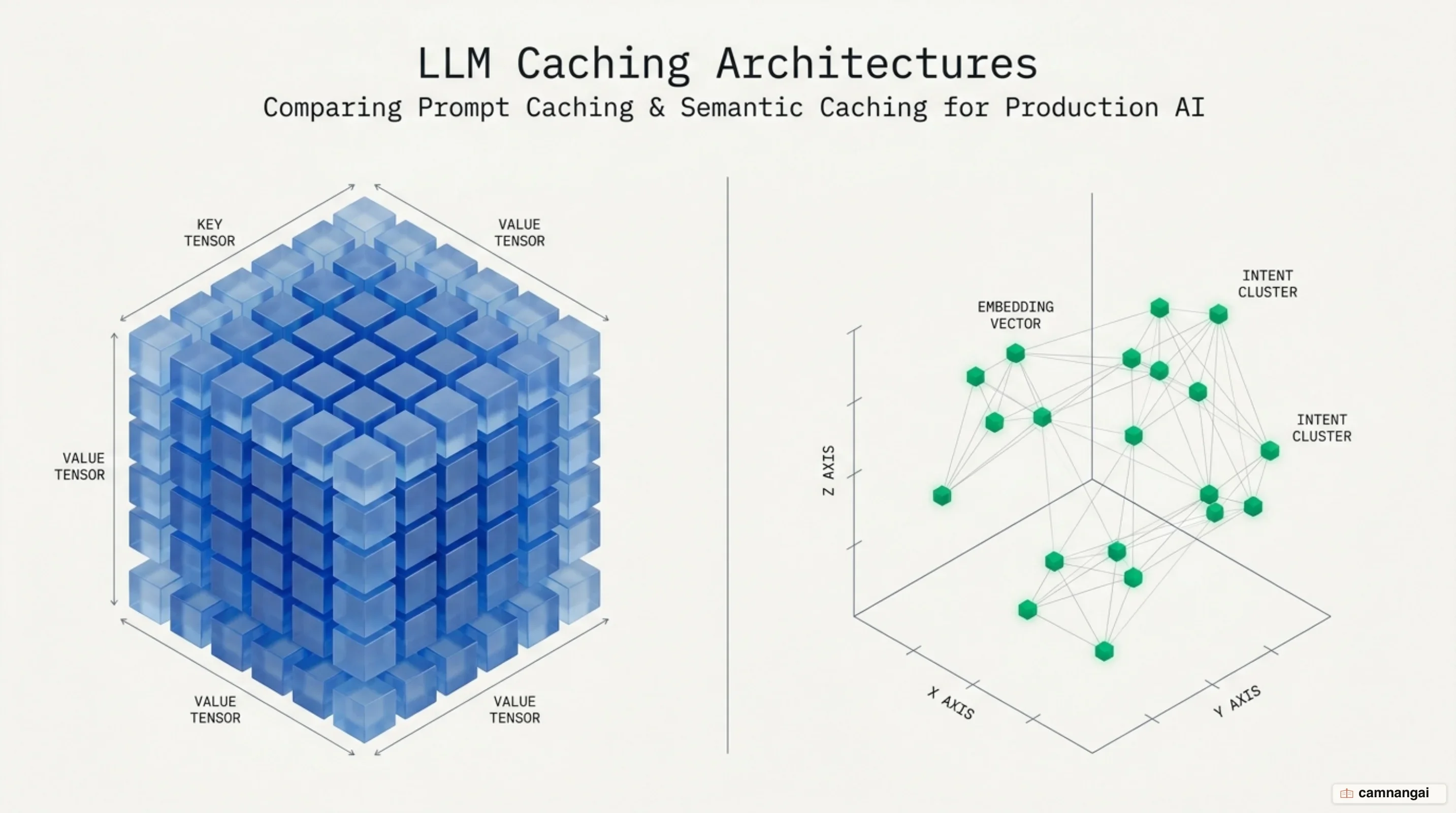
Prompt Caching vs Semantic Caching represents the fundamental architectural choice in high-scale LLM systems between reusing GPU attention states during prefill or bypassing model inference entirely via vector similarity.
Your architectural choice hinges on output variability and context freshness requirements. If your application demands dynamic, unique generated outputs grounded in massive shared contexts—such as long multi-turn agent conversations, extensive technical documentation, or complex tool schemas—Prompt Caching maintains output flexibility at a heavily discounted input prefill rate.
If your workload consists of high-frequency, repetitive queries with predictable answers—such as customer support FAQs or standard product inquiries—Semantic Caching provides instant response reuse. Production enterprise systems frequently combine both paradigms into a multi-tiered caching topology.
Architectural efficiency comes from aligning your caching layer with workload characteristics: optimize prefill compute when outputs must vary, and intercept queries at the gateway when answers are static.
Why LLM Applications Require a Caching Strategy
Production LLM inference involves two distinct operational phases: prefill and decoding. During prefill, the inference engine processes input tokens sequentially to compute high-dimensional Key-Value (KV) representations across attention layers. In the decoding phase, the model generates output tokens auto-regressively, one token at a time. While output tokens carry higher per-token compute costs due to sequential GPU execution, input token costs scale aggressively when requests bundle voluminous system instructions, extensive Retrieval-Augmented Generation (RAG) context documents, complex tool schemas, and multi-turn chat history. A concise 10-word user question often sits downstream of thousands of static input tokens.
Unoptimized production systems face severe economic and computational inefficiencies due to structural query repetition. Enterprise workloads routinely feature users querying identical reference materials (such as software manuals or financial reports) or submitting semantically equivalent support requests phrased in slightly different words. Repetitively processing identical input prefixes forces inference engines to recompute intermediate KV states, wasting GPU cycles, triggering API rate limits, and inflating time-to-first-token latency.
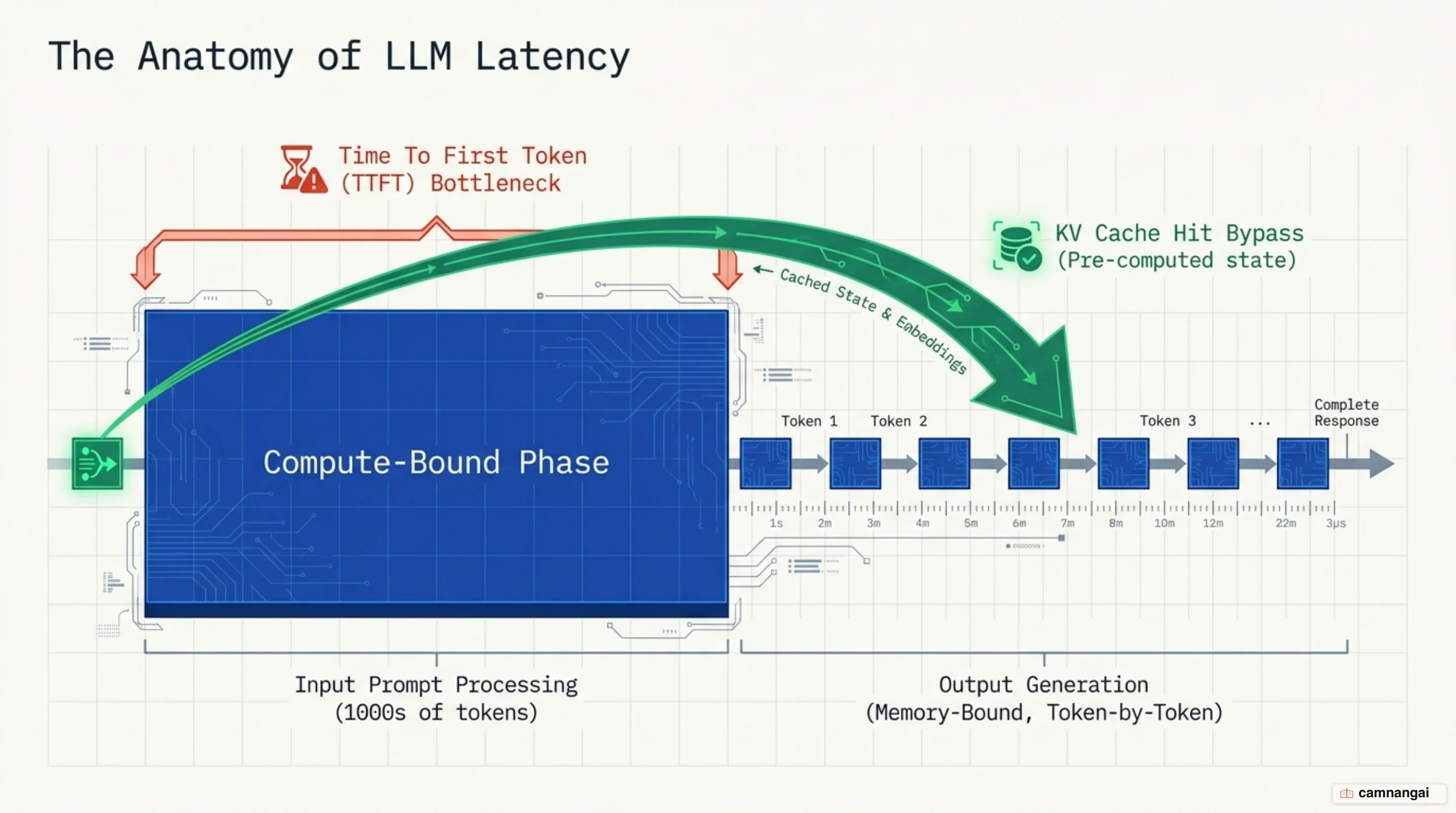
Implementing an architectural caching layer resolves these bottlenecks by eliminating redundant work across inference stages. Caching mitigates the stark cost imbalances between raw input token processing and cached token evaluation. By reducing the volume of un-cached input tokens processed during prefill or skipping the model execution pipeline entirely, you can lower API billing by 50% to 90%, expand request throughput, and achieve sub-second P99 response latencies for high-density traffic.
Prompt Caching: Technical Mechanics, KV Cache, and Prefix Reuse
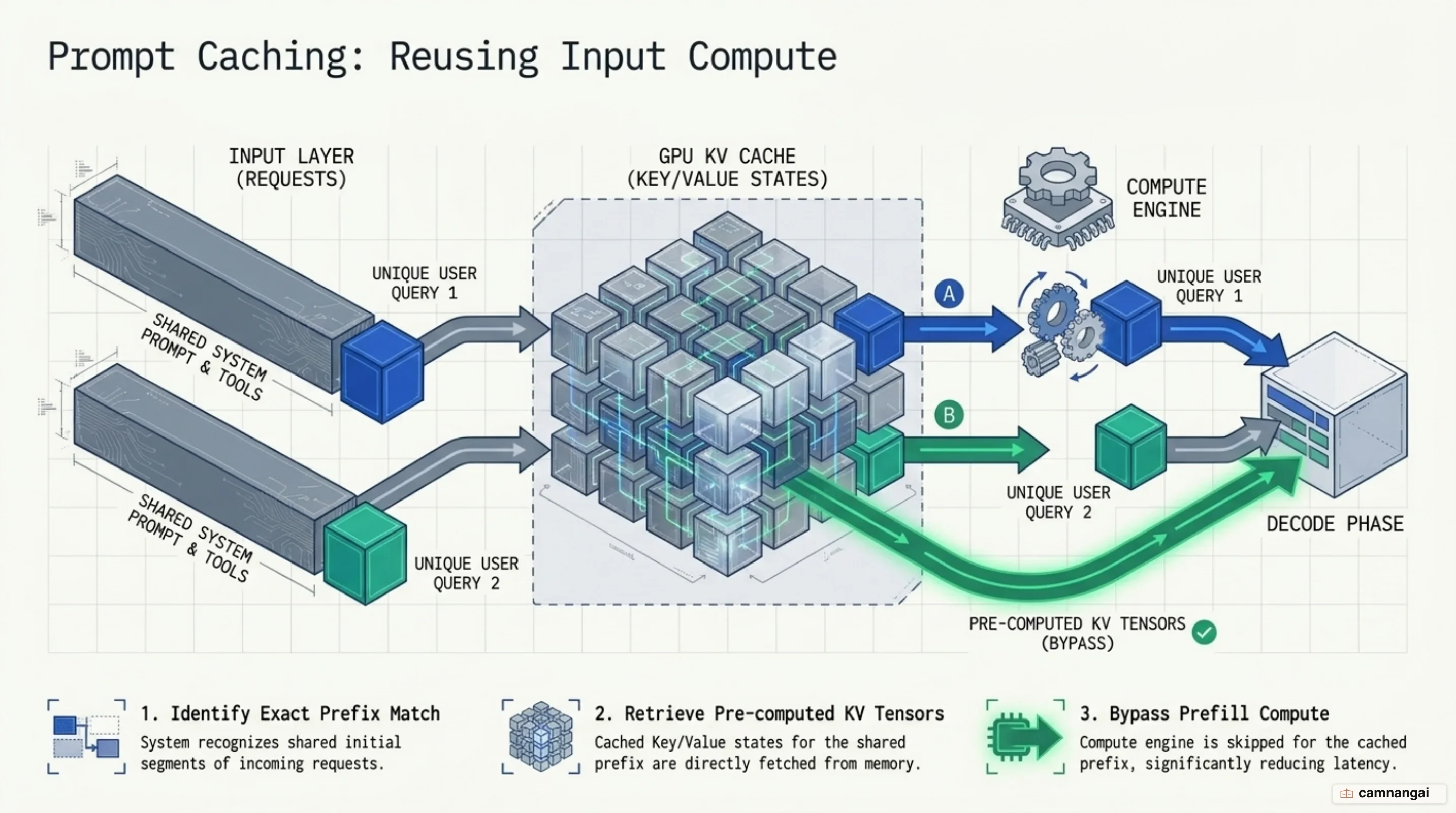
Prompt Caching operates directly within the model inference engine or managed provider API by preserving intermediate Key-Value (KV) tensors generated during the prefill phase. When a causal transformer model evaluates input tokens, it computes key vectors to quantify attention weights and value vectors to store token representations. Engines like vLLM—using Automatic Prefix Caching (APC)—and managed APIs from OpenAI and Anthropic persist these intermediate KV states in ephemeral GPU memory or local memory pools. When a subsequent request shares an identical initial prompt prefix, the inference engine reuses the saved KV states and directly feeds them into the attention mechanism, skipping redundant floating-point operations.
# Enabling Automatic Prefix Caching (APC) in a self-hosted vLLM engine
from vllm import LLM, SamplingParams

llm = LLM(
    model="meta-llama/Llama-3.1-70B-Instruct",
    enable_prefix_caching=True,
    prefix_match_unit=64,  # Aligns sub-block boundary matching across attention layers
)
For open-source engines running advanced architectures, prefix caching requires specific hardware-aligned tuning. In vLLM, hybrid state-space models like Mamba store state on a dedicated block grid, meaning prefix hits normally resume only at full block boundaries. Adding the --enable-mamba-shared-prefix-checkpoint flag stores a state checkpoint at the exact shared-prefix junction, allowing requests to hit sub-block boundaries provided --prefix-match-unit (typically 64) is configured to align with Multi-head Latent Attention (MLA) compression ratios.
Exact prefix matching is governed by strict structural rules. Because causal attention tokens depend on all preceding context, shared content must be positioned at the absolute beginning (prefix position) of the payload. Modifying a single character, altering tool schemas, updating system instructions, or placing dynamic variables (such as timestamps or request IDs) prior to shared text changes the cumulative cryptographic hash, causing a full cache miss. In multi-turn sessions, appending {"role": "system"} messages inside the messages array allows adding dynamic instructions mid-conversation without invalidating the cached top-level system prefix.
Prompt caching enforces provider-specific minimum token thresholds to activate: 512 tokens (Claude Opus 5.5, Sonnet 5.5, vLLM block match units), 1,024 tokens (GPT-5.6, Claude Sonnet 5), 2,048 tokens (Claude Haiku 3.5), or 4,096 tokens (Claude Opus 4.6, Haiku 4.5). All major prompt caching implementations maintain Zero Data Retention (ZDR) compliance because cached KV states are stored as cryptographic tensor representations in ephemeral GPU-local memory (retained up to 24 hours) rather than raw, unencrypted prompt text.
import anthropic

client = anthropic.Anthropic()

# Anthropic Messages API: Top-level cache_control enables automatic prefix caching.
# Explicit cache_control on system text defines a static prefix breakpoint.
response = client.messages.create(
    model="claude-opus-5-5",
    max_tokens=1024,
    cache_control={"type": "ephemeral"},  # Automatic caching across growing messages
    system=[
        {
            "type": "text",
            "text": "You are an enterprise technical support assistant with access to extensive documentation...",
            "cache_control": {"type": "ephemeral"},  # Explicit breakpoint on static system prefix
        }
    ],
    messages=[
        {"role": "user", "content": "How do I configure prefix caching in vLLM?"}
    ],
)
Pricing and routing models reflect the operational overhead of memory retention:
- Anthropic Pricing: 5-minute write surcharges are 1.25x base input cost; 1-hour writes are 2.0x base; read hits are 0.10x base (discounted to 0.05x on Opus 5.5 / Sonnet 5.5, and 0.025x on Fable 5.1 / Mythos 5.1).
- OpenAI Pricing & Routing: Read hits cost 0.10x base input (0.05x for GPT-6.1 Sol). In the Responses API, write TTLs cost 1.25x for 30-minute retention and 2.5x for 12-hour retention. OpenAI routes requests by hashing initial tokens or evaluating a user-supplied
prompt_cache_key. When machine load exceeds 15 requests per minute, overflow routing sends requests to alternate nodes, which can induce unexpected cache misses across multi-tenant clusters. - Anthropic Lookback Window: Explicit breakpoints search backward up to 20 message blocks. If a multi-turn conversation appends 20 or more message blocks between breakpoints, the lookback algorithm fails to locate prior cache writes, forcing an unexpected full cache write charge.
Semantic Caching: Meaning-Based Retrieval via Vector Embeddings
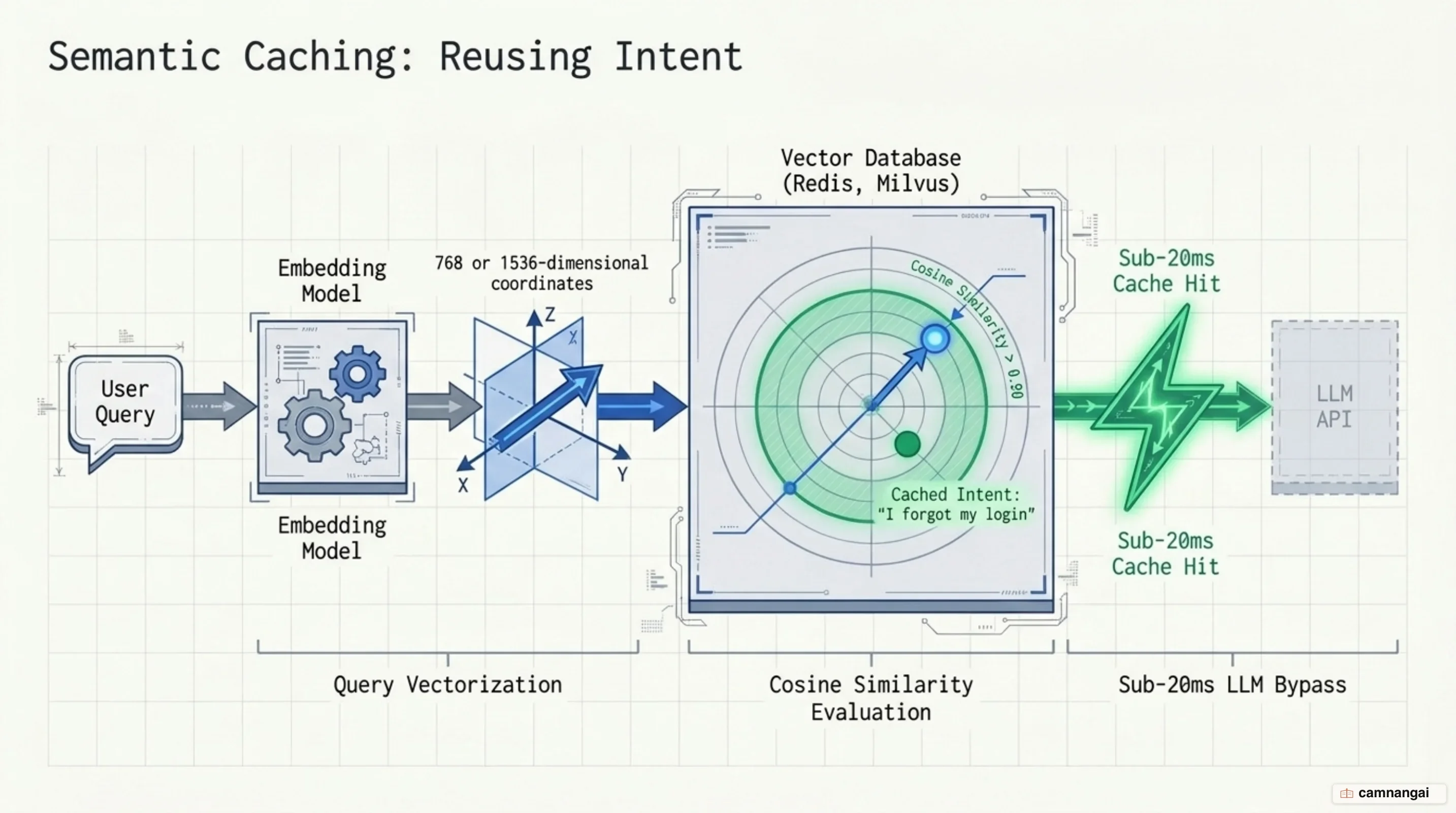
Semantic Caching resides in the application layer outside the model engine, eliminating model inference entirely for redundant query intents. The pipeline passes an incoming query to an embedding model (such as ONNX, Cohere, or OpenAI) to generate a dense numerical vector representation across 768 or 1,536 dimensions. This vector is queried against a specialized vector database or cache store (such as Redis, GPTCache, FAISS, or Milvus) using vector similarity algorithms (e.g., cosine similarity or Euclidean distance) to locate candidate responses.
from gptcache import cache
from gptcache.adapter import openai
from gptcache.embedding import Onnx
from gptcache.manager import CacheBase, VectorBase, get_data_manager
from gptcache.similarity_evaluation.distance import SearchDistanceEvaluation

# Initialize local embedding model and vector storage engine
onnx = Onnx()
data_manager = get_data_manager(
    CacheBase("sqlite"),
    VectorBase("faiss", dimension=onnx.dimension)
)

# Configure semantic cache with cosine distance evaluation
cache.init(
    embedding_func=onnx.to_embeddings,
    data_manager=data_manager,
    similarity_evaluation=SearchDistanceEvaluation(),
)
cache.set_openai_key()
The similarity engine evaluates the distance score against a configured cutoff threshold, typically tuned between 0.85 and 0.95. If the similarity score meets or exceeds the threshold, the gateway records a cache hit and immediately returns the stored text response. A cache hit results in $0 in LLM token charges and delivers sub-20ms lookup latencies—compared to the 1 to 5 seconds required for active LLM generation. On a cache miss, the gateway routes the query to the LLM, collects the output, and asynchronously writes the query embedding and generated response pair back to the vector cache.
While semantic caching yields 50% to 90% overall cost savings, it introduces architectural trade-offs. Applications incur embedding generation costs and vector database lookup latency on every incoming request. On a cache miss, you pay the vector search overhead on top of full LLM generation latency. Furthermore, engineering teams must actively tune similarity thresholds to prevent false positives—where two queries share high vector similarity but require fundamentally different answers.
Side-by-Side Comparison: Prompt Caching vs Semantic Caching
Comparing Prompt Caching and Semantic Caching highlights their fundamental architectural divergence. Prompt Caching operates inside the model inference engine or provider API, evaluating strict token sequences to accelerate prefill and lower input costs while generating fresh output tokens. In contrast, Semantic Caching operates within the application gateway layer, evaluating query intent via vector embeddings to completely bypass the LLM and serve static pre-computed responses.
The choice between these paradigms depends on whether your workload prioritizes output dynamic range or absolute latency and cost minimization. The table below details operational trade-offs across critical engineering dimensions:
| Engineering Dimension | Prompt Caching | Semantic Caching |
|---|---|---|
| Architectural Placement | Inference Engine / LLM Provider API | Application Layer / Gateway / Vector Store |
| Matching Criterion | 100% exact match of initial prompt prefix tokens | Vector similarity / Cosine distance of query embedding |
| Output Characteristics | Fresh, unique token generation per request | Static pre-computed response reuse |
| Cost Impact | Discounted input prefill rate (0.05x–0.1x); full output charges | $0 LLM token cost on cache hit |
| Latency Reduction | Reduces prefill wait time / Time-To-First-Token (TTFT) | Eliminates generation latency entirely (5–20ms lookup) |
| Sensitivity to Context Changes | Invalidated by any token/setting modification in prefix | Dependent on vector similarity score and metadata filters |
| Target Use Cases | Long-context RAG, multi-turn chat, agent tool workflows | High-frequency FAQs, standard support intents, static queries |
Implementation Pitfalls: Context Drift, Multi-Tenancy/RBAC, and Invalidation
Implementing Prompt Caching requires strict context ordering to prevent invalidation cascades across the tool -> system -> messages hierarchy. Modifying a tool schema, toggling web search/citations, changing reasoning effort parameters, or inserting dynamic metadata (such as per-request timestamps) before shared context invalidates downstream cached KV states. At the infrastructure tier, managed routing overflow (such as OpenAI's 15 req/min per-machine limit) can route requests to un-warmed instances, causing unexpected cache misses. In multi-turn applications, failing to manage Anthropic's 20-block lookback window boundary causes silent cache lookup failures when conversations grow long.
Semantic Caching introduces severe risks surrounding semantic false positives and unauthorized data exposure. High vector similarity does not guarantee semantic identity; queries like "Cancel order before shipping" versus "Cancel order after shipping", or plan inquiries ("Does Basic plan support offline access?" vs "Pro plan") yield near-identical vector embeddings but demand opposite business answers. Multi-tenancy and Role-Based Access Control (RBAC) present additional risks: without mandatory metadata filtering (enforcing user ID, tenant ID, and document access scope during vector lookups), User A could receive User B's cached response containing private data.
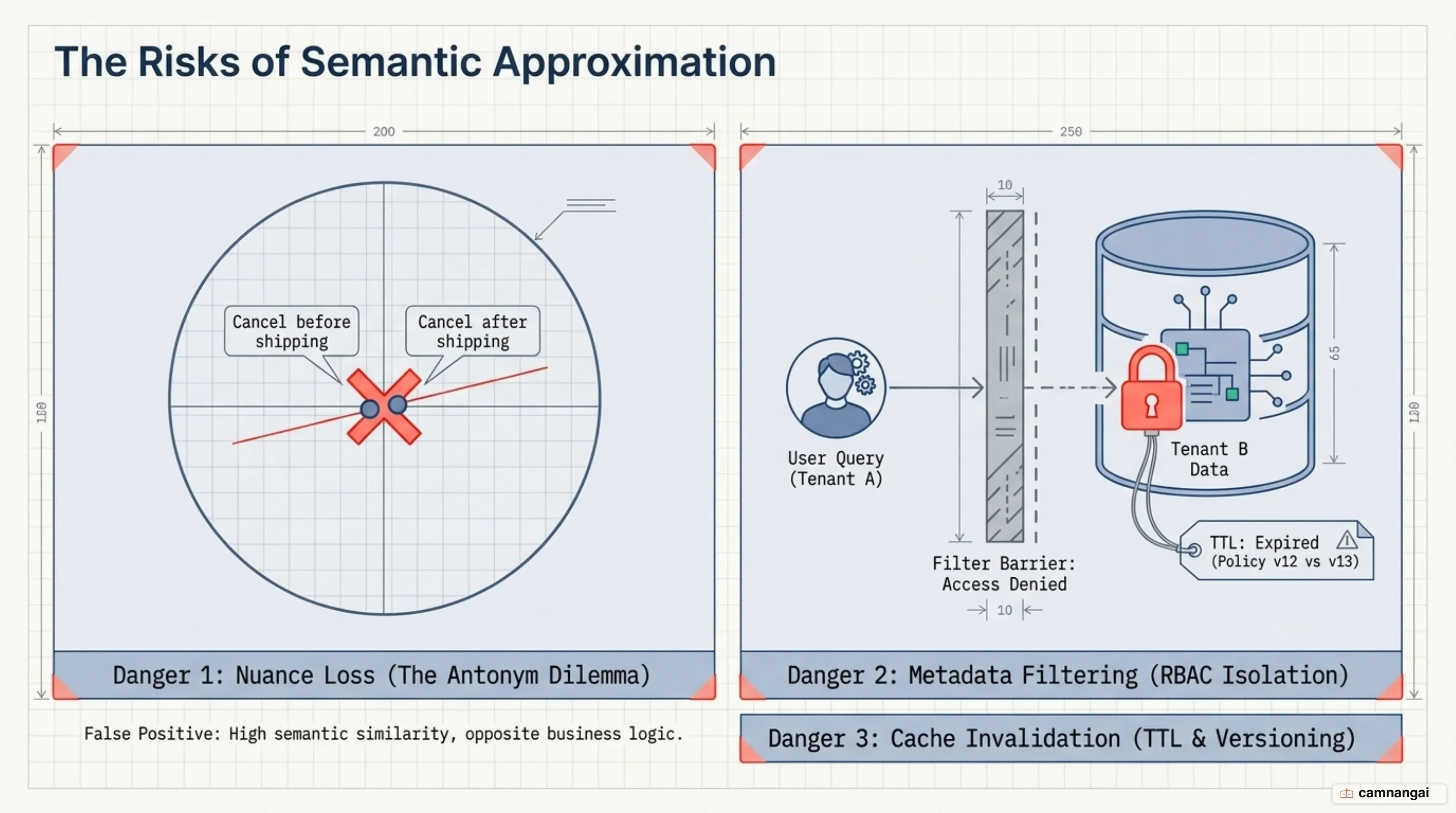
Managing freshness requires cache invalidation strategies tailored to data volatility. Simple Time-To-Live (TTL) policies (ranging from 5-minute windows to 24-hour retention) clear stale data periodically but leave windows where outdated information is served following policy updates. For RAG pipelines, you must implement provenance-aware invalidation by attaching source document chunk version IDs as metadata tags in the semantic store. When underlying source documents, access permissions, or system policies change, the application explicitly purges dependent semantic cache entries by version tag to prevent serving stale or unauthorized answers.
Multi-Tier Architecture: Combining Both Caches in Production
High-throughput enterprise architectures maximize performance by combining exact-match string caching, semantic caching, and prompt caching into a multi-tiered execution path.
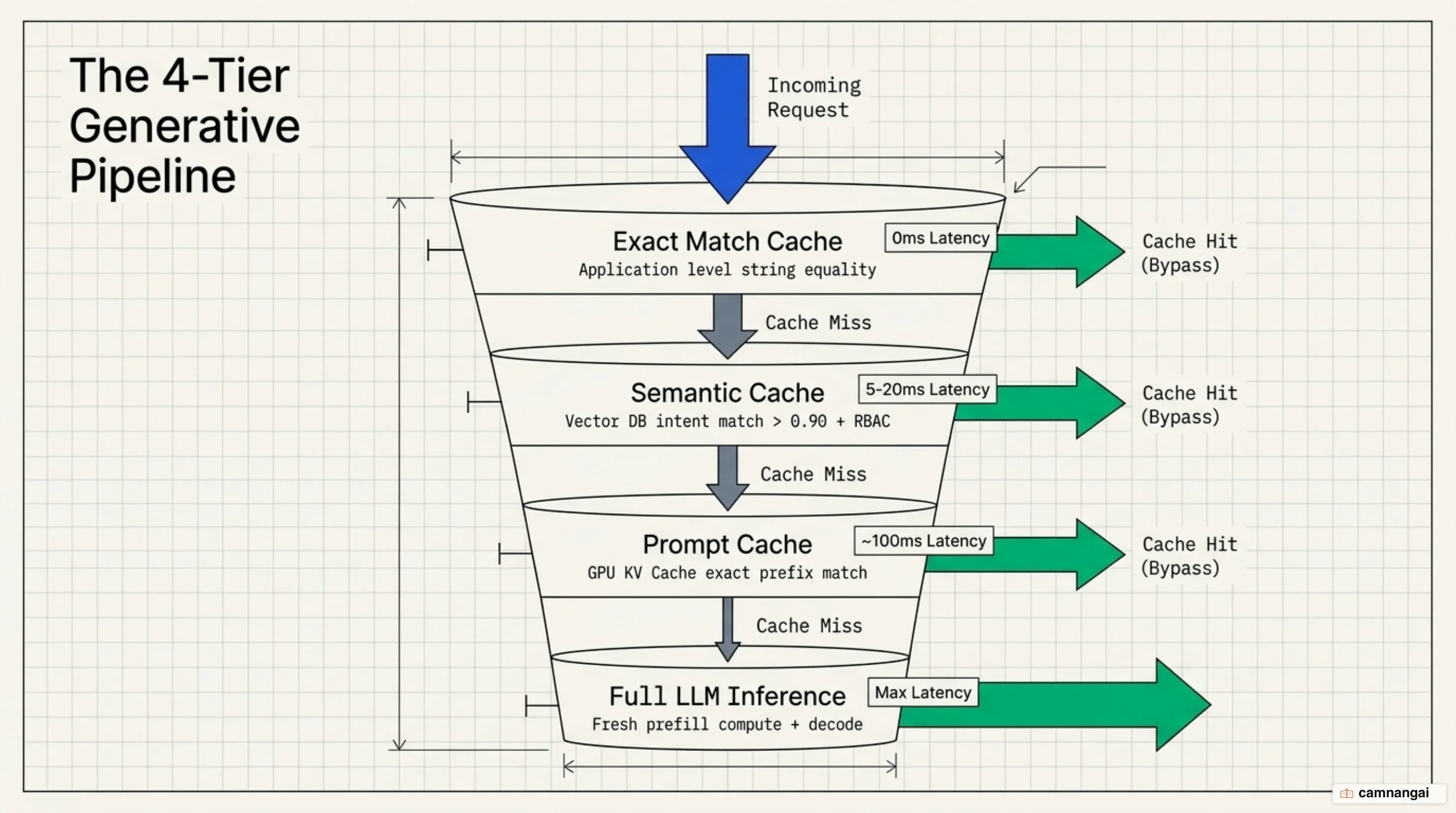
- Exact String Lookup: The gateway executes a fast key lookup (e.g., Redis string key) for identical recent queries.
- Semantic Cache Lookup: On an exact miss, the request falls back to the Semantic Cache, generating a query embedding and evaluating vector distance against stored intent-response pairs. If the match exceeds the threshold (e.g., 0.92), the system returns the cached answer instantly, incurring sub-20ms latency and $0 in LLM generation fees.
- Prompt Cache Prefill: When a semantic miss occurs, the gateway forwards the request to the LLM API or engine, explicitly leveraging Prompt Caching. The engine inspects the prefix—which bundles static instructions, tool definitions, and retrieved RAG context documents—and reuses prefilled KV states from prior executions, reducing TTFT and cutting prefill costs by up to 90–95%.
- Async Write-Back: Upon receiving newly generated output tokens, the gateway asynchronously writes the new query embedding and output pair to the semantic cache store.
Advanced operational patterns incorporate cache pre-warming to eliminate initial cache-miss penalties. You can issue pre-warming requests using Anthropic's max_tokens: 0 pattern to write long system prompts or tool schemas to the KV cache before user traffic arrives. Note that max_tokens: 0 is rejected if stream: true, extended thinking (thinking.type: "enabled"), output schemas (output_config.format), tool choice parameters (type: "tool" or "any"), or Batch API processing are enabled. For streaming endpoints, architectures adopt stream-then-cache patterns—streaming generated tokens directly to the client while buffering the complete string to write back to the semantic cache upon stream completion.
Verdict: A Decision Framework for Your Caching Strategy
Implement Prompt Caching when your application outputs must be dynamic, personalized, or highly generative, but rely on heavy, reusable context payloads such as long document repositories, multi-turn chat histories, or extensive tool sets. Choose Semantic Caching when user queries exhibit high intent repetition, input phrasing varies widely, and pre-computed static answers satisfy user requirements without requiring real-time token generation.
Enterprise AI architectures should deploy both paradigms in a layered topology. Deploying a semantic cache at the application gateway shields your infrastructure from redundant queries, while an underlying prompt cache optimizes GPU compute and input costs for requests that require full model execution.
References
- LLM Prompt Caching Versus Semantic Caching — ByteByteGo
- Prompt Caching — Anthropic Claude Platform Docs
- Prompt Caching in API — OpenAI Documentation
- Automatic Prefix Caching (APC) — vLLM Documentation
- What is semantic caching? Guide to faster, smarter LLM apps — Redis
- GPTCache: A Library for Creating Semantic Cache for LLM Queries — Zilliz