Standard HTTP REST APIs are designed for sub-100 millisecond response times, but heavy artificial intelligence workloads—such as large language model generation, complex inference pipelines, and batch audio or video synthesis—routinely run for seconds or minutes. Attempting to process these operations synchronously over a standard HTTP connection causes severe performance degradation, gateway timeouts, and connection pool exhaustion. Integrating asynchronous processing using durable message queues decouples client HTTP request windows from long-running backend computations, preventing API failures, smoothing out volatile demand spikes, and maintaining high system responsiveness.
When you allow clients to issue synchronous API calls for long-running AI workloads, your backend process holds the underlying network socket open while waiting for model evaluation to finish. This direct coupling exposes your infrastructure to severe operational risks. Network infrastructure, load balancers, and API gateways automatically terminate HTTP requests that exceed fixed timeout thresholds. Keeping persistent synchronous requests active also drains web server memory and thread pools, leaving your API layer vulnerable to complete exhaustion during traffic spikes.
By transitioning long-running AI jobs to asynchronous execution models, your API frontends immediately hand off work items to an intermediary buffering layer, returning control to the client in milliseconds while dedicated worker nodes execute heavy computations out-of-band.
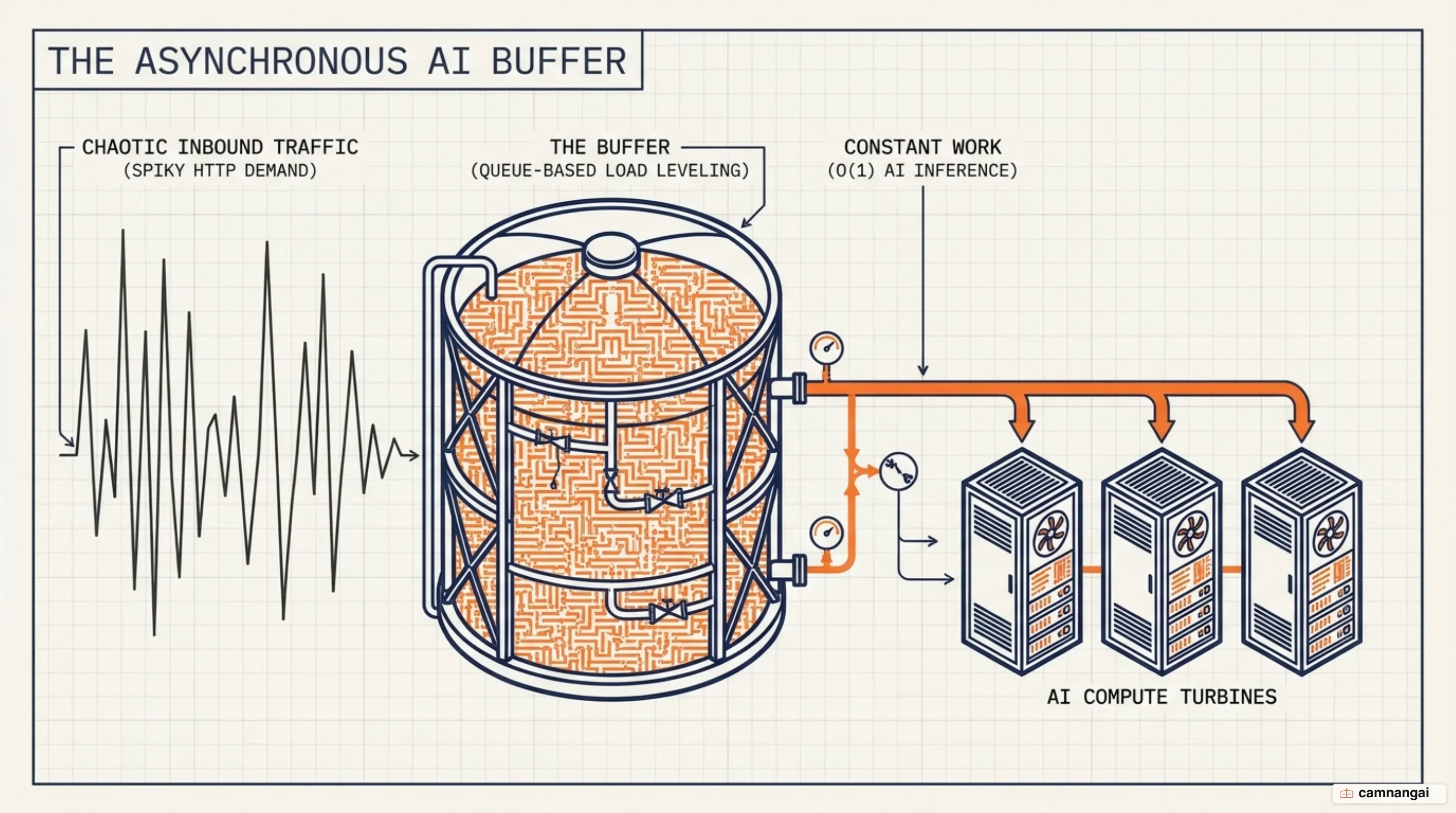
The Bottleneck of Synchronous Requests in AI Tasks
Standard REST APIs following HTTP semantics are optimized to deliver responses in approximately 100 milliseconds or less. In distributed architectures, several inherent latency drivers compound to extend response times, including hosting stack overhead, security inspection layers, geographical distance between clients and endpoints, network transit times, payload size, server queue lengths, and core processing execution. For traditional web operations, these latencies remain manageable. However, AI inferencing tasks require substantial computational resources that inherently span seconds, minutes, or hours, exceeding normal synchronous connection boundaries.
When you rely on synchronous HTTP request-reply semantics for long-running AI operations, you expose your system to severe failure modes. Thread pools on web frontends exhaust quickly as connections remain open waiting for GPU outputs, starving incoming requests. If downstream dependencies experience slowdowns, clients frequently issue uncoordinated retries. This behavior triggers a "spiral of doom," where client retries amplify backend overload, lengthening server queues and causing cascading failures across the entire system. Caches, often used to mitigate load, can amplify system fragility during extreme surges if empty or invalidated, as traffic falls directly onto backend resources.
To eliminate latency variance, you must decouple work arrival from work execution. The Queue-Based Load Leveling pattern inserts an asynchronous message queue between request producers and backend services, absorbing incoming request spikes and storing work items until workers process them at a controlled rate. To harden this layer against unexpected load surges, you can integrate constant-work patterns—where systems perform predictable, fixed amounts of work regardless of load without mode changes. In AI infrastructure, this involves pre-allocating fixed-size tensor inputs and dummy memory slots within execution queues. Sizing queued job payloads to fixed maximum bounds eliminates dynamic compute allocation overhead and prevents memory fragmentation during sudden inference bursts.
The Asynchronous Request-Reply Pattern and HTTP 202
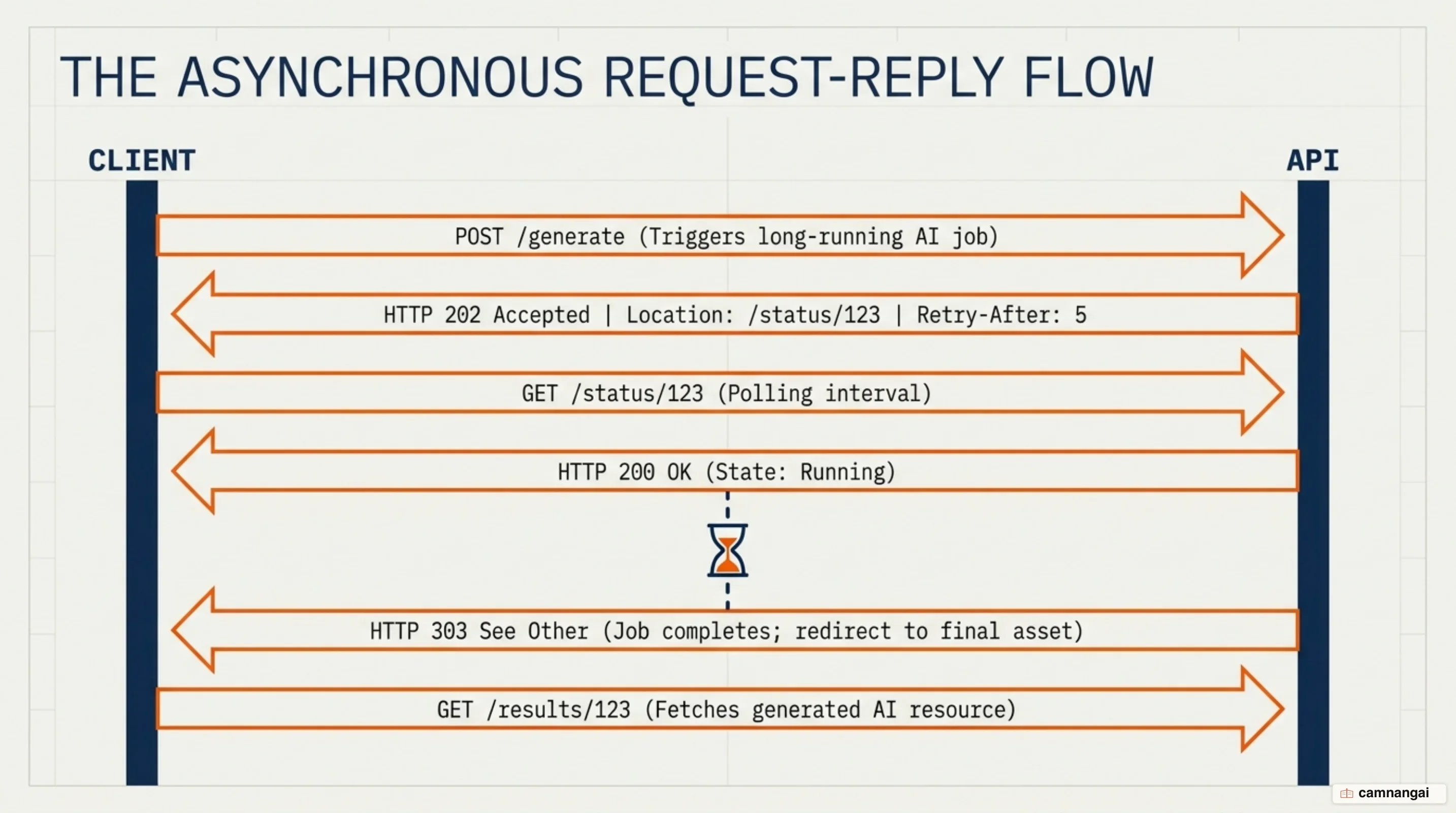
Implementing asynchronous request-reply over HTTP decouples initial intake from execution while providing clients with a clear path to monitor progress. When a client posts an AI task payload, your frontend API first performs strict synchronous validation. If the request body or metadata is invalid, the server responds immediately with an HTTP 400 (Bad Request) status code. Once validated, the API enqueues the work item into a message broker and immediately completes the HTTP call by returning an HTTP 202 (Accepted) status code.
The HTTP 202 response includes headers that govern client interaction. The Location header specifies a URL pointing to a status endpoint where the client polls job progress. In secure environments, this location URL can utilize a shared access signature (SAS) token via the Valet Key pattern to grant access control or offload polling to an alternate backend. The response also includes a Retry-After header specifying an estimated completion or polling interval in seconds, preventing client applications from spamming your backend with excessive GET requests.
HTTP/1.1 202 Accepted
Location: https://api.example.com/api/RequestStatus/7f9a2b8e-3d4c-4a1b-8c2d-9e0f1a2b3c4d
Retry-After: 5
Content-Type: application/json

{
  "status": "Pending",
  "createdAt": "2026-03-30T10:00:00Z",
  "lastUpdatedAt": "2026-03-30T10:00:00Z",
  "percentComplete": 0
}
The status endpoint returns an HTTP 200 (OK) code while work remains in progress, returning a JSON payload containing standardized fields: status (Pending, Running, Succeeded, Failed, or Canceled), createdAt, lastUpdatedAt, and an optional percentComplete integer. Upon job completion, the status endpoint returns an HTTP 303 (See Other) status code to redirect client GET requests to the final result resource URI. Using HTTP 303—rather than HTTP 302 (Found)—is critical because HTTP 303 guarantees that the client converts the subsequent request method to GET, preventing accidental re-execution of original POST payload logic. Alternatively, servers can return HTTP 200, 201 (Created), or 204 (No Content) directly. To allow clients to abort long-running tasks, the status endpoint can expose a DELETE method that forwards cancellation instructions to background workers.
If an operation fails during execution, the status resource persists the failure state and returns an HTTP status code matching the failure, returning a response body formatted according to the RFC 9457 Problem Details standard:
{
  "type": "https://api.example.com/errors/out-of-memory",
  "title": "GPU Memory Exhausted",
  "status": 500,
  "detail": "Model inference failed due to insufficient GPU VRAM during batch tensor evaluation.",
  "instance": "/api/RequestStatus/7f9a2b8e-3d4c-4a1b-8c2d-9e0f1a2b3c4d"
}
Core Anatomy: Producer, Message Queue, and Worker Pool
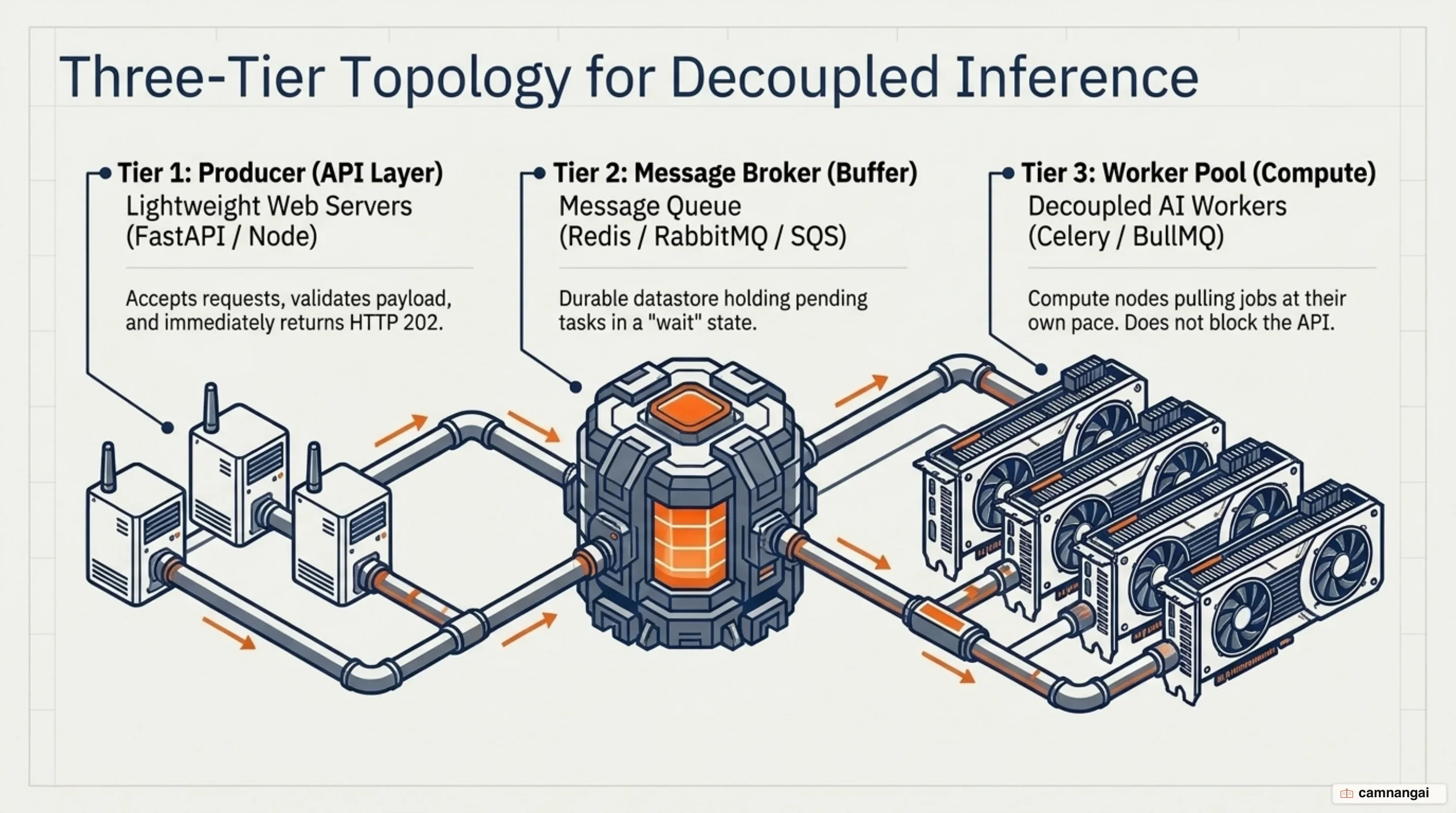
An asynchronous processing system comprises three primary architectural layers:
- Producer: Frontend web API nodes that accept client payloads, construct structured task messages, and push them to a broker.
- Message Queue / Broker: A durable buffer storing task messages for one-to-one (point-to-point) processing, guaranteeing that each message is fetched and processed by exactly one worker.
- Worker Pool: Isolated, scalable background compute nodes that consume messages from the queue and run heavy AI workloads.
Throughout its lifecycle, a job transitions across discrete states within the queue engine. Under BullMQ and RabbitMQ semantics, a job enters the wait state in a standard FIFO list, or the prioritized state where numerical values from 1 to 2^21 - 1 determine execution order (where lower numbers signify higher priority, and 0 serves as the top priority default). Jobs configured with delays enter the delayed state until their timers expire. When parent-child workflows exist, jobs enter waiting-children until all child dependencies complete. Once a worker claims a task, it enters the active state until ending in either completed or failed.
Queue backends rely on specialized storage engines to handle state transitions atomically. Redis-backed queues execute transitions via Lua scripts, allowing workers to block on marker keys without polling overhead. PostgreSQL-backed implementations store jobs in SQL tables using transactional functions, waking idle workers using native LISTEN/NOTIFY commands. Enterprise messaging architectures often employ RabbitMQ with AMQP quorum queues, setting durable=True and setting message properties to persistent (delivery_mode=pika.DeliveryMode.Persistent or delivery_mode=2) to survive broker restarts. To prevent fast workers from being starved while heavy AI tasks accumulate on a single process, workers must disable blind round-robin dispatch by setting a prefetch limit (basic_qos(prefetch_count=1)).
import pika

connection = pika.BlockingConnection(pika.ConnectionParameters(host='localhost'))
channel = connection.channel()

# Declare durable quorum queue across producers and workers
channel.queue_declare(
    queue='ai_tasks',
    durable=True,
    arguments={'x-queue-type': 'quorum'}
)

# Producer: Publish persistent message to broker
channel.basic_publish(
    exchange='',
    routing_key='ai_tasks',
    body='{"task": "generate_llm", "prompt": "..."}',
    properties=pika.BasicProperties(
        delivery_mode=pika.DeliveryMode.Persistent
    )
)

# Worker: Process task with fair dispatching and explicit acknowledgment
def process_ai_task(ch, method, properties, body):
    # Execute heavy inference computation
    ch.basic_ack(delivery_tag=method.delivery_tag)

channel.basic_qos(prefetch_count=1)
channel.basic_consume(queue='ai_tasks', on_message_callback=process_ai_task)
Delivering Results: Polling, Webhooks, and Real-Time Push
Selecting an appropriate result delivery mechanism depends on your client environment, firewall rules, and real-time latency requirements:
- Short Polling & Long Polling: In short polling, your client periodically issues GET requests to the status endpoint based on the
Retry-Afterinterval. In long polling, your client opens an HTTP request and the server holds the socket open until data becomes available or a timeout occurs, reducing response latency at the expense of server connection management overhead. - Webhooks / Callbacks: When job execution finishes, your worker node initiates an asynchronous HTTP POST request to a pre-configured client callback URL. This pattern requires your client to host an accessible endpoint with open network ports and permissive firewall configurations.
- Real-Time Push: When bidirectional or persistent connections are preferred, Server-Sent Events (SSE) offer a lightweight, HTTP-native unidirectional channel for pushing status updates or generated text tokens. WebSockets and SignalR provide full persistent bidirectional connections suitable for interactive streaming applications.
Because holding completed job results in memory or queue brokers degrades broker performance, you should persist output artifacts to dedicated external storage layers, such as Azure Blob Storage or dedicated Redis result backends. To manage storage consumption, you must establish clear resource retention policies. Including an Expires header in your status responses informs client applications of the retention window before temporary result resources are cleaned up.
Production Hardening: Rate Limits, Exponential Backoff, and Dead-Letter Queues
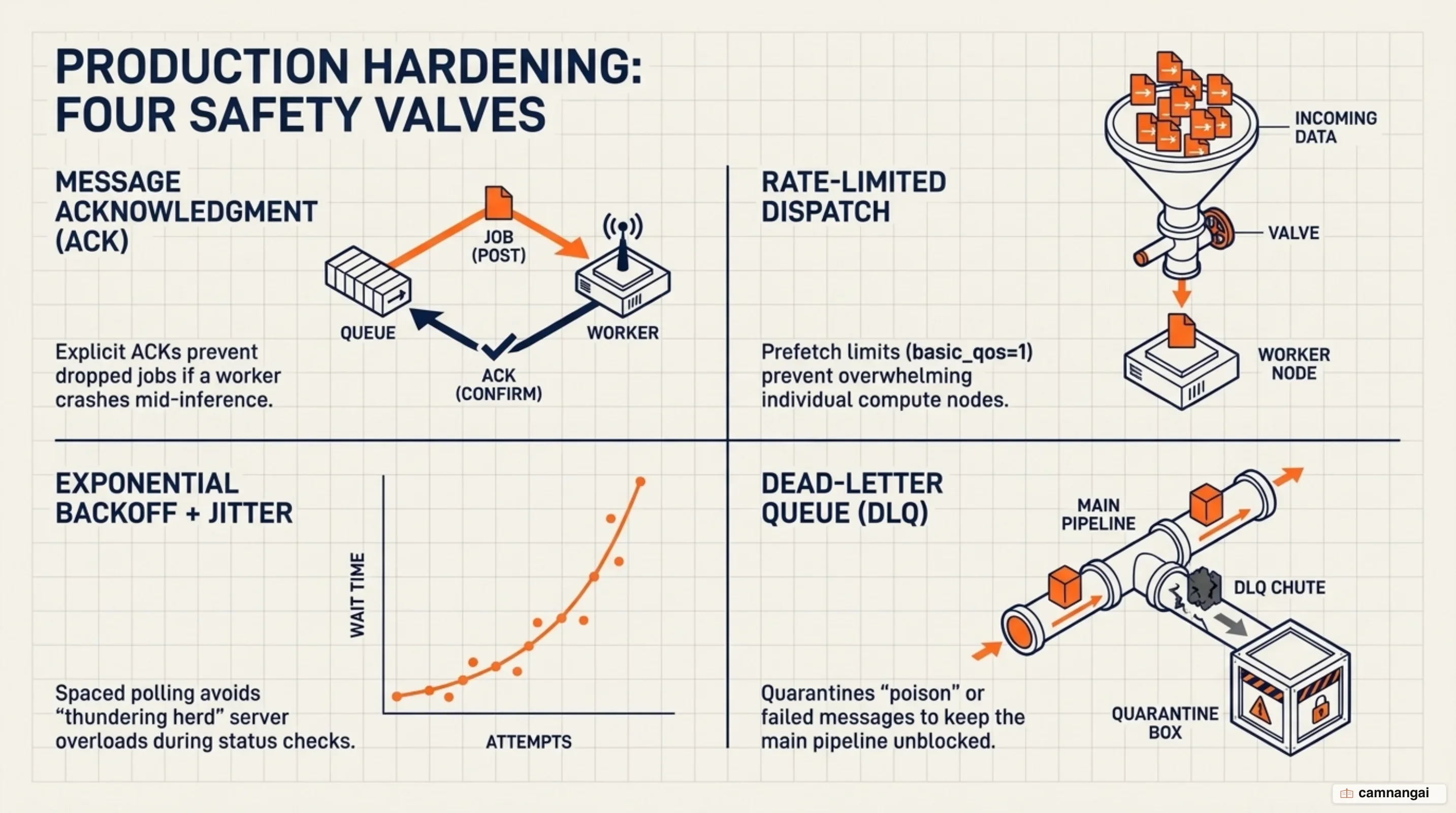
Operating AI task queues in production requires strict concurrency bounds to protect compute nodes and downstream API dependencies. You can configure execution rate limits directly within the framework—such as Celery's rate_limit='10/m' task annotation or BullMQ global rate limits—to throttle consumption. Rate limiting ensures workers do not trigger downstream API rate limit errors or exhaust available GPU VRAM.
When transient processing failures occur, workers must execute retries using exponential backoff with randomized jitter. Incorporating randomized jitter is critical when calling downstream GPU clusters or AI endpoints; without randomness, failed worker retries synchronize into secondary "retry storms" that repeatedly overwhelm recovering backend models and trigger cascading rate-limit rejections. If a task payload is malformed, references missing resources, or repeatedly fails max retry thresholds, the broker routes the payload to a Dead-Letter Queue (DLQ). Isolating poisonous messages to a DLQ prevents unprocessable jobs from cycling endlessly and blocking valid tasks in the queue.
To maintain operational reliability, task processing must implement idempotency and explicit acknowledgments. You should require clients to supply an Idempotency-Key header with initial HTTP POST submissions; if your backend receives a duplicate key, it returns the existing status resource rather than enqueuing a duplicate work item. On the consumer side, message brokers default to at-least-once delivery semantics. Workers must send manual acknowledgments (basic_ack with delivery_tag) only after an AI task successfully completes. If a worker process crashes mid-execution, the broker detects the closed channel and requeues the task for execution by another worker.
In-Process Background Tasks vs. Distributed Message Queues
Framework-level in-process mechanisms, such as FastAPI BackgroundTasks (derived from Starlette), execute asynchronous functions within the same process memory after an HTTP response is emitted. These tools require no external message broker and excel at executing lightweight, non-critical side-effects—such as sending post-response log entries or simple email notifications—where sharing in-memory application state and variables is necessary.
For AI workloads requiring heavy CPU or GPU compute, in-process background execution is insufficient. Heavy processing blocks event loops and risks complete task loss if the application process restarts or crashes. Production AI applications demand distributed message queue architectures like Celery, BullMQ, or RabbitMQ. Distributed queues provide dedicated worker process isolation, multi-server horizontal scaling, rate limiting, task persistence, and dead-letter isolation required to survive system failures.
References
- Asynchronous Request-Reply pattern — Azure Architecture Center | Microsoft Learn
- Queue-Based Load Leveling pattern — Azure Architecture Center | Microsoft Learn
- What is a Message Queue? — AWS
- Reliability, constant work, and a good cup of coffee — AWS Builders' Library
- First Steps with Celery — Celery Documentation
- Architecture & Overview — BullMQ Guide
- Work Queues in Python — RabbitMQ Tutorials
- Background Tasks — FastAPI Documentation