Claude Fable 5 is a Mythos-class model that bills at $10 per million input tokens and $50 per million output tokens. That structure makes the Claude Fable 5 cost roughly twice that of Opus 4.8. For infrastructure engineers, deploying this model without optimization is a recipe for a budget crisis. But you can reach an 80% cost reduction by combining effort tuning, the 10-80-10 routing framework, and technical exploits like prompt caching and image-based context compression.
Fable 5 is built for long-horizon autonomous tasks, but its high intelligence leads to "overthinking": it runs deeper internal loops and generates more thinking tokens than previous generations. Treat the model as a precision instrument rather than a general-purpose worker, and you keep frontier performance while cutting your monthly spend hard.
This report covers the implementation: specific API configurations, state-management patterns, and the pxpipe proxy that takes advantage of vision-token pricing gaps.
Why Claude Fable 5 costs spiral out of control
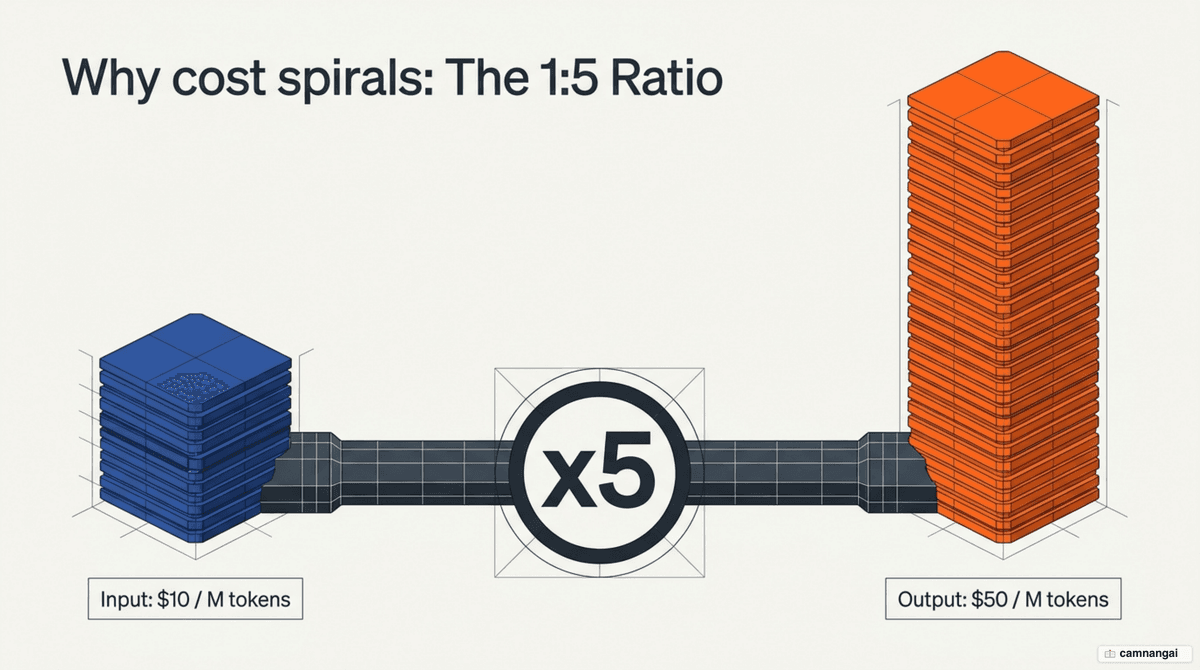
The primary economic risk of Fable 5 is the 5x multiplier on output tokens. At $50 per million tokens, the response and thinking blocks are your dominant cost centers. Fable 5's reasoning capabilities often trigger "overthinking," where the model runs extensive internal loops to verify its own work. That raises accuracy, but it burns tokens far faster than previous models.
In autonomous workflows, Fable 5 can trigger runaway consumption. A single deep-research prompt can spawn over 100 subagents. If every subagent defaults to Fable 5 at "High" effort, you will hit weekly usage limits in hours. This autonomy creates a black box of consumption where cost is no longer tied to one user prompt but to an unpredictable chain of sub-tasks.
Many deployments also lack spending caps. On pay-per-token plans, a single runaway agentic loop can generate a large bill before you get a notification. Without a hard limit in your usage settings, nothing caps how high the bill can climb.
Finally, missing prefix optimization is a major leak. Many developers resend the entire system prompt and full conversation history on every turn. In a 20-turn task, you effectively pay for the same 15,000-token system prompt 20 times at frontier prices — an avoidable $3.00 charge per session.
Effort — the single most important cost dial
The effort parameter in output_config is your most effective lever for balancing performance against cost. Deep Suite benchmarks show Fable 5 at "Low" effort (around $3.76 per task) reaching a 60% pass rate, outperforming Opus 4.8 at "Max" effort (around $13 per task) which only reaches 59%. You get better-than-Opus performance for roughly a 71% discount by adjusting a single config line.
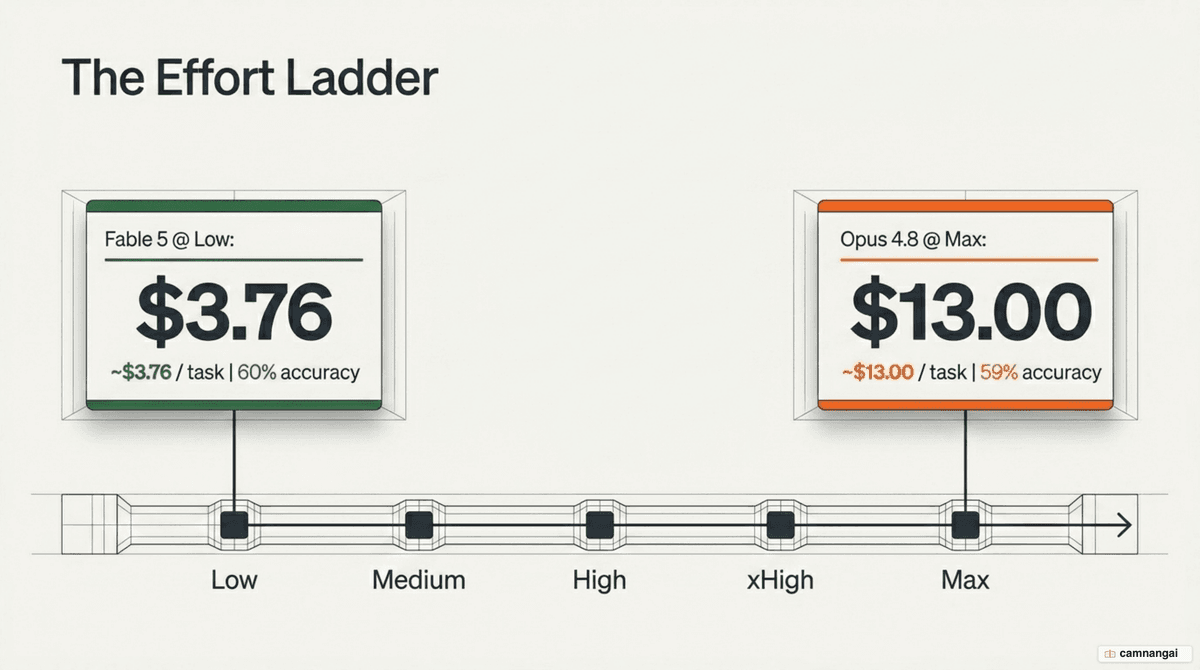
Lower effort doesn't only reduce thinking tokens; it forces the model to be more concise. At "Low" or "Medium," Fable 5 skips unnecessary preambles and combines tool operations, directly attacking the expensive $50/M output side of the bill. For routine tasks like formatting, data extraction, or classification, defaulting to anything higher than "Medium" wastes money.
{
  "model": "claude-fable-5",
  "max_tokens": 32000,
  "output_config": {
    "effort": "high"
  }
}
Default to "High" for complex engineering, but drop to "Medium" or "Low" for routine agentic chores.
Turn on prompt caching to cut input costs by up to 90%
Prompt caching is effectively mandatory for Mythos-class models, and the idea is simple: any stable prefix that repeats on every call — system prompts, tool definitions, reference documentation — is sent once and marked for caching. On later turns the model reads it back from cache at $1/M tokens instead of the $10/M base input rate, a 90% cut on that slice.
How to apply it:
- Wrap the stable prefix in a
cache_controlblock. Put the system prompt, tool definitions, and reference docs at the front of the request and mark them — that's the part reused on every turn. - Don't worry about short prompts. Your prefix only has to clear the minimum cacheable length — 2048 tokens on Fable 5, half of Opus 4.8's 4096 — so even fairly short system prompts qualify. (The threshold differs on third-party platforms like Amazon Bedrock.)
- Warm the cache before real traffic. Send one request with your stable prefix and
max_tokens: 0: the API writes the cache and returns immediately, billing zero output tokens, so every real request after it hits the $1/M rate. - Keep volatile data after the block. Anything that changes between calls — timestamps, request IDs — must sit after the
cache_controlblock, or it changes the hash and breaks the cache.
"system": [
  {
    "type": "text",
    "text": "[Large System Prompt and Documentation...]",
    "cache_control": {"type": "ephemeral"}
  }
]
By caching a 15,000-token prefix in a 20-turn task, your prefix cost drops from $3.00 to roughly $0.48 — one $12.50/M write plus 19 reads at $1/M.
Model routing: let cheap models do the easy work
The 10-80-10 system limits Fable 5 to the segments where its reasoning is indispensable:
- 10% Planning (Fable 5): architect the solution and define constraints.
- 80% Execution (Sonnet 5 / Opus 4.8): perform the repetitive file edits and tool calls.
- 10% Review (Fable 5): a final pass to check the execution matches the architecture.
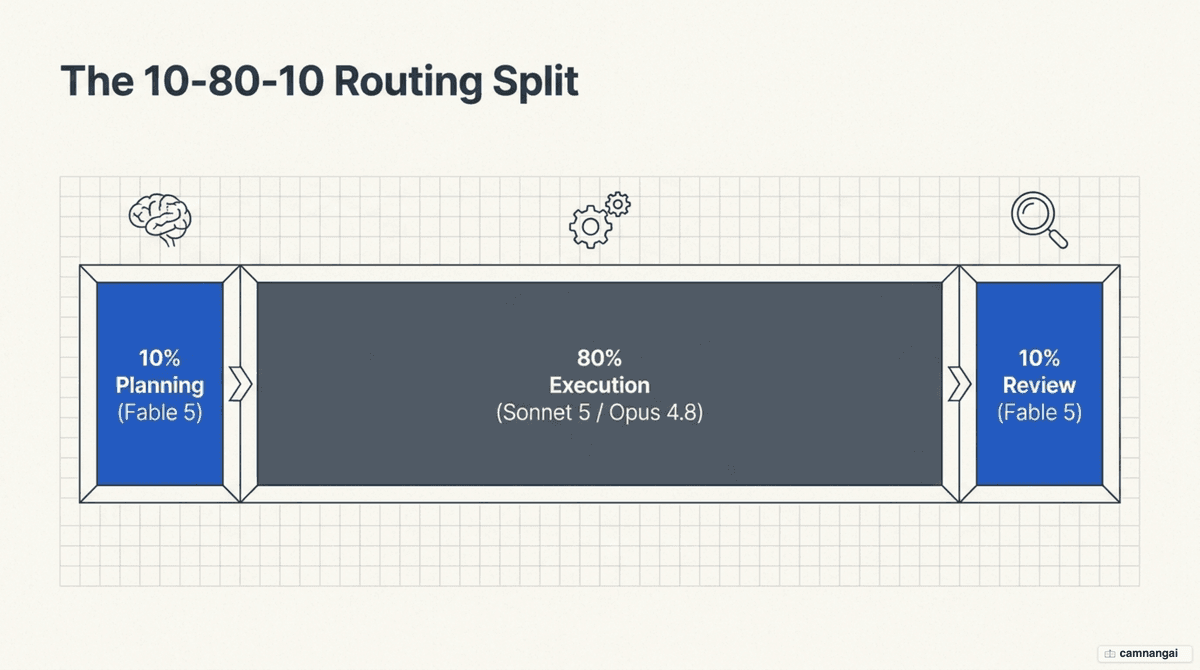
The driver is the pricing delta. Sonnet 5 is currently $2/M input and $10/M output. Routing the Execution slice to Sonnet 5 targets the 5x output cost center, cutting that 80% block's output cost to roughly a fifth.
For automated workflows, use advisor mode. Configure a lower-tier model (like Sonnet 5) as the executor. It handles all tool calls and only queries Fable 5 as the advisor when it hits a logic roadblock. That reserves your $50/M tokens for high-level decisions rather than syntax fixes.
Control output — where the $50 side of the bill lives
Output tokens are your most expensive resource, so steer verbosity directly. Force brevity with a snippet like: "Lead with the outcome. Act when ready. Drop details that don't change decisions."
You can trim output further with external "verbosity reduction" guidelines that push the model to write the minimum code required to hit the objective, saving on the $50/M output charge without sacrificing quality.
Distinguish your two limits:
max_tokens: a circuit breaker to stop runaway loops.- Task Budgets (beta): for long-running agentic loops, use the
task-budgetsbeta to hand the model an advisory token budget so it self-regulates its reasoning depth.
Use external memory instead of resending the whole history
Resending full transcripts in long sessions makes per-turn input cost grow quadratically with session length. Fix it with a state-management pattern: the model writes progress notes to a file (e.g., progress.md).
On each turn, the agent reads the summary and current state from that file rather than the full history, keeping per-turn input flat. Fable 5 is exceptionally good at working from its own notes; in the "Slay the Spire" benchmark, file-based memory improved Fable 5's performance 3x more than it improved Opus 4.8 — evidence that Fable is built for this pattern. Pair it with parallel subagents run at low effort for independent sub-tasks.
Handle refusals and configure fallback correctly
Fable 5 uses safety classifiers that trigger a "refusal" stop reason for topics involving offensive cybersecurity, biology, chemistry, or reasoning extraction. If your prompt asks the model to "show its thinking step-by-step in the output," you risk triggering the reasoning_extraction refusal.
Implement server-side fallback to Opus 4.8 with the header anthropic-beta: fallback-credit-2026-06-01. When a refusal occurs, the request is retried on Opus 4.8 and billed as an Opus session, which keeps your pipeline from breaking on the ~5% of sessions that hit safety guardrails. Always log the stop_reason and the model that actually served the response, and strip stale "show your reasoning" instructions from old prompts.
Compress text into images: an advanced technique with pxpipe
pxpipe is a local proxy that renders bulky text context (like tool documentation) as images. It exploits a pricing gap: image token costs are fixed by pixel dimensions, while text tokens scale with content volume.
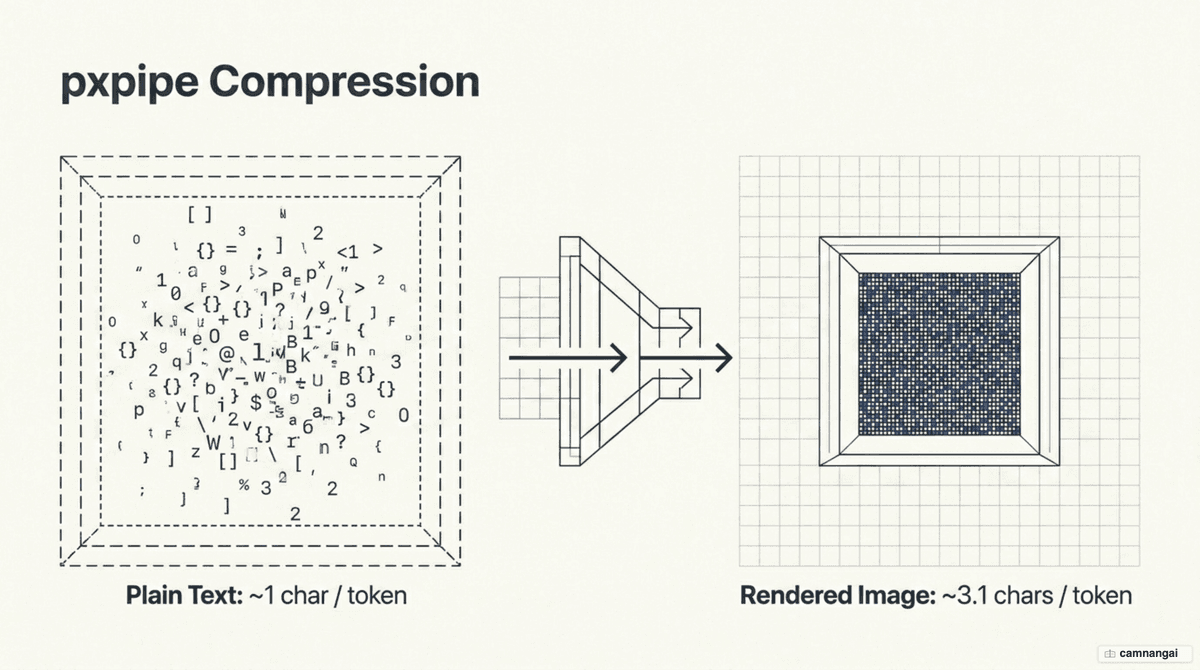
The token-density math favors images for large, dense blocks:
- Text: ~1 character per token.
- Image (pxpipe): ~3.1 characters per token.
A 1928-pixel-wide image holds around 92,000 characters at a near-fixed vision-token cost. The proxy only images a block once its density clears a profitability gate (~19 characters per token), and the maintainers report a 59–70% end-to-end bill reduction on production workloads.
npx pxpipe proxy --base-url [API_URL]This is lossy, though. Because of glyph confusability, the model can misread exact 12-character hex strings — the pxpipe test data shows real misread rates on Fable, and worse on Opus. Keep unique IDs, hashes, and recent turns as plain text, and reserve imaging for prose and docs.
Putting it together: a cost-efficient Fable 5 agent (real cost math)
Compare two scenarios for a 20-turn task with a 15,000-token prefix and 2,000 fresh tokens per turn:
Scenario A (naive build): max effort, no caching, resending all history.
- Cost: ~$6.40 per task. Every turn pays full price for the system prompt and an ever-growing history.
Scenario B (tuned build): high effort, cached prefix, 10-80-10 routing (routine turns to Opus 4.8), and external memory.
- Cost: ~$2.01 per task.
- Arithmetic: one cache write ($0.19) + 19 cache reads ($0.28) + routed output (10 Fable turns at $0.75 + 10 Opus turns at $0.37).
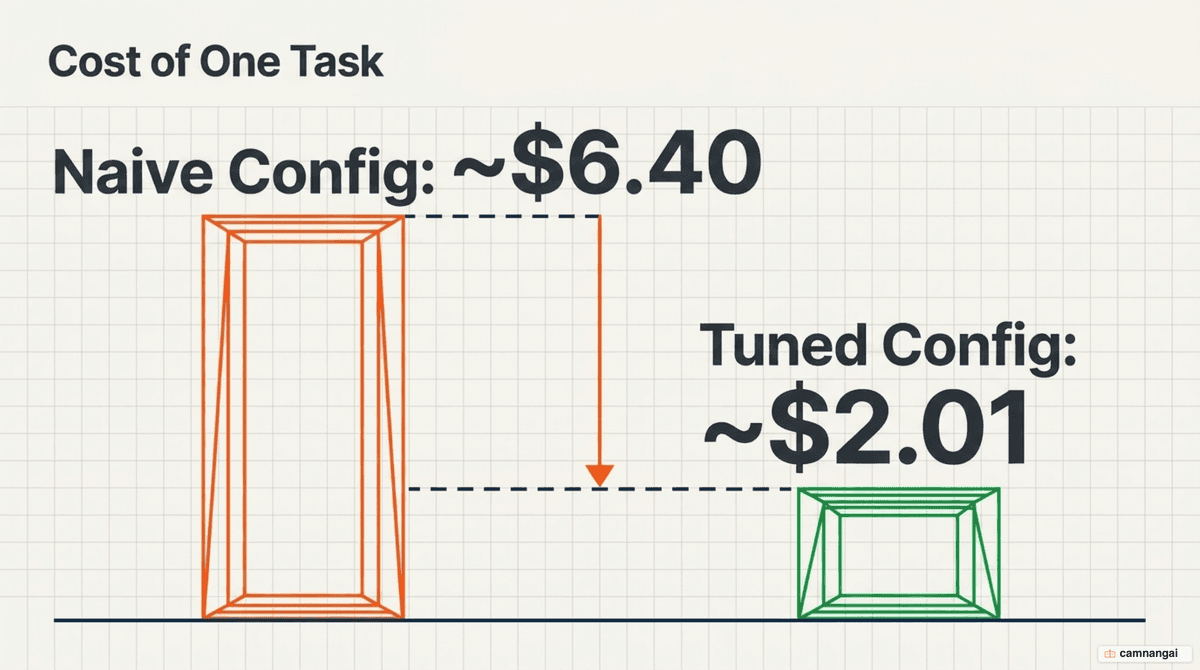
That's roughly a 69–80% reduction depending on how aggressively you route — push the routine half to Sonnet 5 and you drop under $1.80 per task. One compliance note: Mythos-class carries a 30-day data-retention requirement on all traffic, so regulated teams should confirm it (or run a hybrid: sensitive data on Opus/Sonnet under ZDR (zero data retention), everything else on Fable 5).
Final deployment checklist:
- Set
effortto "High" or "Medium" viaoutput_config. - Enable
cache_control: ephemeralon the system prompt; pre-warm withmax_tokens: 0. - Route 80% of execution turns to Sonnet 5 ($2/$10 promo) or Opus 4.8.
- Write agent state to external files; read summaries, not full history.
- Set
anthropic-beta: fallback-credit-2026-06-01to handle safety refusals.
References
- pxpipe — Cut Claude Fable 5 Token Usage by Rendering Text as Images (GitHub)
- Miles Deutscher — How to Use Claude Fable 5 Without Going Bankrupt (X)
- Save 50% Tokens With One Simple Trick (YouTube)
- Make Fable 5 80% Cheaper (& Other Usage Cheat Codes) (YouTube)
- Claude Fable 5 Is Back: How to Use It Up to 90% Cheaper — Noor Mohamad (Medium)