Personal Finance in Claude is a US-only beta tool that ingests read-only financial data from your linked bank and card accounts directly into Claude's .
Announced on November 5, 2026, the integration allows you to run conversational queries, execute cash flow audits, and track recurring obligations using real transaction records. The service operates strictly through an external network protocol, meaning you can analyze historical balances and line items without granting the system permission to move money or execute transactions.
The underlying architecture relies on Plaid as an OAuth proxy to fetch up to 24 months of transaction records across up to 16 financial institution logins. Because access is constrained by a read-only security boundary, the model operates strictly as an analytical pipeline. It parses structured transaction payloads into Markdown tables and visual widgets without persistent memory cross-contamination or model retraining on your financial queries. It can explain where every dollar went, but it cannot touch a cent.

What is Personal Finance in Claude?
Announced on November 5, 2026, Personal Finance in Claude is a US-only beta feature rolling out gradually to personal subscription accounts. You can link bank feeds directly into Claude's interface across web, desktop (macOS and Windows), iOS, and Android clients. If you connect to Claude through a Virtual Private Network (VPN) endpoint routed outside the United States, the system automatically hides the Personal Finance hub from your side menu, though established backend bank connections remain intact.
Access is restricted strictly by tier level. You must hold an active individual Personal subscription: Pro ($20 per month or $200 per year billed upfront), Max ($100 per month), or Ultra ($200 per month). Personal Finance is explicitly excluded from Free tier accounts, as well as organizational Team and Enterprise plans. Upgrading from Pro to higher-capacity tiers like Max or Ultra expands platform query allowances but does not alter bank connector bandwidth, data refresh frequencies, or regional availability parameters.
Your environment enforces a system connection cap of 16 financial institution logins. If you reach this 16-bank maximum, you must manually unlink an existing login before authenticating a new institution. If you transition a personal account into a Team or Enterprise workspace, the system automatically unlinks all connected banks upon initiating the workspace migration.
How it works: Plaid connection and the read-only security boundary
Bank authentication operates via Plaid as an external OAuth proxy. When you initiate account linking, the authentication handshake takes place entirely within Plaid's connection window—rendered as a browser popup on web, an external browser window on Claude Desktop, an in-app view on iOS, or a discrete browser tab on Android. On Claude Desktop, authentication requires that the opened external browser session is logged into the exact same Claude account. You must complete the OAuth handshake within a 10-minute session window. Because authentication occurs on Plaid's domain, Claude never prompts for, ingests, or stores your banking passwords or credentials.
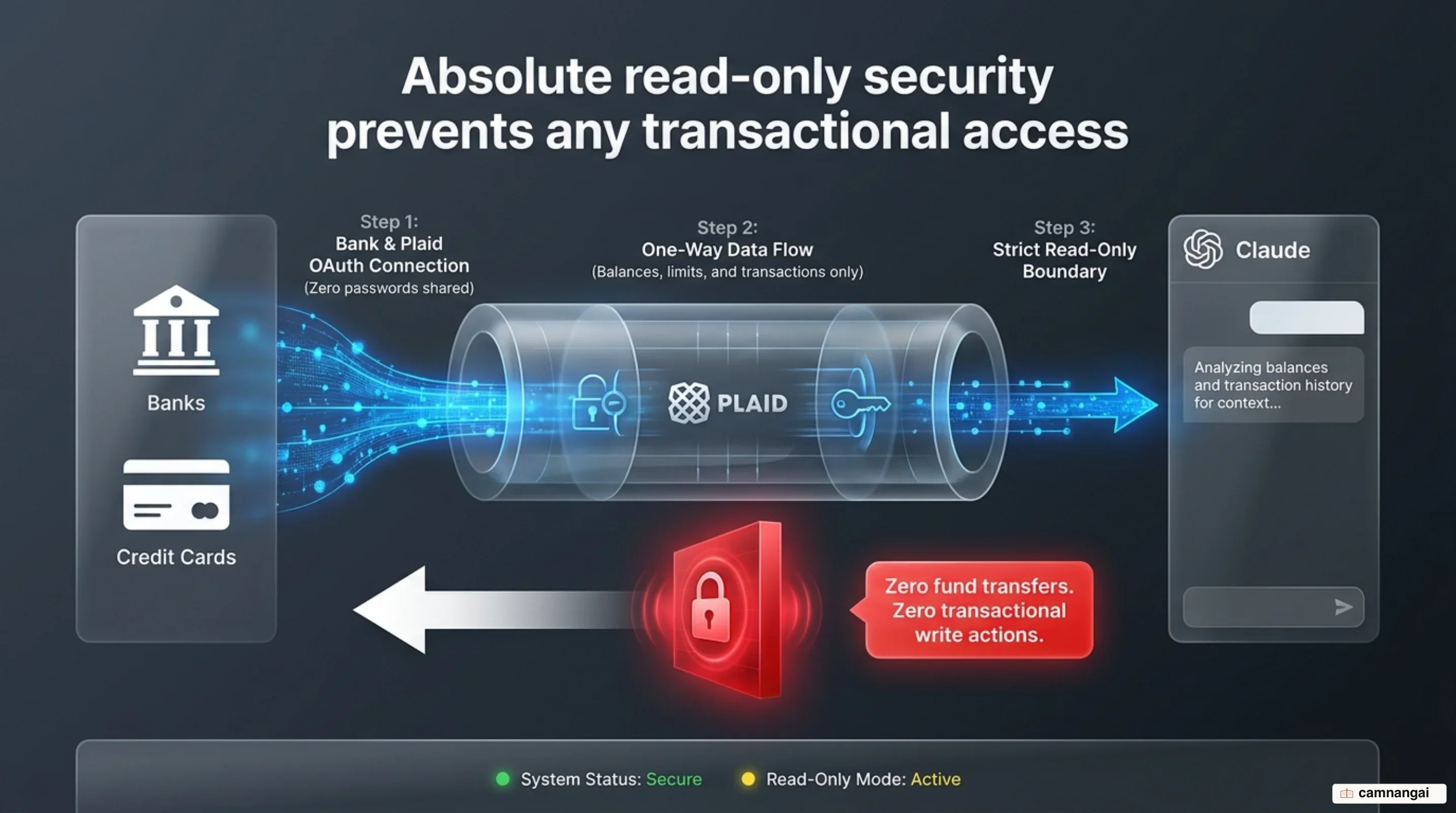
Once authenticated, Plaid serializes specific financial data fields for injection into Claude's processing pipeline. Authorized data schemas include bank names, user-defined account names, account types (checking, savings, credit card, loan, investment), current balances, credit limits, and up to 24 months of line-item transaction history (amount, date, merchant name, category, and raw bank transaction descriptions). Plaid truncates account numbers to the last four digits before data reaches the model context window. However, a potential data leakage vector exists: if your bank hardcodes full account numbers into custom account names or raw transaction description strings, those unmasked account strings will pass directly into the context window.
The system enforces a strict read-only security boundary at the API layer. Claude cannot initiate wire transfers, execute bill payments, reallocate investment portfolios, cancel merchant subscriptions, or alter account configurations. Ingested balances carry explicit technical edge cases: line-item transaction syncs can take several minutes, and reported account balances are frequently 1 to 2 days out of date, making them unsuitable for real-time authorization checks. Furthermore, if you authenticate the same bank under multiple distinct logins, duplicate account counting can occur if the institution formats account metadata inconsistently across those logins. A critical operational failure mode occurs when a linked bank feed temporarily drops out: Claude's dashboard silently excludes that missing bank's data from aggregate spending totals without throwing a system error, creating a false sense of liquidity by underreporting actual expenditure. The data feed also excludes active stock trade executions, granular investment holdings, and contractual interest rate terms.
What Claude can do with your financial data
Personal Finance in Claude parses raw JSON transaction payloads from Plaid into structured, inspectable analytical outputs. You can perform multi-account cash flow audits by querying your transaction history across checking and credit accounts. For example, if payday is 10 days away, asking Claude to evaluate your current cash position executes two distinct data processing steps: first, it parses historical line-item data to report actual spend ($4,309.37 total monthly expenditure, with over half allocated to housing/utilities and $1,024.51 to food and beverage); second, it computes a predictive cash flow projection ($1,393.22 remaining in checking post-settlement of four pending scheduled payments due before payday).
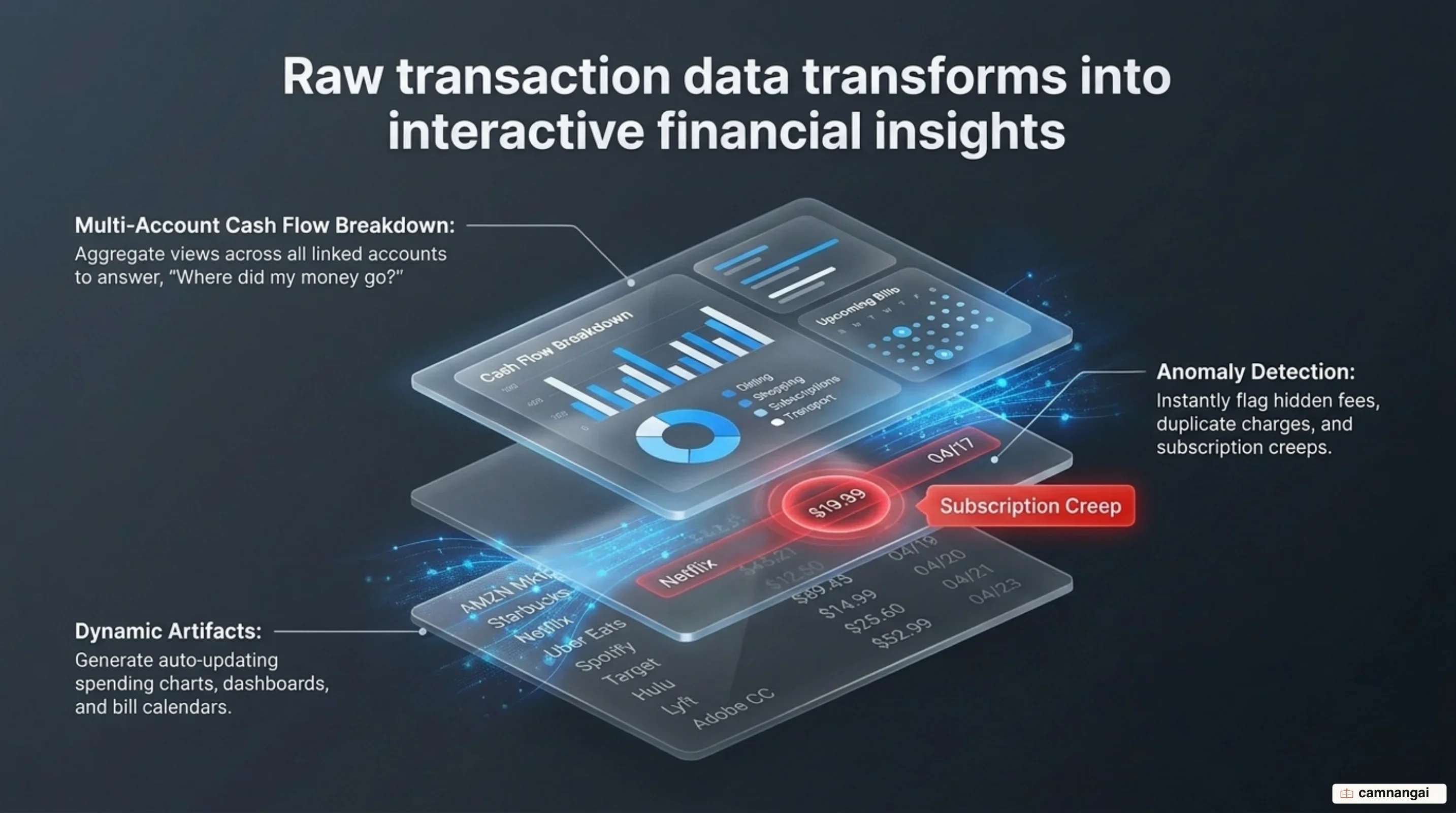
You can run anomaly detection routines across your connected transaction history to surface hidden recurring costs. The model parses multi-month transaction logs to flag recurring membership renewals, detect price creeps on utility or software bills, identify unexpected bank account fees, and isolate potential duplicate charges across linked accounts. When analyzing financial concepts like Annual Percentage Rate (APR), Claude provides context-grounded definitions and iterates over historical transaction rows to sum the exact dollar amount of interest fees billed to your accounts over a specified period.
Data output extends to rendering dynamic visual Claude Artifacts directly within the workspace UI using standard Markdown tables and graphic components. You can instruct Claude to build and update personalized financial summary dashboards, weekly category spending charts, and chronological bill-due-date calendars. You can inspect the precise line items supporting any summary metric by explicitly instructing the model: "show me the transactions behind that number."
Privacy protections, model training exclusions, and ad-free policy
Data retention and model training policies depend directly on where you execute your queries. Queries and context window loads initiated strictly inside the Personal Finance hub are excluded from Anthropic's model training pipelines. Conversely, if you copy transaction rows or statement details into a standard Claude chat thread outside the Personal Finance hub, those data payloads default to your global account privacy settings. Anthropic maintains an ad-free operational model: Personal Finance contains zero advertisements, does not ingest sponsored merchant placement data, and offers no native credit card, loan, or investment referral products.
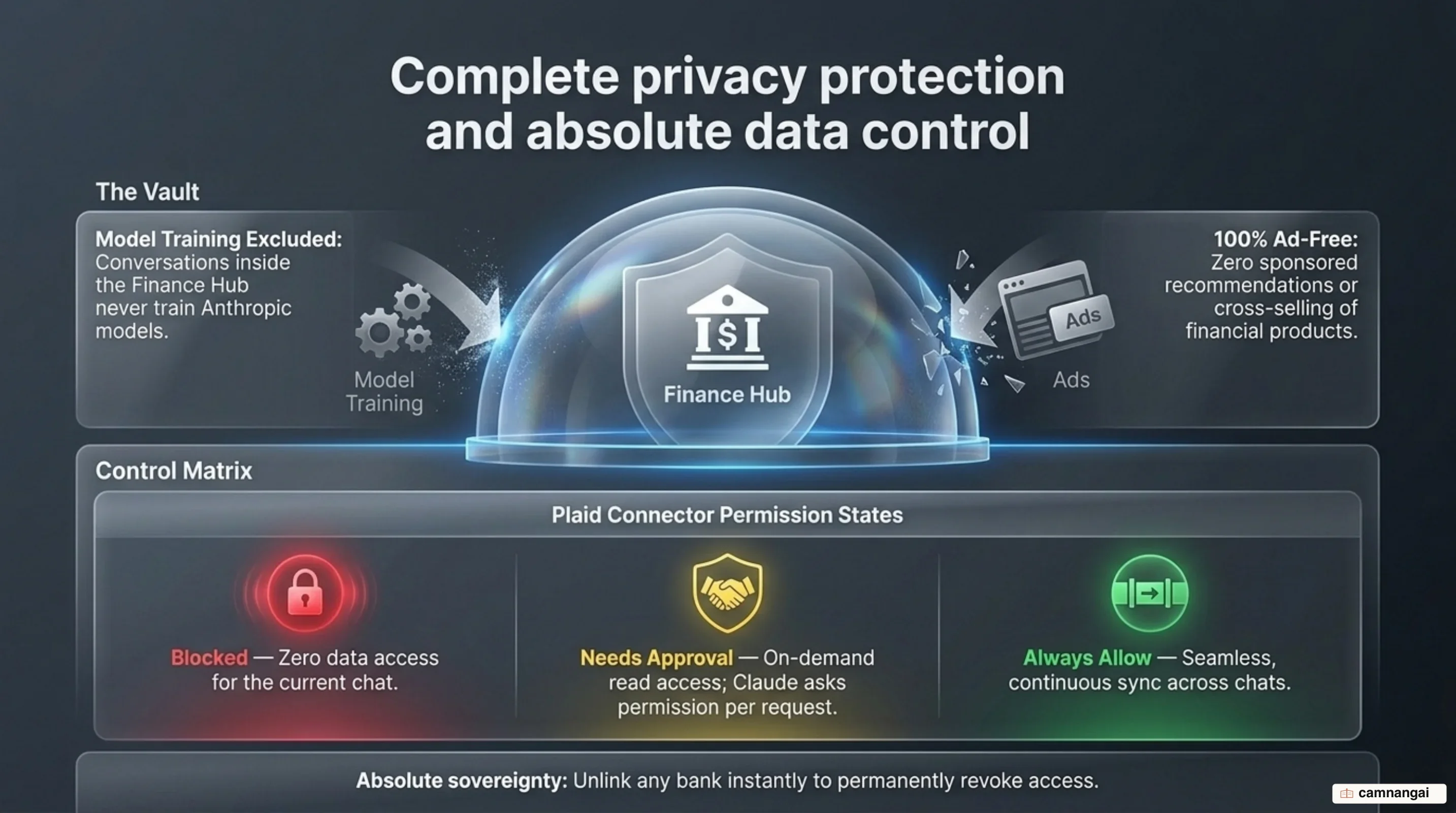
You control Plaid connector data ingestion on a per-chat basis through the interface permissions menu (accessed via the "+" icon in the web and desktop message box, or app settings on mobile). You can toggle the connector across three functional states: Blocked (completely revokes Plaid API data fetching for the thread), Always allow (permits automated data ingestion per prompt), and Needs approval (forces an explicit user confirmation prompt before executing any bank data read).
Architecturally, invoking Plaid connectors inside a chat thread activates strict memory isolation rules: the system excludes financial session data from long-term user memory, local client thread search, and automated monthly recap generation (including thread title indexing). However, critical privacy failure modes exist around Artifacts and shared links. Financial charts or dashboard Artifacts generated during a session persist in your account's Artifact storage even if you delete the originating chat thread. Furthermore, generating a shared chat link exposes all embedded financial figures, line items, and rendered Artifacts to anyone with the link, regardless of their platform authorization or subscription tier.
Account unlinking mechanics enforce explicit data lifecycle behaviors. Unlinking an institution revokes data fetching for all accounts attached to that login session. Unlinking your final connected bank triggers an irreversible software reset of the Personal Finance hub. This action permanently deletes your custom dashboard widgets, personalized layout settings, and setup configurations. Reconnecting a bank later does not restore these deleted configurations, and saved dashboards are excluded from standard Claude account data exports.
Claude vs. traditional budgeting apps: where it fits
Claude approaches personal finance through natural language context querying rather than the structured database schemas of dedicated budgeting software like Mint or Monarch. Traditional budgeting platforms remain superior for generating certified PDF financial statements, maintaining multi-year historical synchronization, and triggering automated balance alerts. Claude excels when you require ad-hoc, unstructured spending audits and plain-English context breakdowns without constructing manual visual filters or navigating static UI tabs.
In the competitive landscape, OpenAI launched ChatGPT Finances in May 2026 (incorporating Plaid connectors alongside Experian credit bureau data across Free, Plus, and Pro tiers), while Perplexity and Gemini with Google Wallet offer native read-only financial data parsing. All competing platforms operate under the same structural read-only security boundary, preventing direct transaction execution. Claude differentiates itself by maintaining an ad-free environment, enforcing model-training exclusions inside its finance hub, and restricting access to paid personal subscription tiers.
Workflow integration restrictions apply across the broader Claude ecosystem. Linked bank connectors cannot be queried or deployed within scheduled tasks, Claude Cowork tasks, Claude Code CLI workflows, or Claude Duet. Additionally, project workspaces that have previously executed code execution tools, processed file upload artifacts, or published interactive applications are restricted from attaching to Plaid bank connectors.
When to use (and when to hold off on) Personal Finance in Claude
Deploy Personal Finance in Claude if you are a US-based Pro, Max, or Ultra subscriber managing multiple accounts who requires rapid, natural-language spending audits. It provides high architectural utility when you need to run ad-hoc cash flow projections, detect subtle subscription price inflation, or verify summary metrics against line-item transaction rows.
Hold off on adopting the feature if you operate outside the US, use Free, Team, or Enterprise tiers, or require real-time balance feeds for instant payment authorization. Furthermore, the system cannot replace dedicated software if your pipeline requires silent background data sync, automated bill execution, active portfolio management, or legal tax document export.
References
- Anthropic Invites Banks to Help Shape Personal Finance Offerings — PYMNTS
- Anthropic upgrades Claude with new Personal Finance feature — 9to5Mac
- Claude Personal Finance Guide: Pricing, Setup, Privacy and Limits — Kingy AI
- Claude Personal Finance: Read-Only Bank Answers — CellCog
- Claude's new Personal Finance tool aims to help analyze your spending - read-only, of course — ZDNET
- Introducing Personal Finance in Claude — Claude by Anthropic
- Personal Finance in Claude: connect your bank accounts and ask about your money — AI Codex
- Use Personal Finance in Claude — Claude Help Center