Claude Fable 5 is Anthropic's new Mythos-class flagship AI model, released on June 9, 2026. It moves past the previous Opus-class hierarchy and is tuned for long-horizon autonomous work and complex reasoning. It is built for long-term planning, self-verification, and multi-stage execution across datasets larger than earlier models could handle.
As the generally available configuration of the Mythos architecture, Claude Fable 5 is a robust agentic worker rather than a standard task-based assistant.
It supports a default 1-million-token context window and can generate up to 128k output tokens per request. It includes a tiered safety architecture that routes high-risk frontier queries to a secure fallback model while keeping top-tier performance on standard enterprise and engineering workloads.

What is Claude Fable 5?
Claude Fable 5 is the generally available implementation of Anthropic's Mythos-class intelligence.
It goes beyond the Opus-class in one concrete way: it can manage a 1-million-token context window and produce 128k output tokens per request. The shift is from "giving AI tasks" to "assigning it responsibilities" — the model plans across multiple stages, delegates to sub-agents, and verifies its own execution over multi-day sessions.
A core technical requirement for Fable 5 is the use of "adaptive thinking" as the mandatory reasoning mode. Developers control reasoning depth through an effort parameter (options: low, medium, high, xhigh). Note that raw thinking content is never returned to the user; thinking.display defaults to "omitted", but can be set to "summarized" to receive readable reasoning summaries. Integration also supports beta features such as task budgets (via the task-budgets-2026-03-13 header) and context management (via the context-management-2025-06-27 header).
How Fable 5 and Mythos 5 differ
Claude Fable 5 and Claude Mythos 5 share the same underlying architecture but are distinguished by their safety tuning and access protocols:
- Claude Fable 5: the public-facing model using active safety classifiers. If a query is flagged for high-risk frontier capabilities, the system uses a "fallback" mechanism — these requests are routed to Claude Opus 4.8, which provides a safe response without a hard refusal.
- Claude Mythos 5: a restricted version available to trusted partners in Project Glasswing. This version has specific safeguards lifted — particularly in cybersecurity — to allow offensive security research and critical-infrastructure protection.
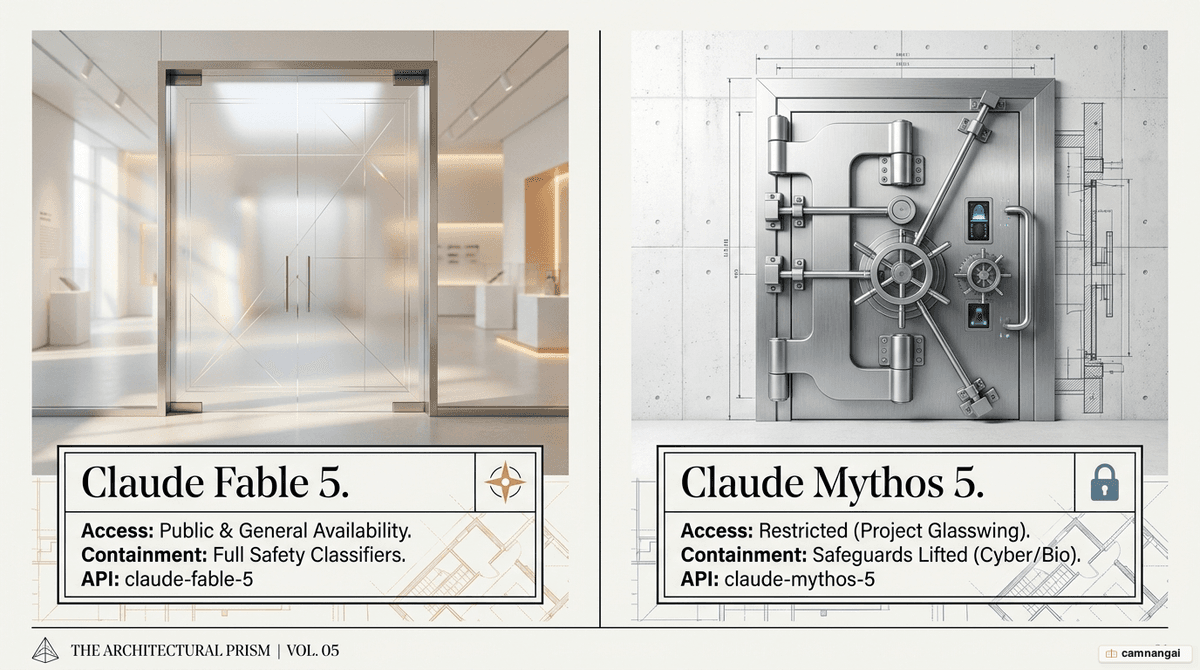
Anthropic reports that over 95% of Fable 5 sessions do not trigger the safety fallback, meaning the vast majority of users experience the full Mythos-class capability.
Where Fable 5 excels
The model leads by a wide margin in large-scale engineering and dense visual synthesis:
- Software engineering: in a documented case study, the model executed a codebase-wide migration of a 50-million-line Ruby codebase for Stripe. This task, which would typically require a human team over two months, was completed in a single day.
- Vision and simulation: Fable 5 reached game completion in Pokémon FireRed using only raw screenshots and a minimal vision-only harness, whereas previous models required complex tool-assisted scaffolding. It can also derive physics simulations, such as solar-system models, from first principles to predict astronomical events.
- Enterprise document processing: the model excels at interpreting nested diagrams, complex tables, and charts within financial and legal PDFs, often "one-shotting" the creation of full applications from high-level specifications.
The numbers: benchmarks and performance
The following data reflects the Mythos-class architecture's performance across validated evaluations:
| Benchmark | Score |
|---|---|
| SWE-bench Pro | 80.3% |
| Terminal-Bench 2.1 | 88.0% |
| OSWorld-Verified | 85.0% |
| Humanity's Last Exam (with tools) | 64.5% |
| Humanity's Last Exam (without tools) | 59.0% |
| ExploitBench CTFs | 78.0% |
| HealthBench Professional | 66.0% |
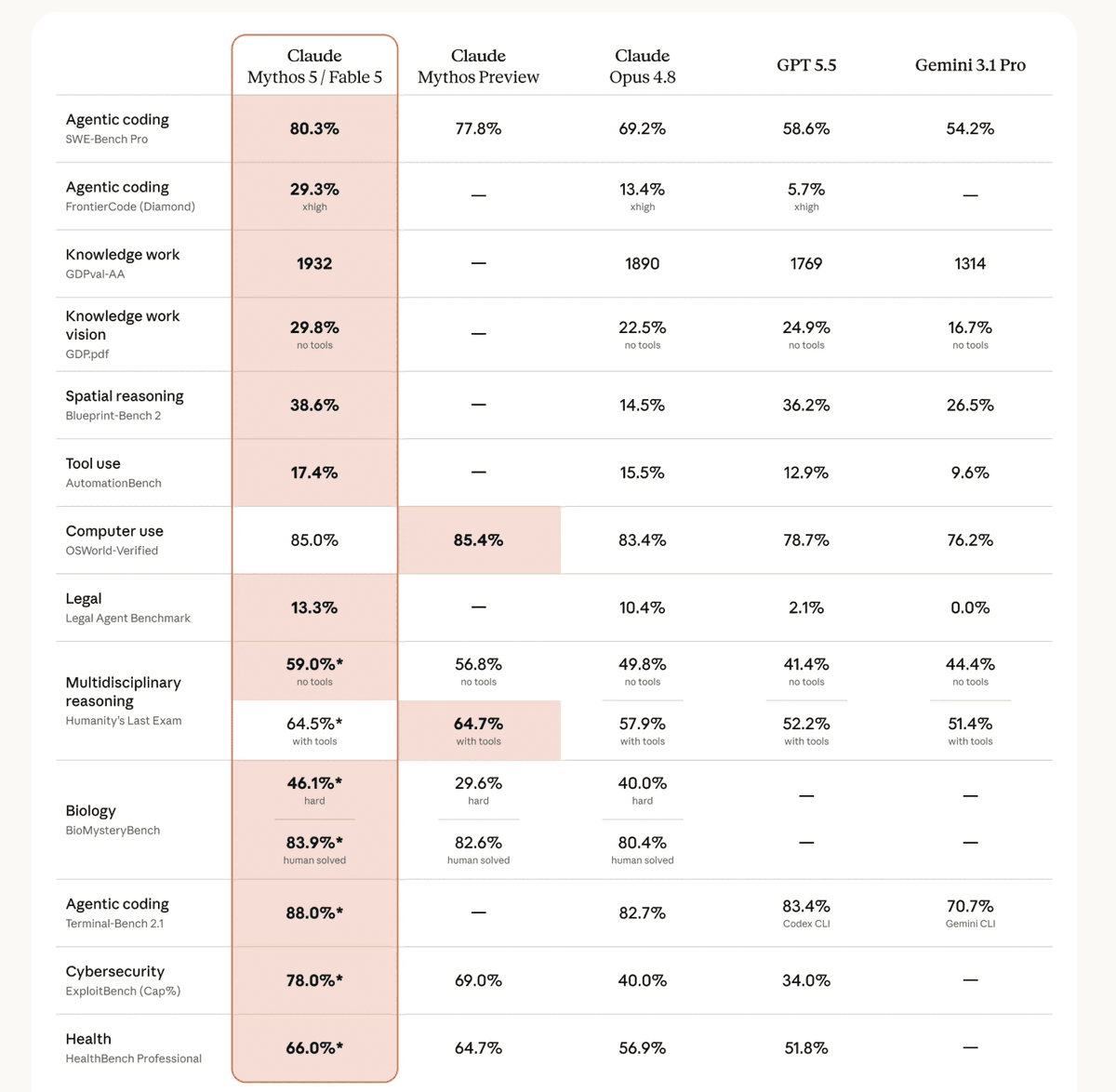
Source: Claude Fable 5 Benchmark Scores — Weights & Biases
In frontier physics research evaluations, Fable 5 matched GPT-5.5's results in 36 hours, against the four days GPT-5.5 took — and used only a third of the reasoning tokens its competitor needed.
Safety system and fallback
To mitigate the risk of "uplift" — where the model provides information that helps malicious actors in ways standard resources cannot — Anthropic implemented specialized classifiers targeting three domains:
- Cybersecurity: detection of offensive techniques, malware development, and agentic hacking.
- Biology and chemistry: sensitive molecular mechanisms and laboratory methods.
- Distillation: detection of attempts to extract internal reasoning to train competing models.
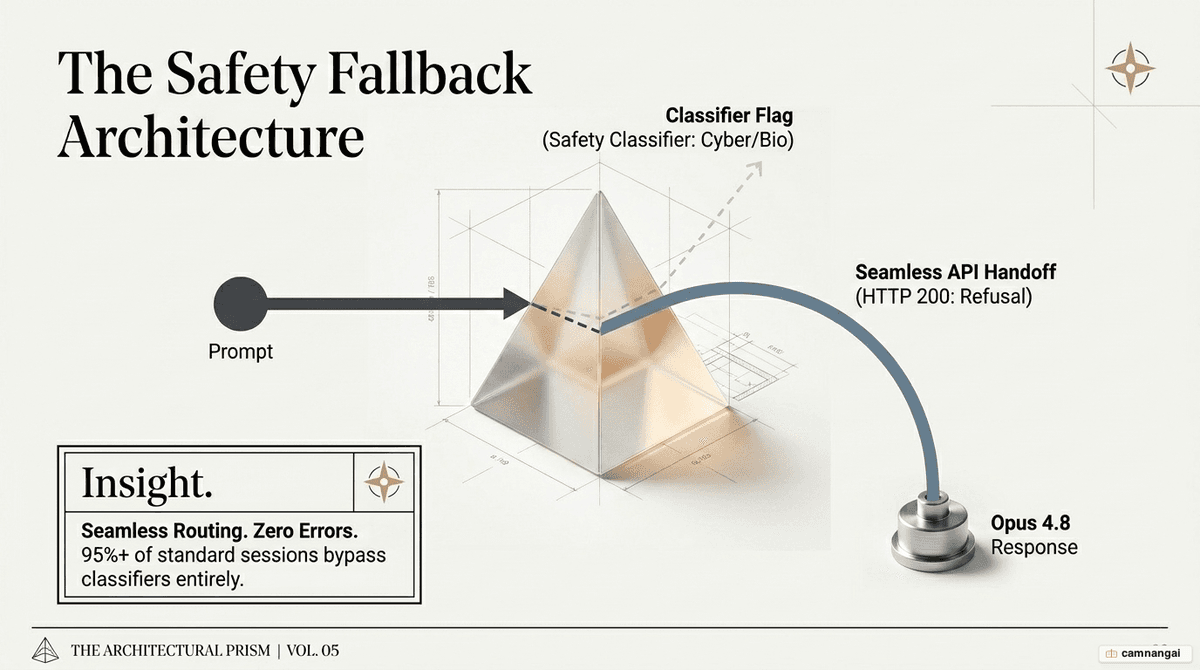
When a classifier flags a request, the API returns stop_reason: "refusal" within a successful HTTP 200 response. The request is then automatically served by Claude Opus 4.8. Users are informed of the fallback and are not charged Mythos-tier pricing for these rerouted responses. All Mythos-class models are "Covered Models," requiring a 30-day data retention policy. For privacy, Anthropic logs all human access to this safety data and deletes it after the 30-day window.
Pricing, release date, and access
Claude Fable 5 was released on June 9, 2026, with the API model ID claude-fable-5.
- Token pricing: $10 per million input tokens and $50 per million output tokens.
- Prompt caching: a 90% discount applies to input tokens that use prompt caching, which cuts the total cost of ownership (TCO) for long-context agentic workflows.
- Regional premiums: workloads requiring US-only inference are subject to a 1.1x pricing premium.
- Rollout schedule: Pro, Max, and Team subscribers have free access until June 22, 2026. Starting June 23, the model transitions to a usage-based credit system for these tiers.
Who should use Claude Fable 5?
Fable 5 is a premium tool designed for high-value, high-complexity workflows. Ideal usage profiles include:
- System architects: deploying multi-agent orchestrations that require autonomous planning and sub-agent management.
- Engineering leads: managing legacy codebase migrations, multi-day debugging, or large-scale refactoring.
- Research scientists: synthesizing novel hypotheses from dense visual data and unstructured research repositories.
For routine tasks like short-form summarization or basic Q&A, lower-tier models such as Claude Haiku or Sonnet remain the more cost-effective engineering choice.
References
- Claude Fable 5 and Claude Mythos 5 — Anthropic
- Introducing Claude Fable 5 and Claude Mythos 5 — Claude API Docs
- Claude Fable — Anthropic
- Prompting Claude Fable 5 — Claude API Docs
- Felix Rieseberg on X: Claude Fable 5 and Mythos 5 announcement
- Claude Fable 5 and Claude Mythos 5 Just Launched: Everything You Need to Know — Medium