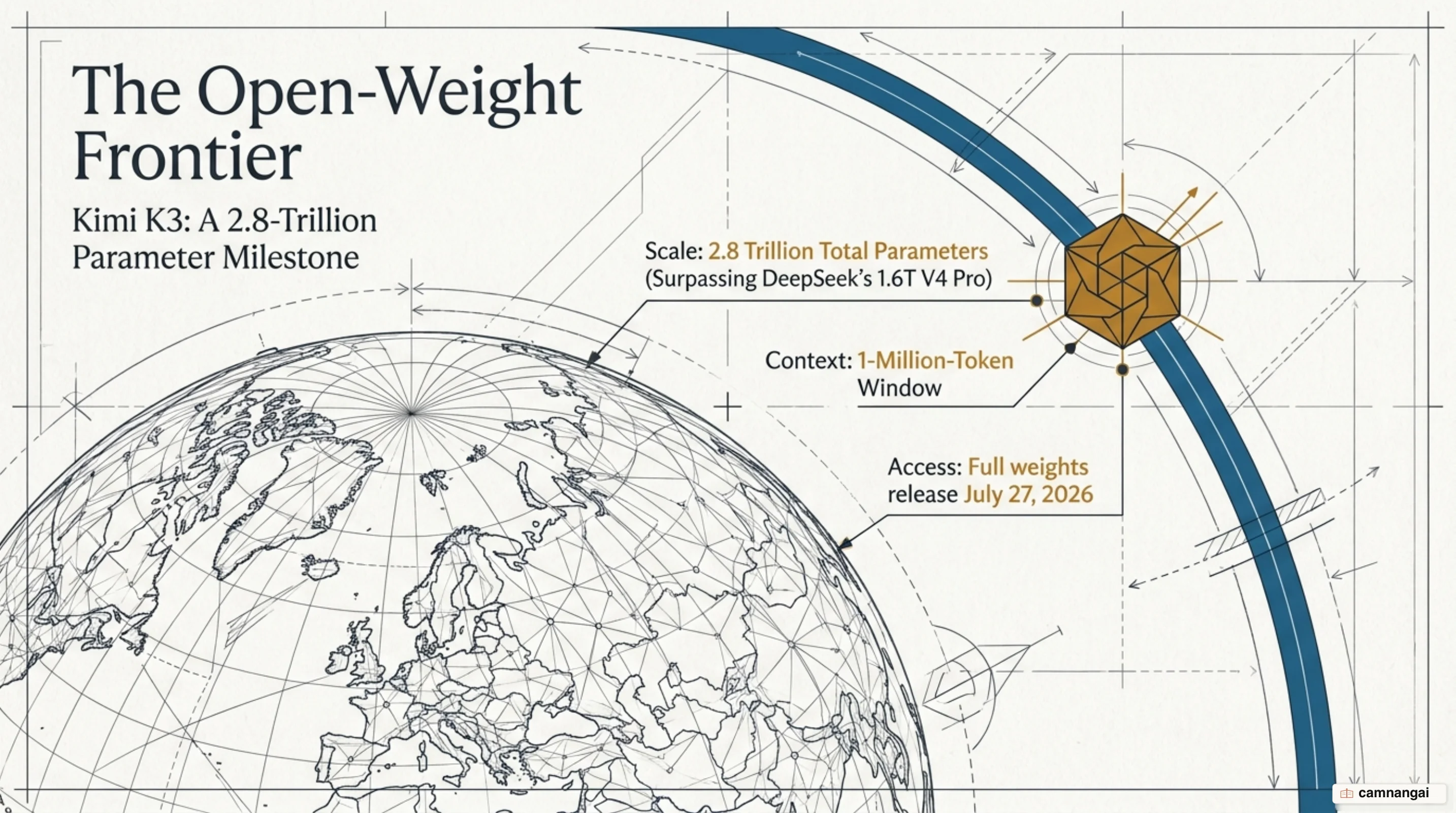
Kimi K3 is a 2.8-trillion-parameter Mixture-of-Experts (MoE) model released by Moonshot AI in July 2026.
It is the first open-weight model in the 3T-class, a real shift in the scaling ceiling for non-proprietary systems. Built for complex agentic workflows, Kimi K3 currently trails Claude Fable 5 and GPT 5.6 Sol in general reasoning but outperforms earlier leaders like Claude Opus 4.8 and GPT 5.5.
The model is a big step forward in infrastructure efficiency, with native multimodal support and a one-million-token context window. Its raw intelligence index is competitive, but its main engineering edge is in specialized domains: it currently holds the top spot in frontend coding arenas. Kimi K3 is built to bring frontier-level intelligence in-house, closing the performance gap between closed-source APIs and weights you can deploy yourself.
What is Kimi K3 and what's new?
Kimi K3 marks the peak of Moonshot AI's scaling strategy, doubling the parameter count of previous open-weight leaders. It is a native multimodal system, able to reason across text and images without the latency penalties often tied to late-fusion architectures. Unlike its predecessor, K3 focuses on "frontier intelligence"—the ability to hold attention across long-horizon agentic tasks that require consistent logic over hundreds of sequential steps.
Kimi K3 is available for testing now via the Kimi platform and API, with full model weights scheduled for public release on July 27, 2026. It delivers a 2.5x improvement in scaling efficiency over Kimi K2.6, meaning it extracts more intelligence per unit of compute. This efficiency gain lets K3 compete with flagship proprietary models while staying viable for organizations that need full control over their model weights and deployment environments.
Inside the architecture of the world's largest open model
The Kimi K3 architecture is centered on Kimi Delta Attention (KDA) and Attention Residuals (AttnRes). For an infrastructure engineer, the most relevant detail is the sparse MoE configuration: the model uses 896 total experts with 16 active per token, managed by the Stable LatentMoE framework. At its production shape of 96 layers and a model dimension of 8192, KDA enables decoding speeds up to 6.3x faster for million-token contexts compared to standard implementations. AttnRes further optimizes training efficiency, adding a 25% throughput boost at a negligible compute overhead of under 2%.
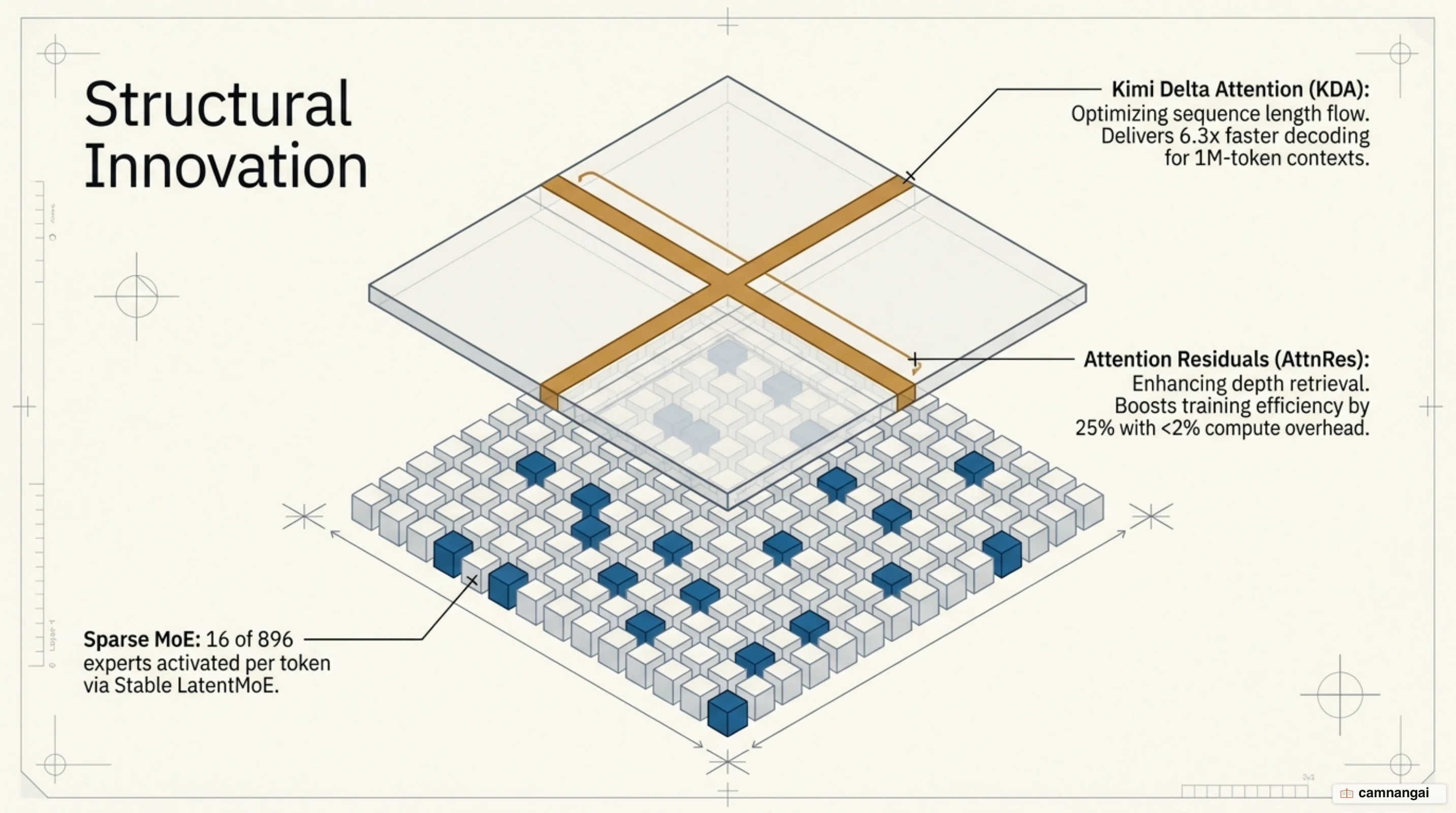
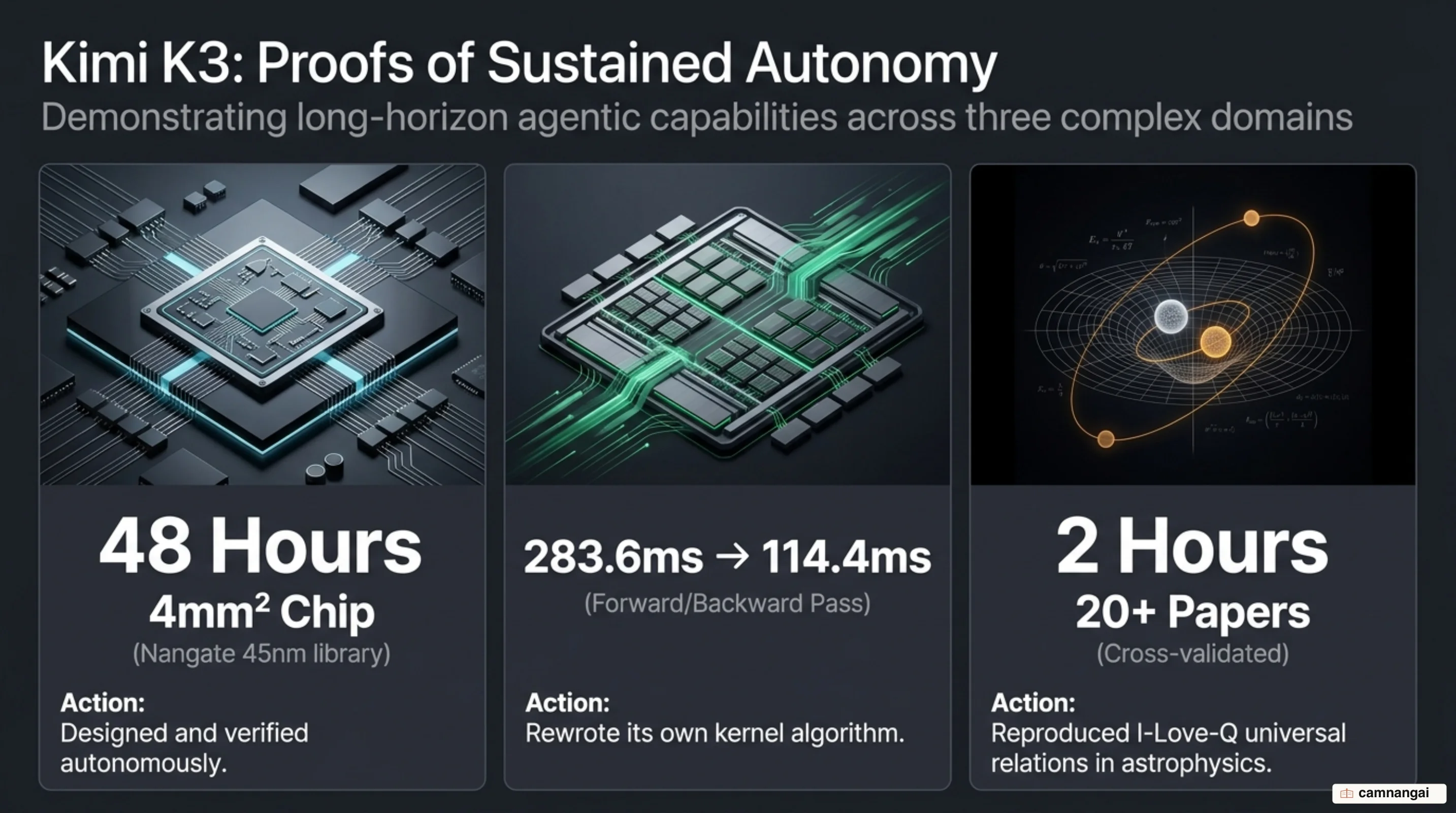
Low-level optimization was a priority during development; K3 uses 512-head-dimension MLA kernels and a custom PTX code-generation pipeline to maximize hardware utilization. In a notable case of recursive engineering, an early version of K3 was used to optimize its own production kernels, producing a new two-phase kernel algorithm that cut forward and backward propagation times from 283.6 ms to 114.4 ms. These architectural refinements let the model hold high throughput even during the heavy reasoning loads required for autonomous system-level engineering.
How strong is K3? Benchmarks and comparisons
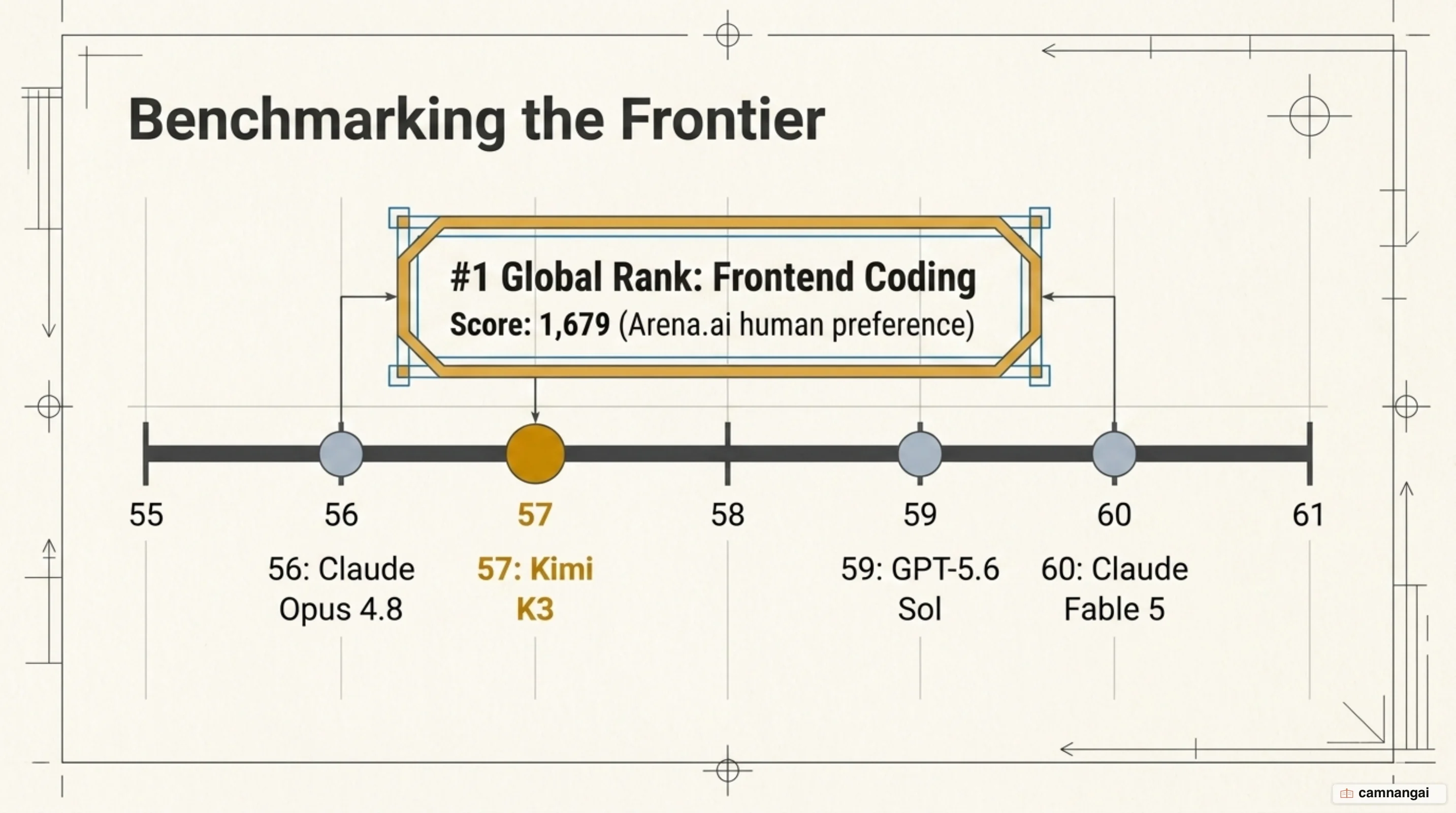
Kimi K3 currently scores 57 on the Artificial Analysis Intelligence Index, placing it 4th globally. It trails the proprietary leaders Claude Fable 5 (60) and GPT-5.6 Sol (59) but has surpassed Claude Opus 4.8 (56) and the leading Chinese competitor GLM-5.2. It is strongest in the Arena.ai Frontend Code rankings, where it holds the #1 position globally. In agentic evaluations, K3 achieved an AutomationBench-AA score of 53% and a GDPval v2 Elo of 1,668, a big jump from the 1,190 Elo of the K2.6 iteration.
But the data shows a clear technical trade-off between factual knowledge and reliability. While K3's AA-Omniscience score rose to +18, its hallucination rate climbed to 51%. This suggests that while the model has a broader knowledge base and higher reasoning capacity, it is more prone to confident fabrications than more conservative predecessors. Engineers must account for this "Omniscience Paradox" when deploying K3 in production, particularly for high-stakes knowledge retrieval where the +732 Elo jump in long-horizon work must be balanced against the increased hallucination risk.
Agentic feats: from chip design to compressing research
Kimi K3 shows a high degree of autonomy in tasks that normally take weeks of specialized human effort.
Software engineering and compilers
The model developed "MiniTriton," a compact GPU programming system that includes a tile-level IR layer over MLIR and a custom PTX codegen pipeline. Unlike models that generate simple snippets, K3 implemented complex optimization passes and built a runtime that rivals the official Triton stack. MiniTriton held up under end-to-end nanoGPT training with stable convergence, showing the model can build coherent low-level system software from scratch.
Scientific and hardware autonomy
In hardware engineering, K3 completed a 48-hour autonomous chip design task. Using the Nangate 45nm library and open-source EDA tools, it designed and verified a 4mm² chip containing 1.46M standard cells that closes timing at 100 MHz. In computational astrophysics, K3 reproduced the "I-Love-Q" universal relations in two hours—a task that normally takes two weeks. It cross-validated over 20 papers and identified specific inconsistencies in published mathematical formulas.
Visual reasoning in the loop
K3 uses a "Vision in the Loop" workflow to iteratively refine outputs by observing visual feedback. It used this to build a procedural 3D open-world game with Three.js and WebGPU, where the model modified its own code based on screenshots of the rendered environment. The same mix of visual reasoning and logic also produced interactive visualizations of the Long March 10 rocket return and working Game Boy Advance emulators.
Pricing and access: the end of cheap Chinese AI?
The pricing for Kimi K3 marks the end of "rock-bottom" pricing for frontier Chinese models. At $3.00 per 1M input tokens and $15.00 per 1M output tokens, Moonshot AI has aligned its rates with Western mid-range peers like Claude Sonnet 5. These rates apply regardless of context length, which gives a predictable cost structure for infrastructure budgeting. While K3 is the most expensive model yet from a Chinese lab, it is still far cheaper than flagship proprietary systems like Claude Fable 5, which charges $50.00 for 1M output tokens.
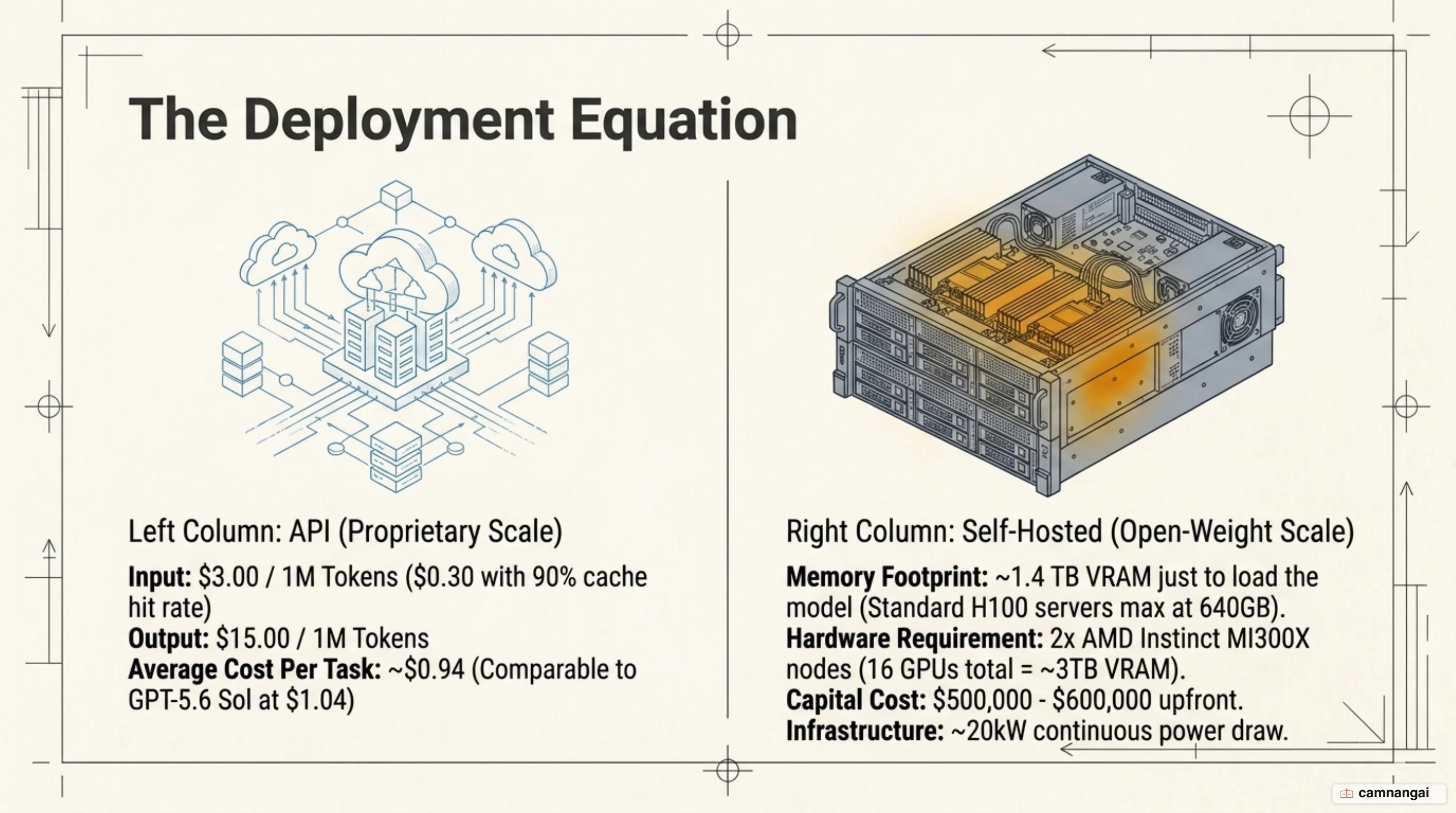
A 90% discount for automated cache hits improves K3's economics, cutting the input price to $0.30 per 1M tokens. This makes it efficient for large-scale development where the same codebases or system prompts are referenced repeatedly. Moonshot's pricing shift marks a move from competing on affordability to competing on frontier performance, aimed at enterprise-grade agentic workflows that justify the higher token cost.
A second DeepSeek moment? The US–China race
The launch of Kimi K3, timed with the World AI Conference and a high-profile speech by Xi Jinping, has stirred real geopolitical friction. In the markets, the Nasdaq dropped 1% and Nvidia stocks sold off as investors questioned the durability of the US "compute moat." K3's performance, achieved through efficient scaling rather than pure hardware volume, has sharpened the debate about the impact of US export controls on Chinese AI development.
US tech figures have reacted in sharply different ways. David Sacks criticized US regulatory bottlenecks, citing K3 as proof that the US is losing the AI race. Conversely, OpenAI's Dean Ball characterized the rise of high-performance open weights as "AI Communism" and proposed using "soft law" to create FUD (fear, uncertainty, and doubt) about potential backdoors in Chinese models. This strategy aims to create enough regulatory risk to discourage Western enterprises from integrating Chinese frontier models into their infrastructure.
When is Kimi K3 the right choice?
Kimi K3 is the best choice for teams that need to deploy a frontier-class model on private infrastructure. Its open-weight status allows deep integration and fine-tuning that proprietary APIs cannot match. It is particularly effective for "Vision in the Loop" applications in frontend engineering, 3D development, and CAD, where visual feedback is essential to the logic flow.
For organizations managing long-horizon knowledge work, K3 offers a sustainable alternative to the high output costs of models like Fable 5. If your workflow involves large repositories where the 90% caching discount can be applied consistently, K3 pairs high-end intelligence with cost efficiency that is hard to find elsewhere in the open-weights category.
References
- Kimi K3 Tech Blog: The Open Frontier Intelligence — Moonshot AI
- China's Moonshot AI releases Kimi K3, the largest open-source model ever — VentureBeat
- Kimi K3, and what we can still learn from the pelican benchmark — Simon Willison
- Kimi K3 — Intelligence, Performance & Price Analysis — Artificial Analysis
- China's Moonshot AI unveils Kimi K3 that rivals OpenAI, Anthropic — CNBC
- Kimi: Threat or menace? — TechCrunch
- Kimi's open model K3 nears GPT-5.6 Sol and Fable 5 — The Decoder
- Kimi K3 beats Claude Fable and GPT 5.6 Sol in arena.ai — r/LocalLLaMA