Evaluating ChatGPT vs Claude vs Gemini vs Copilot in 2026 demonstrates that no single artificial intelligence platform dominates every enterprise workflow. Top-tier foundation models have reached functional benchmark convergence, shifting the competitive frontier away from generic chat interfaces toward specialized operational tools, task-execution boundaries, and ecosystem integration costs.
Selecting the right AI platform in 2026 is no longer about finding a universal model, but about matching specific workload profiles to platform strengths across latency, context, and compute cost.
An AI infrastructure optimized for autonomous multi-file code refactoring requires fundamentally different architectural tradeoffs than high-volume document ingestion or enterprise spreadsheet automation. The era of the single all-in-one AI is over, replaced by deliberate multi-model orchestration.
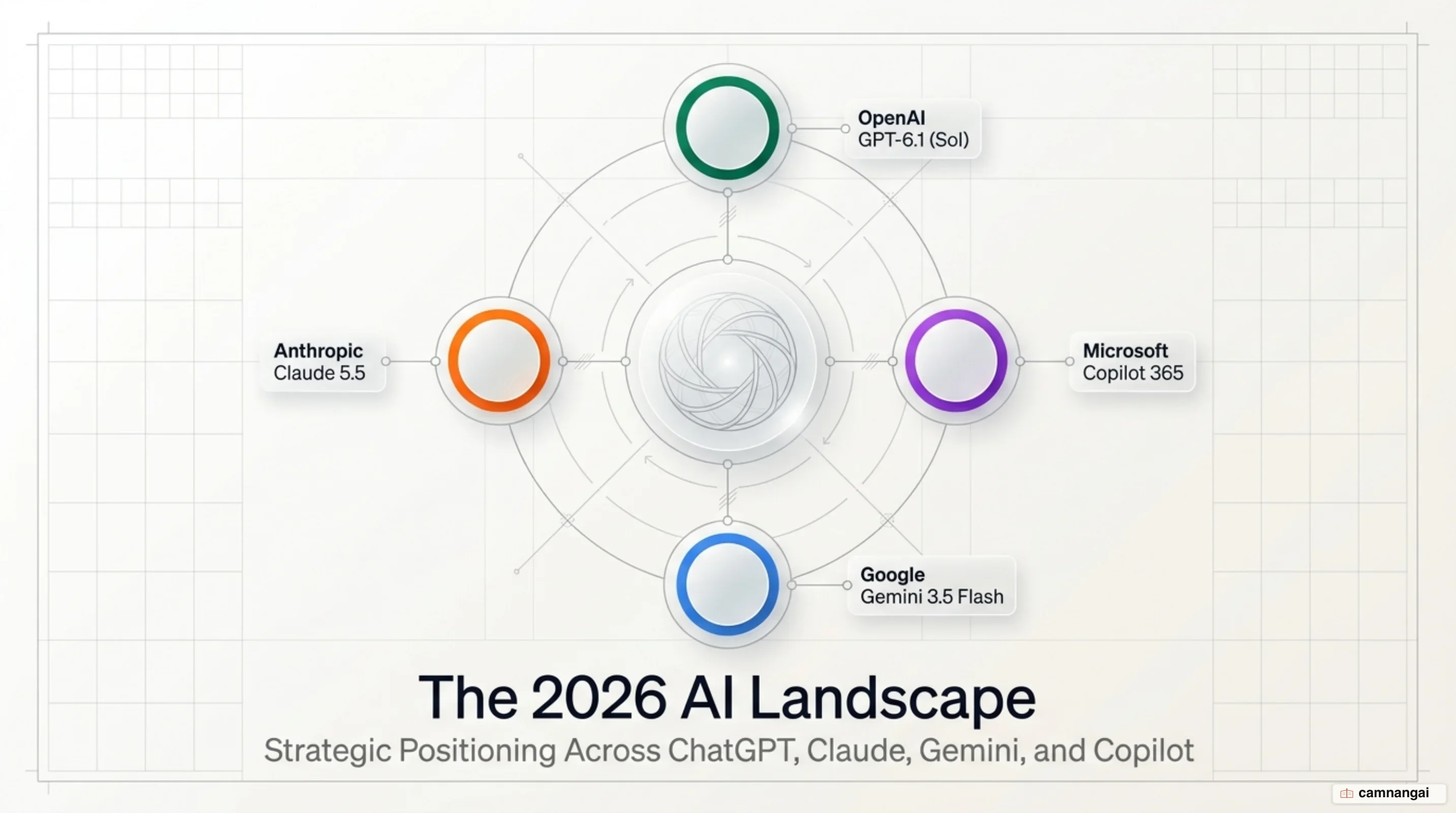
The 2026 Landscape: Why the Era of the Single All-in-One AI Is Over
Standard reasoning benchmarks across top-tier large language and multimodal models have largely flattened. Evaluating AI platforms purely on general intelligence yields diminishing operational returns. Engineering teams and enterprise administrators differentiate systems based on operational tooling—such as command-line terminal agents, IDE sidebars, headless browser runners, and integrated workspace extensions—rather than central chat interfaces.
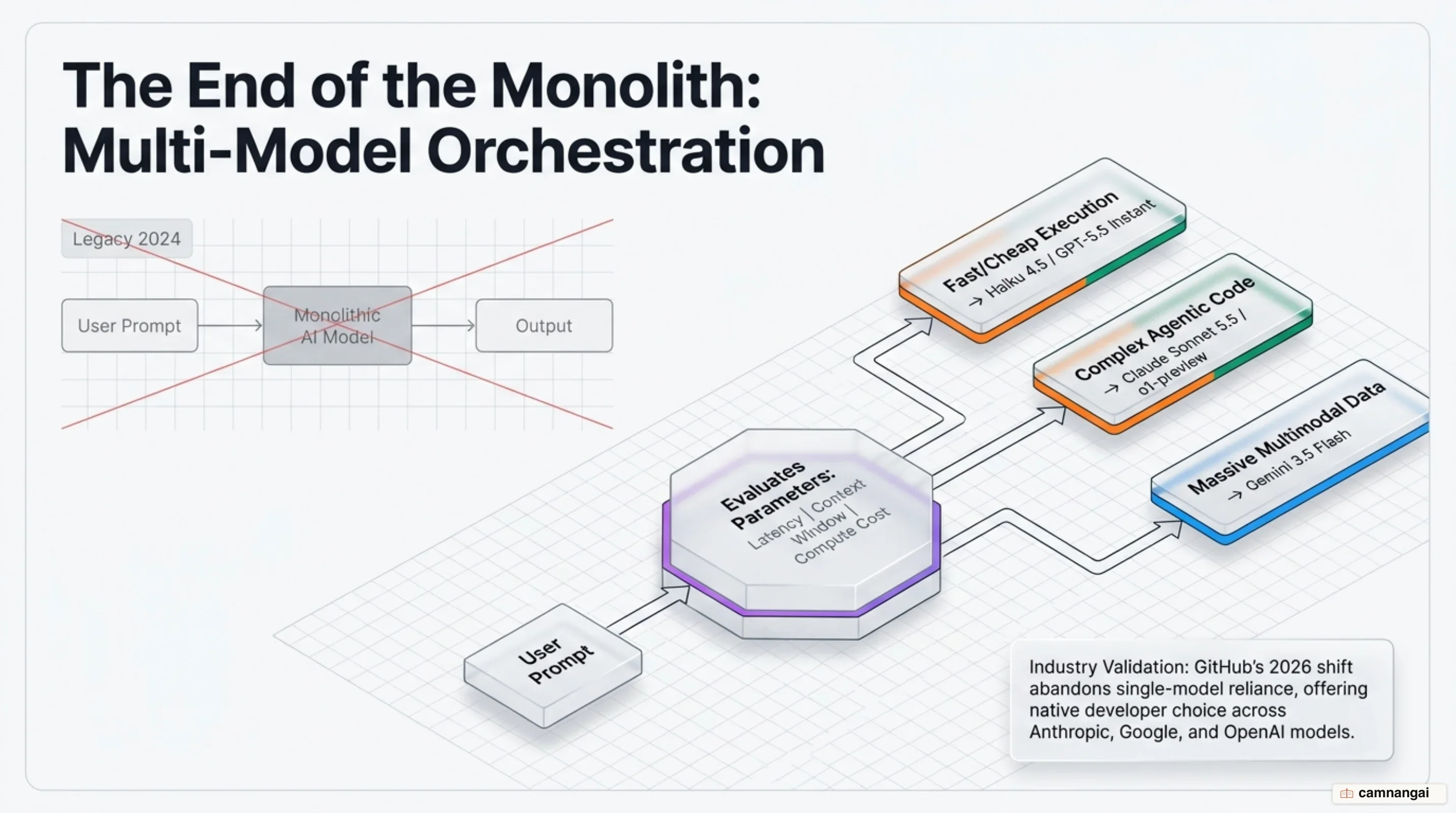
API pricing structures span several orders of magnitude, forcing organizations to build dynamic model routing into their software architectures. High-volume lightweight models handle bulk ingestion and classification tasks efficiently, while flagship reasoning models command premium compute budgets for complex mathematical and algorithmic verification. Balanced operational models fill the intermediate layer for daily code generation and technical documentation.
Usage caps on managed subscription tiers ($20/month Plus/Pro tiers versus $100–$500/month Pro/Max tiers offering higher rate limits) enforce hard throttle boundaries during sustained query loads. When continuous agent execution or batch document processing exhausts token allocations on one provider, unmanaged pipelines fail without resilient multi-provider fallbacks.
To maintain continuous execution and control compute costs, enterprise AI engineering teams deploy API proxy gateways with semantic routing middleware. These proxies dynamically route queries based on task complexity, falling back to cost-efficient tiers or switching providers entirely when rate limits are triggered. Splitting workloads across specialized systems is now mandatory for operational continuity.
Writing and Content Editing: Claude Retains the Crown for Natural Prose
For long-form prose generation, technical document editing, and refined creative drafting, Anthropic's Claude models consistently demonstrate higher prompt alignment and lower stylistic drift than competing platforms. Claude maintains structural tone constraints over extended multi-turn editing sessions without degrading into predictable synthetic phrasing. Built-in style management interfaces allow you to enforce deterministic constraints across custom writing profiles, such as corporate technical communications or informal developer documentation.
OpenAI's ChatGPT now handles document editing directly in the chat. In late May 2026, OpenAI removed the Canvas workspace from its new models, replacing it with writing blocks and code blocks inside the response itself. Since GPT-6 (October 2026), ChatGPT also picks the presentation format on its own, such as side-by-side comparisons, diagrams, or interactive tools inside the conversation. Recent GPT models have toned down the heavily bulleted layouts of earlier generations, but ChatGPT's default prose still leans toward executing instructions rather than acting as an exploratory editing partner, and it benefits from explicit style instructions.
Productivity-centric interfaces like Gemini's Visual Layout and Copilot's inline drafting within Microsoft Word focus on dynamic template population and document formatting rather than deep narrative synthesis. A notable functional constraint of the Claude platform is its complete lack of native image generation models. ChatGPT includes native visual asset generation, enabling integrated text and graphic generation within a single workspace, whereas Claude workflows require external API calls to third-party image generation models.
Coding and Software Engineering: The Battle Among Claude Code, Codex, and GitHub Copilot
Enterprise software development benchmarks highlight a clear operational divergence between standalone terminal agents and integrated developer environments. Claude Code—Anthropic's terminal-native agent tool—has emerged as a leading tool for autonomous, long-running codebase refactoring. Rather than serving purely as an inline autocomplete engine, Claude Code directly invokes system sub-processes, evaluates terminal output, executes test suites within local bash loops, and delegates sub-tasks across parallel sub-agent instances. To prevent token window saturation during multi-hour builds, Claude Code implements context compaction routines that summarize execution history before passing state to downstream agents.
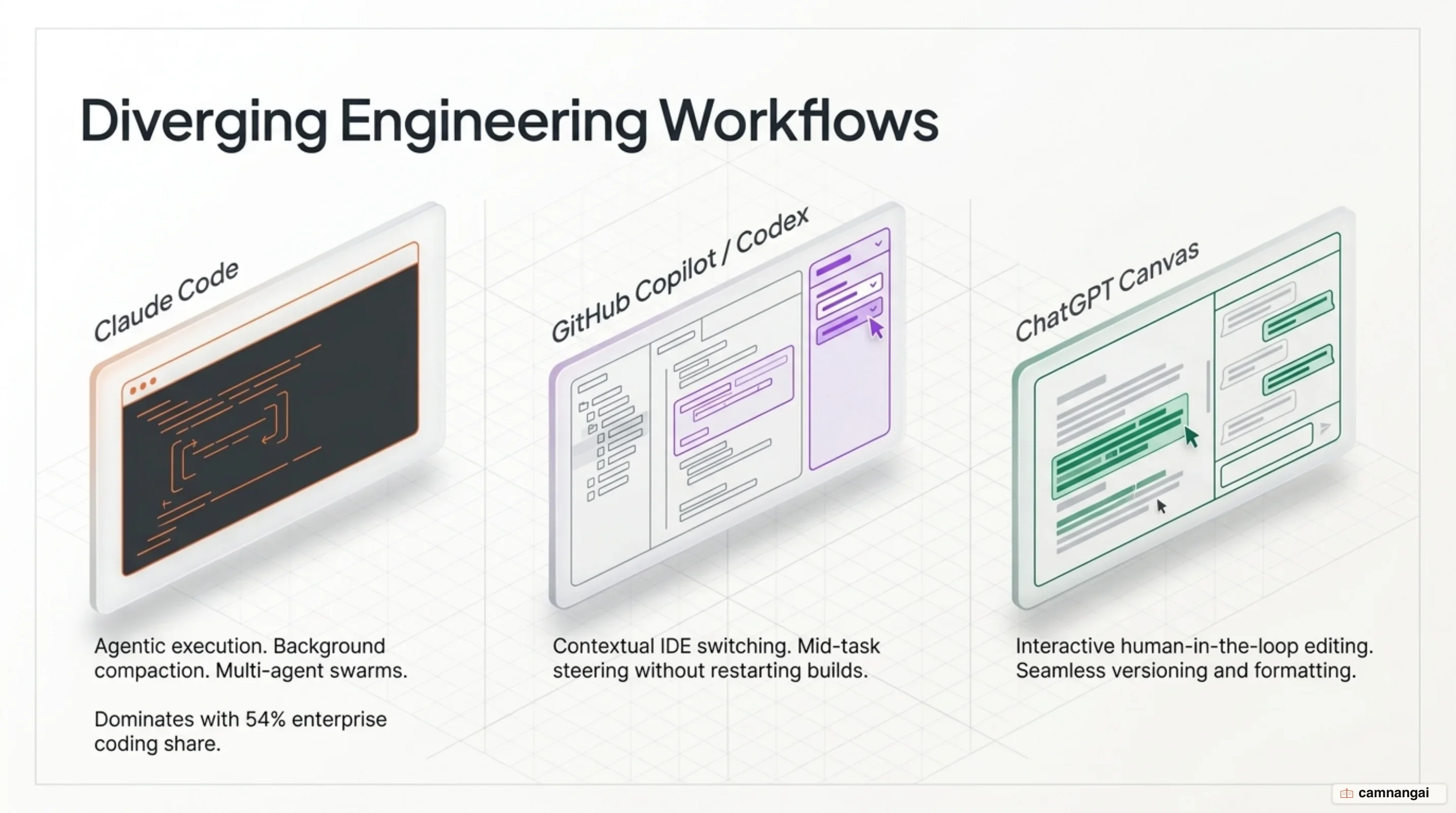
OpenAI targets software development through Codex, its dedicated coding agent, available in the ChatGPT app, in the terminal through the Codex CLI, and inside IDEs. Codex supports mid-task steering, letting developers interrupt and redirect the agent while it writes code without resetting the active task, and it can run tasks in the background in the cloud, returning its changes as a pull request for review.
For teams prioritizing model flexibility over vendor-specific terminal tools, GitHub Copilot provides a unified multi-model switcher. Developers can toggle between Anthropic's Claude Sonnet 5.5 and Opus 5.5, Google's Gemini 3.8 Flash, and OpenAI's GPT-6 family directly within VS Code, JetBrains IDEs, GitHub.com, and the Copilot CLI.
# Claude Code: pick the model and the auto-compact window for this session
claude --model opus --autocompact 500k
# GitHub Copilot CLI: launch it, then type /model in the session to switch models
copilot
Configuring these setups involves specifying context-compaction flags or explicitly routing tasks based on code complexity. Claude Code functions effectively as an autonomous software engineer substitute for multi-file refactoring, while GitHub Copilot acts as a multi-model extension layer within existing IDE environments.
Deep Research and Document Synthesis: Gemini's Long-Context Advantage
Processing large-scale technical documentation, repository archives, and unstructured media highlights the architectural design choices of Google's Gemini platform. Gemini 3.1 Pro and the latest Flash models provide native context windows of 1 million tokens. This massive context window allows you to load entire source-code repositories, multi-hour video streams, or high-density PDF libraries into a single prompt payload without pre-processing files through chunking or extraction layers.
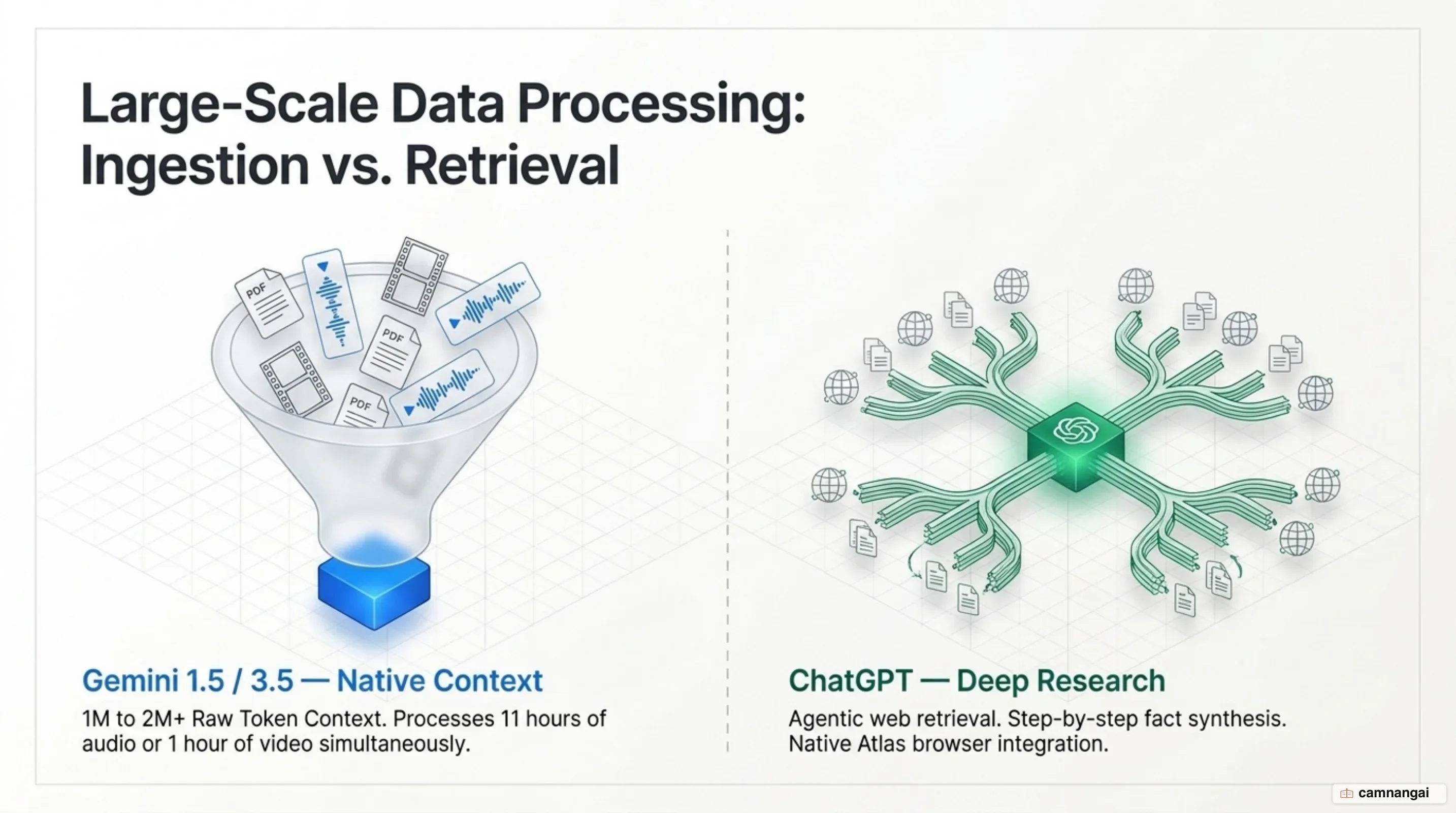
Direct ingestion of massive context windows eliminates traditional vector database indexing and pre-processing ETL pipelines. However, from an AI infrastructure perspective, brute-force context window ingestion introduces distinct operational trade-offs. Processing a million tokens in a single prompt generates high Time-To-First-Token (TTFT) latency and exponential compute costs due to attention scaling. Long-context models can also show retrieval degradation across dense token spaces if prompts lack precise structural anchors.
In contrast, OpenAI's ChatGPT Deep Research mode relies on an agentic retrieval architecture. Instead of ingesting millions of tokens upfront, Deep Research deploys sub-agents to perform iterative web crawling, targeted vector search, and recursive source verification. This approach minimizes context window overload and token processing costs, though it introduces processing delays while sub-agents execute web search loops.
User interface implementations reflect these differing backend architectures. Gemini provides a split-screen Visual Layout that renders live interactive widgets alongside direct, native file-retrieval hooks into Google Drive and Gmail. ChatGPT provides mid-stream prompt modification to adjust deep research parameters while agent loops execute. Claude uses modular workspace artifacts and interactive follow-up selection modules to structure complex document outputs.
Workplace Productivity and Ecosystem Lock-in: Microsoft 365 Copilot vs. Google Workspace
Enterprise productivity deployment is closely bound to existing cloud provider lock-in. Microsoft 365 Copilot is integrated directly across Windows, Word, Excel, PowerPoint, and Outlook. Available via individual subscriptions or enterprise add-ons, Copilot operates directly over the Microsoft Graph to analyze tenant spreadsheets, auto-generate slide decks, draft Outlook email responses, and execute operating system configurations.
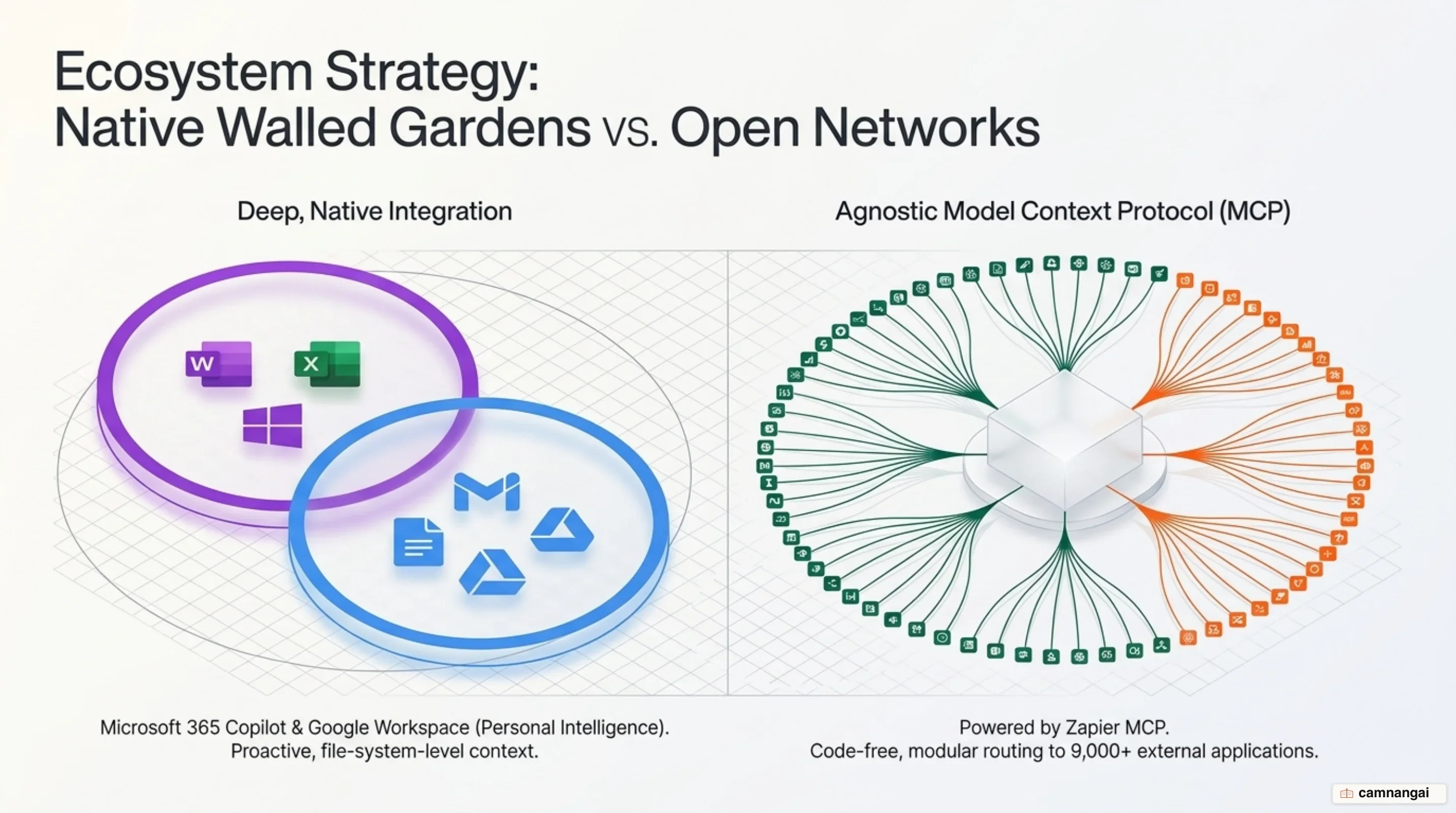
Google counters with Personal Intelligence inside Gemini, natively spanning Gmail, Docs, Drive, Maps, and YouTube. When enabled, Gemini references your historical search and communication data across Google services to auto-contextualize responses without requiring explicit file attachment. For enterprise background process automation, Copilot Studio provides custom agent development for internal systems, whereas Google's autonomous agent framework emphasizes workflow automation across Workspace apps.
ChatGPT lacks a proprietary enterprise office suite, but mitigates ecosystem lock-in through broad integration hooks. It supports native app connections across enterprise tools like SharePoint, OneDrive, Teams, GitHub, HubSpot, and Slack, and extends further through plugins and Model Context Protocol (MCP) integrations. ChatGPT's agent mode runs an isolated virtual browser to interact with web application interfaces, fill in forms, and execute tasks across third-party web portals, while ChatGPT Work (launched July 2026) takes on longer jobs, working across connected apps and files to produce finished documents, spreadsheets, and presentations. One caution: in September 2026 OpenAI announced plans to retire custom GPTs in favor of plugins, so teams that depend on GPTs should plan a migration.
Multimodal Capabilities and Complex Reasoning: Distinct Strengths Across Providers
Multimodal media synthesis reflects diverging core strategies among top AI vendors. Gemini provides an end-to-end media generation suite: video generation via Veo (featuring synchronized audio and character continuity), musical composition, and high-fidelity image generation. ChatGPT focuses on image generation (ChatGPT Images 2.5) and conversational multimodal interaction, while video lives in OpenAI's separate Sora app. Claude completely omits native image and video generation models, directing all visual compute toward input image analysis and diagram interpretation.
Voice interaction architectures show similar technical divergence. ChatGPT Voice handles natural spoken conversation and, since September 2026, can call on GPT-6 Astra to search or reason through harder questions, and even use plugins to get work done by speaking. Gemini Live combines real-time spoken dialogue with Google Search grounding, while Claude's voice mode offers spoken conversation across mobile, desktop, and web.
Complex technical reasoning relies on dedicated chain-of-thought model variants. OpenAI's GPT-6 models, with reasoning levels from Instant up to Extra High, excel at constraint satisfaction problems, edge-case evaluation, and formal logic validation. Anthropic's flagship models deliver high-tier analytical execution for autonomous system interaction and multi-step desktop automation. Gemini's specialized reasoning models offer solid logic execution, but trail OpenAI and Anthropic on edge-case code verification and deep software engineering tasks.
The Decision Matrix: How to Allocate Your AI Budget in 2026
Optimizing enterprise AI expenditures requires allocating subscription tiers based on functional execution profiles rather than blanket user licensing. Dedicated software development teams should be assigned Claude Pro ($20/month) or Claude Max ($100–$200/month) to run terminal-native Claude Code agents, or deployed on GitHub Copilot (Pro at $10/month, Pro+ at $39/month) to enable multi-model switching between Claude, Gemini, and OpenAI within the IDE. Organizations heavily committed to cloud office suites should equip workers with their native vendor plans—Microsoft 365 Premium ($19.99/month, which replaced the discontinued Copilot Pro), Microsoft 365 Copilot for business, or Google AI Pro ($19.99/month)—to maximize contextual access to internal file graphs.
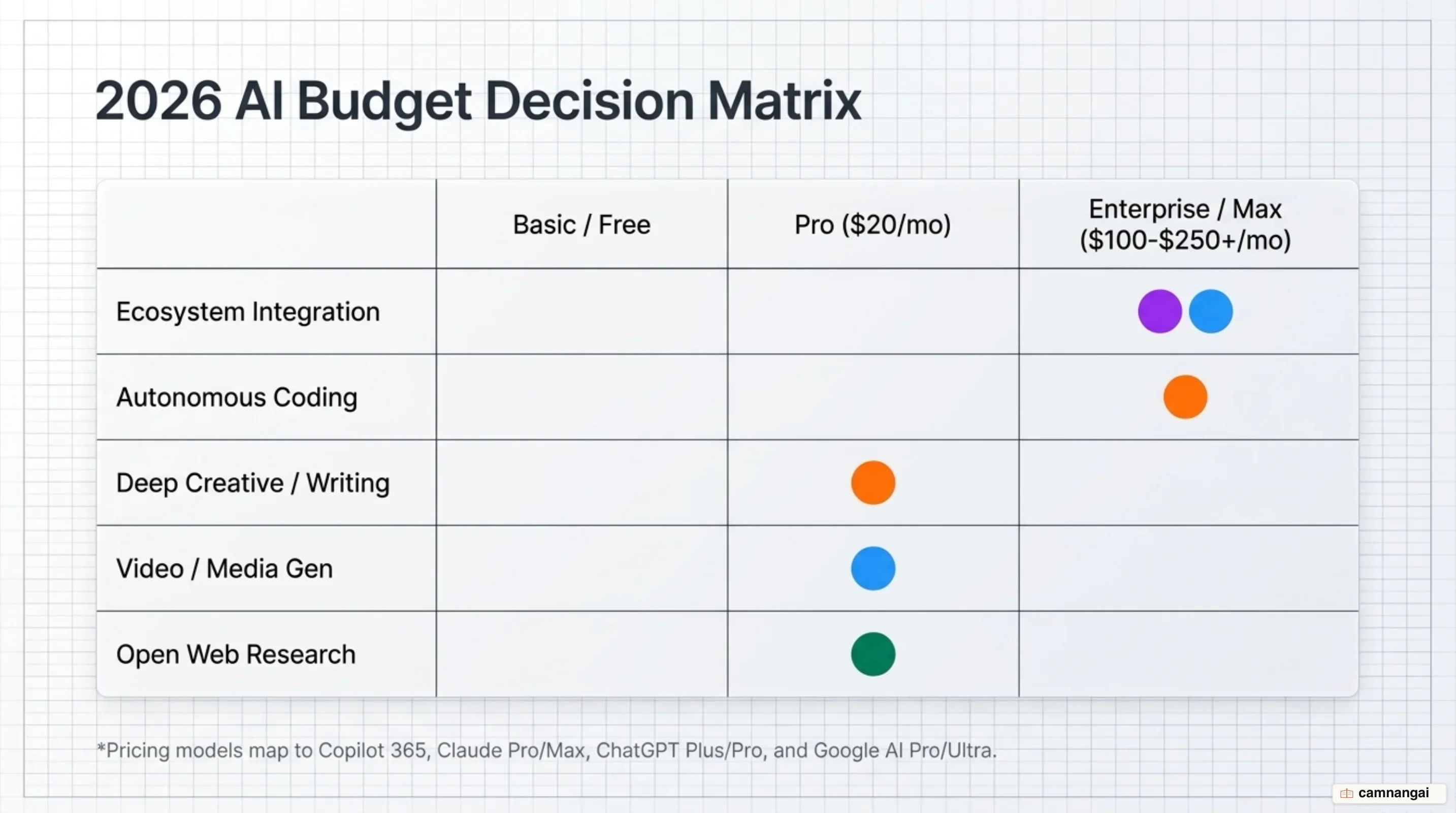
Operations teams, content strategists, and general research staff should use ChatGPT Plus ($20/month) or ChatGPT Pro ($100, $200, or $500/month) to access agent mode, ChatGPT Work, Codex, and multimodal asset generation.
As an operational architecture standard, engineering leaders should deploy internal API proxy gateways with semantic fallback rules. Routing routine queries to entry-level models and reserving flagship reasoning models for complex tasks controls spend while preventing workflow disruption when individual platform rate limits are reached.
References
- The best AI chatbots of 2026: Expert tested and reviewed — ZDNET
- Claude vs. ChatGPT: Which is best? [2026] — Zapier
- Copilot vs. ChatGPT: Which AI chatbot should you use? [2026] — Zapier
- Gemini vs. ChatGPT: What's the difference? [2026] — Zapier
- I tested ChatGPT vs. Claude to see which is better - and if it's worth switching — ZDNET
- Bringing developer choice to Copilot with Anthropic's Claude 3.5 Sonnet, Google's Gemini 1.5 Pro, and OpenAI's o1-preview — The GitHub Blog
- Introducing Gemini 1.5, Google's next-generation AI model — Google Blog
- ChatGPT release notes — OpenAI Help Center
- Supported AI models in GitHub Copilot — GitHub Docs
- Gemini Apps release notes — Google
- CLI reference — Claude Code Docs