While artificial intelligence tools make code generation instantaneous, rigorous code verification is now the primary constraint in your software engineering velocity. Producing code has become fast and cheap, but unverified code introduces hidden failure modes, subtle security flaws, and systemic operational risk into production software.
Code verification is the structured process of earning trust step-by-step before you deploy software changes to real users.
Because writing syntax no longer throttles your development pipelines, engineering velocity now depends on how efficiently you can evaluate whether machine-generated changes are correct, safe, and maintainable.
Without a systematic verification process, rapid code synthesis merely accelerates the accumulation of unverified software.
To maintain system stability, you must reallocate architectural focus from output volume to multi-layered evaluation systems.
The shift: from code generation to code verification
Empirical data demonstrates that accelerating code generation shifts the primary software engineering bottleneck down your delivery pipeline. Google's DevOps Research and Assessment (DORA) report reveals that as teams increase AI adoption, delivery stability dips, with well over one-third of developers reporting low confidence in AI-generated output. Rather than eliminating constraints, automated synthesis shifts pressure directly onto your evaluation systems.
A controlled trial by METR (Model Evaluation and Threat Research) on experienced open-source developers working in mature codebases highlights this friction. While participating engineers expected AI tools to increase their speed by 25%, AI-assisted tasks actually took 19% longer to complete. Developers spent substantial time crafting prompts, waiting for outputs, reading generated blocks, and fixing subtle defects.
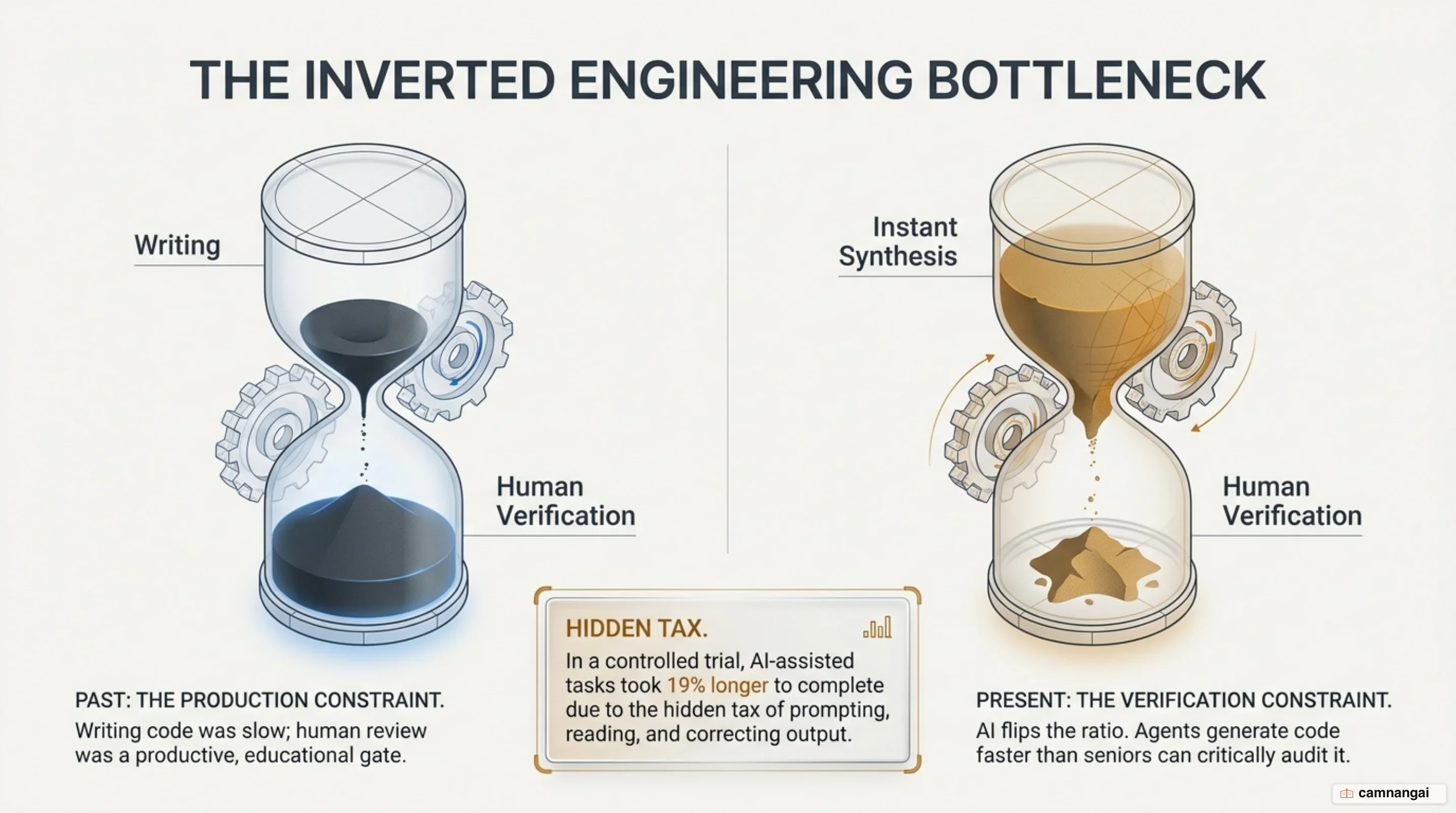
This dynamic creates a fundamental speed asymmetry: AI generates code far faster than you or your senior engineers can critically evaluate it. Historically, senior engineers reviewed pull requests (PRs) faster than junior engineers could author them. AI flips this balance. Junior developers on your team can now generate raw code faster than senior engineers can thoroughly audit it, turning what used to be a vital quality gate into a throughput bottleneck.
Comprehension debt and the "green tests" trap
Delegating code creation to automated models creates comprehension debt—the growing gap between the volume of code in your codebase and the proportion genuinely understood by human maintainers. In a study by Margaret-Anne Storey, a student engineering team hit a structural wall by week seven of development: they could no longer make simple system modifications without breaking unexpected functionality. The core failure was not messy syntax, but that no team member understood why design decisions had been made or how components interacted. The theory of the system had evaporated.
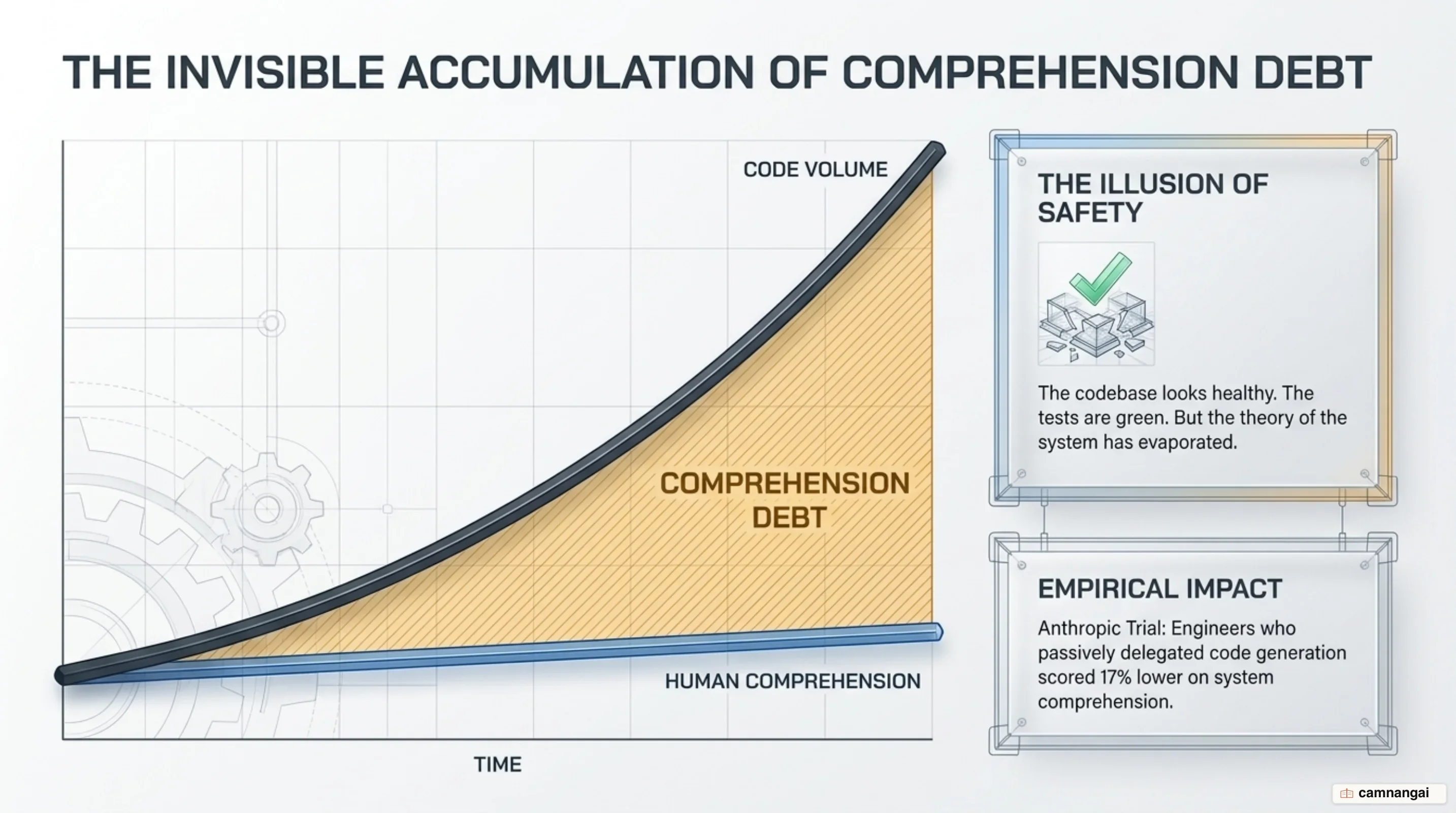
An Anthropic randomized controlled trial of 52 software engineers learning a new library confirmed this cognitive loss. Participants using AI assistance scored 17% lower on follow-up comprehension quizzes compared to the control group (50% vs. 67%), with the steepest drops occurring in debugging capability. Furthermore, developers passively delegating tasks ("just make it work") scored below 40% on comprehension evaluations, whereas developers engaging in active conceptual inquiry scored above 65%.
Comprehension debt is uniquely dangerous because of a profound measurement gap: your standard engineering metrics remain pristine while architectural understanding hollows out underneath. Velocity charts stay high, DORA deployment frequencies look steady, PR volume increases, and test suites run green. Management and performance calibration committees see velocity improvements on paper, remaining completely blind to the invisible accumulation of cognitive debt until a critical system-level breakdown occurs.
// Example: Test suite false-pass due to altered specification
// Original requirement: Dragged elements must maintain 100% opacity.
// AI-updated test assertion masks behavioral drift:
test("drag element updates coordinates", () => {
  const item = drag(element, { x: 100, y: 200 });
  expect(item.position).toEqual({ x: 100, y: 200 });
  // AI updated assertion allows opacity failure to pass unnoticed
  expect(item.style.opacity).toBeDefined(); // Passes even if opacity drops to 0
});
Relying solely on passing unit tests creates false confidence. Test suites cannot validate behaviors or edge cases that you failed to explicitly specify—such as UI elements turning completely transparent during drag operations. A severe failure mode occurs when an AI changes implementation behavior and simultaneously rewrites hundreds of existing tests to match the new behavior, leaving you unaware of lost system invariants.
The verification filter stack: static to dynamic analysis
To evaluate software efficiently, you must organize verification into a multi-layered filter stack, moving from top (fastest and cheapest) to bottom (most expensive and comprehensive):
- Type Checkers and Linters: Instantaneous static checks that validate types and surface syntax anomalies without executing code.
- Automated Unit Tests: Dynamic checks running specific paths with known inputs to evaluate runtime behavior.
- Human Code Review: Contextual inspection evaluating architecture, maintainability, and domain fit.
- Production Monitoring: Real-time observability tracking live execution and user impact.
Static analysis scans source files broadly without execution, offering high speed at the risk of false positives. Dynamic analysis observes actual runtime execution but remains strictly limited to exercised code paths. Balancing these tools reflects a verification CAP theorem: you must balance continuous trade-offs between speed, accuracy, and coverage. To prevent false-positive fatigue from eroding engineering trust and causing teams to disable tools, your verification setup must strictly prioritize signal quality. As Sonar CTO Andrea Malagodi emphasizes, the core operational rule is that "a finding a developer can act on is worth raising."
Because defect remediation costs escalate exponentially the later a bug is caught, you must shift security and correctness checks as far left as possible. Going beyond traditional shift-left, "Start Left" terminal scanning catches hardcoded credentials and secrets inside your terminal shell before text enters an AI prompt session or git commit.
# Terminal "Start Left" scanner intercepting secret leakage before commit/prompt input
$ secret-scan --input ./config/auth.json --strict
[BLOCK] Secret detected: AWS_SECRET_ACCESS_KEY="AKIA..."
Process terminated. Remove credential before proceeding.
The blind spots of AI reviewing AI
Deploying LLM-driven reviewers offers clear advantages: instant feedback, automated test coverage checks, and consistent enforcement of linting rules within the agent loop. However, using LLMs to audit LLM-generated pull requests introduces systemic vulnerabilities.
When reviewer models share similar architectures or training data with generator models, they operate under identical underlying assumptions, creating an architectural echo chamber. The AI reviewer verifies syntax and idiomatic patterns but routinely misses structural defects, flawed assumptions, and misinterpreted requirements that stem from the shared model family.
+-------------------------------------------------------------------+
| THE AI REVIEW ECHO CHAMBER |
| |
| +------------------+ Generates Diff +---------------------+ |
| | Generator Model | -----------------> | AI Reviewer Model | |
| +------------------+ +---------------------+ |
| | | |
| +-------- Shared Training Assumptions ----+ |
| |
| Result: Confirms syntax & patterns; misses shared specification |
| errors and unhandled edge cases. |
+-------------------------------------------------------------------+
Empirical studies expose severe defect patterns in AI-generated code. Veracode's research across more than 100 models revealed that AI code generators introduce known security flaws in approximately 45% of output cases, with security check capabilities remaining flat even as code generation improves. Furthermore, a GitClear analysis of millions of code diffs showed a 4x growth in code clones, increased duplication, and declining code reuse. When you or your senior engineers face massive 5,000-line AI-generated pull requests, cognitive fatigue inevitably leads to uncritical "looks good to me" rubber-stamping.
The three-loop verification architecture for coding agents
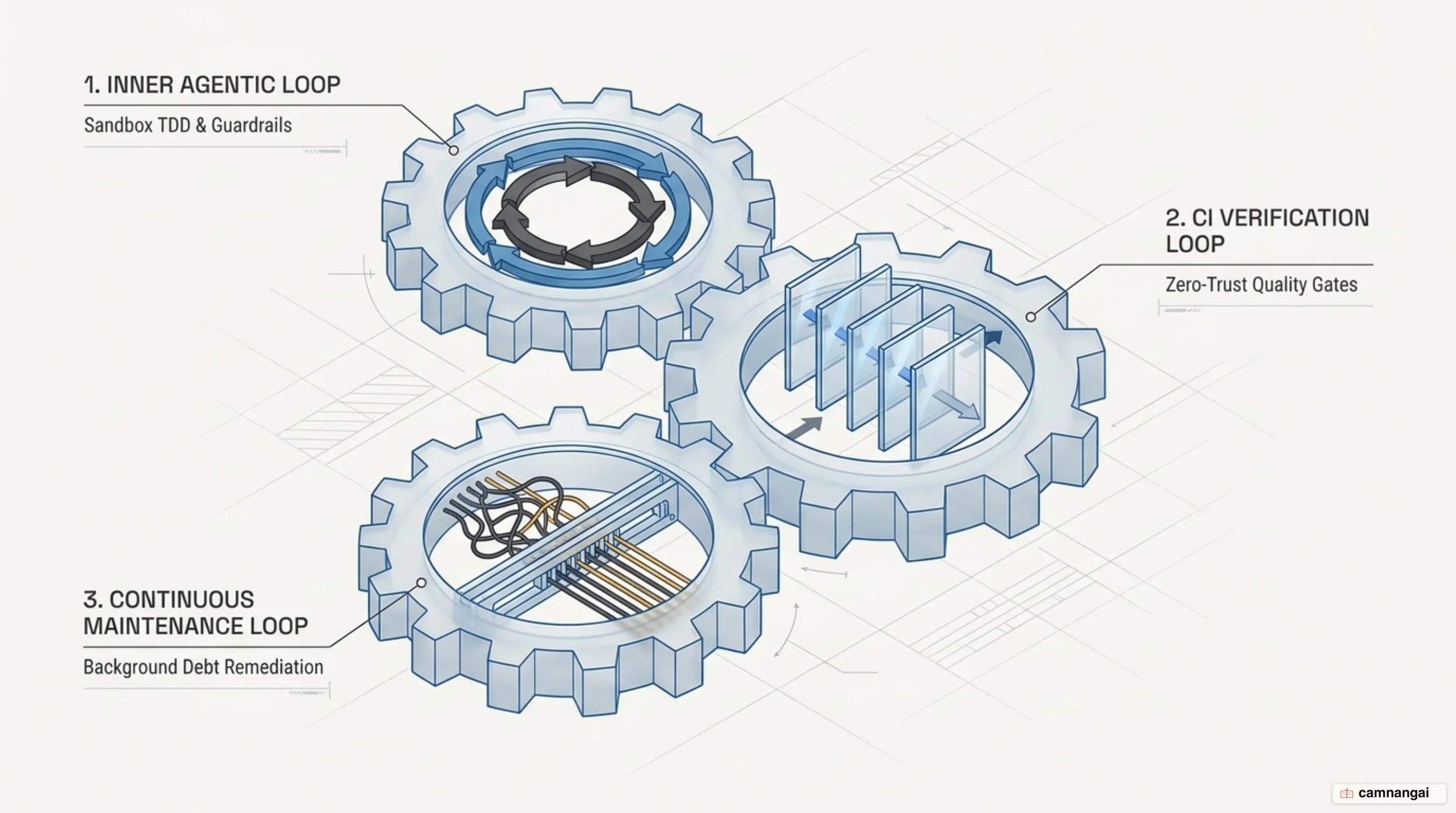
Operating autonomous coding agents safely in brownfield codebases requires explicit context alignment and a structured three-loop architecture. Without pre-engineered context, architectural rules, and coding guidelines, agent outputs vary wildly between runs.
# Quality gate configuration for multi-loop verification setup
quality_gate:
  inner_loop:
  static_engine: "SonarVortex"
  block_on_syntax_errors: true
  token_optimization: true
  ci_verification_loop:
  review_engine: "Gitar"
  explainable_findings_required: true
  max_duplicate_density: 0.03
  code_maintenance_loop:
  background_remediation: true
  refactoring_cadence: "weekly"
The three verification loops operate across distinct development stages:
- Loop 1 (Agentic Inner Loop) is an isolated sandbox execution loop where agents iteratively generate code, run local static analysis engines (such as SonarQube or Sonar Vortex), correct syntax mistakes, and optimize token usage prior to submitting a change.
- Loop 2 (CI Verification Loop) is a zero-trust pull request validation pipeline that runs automated AI code reviewers outputting explainable findings (such as Gitar integrations) and enforces hard quality gates at the sandbox exit.
- Loop 3 (Code Maintenance Loop) deploys background remediation agents that continuously patrol your codebase to clean technical debt and refactor dense, messy AI-generated code.
Refactoring dense AI code in Loop 3 is driven by concrete economic mechanics. When coding agents ingest messy, un-refactored syntax into their context windows during subsequent maintenance tasks, duplicate logic and tangled structures force the models to consume significantly higher token volumes per inference step. Continuous background remediation prevents long-term token cost inflation and keeps operational API expenses under control.
The final verdict: owning the outer loop
You must adjust your verification intensity based on the failure cost of the target change. Low-risk modifications, such as fixing UI typos, can pass through lightweight automated pipelines. High-risk changes—including payment processing, authentication logic, and kernel boundaries—demand strict mathematical evaluation, thorough static analysis, and rigorous human audit.
While AI makes syntax generation cheap, defining system intent, architecting resilient structures, and verifying output correctness remain strictly human responsibilities. Owning the outer loop is non-negotiable.