To succeed as an LLM engineer in 2027, you must move past shallow API scripts to build production-grade infrastructure: hybrid search pipelines, stateful workflows, centralized AI gateways, automated evaluation suites, and fine-tuned small language models.
Simple API calls inevitably break under real-world latency, cost, reliability, and security constraints.
Mastering these five hands-on projects provides the technical rigor you need to design resilient, deterministic platforms around non-deterministic .
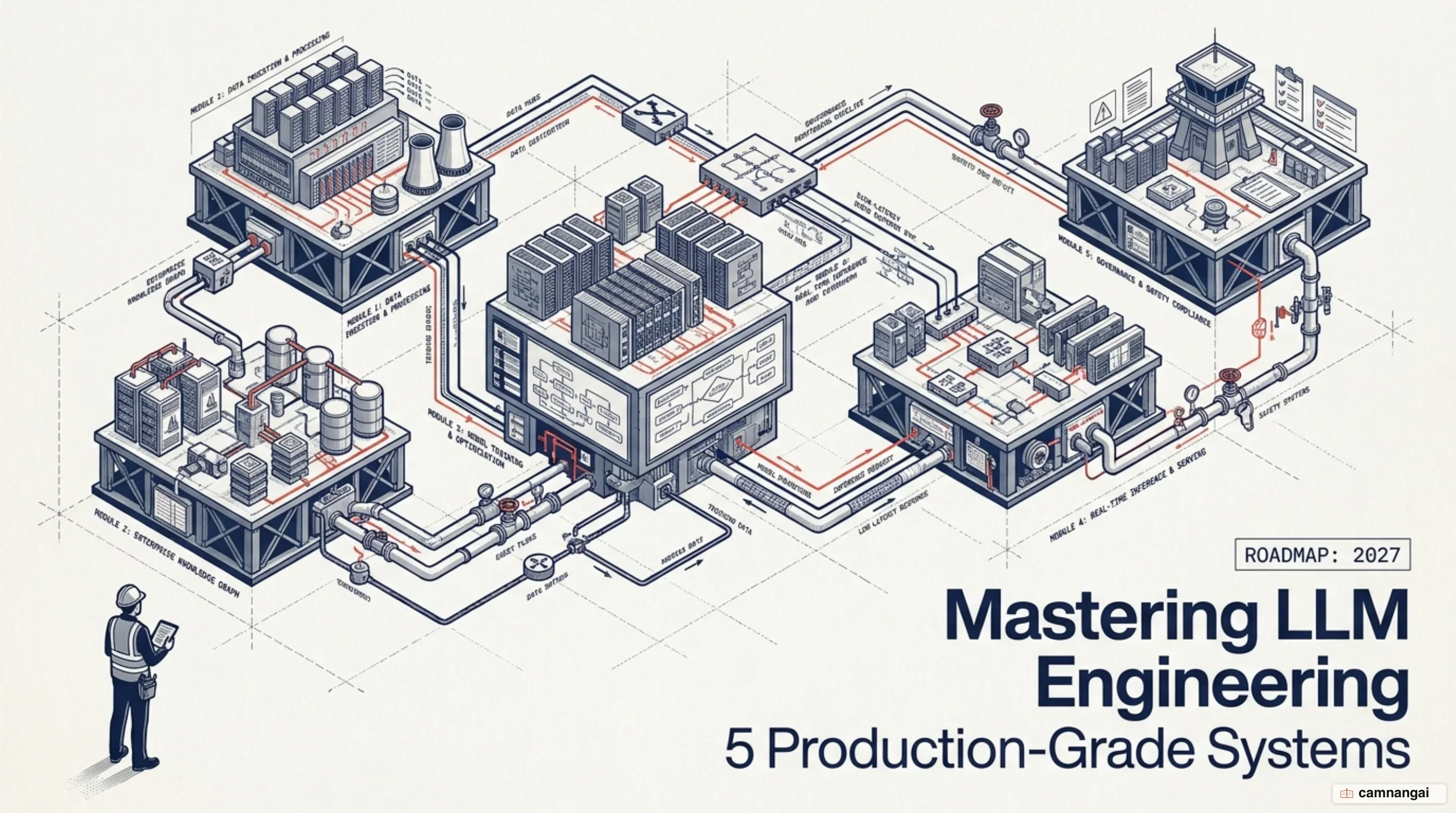
The Tutorial Hell Trap and the 2027 AI Engineer Hiring Standard
Passive learning through books, courses, or code walkthroughs will never build true production engineering capability. When you only read theory or run pre-packaged scripts, you gain a false sense of confidence that collapses when exposed to production edge cases. True engineering skills develop when you hit runtime failures, debug complex system integration bugs, resolve unexpected model drift, and glue disparate infrastructure components into an operational architecture. You forge capability by diagnosing why a production pipeline chokes under concurrent load or why a model outputs hallucinated generations under context pressure.
Basic API wrapper scripts lack the foundational software components required for enterprise deployment. If you send raw prompts directly to a foundation model API, your application operates without context augmentation, input and output , dynamic model routing, latency caching layers, or platform observability. Deploying a model without these surrounding control systems leaves your infrastructure vulnerable to excessive latency, unconstrained API costs, security breaches from attacks, and silent system failures driven by unvalidated generations.
As Andrej Karpathy observed, building a simple demo is easy, but turning it into a production product takes massive infrastructure rigor. Moving beyond basic script execution requires you to provide verifiable proof that you can manage complex engineering trade-offs between latency, throughput, compute cost, and system reliability. Enterprise hiring standards in 2027 demand that you demonstrate how to design deterministic execution control systems around non-deterministic language models, ensuring operational predictability across enterprise deployment environments.
Project 1: Production RAG with Hybrid Search, Reranking, and Graceful Refusal
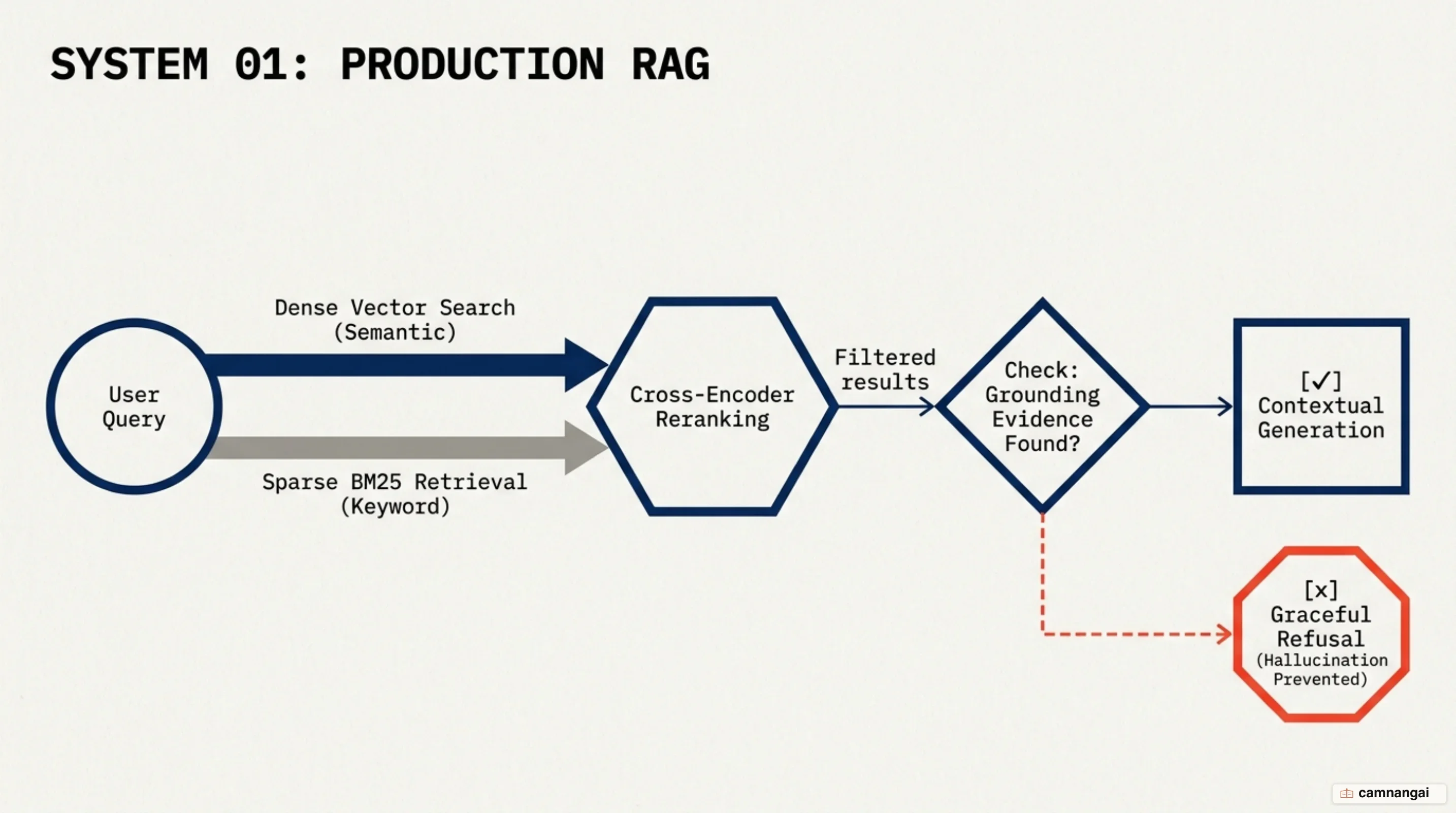
When you build Retrieval-Augmented Generation (RAG) systems, requires a dual-retrieval architecture. Term-based retrieval engines like BM25 and Elasticsearch rely on TF-IDF and inverted indices to execute fast, exact keyword matches across document collections. Conversely, dense vector search engines leverage approximate nearest neighbor (ANN) algorithms—such as FAISS, ScaNN, HNSW, and Annoy—to compute vector similarities across dense spaces. When staging vector retrieval, you must continuously balance four core vector index metrics: Recall, Queries Per Second (QPS), Build Time, and Index Size. High-throughput engines like Google's ScaNN can query a 2-trillion vector database in 10ms using euclidean L2 distance on BERT embeddings, but building and storing those indices demands substantial memory. To balance precision and compute, you must construct a two-stage sequential hybrid search pipeline: an initial term-based retriever rapidly fetches candidate documents, followed by vector search or cross-attention reranking to isolate the most semantically relevant context chunks.
Context arrangement directly governs model generation quality. Under the "Lost in the Middle" phenomenon (Liu et al., 2023), language models recall and process information placed at the precise beginning or end of a context window with far higher fidelity than information embedded in the middle. Beyond chunk positioning, your pipeline must resolve conversational context drift using query rewriting. Because multi-turn user queries frequently contain missing context or ambiguous pronouns, you must deploy an intent-classification model to perform identity resolution, transforming incomplete user inputs into explicit, standalone search queries before querying your index.
Handling structured tabular data and unanswerable queries demands specialized logic paths. For structured targets such as SQL tables or dataframes, you must implement Text-to-SQL workflows: dynamically inspecting table schemas, translating natural language into validated SQL queries, executing the query against the database, and synthesizing the resulting dataset into the output. When retrieved context lacks the answer, your architecture must force a graceful refusal rather than allowing the model to fabricate data. To systematically validate this behavior, implement Abhishek Pan's pre-building testing protocol: draft 20 specific test questions mapped directly to exact document pages and sections before building your user interface. This diagnostic dataset isolates system errors, proving whether a generation failure stems from a retrieval miss in the vector store or a context reasoning failure in the language model.
Project 2: Stateful Multi-Agent Workflows with Guardrails and Human-in-the-Loop
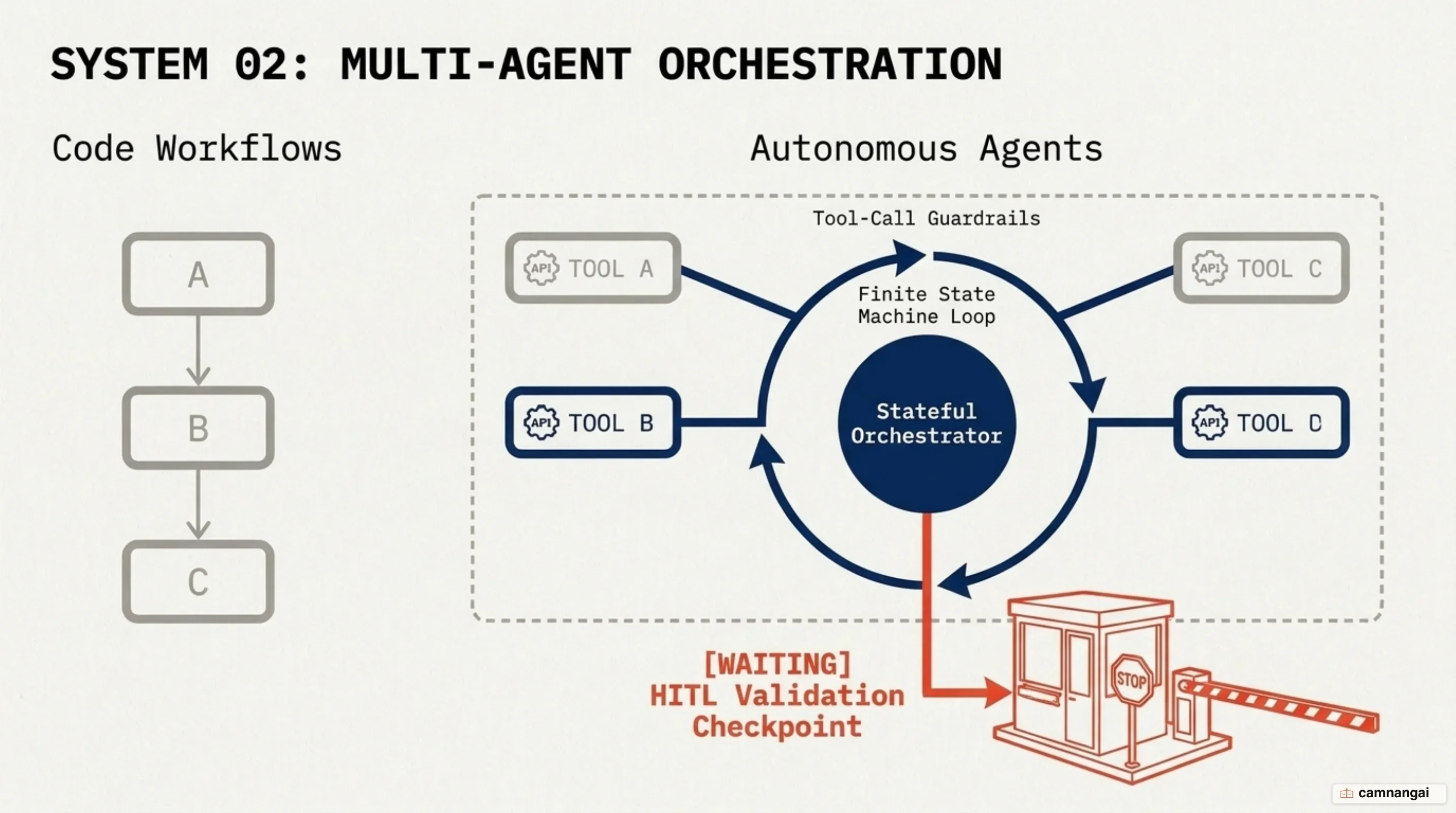
When you engineer agentic systems, you must draw a strict boundary between deterministic workflows and autonomous agents. Workflows orchestrate language models and execution tools through predefined, hardcoded code paths to maintain absolute execution control. Autonomous agents, by contrast, empower language models to dynamically evaluate environmental feedback, construct multi-step execution plans, select tools, and govern loop termination independently.
You construct production agentic architectures by composing five foundational building blocks. Prompt Chaining breaks complex tasks into sequential steps, executing programmatic gate checks to validate intermediate outputs before proceeding. Routing utilizes intent classification models to direct inputs to specialized prompts or downstream models. Parallelization splits execution across simultaneous paths using either Sectioning—dividing independent subtasks, such as running input guardrails parallel to core response generation—or Voting, which runs identical prompts across multiple instances to achieve consensus or filter out anomalous outputs. Orchestrator-Workers uses a central model to dynamically decompose tasks, delegate sub-problems to worker models, and synthesize results. Evaluator-Optimizer establishes an iterative loop where a generator model produces output while a secondary evaluator model provides targeted critique for continuous refinement.
System safety demands robust input and output guardrails. Input guardrails sanitize incoming requests by detecting and masking personally identifiable information (PII) using reversible dictionary mappings, blocking prompt injection and jailbreak attempts, and filtering restricted topics. Output guardrails inspect generations for structural compliance, validating outputs against JSON schemas or regex patterns via constrained sampling tools. Furthermore, output guardrails evaluate responses for empty payloads, toxicity, sensitive data regurgitation, and factual hallucinations using specialized scoring models or fact-checking evaluators.
Tool integration requires a strict operational division between read-only actions and write actions. Read-only actions, such as document retrieval or database queries, gather context without altering external environment state. Write actions—such as executing database updates, executing bank transfers, or sending external emails—modify real-world state and introduce system risks. To prevent unintended modifications caused by prompt injections or model hallucination, you must gate all high-risk write actions behind human-in-the-loop approval checkpoints, pausing system execution to require explicit human verification when actions alter external databases or when user sentiment analysis detects escalation.
Project 3: AI Gateway with Dynamic Routing, Semantic Caching, and Cost Governance
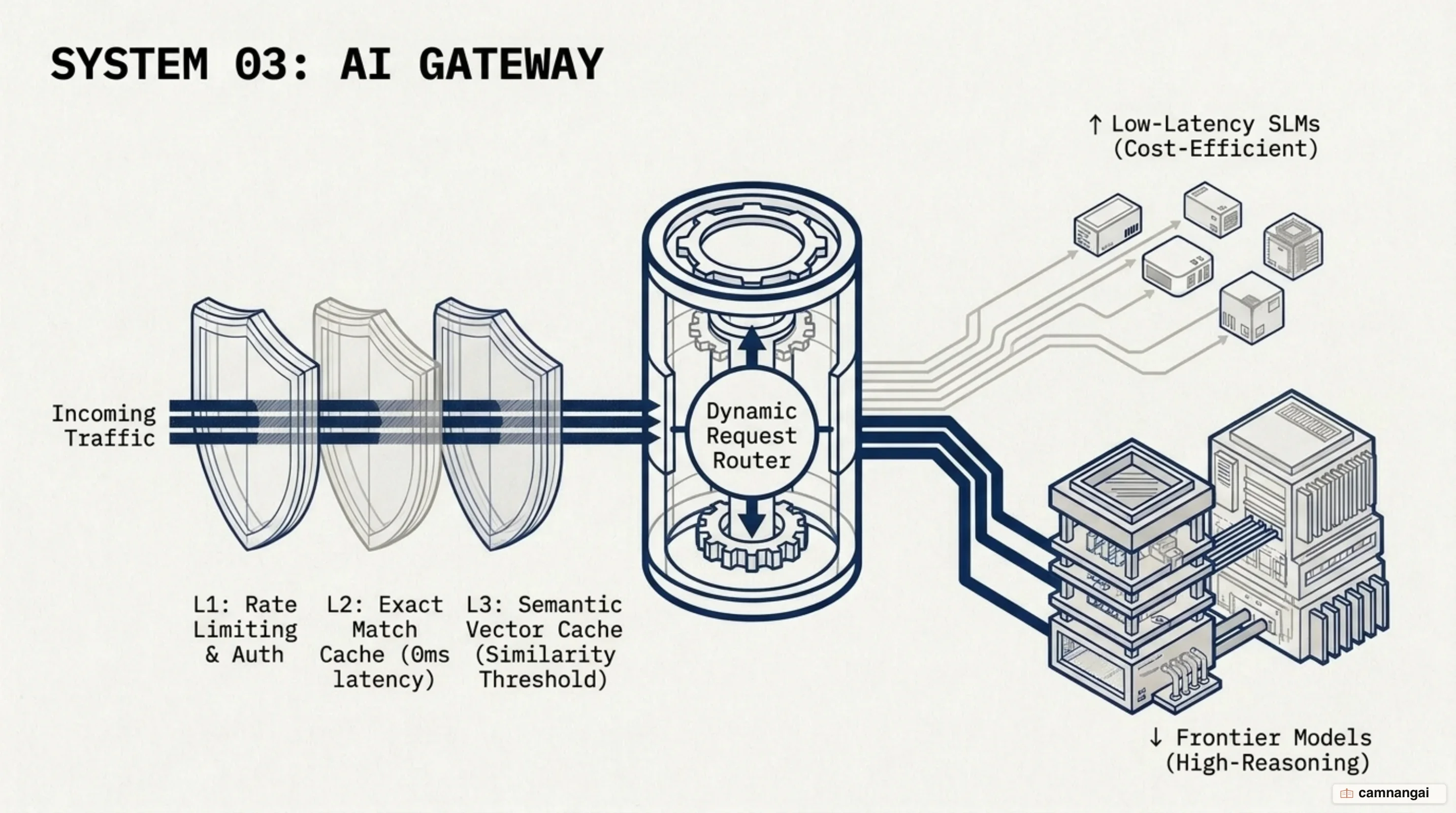
A centralized AI Gateway operates as an abstraction layer between application services and external model providers. Your gateway standardizes provider interfaces, presenting a unified API wrapper across commercial services like OpenAI and Gemini alongside self-hosted open-weights endpoints. Beyond interface unification, the gateway enforces centralized access control, manages API tokens, balances traffic across model clusters, and executes automated fallback policies to gracefully mitigate provider rate limits, timeouts, or service outages.
Dynamic model routing optimizes infrastructure expenditure by directing queries based on task complexity. An intent classifier and next-action predictor evaluate incoming prompts to determine required reasoning depth. Simple queries are routed to compact, low-cost models like Claude Haiku 4.5, while complex reasoning tasks escalate to high-capacity models like Claude Sonnet 4.5. When routing prompts across models with varying context boundaries, your gateway dynamically truncates or expands context payloads to remain within target token limits without dropping critical system instructions.
Latency and cost optimization rely on three distinct caching strategies. Prompt Caching reuses the Key-Value (KV) attention states of static system prompts and long context documents. For instance, caching a 1,000-token system prompt across 1,000,000 daily API calls saves approximately 1 billion input tokens per day at a 75% context caching discount, offset only by a small storage fee ($1.00 per 1 million tokens per hour). Exact Caching uses Redis or in-memory key-value lookups to instantly return responses for identical prompt strings. Semantic Caching embeds incoming queries and queries a vector database to fetch cached answers for historical prompts matching within a strict similarity threshold. However, semantic caching carries significant operational risks: vector search introduces computational overhead, and improperly tuned similarity thresholds risk returning invalid, out-of-context answers to your users.
Governing an enterprise AI platform requires tracking real-time performance and financial telemetry. Your gateway must continuously capture model performance metrics alongside traditional application uptime and compute memory usage. Essential operational metrics include Time to First Token (TTFT) to measure initial latency, Time Between Tokens (TBT) to measure streaming stability, Tokens Per Second (TPS) to evaluate generation throughput, and Time Per Output Token (TPOT) to calculate individual token generation speeds. Tracking total input and output token volume against provider rate limits ensures cost predictability across multi-tenant production environments.
Project 4: Automated Evaluation Suite and CI-Gated Regression Harness
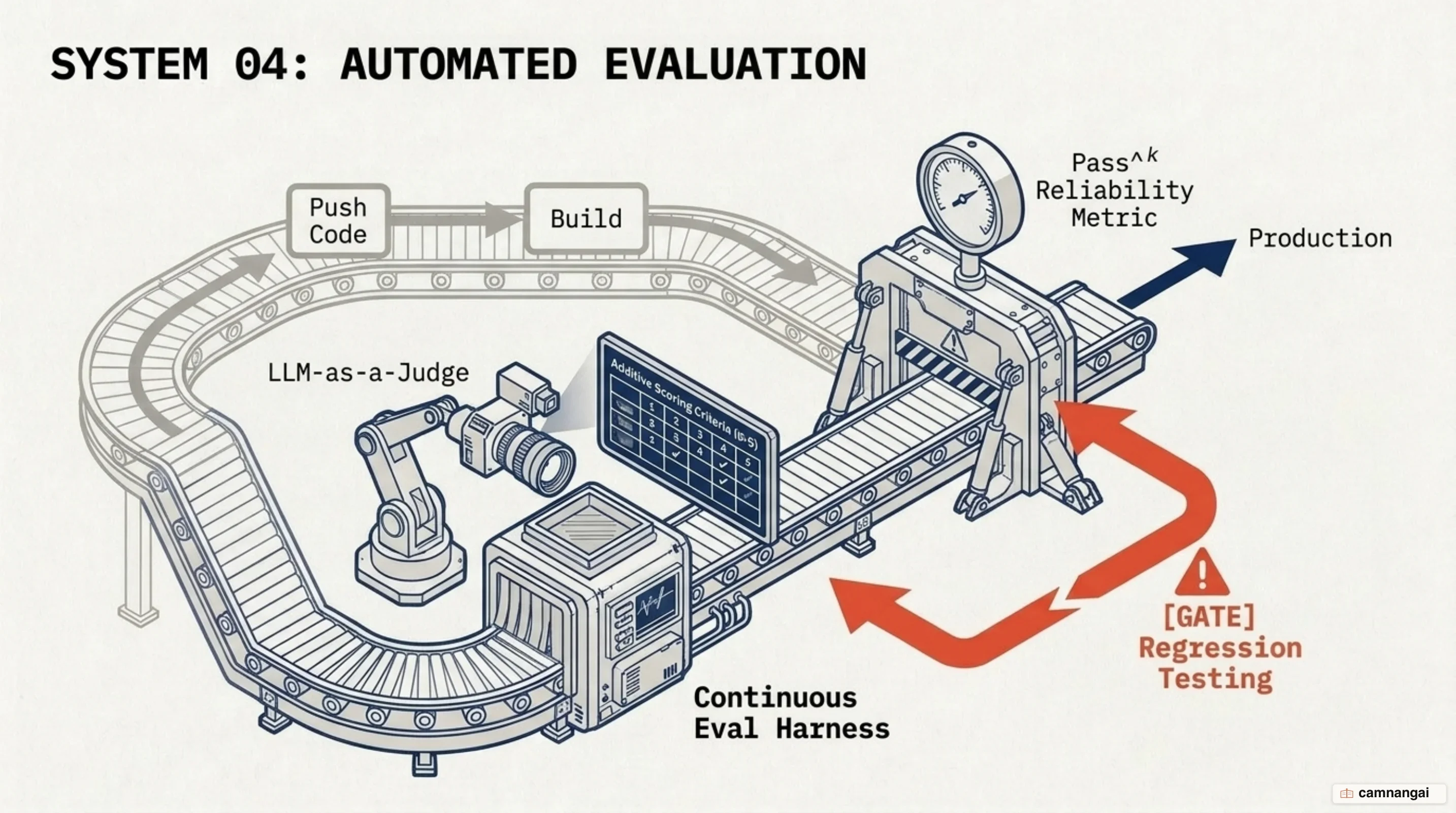
To build a reliable evaluation pipeline, you must implement LLM-as-a-Judge systems anchored in structured prompt engineering. Evaluation prompts must enforce explicit additive scoring scales (such as 0–3 or 0–5 point criteria), requiring the judge model to award distinct points for specific quality criteria like context adherence or completeness. Your evaluation prompts must require step-by-step Chain-of-Thought (CoT) reasoning, force outputs into strict JSON schemas containing explicit reasoning and total score fields, and incorporate domain-specific few-shot anchor examples representing 0-score, 1-score, and 3-score baselines to align automated scoring with expert human judgment.
Conventional machine learning metrics fail when applied to open-ended generative tasks. Classical n-gram matching metrics like BLEU (precision-based with a brevity penalty) and ROUGE (recall-based, including ROUGE-N, ROUGE-L longest common sequence, and ROUGE-S skip-bigram) exhibit poor correlation with human evaluations of fluency and factual accuracy. A meta-analysis across 2,000 studies demonstrated that ROUGE scores were notoriously difficult to reproduce due to unstandardized implementations across libraries. Embedding metrics like BERTScore and MoverScore improve semantic matching, but model-based judges like G-Eval evaluate complex criteria such as coherence, factual consistency, and contextual relevance far more reliably.
Deploying an LLM judge requires explicit engineering to neutralize inherent model biases. Position bias—the tendency of a model to favor the first presented response in pairwise evaluations—is neutralized by running evaluations twice while swapping option order. Verbosity bias—where models favor wordier completions regardless of quality—is mitigated by length-normalizing candidate outputs prior to scoring. Self-enhancement bias—the propensity of a model to award higher scores to its own generations—is eliminated by ensuring the judge model is distinct from the generator model being evaluated.
You must integrate automated evaluation harnesses directly into continuous deployment pipelines. By utilizing asynchronous execution clients like AsyncOpenAI configured with concurrency semaphores, your harness can score hundreds of benchmark samples in parallel. Integrating these evaluation runners into Continuous Integration (CI) workflows creates an automated regression gate: if a prompt modification or model update causes evaluation scores on golden benchmark datasets to drop below defined acceptance thresholds, the build fails and deployment is automatically blocked.
Project 5: Domain-Specific Small Language Model (SLM) Fine-Tuning and Inference Optimization
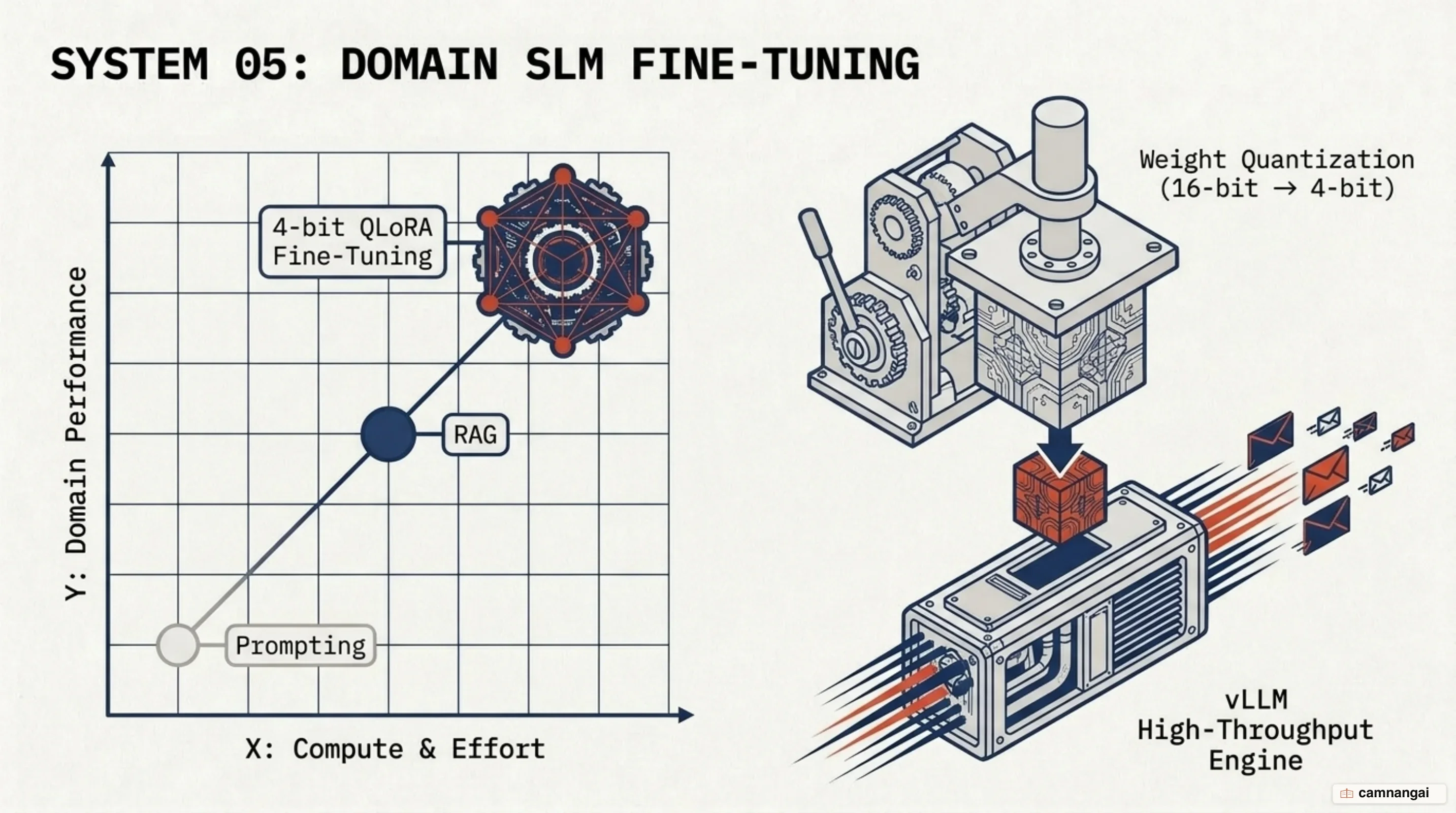
Model customization spans a spectrum of paradigms tailored to specific data and infrastructure constraints. Continued Pre-training applies unsupervised next-token prediction to raw domain corpora to expand foundational model knowledge. Instruction Fine-Tuning adapts pre-trained base models to follow task directions using formatted prompt-response datasets. Single-Task Fine-Tuning optimizes a model for narrow capabilities like classification or entity extraction. Parameter-Efficient Fine-Tuning (PEFT) updates a fraction of model parameters, reducing training memory requirements while avoiding the alignment tax where fine-tuning degrades broad baseline capabilities.
Modern PEFT mechanisms drastically lower hardware barriers for fine-tuning open-weights models. Techniques like Soft Prompt Tuning, Prefix Tuning, and Adapters insert trainable parameters into input embeddings or transformer layers while keeping base model weights frozen. Low-Rank Adaptation (LoRA) decomposes weight update matrices into low-rank representations, capitalizing on the low intrinsic dimension of model adaptation. QLoRA advances this efficiency by quantizing frozen base model weights into 4-bit NormalFloat (NF4), executing double quantization to compress quantization constants, and leveraging paged optimizers to manage memory spikes. These innovations reduce the VRAM required to fine-tune a 65B parameter model from over 780GB to just 48GB without degrading predictive performance.
Fine-tuning compact open models (7B parameter models such as Falcon-7B, Flan-T5, BERT, or RoBERTa) provides distinct operational advantages over relying exclusively on commercial cloud APIs. Hosting custom fine-tuned small models ensures complete data privacy and PII compliance by keeping sensitive enterprise data within your internal network. Small open models eliminate third-party API rate limits, reduce per-token operational costs at scale, give you full control over deployment infrastructure, and bypass restrictive commercial alignment filters that can interfere with domain-specific tasks.
Optimizing fine-tuned models for real-time production serving requires post-training inference modifications. Your serving engine must implement Key-Value (KV) caching to avoid recomputing attention states for historic tokens across generation steps. Batch inference techniques combine concurrent requests to maximize GPU compute utilization. Trimming context window limits to the minimal viable size reduces memory overhead, while model quantization converts 16-bit weights to 8-bit or 4-bit representations, accelerating token throughput and lowering serving latency on production endpoints.
Engineering Standards That Turn Personal Projects into High-Signal Hiring Proof
Transforming personal software repositories into high-signal engineering portfolios requires enforcing enterprise observability standards. You must implement the full observability triad: Logging, Traces, and Metrics. Structured logging requires tagging system configurations, input prompts, intermediate tool states, and raw model outputs in JSON format. Tracing visualizes the complete execution path of a request across downstream components, utilizing tools like LangSmith to reveal step-by-step latency breakdowns and component costs. System metrics track uptime, memory usage, and API throughput, while model metrics monitor real-time toxicity, hallucination rates, and task accuracy over time.
Tool development within agentic systems demands rigorous Agent-Computer Interface (ACI) engineering. Applying Human-Computer Interface principles to tool design requires providing explicit tool descriptions and complete parameter docstrings to instruct the model on valid tool usage. You must avoid formatting overhead by choosing native text or markdown interfaces over deeply nested JSON strings that force the model to handle heavy newline (\n) and quote (\") escaping, giving the model space to "think" before generating constrained output. Implement poka-yoke (mistake-proofing) principles to constrain arguments and prevent predictable errors—such as forcing tools to accept absolute filepaths exclusively, eliminating path resolution failures caused by relative directory navigation.
Defensive UX patterns protect system reliability by gracefully managing probabilistic model failures. Your user interfaces must set accurate user expectations by displaying clear operational disclaimers, presenting multi-option completions when generation confidence is low, providing explicit attribution citations for retrieved information, and enabling one-click dismissal of automated suggestions. Your system must capture explicit user feedback (thumbs up/down ratings) alongside implicit interaction signals (accepting, editing, or ignoring generated outputs) to build continuous data flywheels that fuel downstream evaluation suites and model fine-tuning runs.
Where to Begin: A 3-Month Implementation Roadmap from Idea to Production
Month 1 focuses on building foundational context retrieval alongside systematic evaluation infrastructure. You will implement Project 1 (Production RAG with Hybrid Search) and Project 4 (Automated Evaluation Suite). Build the term-based and vector retrieval pipelines, implement sequential reranking, and set up multi-turn query rewriting. Crucially, establish golden evaluation benchmark datasets and deploy an LLM-as-a-Judge pipeline before attempting to optimize retrieval prompts. Establishing objective evaluation harnesses early eliminates reliance on "vibe-checking" and provides a reliable baseline for measuring system regressions throughout the rest of your build.
Month 2 focuses on runtime governance, cost control, and execution safety. You will build Project 2 (Stateful Multi-Agent Workflows with Guardrails) and Project 3 (AI Gateway). Construct multi-agent workflow patterns (Prompt Chaining, Routing, Orchestrator-Workers, Evaluator-Optimizer), enforce input PII masking via reversible dictionaries, validate output schemas, and integrate human-in-the-loop checkpoints for state-modifying write actions. Concurrently, deploy your AI Gateway to centralize model provider management, configure intent-based routing to steer simple queries to cheap models like Claude Haiku 4.5 versus Claude Sonnet 4.5, and deploy prompt, exact, and semantic caching layers.
Month 3 executes domain specialization, platform hardening, and continuous deployment automation. You will execute Project 5 by fine-tuning an open-weights Small Language Model (such as Falcon-7B or Flan-T5) using QLoRA, applying 4-bit NF4 quantization, double quantization, and paged optimizers to manage memory spikes. Hardening your platform requires deploying full observability tooling (structured logs, LangSmith traces, model quality metrics), integrating defensive UX feedback channels, and embedding your automated evaluation harness into CI/CD pipelines to block regressions prior to production releases.
References
- Build These 5 Projects to Master LLM Engineering in 2027 — Javarevisited
- Patterns for Building LLM-based Systems & Products — Eugene Yan
- Your AI Product Needs Evals — Hamel Husain
- Building Effective Agents — Anthropic Research
- Building A Generative AI Platform — Chip Huyen
- LLM Evaluation doesn't need to be complicated — Philipp Schmid
- Projects That Actually Land AI Jobs — Landed AI (GitHub)