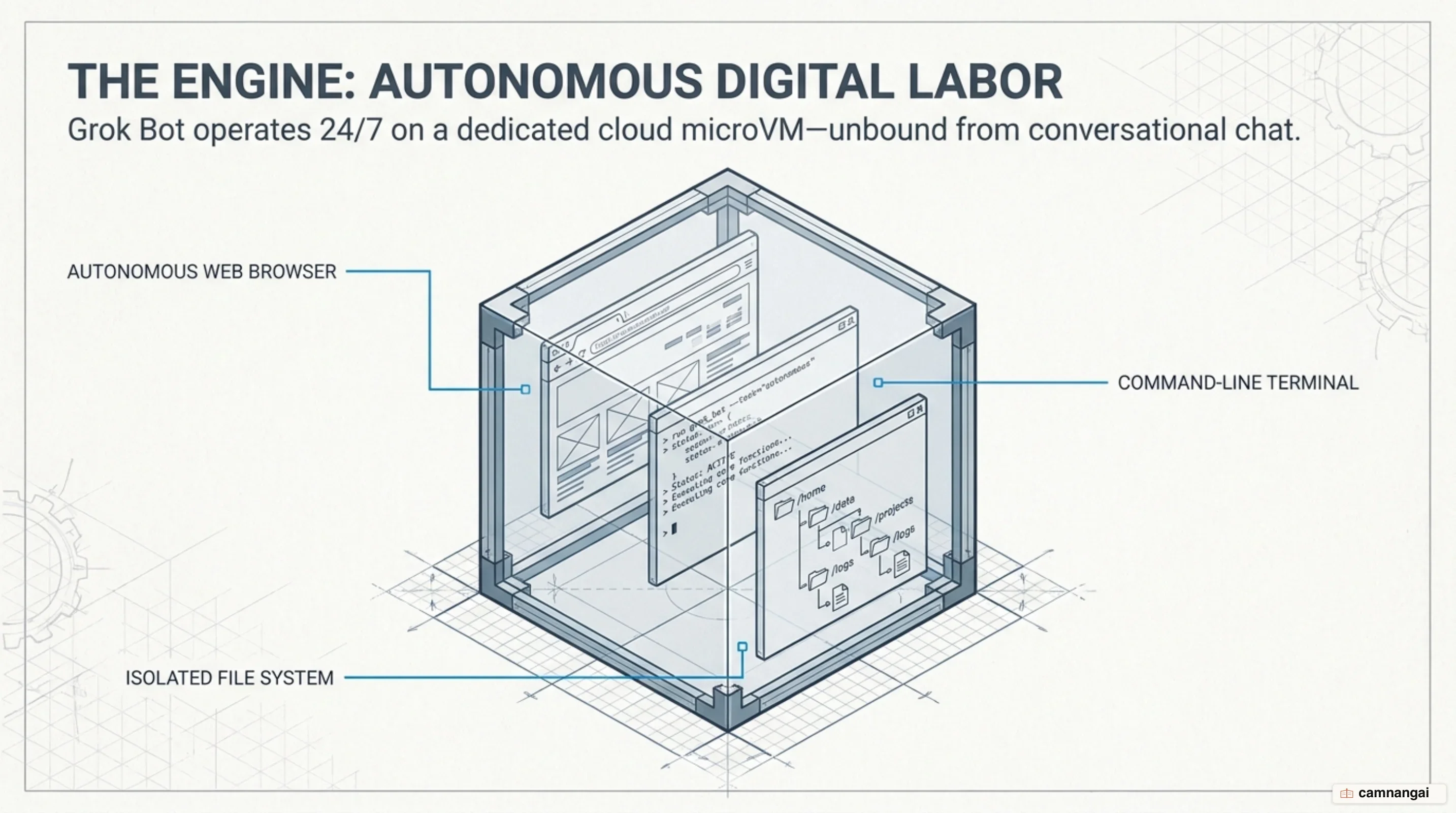
To achieve true task automation with Grok Bot, you must shift from surface-level conversational prompt interactions to deploying systematic digital labor. Grok Bot operates continuously 24/7 on dedicated cloud microVMs equipped with isolated file systems, web browsers, and command-line terminals.
Automating tasks with Grok Bot shifts operational focus from manual scripting to deploying autonomous digital labor running 24/7 on dedicated cloud microVMs.
Achieving reliable automation requires decoupling the business outcome from procedural execution. You offload operational tasks to specialized agent architectures while enforcing strict system boundaries, continuous feedback evaluation, and deterministic operational .
Reliable autonomy requires decoupling business outcomes from procedural execution, deploying specialized fleets, and enforcing deterministic verification guardrails.
The Automation Mindset: Separating the Goal from the Process
To build durable automations, you must break down complex operational goals into discrete, deterministic steps. Consider basic procedural mechanics: baking an apple pie requires sourcing ingredients, preparing them, assembling the crust, baking, and cooling. Replacing a flat tire requires jacking up the vehicle, unbolting the lug nuts, swapping the wheel assembly, and securing the mounting hardware. In both cases, the goal defines the required state transformation, while the process defines the intermediate execution steps.
When you design an automated system, you must avoid confusing an intermediate procedural step with the ultimate business goal. Actions like filling out a web form or sending a notification email are procedural steps, not business outcomes. Primary business goals map directly to core enterprise metrics: increasing revenue (processing customer transactions, shipping product features) or reducing operating costs (optimizing inventory orders, reducing idle infrastructure). Decoupling the business goal from legacy manual procedures allows your autonomous agents to evaluate the process and identify more direct, lower-overhead execution pathways.
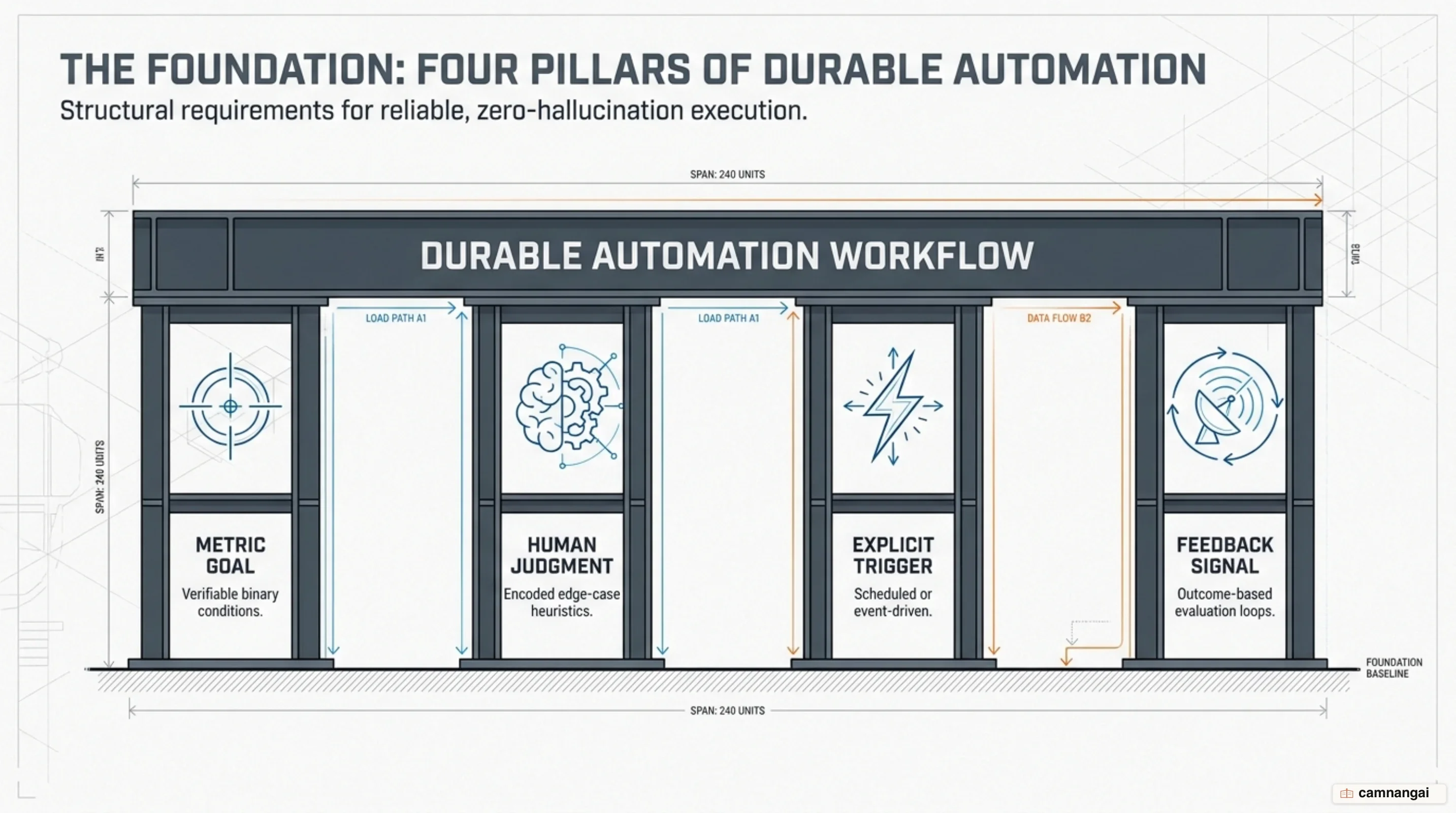
Engineered automation relies on four structural pillars:
- A Goal with a Metric Attached: A defined numeric target or binary verifiable condition (e.g., zero unanswered support tickets older than 2 hours).
- A Process Encoding Human Judgment: Explicit decision logic for handling edge cases, exceptions, and data conflicts.
- An Explicit Trigger: A precise temporal schedule or system event that initiates execution.
- A Feedback Signal & Evals: Programmatic evaluation metrics that allow the agent to verify execution success or failure.
Deploying Grok Bot fundamentally alters your execution infrastructure. Instead of outputting static text snippets within a local chat session, Grok Bot provisions autonomous digital labor. Every agent runs on a dedicated cloud computer (microVM) containing an isolated file system, headless browser, and command-line terminal. This architecture allows agents to run complex, long-duration tasks in the background without depending on a persistent local workstation connection.
Teaching Your Bot How to Think: Reverse Interviewing and Voice Brain Dumps
When you translate domain expertise into agent instructions, you must extract implicit heuristics that human operators execute instinctively. An experienced operator automatically factors in service durations, staff availability, appointment buffer windows, and data priority rules (e.g., determining whether to trust a customer email timestamp over a conflicting booking database entry). Because an autonomous agent operates without assumed context, you must explicitly codify every implicit evaluation rule.
To extract this domain context efficiently, execute a "Voice Brain Dump" using Grok Bot's voice dictation interface. Stream an unorganized brain dump detailing the complete operational lifecycle of the task. Speak through standard operational steps, exception triggers, application tool dependencies, verification steps, data source locations (such as Slack channels, email inboxes, or database tables), and downstream metrics.
Once you complete the initial voice dump, instruct the bot to restate the process. Review its response for logic gaps, then command the bot to evaluate its restated process directly against your primary business goal to uncover potential efficiency gains. Next, deploy the "Reverse Interviewing" workflow to capture missing edge-case rules. Instruct your bot (named "Potato" or auto-named) to interview you one question at a time to resolve system priority rules, validation criteria, and human escalation triggers before compiling system prompts or executing code.
Potato, help me figure out what I haven't told you about this process yet. Ask me questions about how I make decisions, where I get my information, how I check the work, and when you should ask me for help. Ask one question at a time, then walk me through a few examples so I can give you feedback before we automate this.Multi-Bot Architecture: Chief of Staff, Specialized Workers, and Anti-Jobs
Assigning broad operational scopes and dozens of tool integrations to a single bot triggers the Monolithic Bot Anti-Pattern. Monolithic agents suffer from severe degradation, high wastage, tool mis-selection, and boundary . You must mitigate these failure modes by decomposing monolithic tasks into multi-agent fleets with strict state isolation.
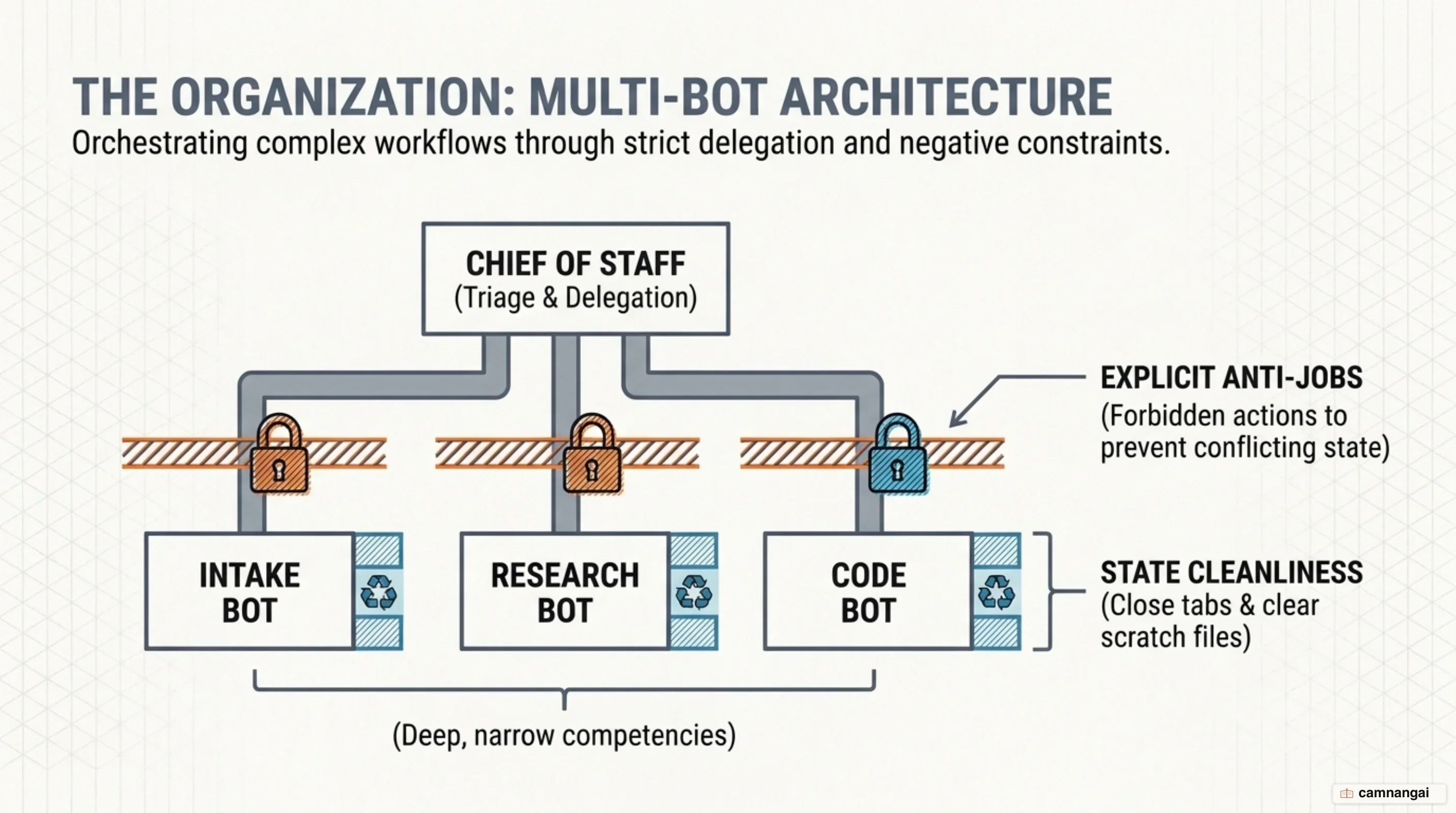
Implement a Chief of Staff and Worker Architecture. The Chief of Staff bot operates as a centralized coordinator: it triages incoming events, decomposes high-level goals into discrete sub-tasks, delegates execution to specialized worker bots, monitors task milestones, and aggregates results. Specialized Worker Bots maintain narrow operational scopes (e.g., Customer Intake Worker, Research Scraping Worker, Code Verification Worker). Worker bots preserve state cleanliness by clearing temporary scratch files, closing browser tabs upon task completion, and passing concise, structured data artifacts back to the coordinator, preventing context bloat across multi-step execution chains.
Every agent configuration file must specify "Anti-Jobs"—explicit negative constraints defining actions the bot is forbidden from executing. Standard operational anti-job pairs include:
- Drafting customer response emails vs. sending external communications directly
- Flagging static code vulnerabilities vs. merging pull requests into
mainwithout review - Preparing inventory purchase orders vs. executing financial payments
For meta-provisioning, deploy Dr Eggbot v2, a specialized meta-bot on xAI Grok Bot designed by Lauren Tan to provision child agents via the CreateAgent API. Dr Eggbot v2 enforces "Poteto Mode" across generated technical agents, mandating concise execution, plain unslopped prose, simple code structures, tool minimization, and mandatory end-to-end verification.
agent_config:
  name: "Customer-Intake-Worker"
  scope: "Triage incoming customer booking requests and verify slot availability."
  tools:
    - "calendar_read"
    - "email_draft"
  anti_jobs:
    - "DO NOT execute payments or access financial APIs."
    - "DO NOT send external emails directly; only create drafts for human approval."
    - "DO NOT modify master staff schedules."
Shifting to Autonomous Execution: Routines, Triggers, and Self-Improving Feedback Loops
To transition from manual prompt invocations to fully autonomous execution, you must construct background Routines. Routines execute agent workflows continuously on dedicated cloud microVMs based on deterministic system events, eliminating manual human triggers.
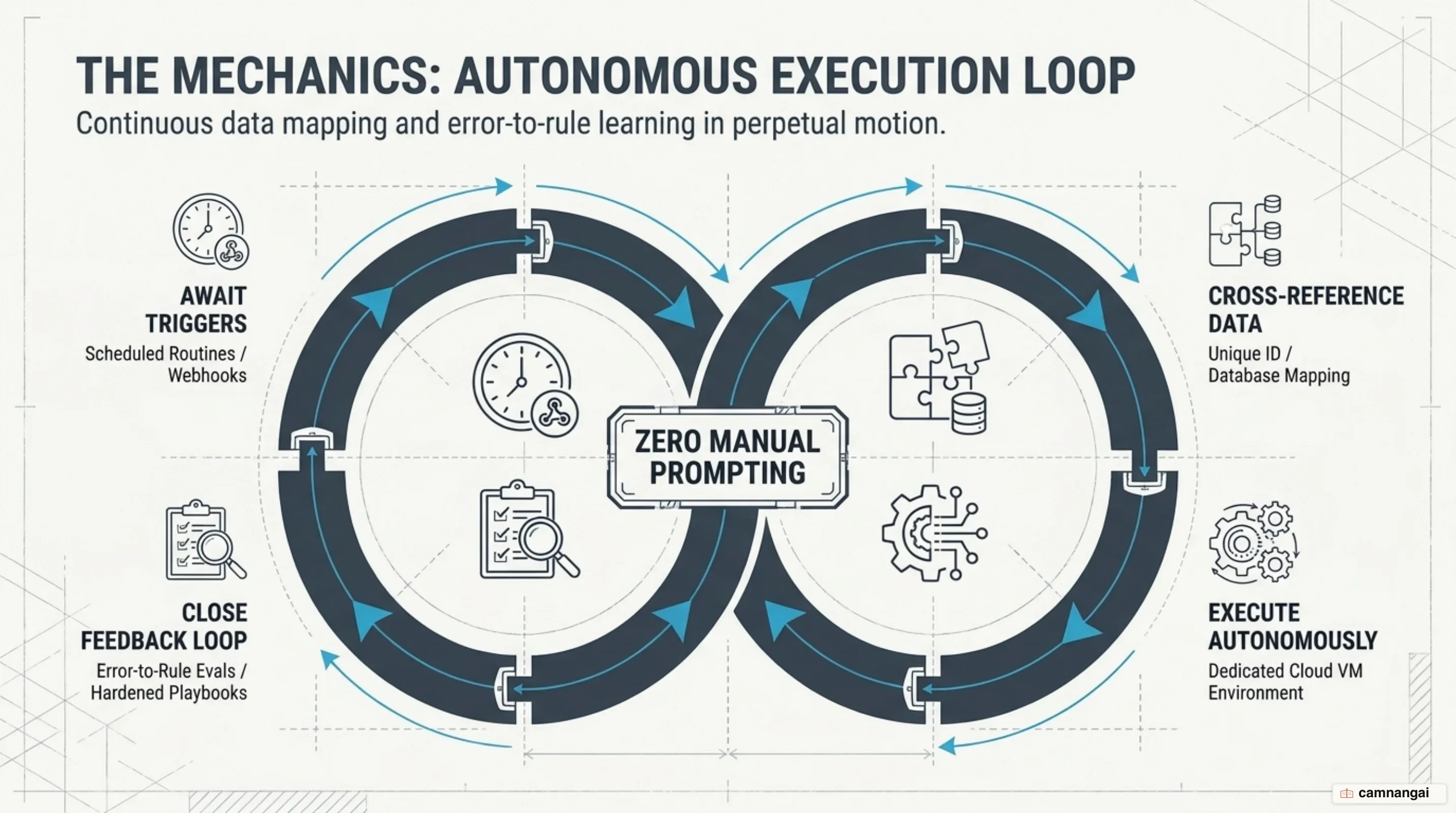
Configure routines using two core trigger mechanisms:
- Schedule Triggers: Cron or cadence-based execution schedules (e.g., daily 8:00 AM status summaries or hourly database syncs) instantiated via the
scheduler_createtool. - Event Triggers: Event-driven executions initiated by incoming webhooks, new emails, Slack/Teams channel mentions, or GitHub issue creations.
To sustain background operations across recurring routine runs, Grok Bot uses long-lived session tokens stored within secure credential vaults, eliminating repeated user authentication prompts.
Autonomous systems must also execute closed-loop self-improvement. Provide your agents with direct programmatic access to outcome metrics—such as customer emails, application error logs, or Yelp/Google reviews—allowing them to analyze operational failures and deploy workflow patches.
If structured timestamp data does not exist within your environment, instruct Grok Bot to custom-build web or mobile data-entry interfaces to capture the required metrics. For example, in a car repair facility, you can have Grok Bot build a lightweight logging interface to track timestamps for:
- Customer shop arrival time
- Service representative contact time
- Key handoff time
- Service start time
- Service completion time
By cross-referencing these timestamps across systems using consistent Unique IDs (e.g., Customer IDs, order numbers, part numbers, employee IDs, or barcodes), the agent isolates operational bottlenecks and recalibrates scheduling buffers automatically.
Guardrails and Verification: Setting the Human-in-the-Loop Boundaries
System reliability in autonomous agents relies on programmatic verification gates and continuous guardrail hardening. When an agent experiences an operational failure, execute the "Error-to-Rule" Feedback Loop ("Every weed you pull becomes a rule"). Rather than manually correcting the output and proceeding, trace the execution failure to an unstated system assumption. Codify that assumption as an explicit constraint, validation check, or lint rule. This systematically hardens the agent loop against repeating known failure modes.
Enforce strict Verification Gates across all worker threads. Never accept an agent's self-reported task completion status without programmatic verification. Require verifiable output artifacts, such as automated test execution logs, unified code diffs, database query confirmations, or headless browser screenshots.
Implement Tiered Human-in-the-Loop (HITL) Gating to isolate system risk:
- Low-Risk Actions: Read-only operations, data parsing, draft generation, and internal summarization run fully autonomously.
- High-Risk Actions: 2FA authentication, password entries, financial transactions, database writes, code commits to
main, and external communications require mandatory human token approval before execution.
[GUARDRAIL_RULE: FINANCIAL_AND_PUBLIC_GATE]
IF proposed_action IN ["EXECUTE_PAYMENT", "COMMIT_TO_MAIN", "SEND_EXTERNAL_EMAIL", "ENTER_2FA"]
THEN:
  1. PAUSE execution thread.
  2. GENERATE payload summary and risk assessment artifact.
  3. PUSH notification to Human-in-the-Loop approval gate.
  4. AWAIT explicit positive token confirmation BEFORE proceeding.
Where to Start with Grok Bot?
Select a single repetitive operational workflow within your infrastructure. Construct a targeted bot instance, define one business goal bound to a verifiable numeric metric, and explicitly configure its anti-job boundaries to prevent unauthorized side effects.
To accelerate multi-agent deployment, initialize your workspace using the Dr Eggbot v2 meta-bot template (https://x.ai/bot/rJW52lmFLtCvy2tSHcIag). Use the meta-bot to interview your subject matter experts, generate constrained child bot configurations via the CreateAgent API, and deploy isolated worker agents directly to your cloud microVM environment.
References
- Automate Anything with Grok Bot — Lauren Tan
- Dr Eggbot v2 by lauren — xAI Grok Bot
- Introducing Grok Bot: Autonomous AI Teammates on Cloud Computers — xAI
- Grok Bot Workflows, Routines, and Tool Integrations — xAI Docs
- Inside xAI's Agent Playbook: The 4 Pillars of Grok Bot Automation — Linas Beliūnas
- Designing Multi-Agent Teams: The Chief of Staff and Worker Bot Pattern — Bots & Beans
- Guardrails and Error-to-Rule Feedback Loops in Autonomous Cloud Agents — CellCog AI