Software architecture is the shared understanding your expert developers hold regarding a system's design.
It represents the "important stuff"—those critical decisions you wish you could get right early because they are prohibitively expensive to change later.
As a systems lead, you must view architecture as the design decisions governing overall system structure and behavior. It is the conceptual glue that allows you to analyze how a workload will achieve essential qualities like 99th percentile (p99) response times or multi-region availability before you ever commit a single line of implementation code.
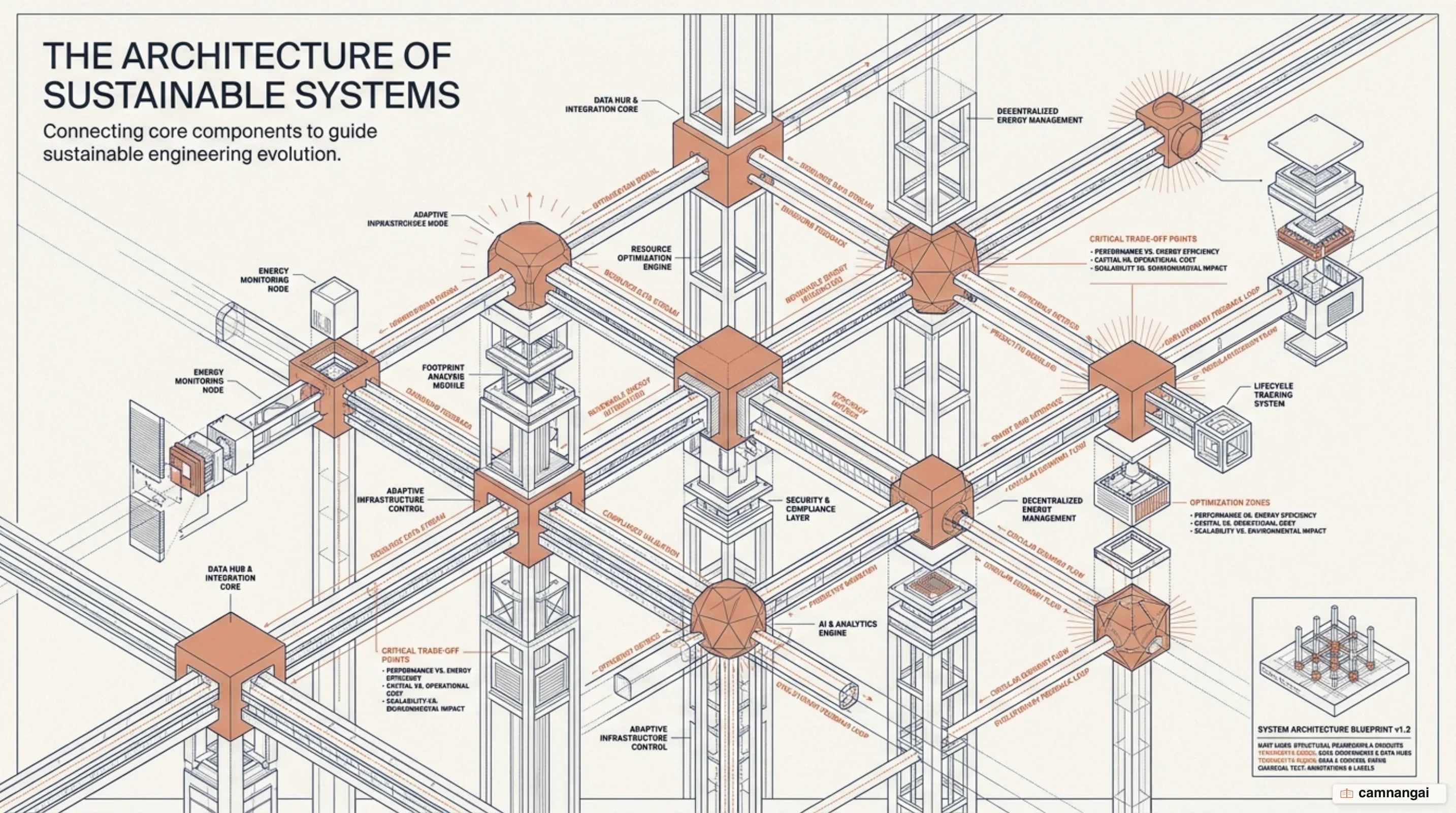
What is software architecture?
Architecture is the set of design decisions that are hardest to change once implementation begins. While you might see it defined elsewhere as "high-level organization," Ralph Johnson more accurately describes it as the shared mental model of your most senior engineers. It is a pragmatic focus on the "important stuff"—whatever that may be in your specific technical context—that requires significant energy to maintain and refine over the lifecycle of a product.
You must recognize that applications are social constructions rather than objective technical boundaries. In your day-to-day, these boundaries are defined by three distinct units: a body of code seen as a single unit by your developers, functionality perceived as a unit by business owners, and an initiative viewed as a unit by those controlling the budget. These boundaries can encompass the coordination of 10+ cross-functional teams or, more ideally, a single "two-pizza team" managing a decoupled service.
To succeed in this role, you must ride the "architect elevator," moving between the executive penthouse and the engine room. You aren't just engaging with abstract strategy; you are translating a 20% cost-reduction mandate from the board into a concrete decommission plan for legacy mainframe dependencies. By stopping at every floor, you ensure that high-level digital visions are grounded in the metrics of the engine room, such as the friction of cross-team dependencies or the reality of technical debt.
Architecture vs. software design: understanding the boundary
The boundary between architecture and design is hazily defined and deeply intertwined rather than existing as separate phases. As Martin Fowler notes, all architecture is design, but not all design is architecture. You should view architecture as a set of constraints that restrict the universe of design choices to ensure specific properties emerge. For instance, adopting a microservices style constrains you to independent services with private data stores, which in turn enables the emergent properties of independent deployment velocity and fault isolation.
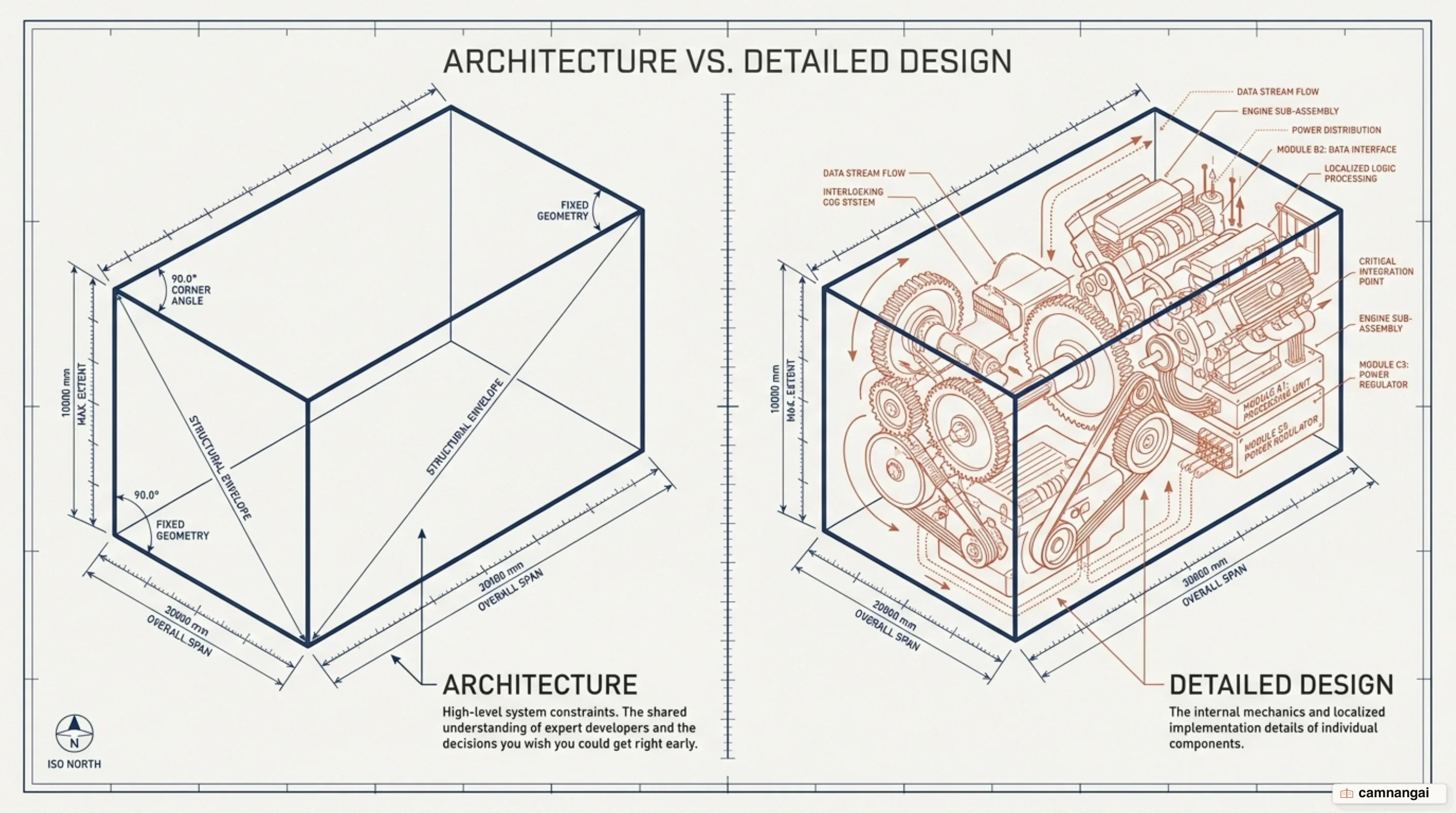
You must balance traditional up-front design with the evolutionary approach favored in agile environments. While the former attempts to finalize details early, evolutionary design focuses on minimizing up-front decision-making where possible, maintaining architectural integrity through short-cycle iterations. This acknowledgment that requirements will shift allows you to build systems that support their own evolution rather than becoming rigid monuments to initial assumptions.
Ultimately, your architectural work focuses on the wiring of high-level components, while design handles the internal mechanics of those components. However, because architectural decisions directly impact the ease of future design changes, you cannot separate the two. Good architecture is a practice that supports programming; it is never a document removed from the reality of the repository.
Why software architecture matters: the economics of change
The Design Stamina Hypothesis demonstrates that while neglecting design might lead to a faster initial feature release, the accumulation of "cruft"—internal elements that impede developer understanding—will eventually kill your team's productivity. High internal quality is not a luxury; it is a prerequisite for delivery speed. By reducing cruft, you ensure that adding a new capability doesn't require a week-long archeological dig through the codebase.
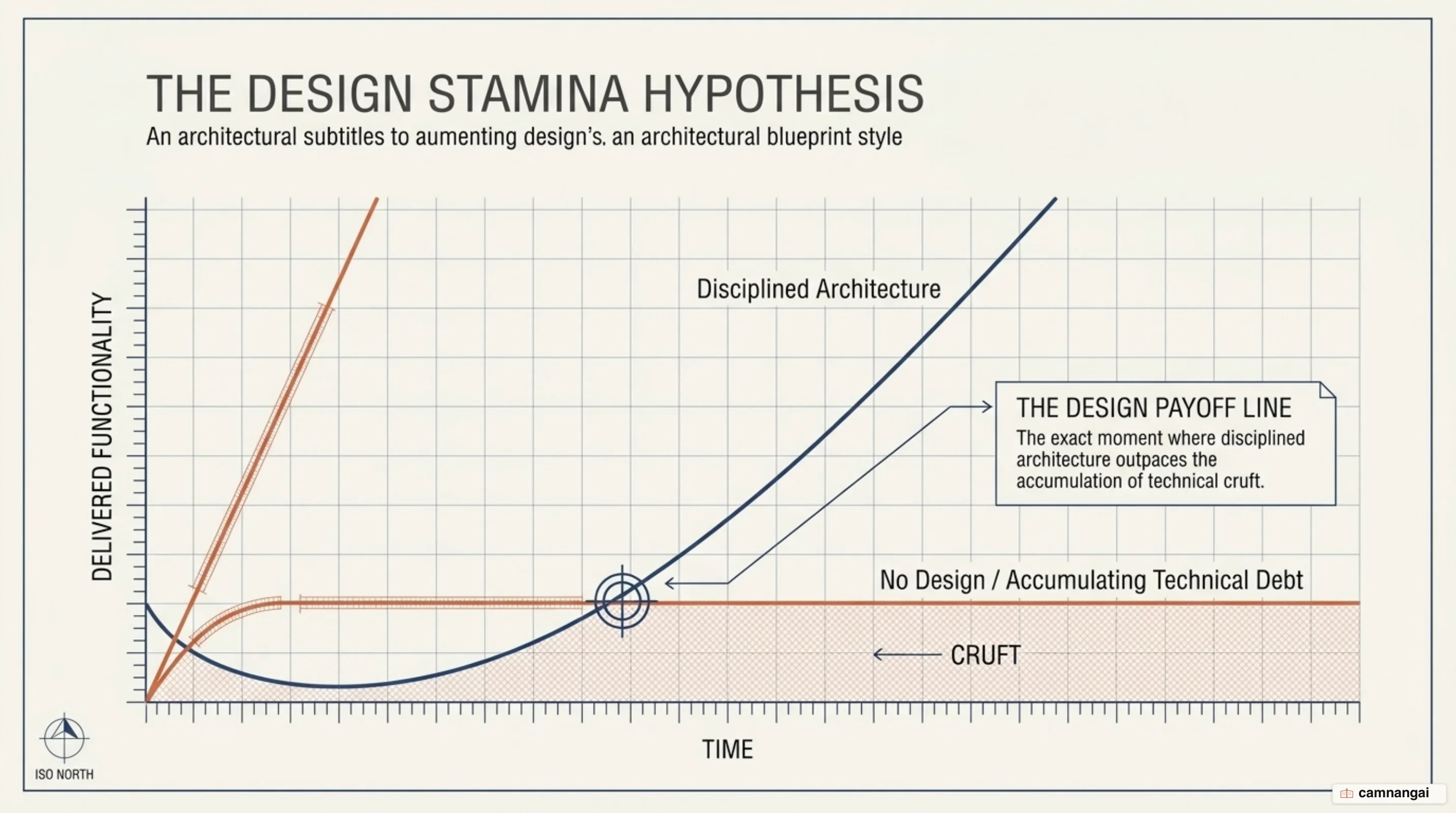
In software engineering, the relationship between quality and cost is often the inverse of what you expect. While a premium user experience costs more to build, high-quality internal architecture actually reduces the long-term cost of adding features. The design payoff line marks the point where a project with disciplined architecture overtakes a "no-design" project in cumulative functionality.
In practice, this payoff often occurs in weeks, not months. If your project delivery falls above this line, neglecting design is an illusory trade-off that will inevitably lead to shipping later. You should treat technical debt as a literal financial instrument: taking out the "loan" is only worth it if the value of shipping today outweighs the "interest" paid in slowed productivity later.
Core quality attributes and architectural trade-offs
Your role involves managing architecturally significant qualities using a structured framework. The AWS Well-Architected Framework, built on learnings from hundreds of thousands of customer architectures, identifies six pillars: Operational Excellence, Security, Reliability, Performance Efficiency, Cost Optimization, and Sustainability. These pillars guide you in evaluating if your workload aligns with cloud best practices, such as automating changes to reduce human error.
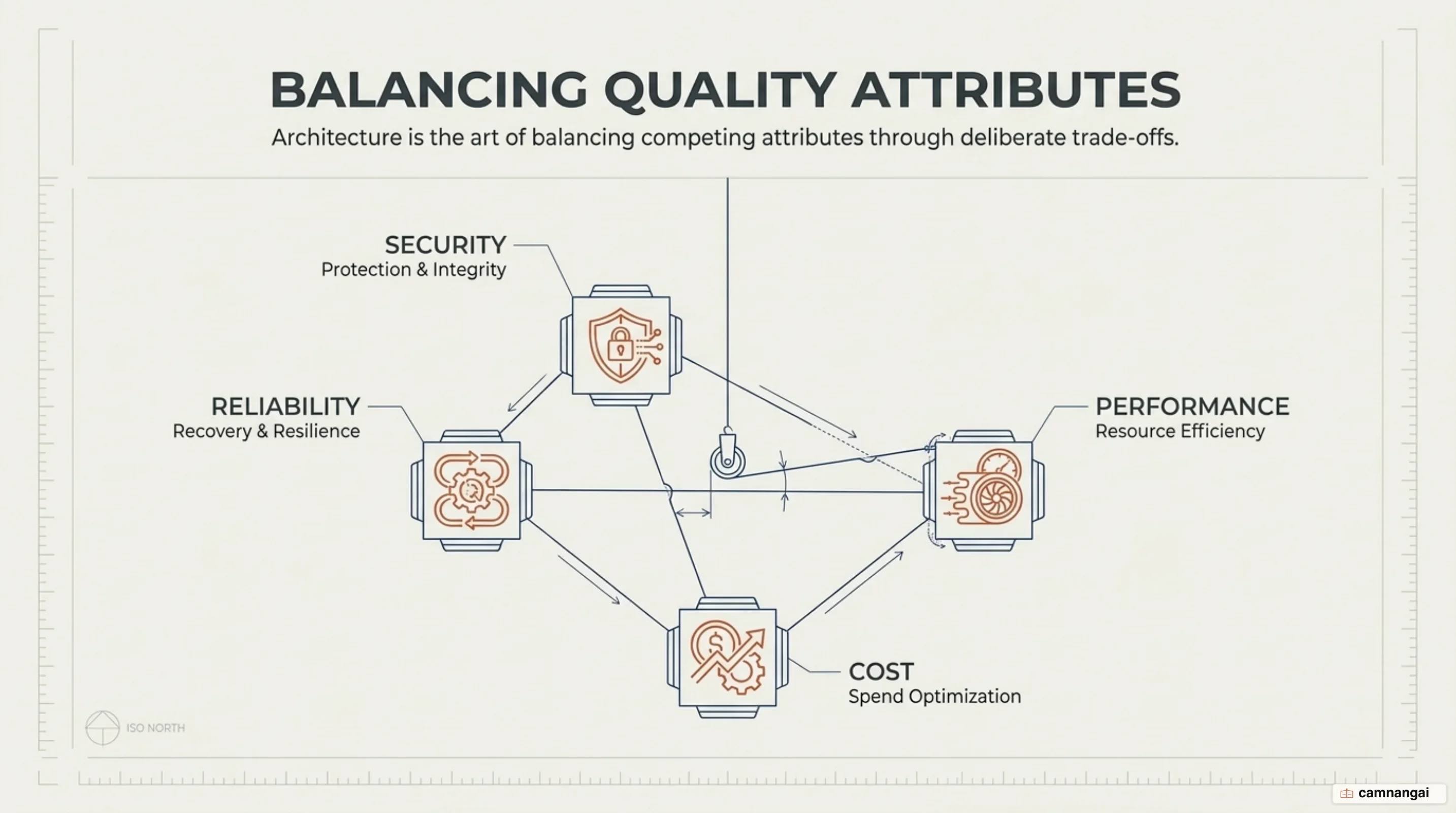
You must accept that no architecture can maximize every quality attribute simultaneously; trade-offs are mandatory. For example, if you increase reliability through a multi-region distributed design, you will almost certainly increase system complexity and operational cost. Improving performance efficiency through aggressive caching might compete with the security requirement for immediate data invalidation.
To balance these conflicting demands, use the Architecture Tradeoff Analysis Method (ATAM). This allows you to evaluate how specific design decisions impact competing goals like modifiability and availability. Identifying these risks early prevents the catastrophic rework that occurs when you discover, six months into production, that your "performant" system cannot meet its security compliance mandates.
Common architectural styles and patterns
Architecture styles provide families of characteristics that guide the shape of your system. N-tier is traditional for business domains with low update frequency, using horizontal tiers divided by physical subnets for dependency management. Web-Queue-Worker decouples front-end HTTP jobs from back-end workers using asynchronous messaging, which is best for simple domains with resource-intensive tasks like image processing.
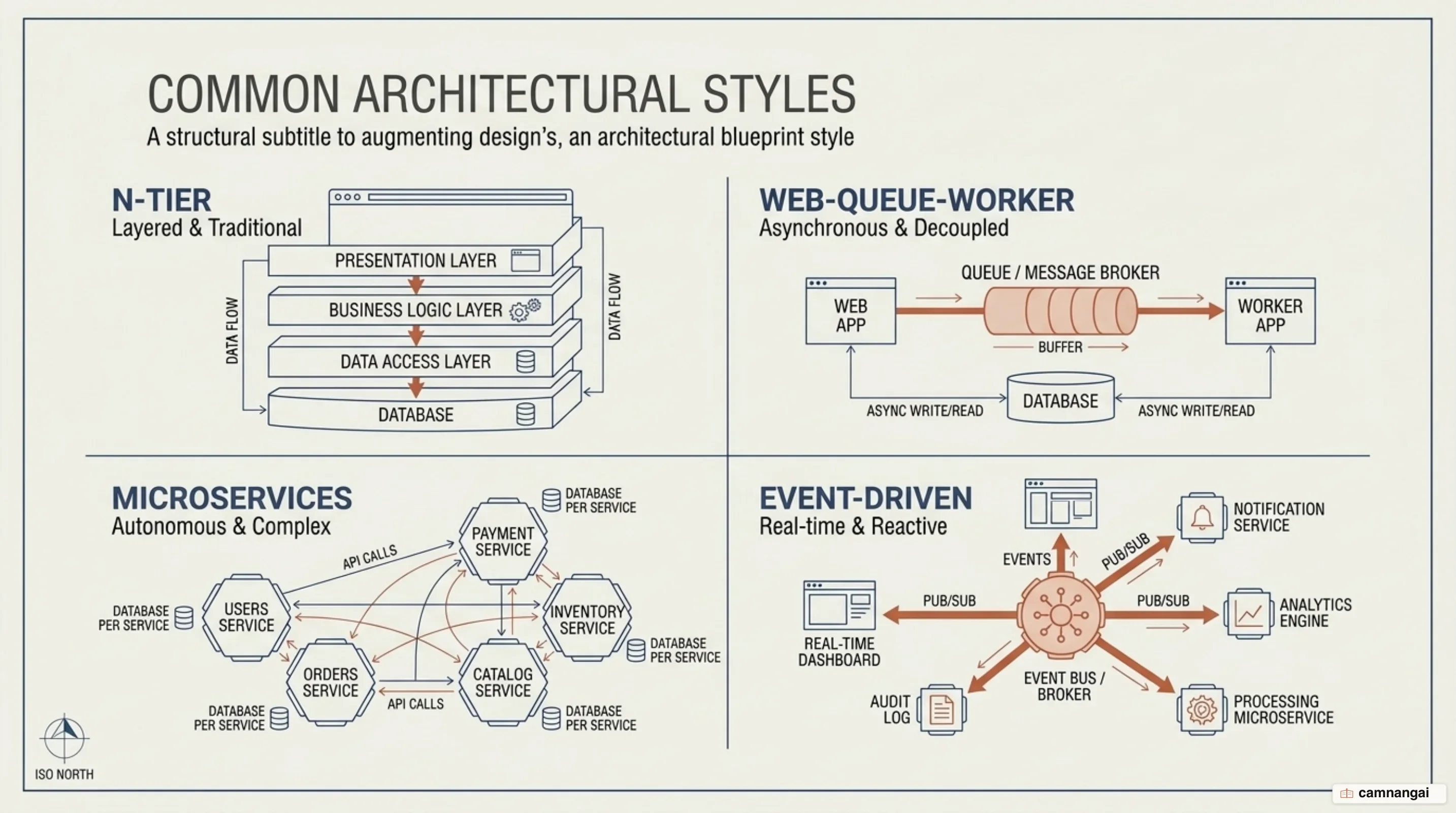
For complicated domains requiring frequent updates, Microservices provide vertical functional decomposition via APIs (application programming interfaces), though they increase interservice communication overhead and demand mature DevOps automation. Event-driven styles serve IoT and real-time systems by decoupling producers and consumers through event brokers, allowing each subsystem an independent view. Big Data architectures handle massive datasets by partitioning data for parallel processing, while Big Compute allocates data to thousands of cores for intensive simulations.
To document these choices, you should use Architectural Decision Records (ADRs). This ensures that the "why" behind a decision is preserved even after the original team has moved on. Below is a concrete ADR format for a common cloud transition:
# ADR 5: Decomposing Order-Processor into Microservices

## Status

Accepted

## Context

The current monolith has a cyclomatic complexity > 500 across the core checkout path, and we are experiencing 4+ hour CI/CD wait times across 50+ micro-repos.

## Decision

We will migrate the Order-Processor to vertically autonomous services using private PostgreSQL instances and gRPC for synchronous inter-service communication.

## Consequences

Enables independent scaling for the checkout service; introduces eventual consistency challenges and requires distributed tracing for latency monitoring.
Documenting and visualising architecture
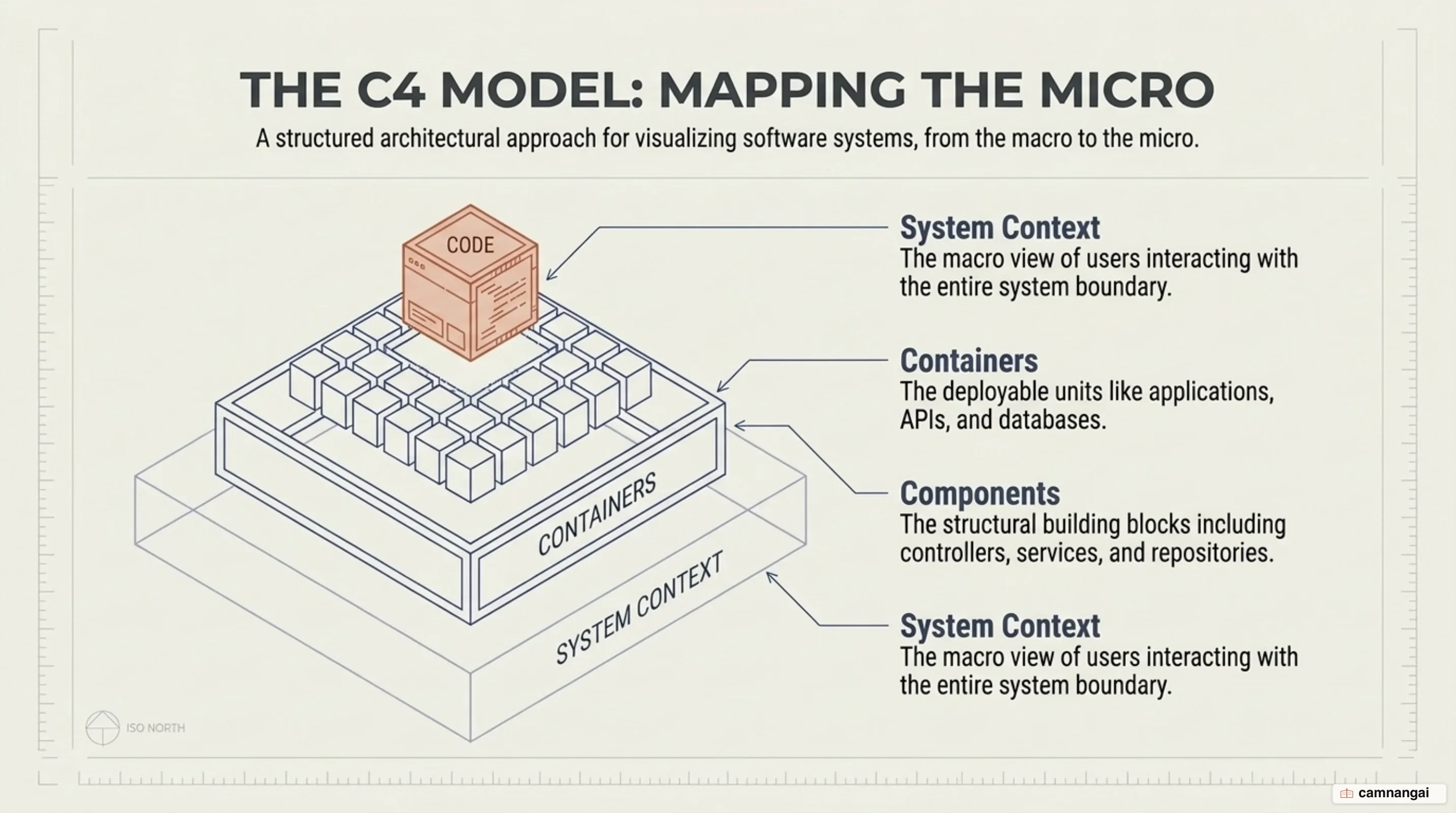
You need a hierarchical approach to visualization to communicate effectively with different stakeholders. The C4 model provides four levels of abstraction: System Context (how your system fits into the world), Containers (applications and data stores), Components (modular parts of containers), and Code. This notation-independent framework allows you to show a CTO the high-level boundaries and a developer the specific wiring of a service.
The arc42 template offers a pragmatic structure for your documentation. You should focus on three key sections: Context & Scope (defining external interfaces), the Building Block View (the structure of source code and modularization), and the Runtime View (how components interact during specific scenarios). This prevents your documentation from becoming a "big ball of mud" where technical and business concerns are hopelessly blurred.
For mission-critical systems where the cost of failure is measured in lives or massive financial loss, you should look toward the Architecture Analysis and Design Language (AADL). AADL allows you to build and analyze virtual systems to find problems—such as mismatched assumptions between software timing and hardware clock cycles—before a single component is built. This is essential for avionics or safety-critical embedded systems where late-stage discovery is fatal.
Cultivating architectural thinking in software engineering
Your success as an architect is measured not by the choices you make, but by how well you help others make the right choice. Architectural thinking requires a shift from top-down dictation to building bridges between teams and cultivating communities of learning. You are a partner in the development process, responsible for radiating knowledge and ensuring the team understands the "why" behind every constraint.
Ultimately, architecture is a continuous process of measurement, validation, and refinement. By focusing on the "important stuff" and maintaining high internal quality, you ensure that your system remains evolvable. This discipline allows you to sustain long-term delivery stamina and prevent the technical debt that eventually brings feature velocity to a standstill.
References
- Software Architecture Guide — Martin Fowler
- Software Architecture — Carnegie Mellon SEI
- Design Stamina Hypothesis — Martin Fowler
- Architecture Styles — Azure Architecture Center
- AWS Well-Architected Framework — AWS
- The C4 Model for Visualising Software Architecture — Simon Brown
- arc42 Template Overview — arc42