Semantic Kernel is an open-source, model-agnostic AI orchestration SDK developed by Microsoft that integrates foundation models into C#, Python, or Java business logic.
It functions as enterprise middleware that allows you to manage tool and plugin invocation via native function calling and structure multi-agent systems using native programming languages.
The framework solves the fundamental integration challenge between unstructured, probabilistic language models and strongly typed backend enterprise systems.
Instead of writing custom integration glue code for every model call, you can use Semantic Kernel to expose your existing APIs to Large Language Models (LLMs), parse model outputs, handle structured data schemas, and execute native code directly within your software runtime.
To support production environments across different enterprise ecosystems, Semantic Kernel provides official SDK implementations for C# (.NET 10.0+), Python (Python 3.10+), and Java (JDK 17+). Additionally, Microsoft Agent Framework (MAF 1.0) provides the production-ready enterprise successor for high-level multi-agent orchestration, operating on top of and maintaining full compatibility with core Semantic Kernel SDK foundations.
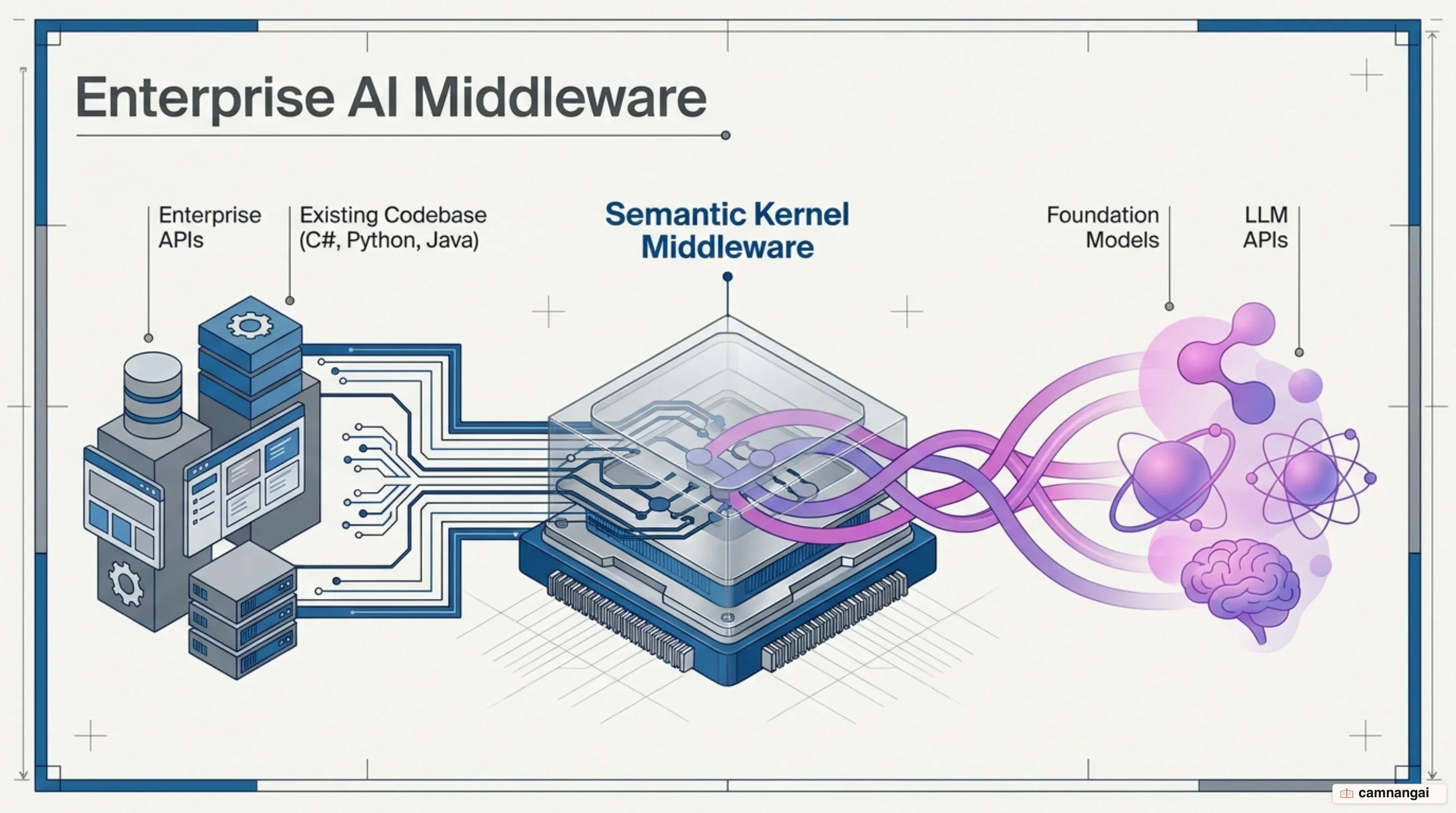
What is Semantic Kernel and what problem does it solve?
Semantic Kernel functions as a lightweight architectural middleware layer that bridges foundation models (such as OpenAI, Azure OpenAI, Hugging Face, NVidia, or local runtimes like Ollama, LMStudio, and ONNX) with your enterprise backend services. In traditional software engineering, your APIs rely on explicit, deterministic control flows and strongly typed contracts. LLMs, conversely, operate on natural language inputs and generate text or JSON function execution requests. Semantic Kernel provides the translation layer required to convert these probabilistic LLM requests into strongly typed runtime code executions and return the resulting output data back to the model context.
When you rely solely on raw LLM API calls, your applications lack standardized architectural controls. Exposing raw model APIs forces you to handle manual prompt formatting, custom JSON parsing, custom retry loops, and bespoke error handling across every endpoint. Semantic Kernel addresses these operational gaps by introducing enterprise-grade software patterns directly into the orchestration lifecycle. It delivers non-breaking API stability guarantees (across its v1.0+ releases), built-in telemetry support, structured logging, and extensible hooks and filters for auditing and responsible AI policy enforcement.
By encapsulating native APIs into modular components, Semantic Kernel enables you to update or swap underlying AI models without altering your core application logic or rewriting client code. You can integrate the framework into your runtime environment using standard package managers, such as executing pip install semantic-kernel for Python projects or running dotnet add package Microsoft.SemanticKernel within .NET solutions.
Core architecture: The Kernel, AI Services, and Dependency Injection
At the core of the SDK is the Kernel object. The Kernel acts as a central Dependency Injection (DI) container modeled directly after .NET's Service Provider pattern. It manages the lifecycle and configuration of all registered AI completion endpoints, telemetry loggers, custom HTTP clients, and native plugins required by your application. Because the Kernel encapsulates these dependencies, any prompt execution, agent action, or plugin invocation maintains access to your shared application services.
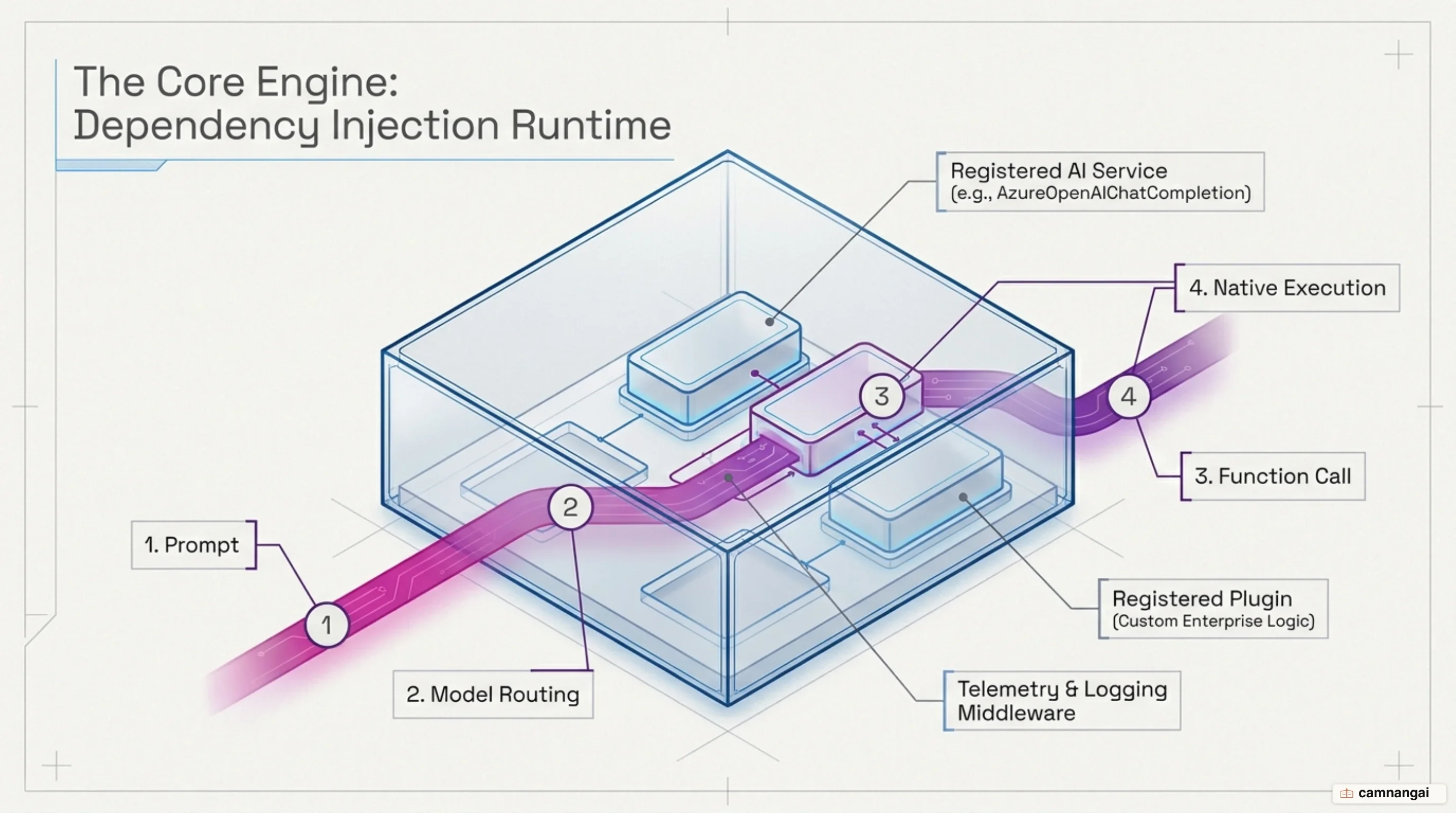
When your application invokes a prompt or requests an action through the Kernel, the SDK processes the request through a structured execution pipeline:
- Model Selection: The kernel identifies and selects the appropriate registered AI service endpoint (e.g., chat completion).
- Template Rendering: Prompt templates are rendered using your provided arguments and environment context.
- Payload Generation: The kernel formats the rendered prompt and tool definitions into the JSON payload required by the target AI service.
- Service Dispatch: The payload is transmitted over the wire with configured middleware, retry handlers, and logging hooks active.
- Response Parsing: The incoming response or function-call request is parsed, executed if necessary, and returned as strongly typed output objects.
Lifecycle management of the kernel follows standard software architecture practices. You should instantiate kernels as short-lived or transient instances because their internal plugin collections are mutable. Conversely, you register underlying heavy dependencies—such as HTTP client handlers, vector store client connections, and AI service configurations—as singletons within your application container.
using Microsoft.Extensions.DependencyInjection;
using Microsoft.Extensions.Logging;
using Microsoft.SemanticKernel;

var builder = Kernel.CreateBuilder();

// Add AI completion services and infrastructure singletons
builder.AddAzureOpenAIChatCompletion(
    deploymentName: "gpt-4",
    endpoint: "https://your-resource.openai.azure.com/",
    apiKey: "YOUR_AZURE_OPENAI_KEY"
);

builder.Services.AddLogging(c => c.AddDebug().SetMinimumLevel(LogLevel.Trace));

// Register native plugins into the builder container (using a custom plugin class)
builder.Plugins.AddFromType<LightsPlugin>();

// Build transient Kernel instance
Kernel kernel = builder.Build();

// Stub definition for native plugin registered in container
public class LightsPlugin
{
    [KernelFunction, System.ComponentModel.Description("Gets current light status.")]
    public string GetStatus() => "All lights operational.";
}
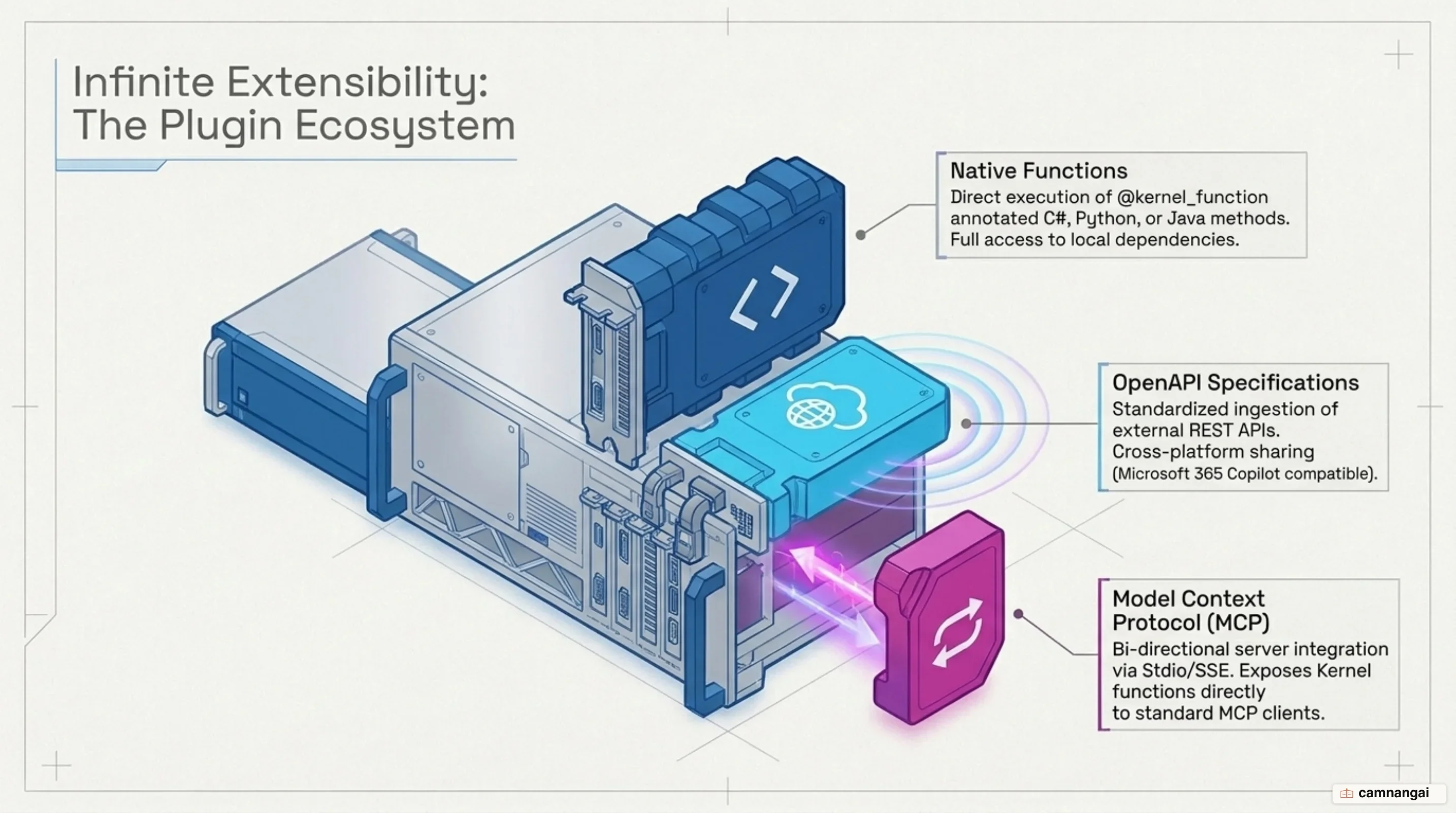
Beyond standard model orchestration, Semantic Kernel allows you to convert registered kernel functions and prompt templates directly into Model Context Protocol (MCP) servers. By calling constructs like kernel.as_mcp_server(server_name="sk"), you can expose your kernel's capabilities over standardized transports such as Stdio or SSE. To expose prompt templates alongside native functions over MCP, you configure a KernelPromptTemplate using a PromptTemplateConfig (defining input variable schemas) and pass it directly via the prompts argument in as_mcp_server(). This allows external client applications to consume your local prompt templates and plugins as remote MCP tools.
Extending model capabilities with Plugins and Native Functions
Plugins are the primary mechanism for extending LLM capabilities within Semantic Kernel. A plugin is a logical grouping of native code functions or prompt templates exposed to an AI model as invokable tools. To expose native runtime code to an LLM, you annotate application methods with specific attributes (such as [KernelFunction] in C# or @kernel_function in Python) along with detailed description annotations. Semantic Kernel extracts this metadata to construct parameter schemas, allowing LLMs to reason about function behavior, expected inputs, outputs, and side effects during function calling routines.
from typing import Annotated
from semantic_kernel.functions import kernel_function

class InventoryPlugin:
    @kernel_function(
        name="get_stock_level",
        description="Retrieves current warehouse stock level for a specific product SKU."
    )
    def get_stock_level(
        self,
        sku: Annotated[str, "The unique product SKU identifier."]
    ) -> Annotated[str, "JSON formatted string containing SKU and stock count."]:
        # Native business logic execution
        return f'{{"sku": "{sku}", "stock_count": 150}}'
Semantic Kernel supports three primary mechanisms for importing plugins into your runtime environment:
- Native Application Code: Importing strongly typed methods directly from local backend services, taking advantage of standard runtime dependency injection for database connections or external client integration.
- OpenAPI Specifications: Generating plugins dynamically from RESTful API OpenAPI/Swagger documents, allowing models to communicate directly with web services.
- External MCP Servers: Connecting to third-party or remote Model Context Protocol servers to consume tools hosted outside application boundaries.
When authoring native plugins, you must adhere to core architectural guidelines to maintain execution accuracy and model performance. Keep total tool definitions under 20 per call (10 to 20 is optimal), as model accuracy degrades when choosing among excessive tool schemas. Use explicit primitive parameters named with snake_case conventions across all languages, as underlying model function calling capabilities are optimized on Python-style schemas. When handling large or sensitive enterprise datasets (such as emails or internal financial records), process data locally and pass unique local state identifiers (such as a state ID) to the LLM instead of sending sensitive raw data payloads over public API requests.
Managing memory and integrating RAG with Vector Store Connectors
To supply external enterprise context to LLMs without exceeding prompt token limits, Semantic Kernel provides standardized vector store abstractions. Located in modules such as Microsoft.Extensions.VectorData.Abstractions in .NET, semantic_kernel.data.vector in Python, and com.microsoft.semantickernel.data.vectorstorage in Java, these connectors offer a model-first, strongly typed abstraction layer. This layer abstracts vendor-specific operations across vector databases including Azure AI Search, Qdrant, Elasticsearch, Azure Cosmos DB, MySQL/JDBC, and Chroma.
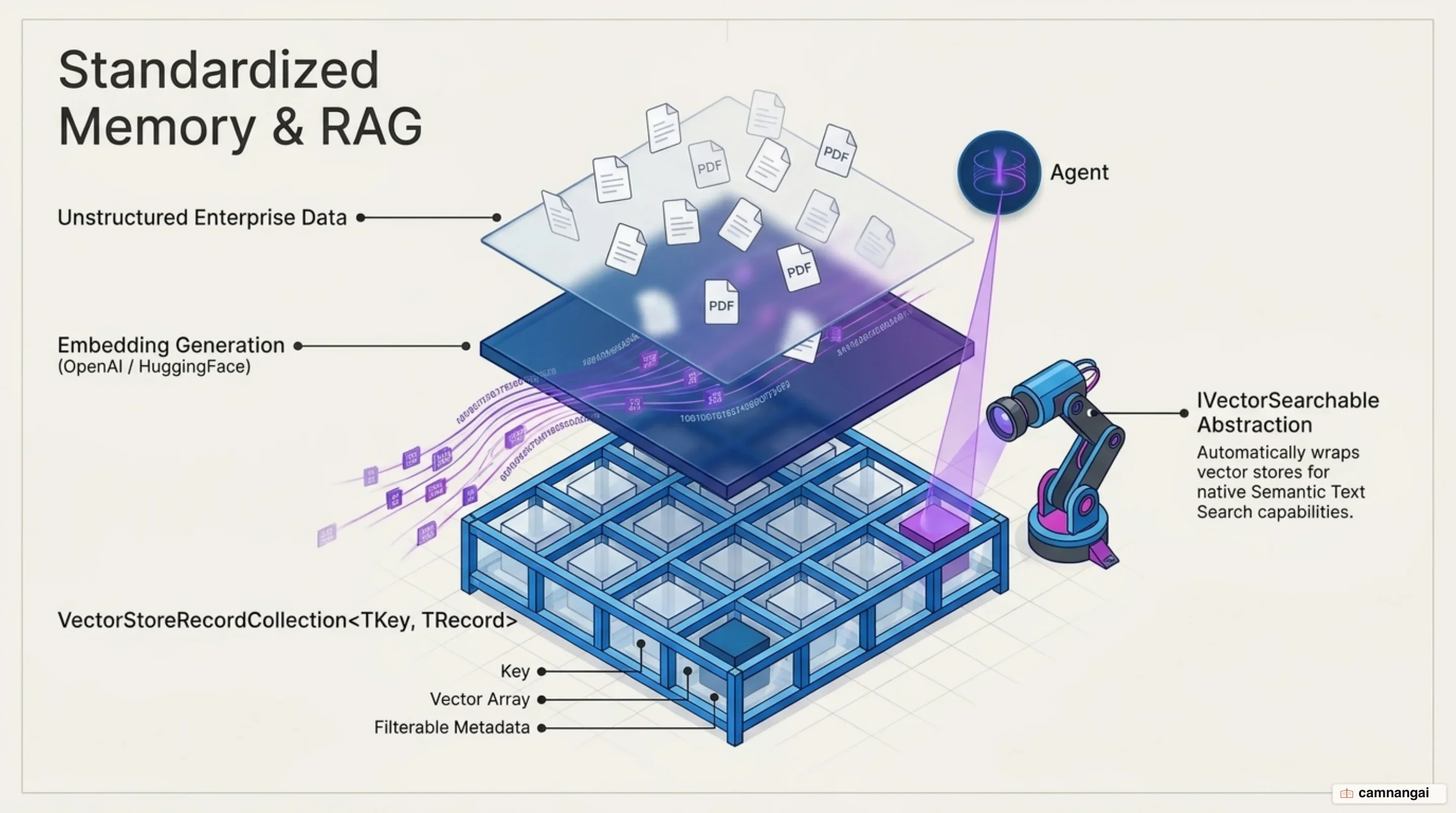
You define your database schema using attributed data models across supported languages. In C#, you annotate class properties with key, data, and vector attributes. In Python, you decorate data classes with @vectorstoremodel and annotate fields using VectorStoreField('key'), VectorStoreField('data', is_filterable=True), and VectorStoreField('vector', dimensions=..., distance_function=..., index_kind=...). These explicit field annotations declare record keys, filterable metadata fields, full-text searchable properties, and vector embedding properties along with index types (such as HNSW) and distance metrics (such as Cosine Similarity):
using Microsoft.Extensions.VectorData;

public class DocumentChunk
{
    [VectorStoreKey]
    public string ChunkId { get; set; }

    [VectorStoreData(IsIndexed = true)]
    public string DocumentName { get; set; }

    [VectorStoreData(IsFullTextIndexed = true)]
    public string TextContent { get; set; }

    [VectorStoreVector(Dimensions: 1536, DistanceFunction = DistanceFunction.CosineSimilarity, IndexKind = IndexKind.Hnsw)]
    public ReadOnlyMemory<float> Vector { get; set; }
}
The VectorStoreCollection interface allows you to create collections, upsert records, and execute vector searches using generated embeddings. To integrate vector storage into Retrieval-Augmented Generation (RAG) pipelines, Semantic Kernel allows you to wrap vector search collections into high-level Text Search abstractions or expose them as agent search functions via collection.create_search_function(...). To map raw database records into clean context strings that LLMs can digest, you pass custom mapping functions—such as Python's string_mapper=lambda x: f"Document {x.record.document_name}: {x.record.text_content}"—when creating search functions. This mapping mechanism ensures search results are formatted into structured text blocks before insertion into the model's reasoning context.
Building AI Agents and enterprise multi-agent orchestration
An AI Agent in Semantic Kernel is an autonomous or semi-autonomous software component that combines systemic instructions, AI model endpoints, execution plugins, and thread-based conversation history. The SDK provides several specialized agent implementations within modules like Microsoft.SemanticKernel.Agents.Core (.NET) or semantic-kernel.agents (Python):
ChatCompletionAgentuses standard chat completion model endpoints to process input messages and execute assigned plugins.OpenAIAssistantAgentwraps the stateful OpenAI Assistants API to manage threads and server-side code interpreters or tools.AzureAIAgentintegrates natively with hosted Azure AI agent infrastructure.OpenAIResponsesAgentoperates against structured response endpoints.
import asyncio
from semantic_kernel.agents import ChatCompletionAgent
from semantic_kernel.connectors.ai.open_ai import AzureChatCompletion

async def initialize_agent():
    # Instantiate agent with service, instructions, and tool bindings
    agent = ChatCompletionAgent(
        service=AzureChatCompletion(),
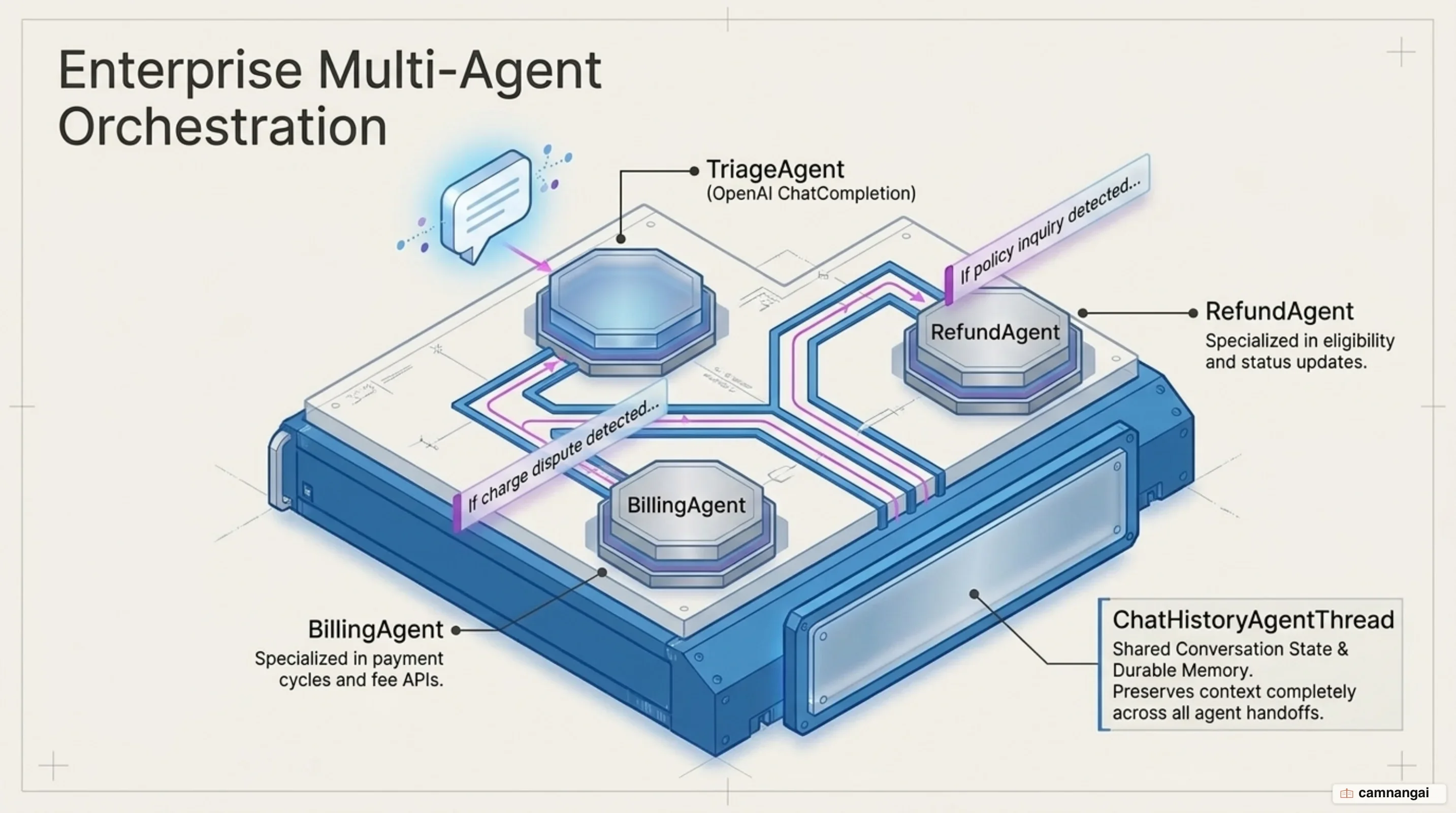
        name="SupportTriageAgent",
        instructions="Analyze user support queries and route them to specialist plugins.",
    )

    response = await agent.get_response(messages="I need help with a duplicate charge on my account.")
    print(f"Agent Response: {response.content}")

asyncio.run(initialize_agent())
For complex enterprise workflows, Semantic Kernel enables multi-agent collaboration patterns. Specialized agents can delegate sub-tasks, execute specialist routing (such as a triage agent analyzing user intent and invoking billing or refund agents via tool calls), or coordinate distributed workflows across separate execution channels using Agent-to-Agent (A2A) protocols, MCP, or specialized developer execution environments.
For production-grade enterprise deployments, you can equip agents with durable, cross-session memory by attaching persistent store backends like Azure Cosmos DB, allowing agents to automatically recall past user preferences, conversation turn summaries, and historical context. Furthermore, you can embed agents into sandboxed developer engines like the GitHub Copilot runtime to grant agents secure, enterprise-governed execution capabilities over file operations, CLI commands, and repository code inspection.
Semantic Kernel vs LangChain: When to choose Microsoft's SDK
Semantic Kernel and LangChain target distinct engineering needs and language ecosystems. Semantic Kernel is architected specifically for C#/.NET, Python, and Java enterprise ecosystems. It emphasizes native Dependency Injection, strict type safety, built-in telemetry, non-breaking API guarantees, and native integration with the Azure and Microsoft enterprise stack. LangChain targets Python-first environments prioritizing rapid prototyping, providing a broad ecosystem of community-maintained third-party connectors with less emphasis on compile-time type safety and enterprise governance patterns.
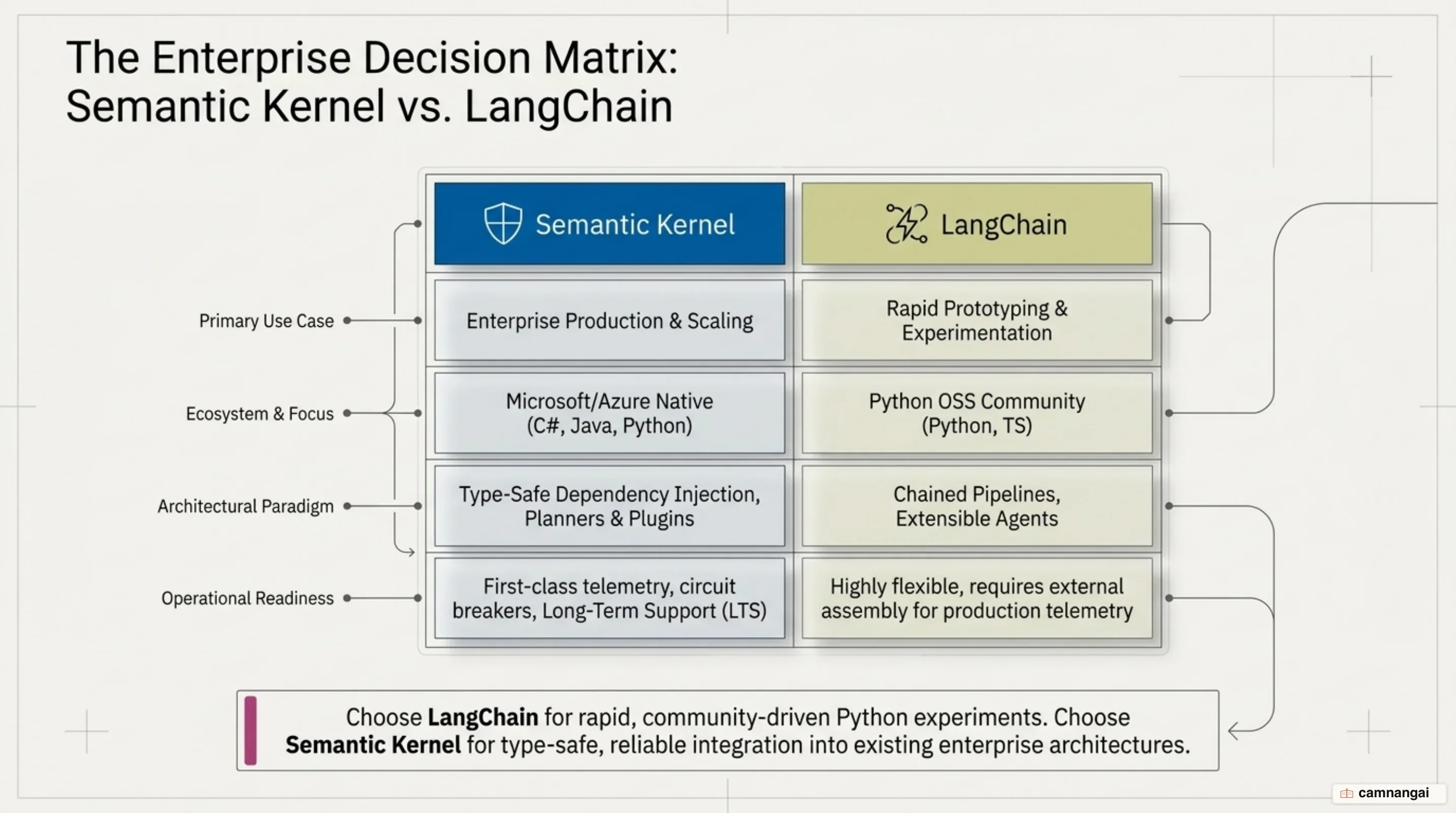
You should choose Semantic Kernel if your organization operates on Azure or .NET backend infrastructure, requires compile-time type safety, relies on structured software design patterns, and demands vendor-backed long-term support (LTS). You should choose LangChain if you operate in pure Python research environments, focus on rapid experimental prototyping, or depend on niche third-party database integrations not supported by mainstream enterprise SDKs.
References
- GitHub - microsoft/semantic-kernel: Integrate cutting-edge LLM technology quickly and easily into your apps · GitHub
- Introduction to Semantic Kernel | Microsoft Learn
- Understanding the kernel in Semantic Kernel | Microsoft Learn
- Plugins in Semantic Kernel | Microsoft Learn
- Semantic Kernel Agent Framework | Microsoft Learn
- What are Semantic Kernel Vector Stores? (Preview) | Microsoft Learn
- Microsoft Agent Framework | The latest news from the Microsoft Agent Framework team for developers
- Semantic Kernel vs LangChain: Microsoft's Framework vs the Community Standard