Qdrant is an open-source vector search engine and vector database written in Rust, designed for storing, indexing, and querying high-dimensional vector embeddings alongside structured JSON payloads.
You use vector databases when working with unstructured data converted into high-dimensional numerical vectors by neural network models, where conventional relational or full-text databases cannot efficiently perform geometric distance calculations across hundreds or thousands of dimensions.
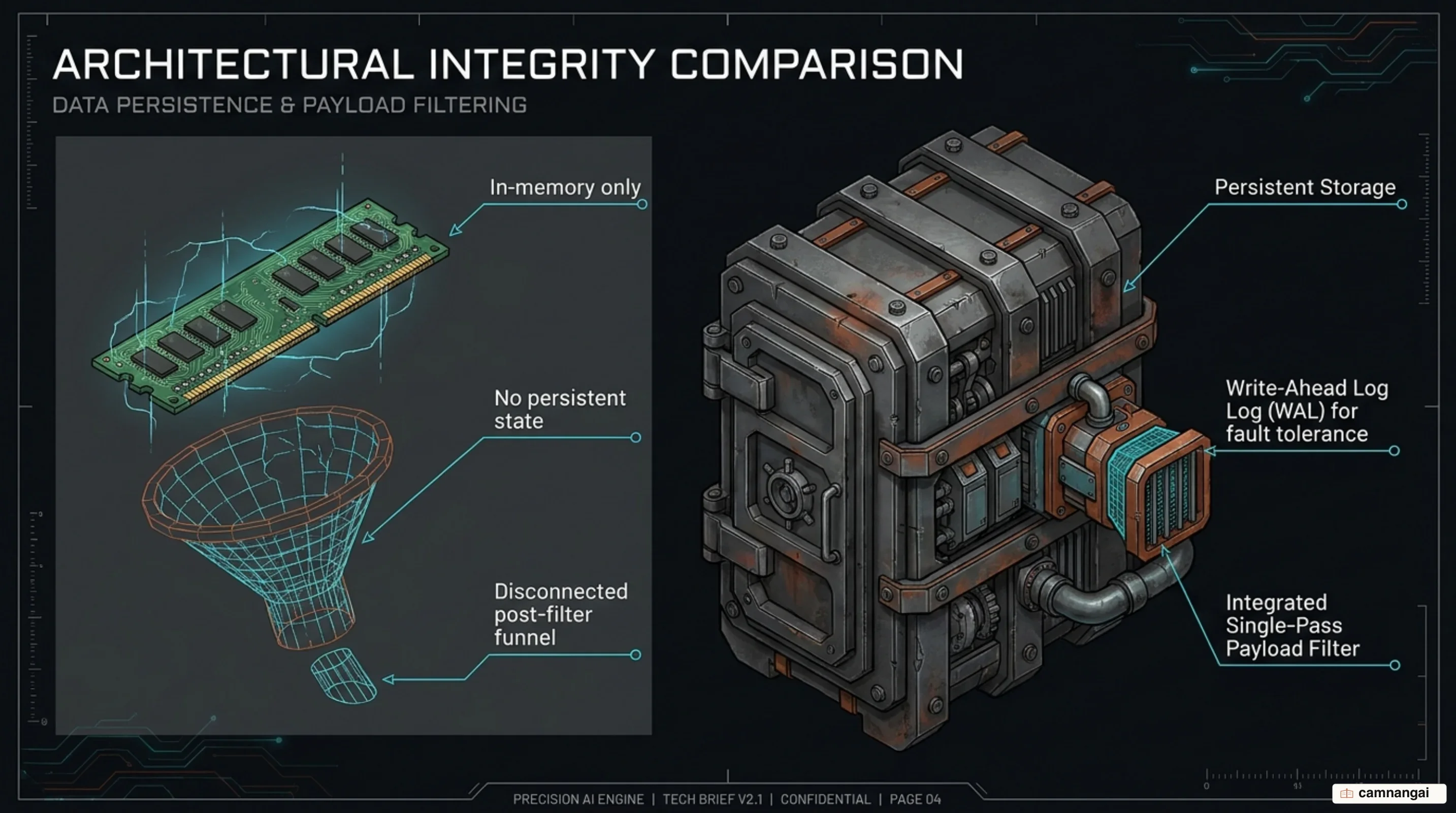
Unlike standalone approximate nearest neighbor (ANN) search libraries that process static in-memory matrices, Qdrant operates as a persistent database service.
Qdrant provides transactional data updates, dynamic metadata filtering during graph traversal, multi-language client SDKs, and deployment options ranging from embedded local applications to distributed multi-node clusters.
What is Qdrant and what problem does it solve?
Finding relevant unstructured items—such as documents, images, audio, or user activity logs—requires projecting raw data into vector spaces using machine learning encoders. Performing similarity search across these embeddings involves calculating vector distance metrics (such as Cosine distance, Dot product, or Euclidean distance) to identify the nearest points in high-dimensional space. Relational engines and B-tree indexes cannot index vector topologies efficiently, rendering them incapable of low-latency nearest neighbor search at scale.
Engineers historically addressed this challenge using standalone Approximate Nearest Neighbor (ANN) libraries like FAISS or Annoy. While these libraries deliver rapid similarity matching across static in-memory index files, they lack essential database infrastructure. They offer no Write-Ahead Logging (WAL) for durability, no transactional updates, no ability to filter dynamic metadata without sacrificing recall, and no API tier for concurrent network access. Modifying vectors in an ANN library typically requires halting execution and rebuilding the entire index graph from scratch.
Qdrant resolves these production engineering constraints by delivering a dedicated, open-source (Apache-2.0) vector database engine. It exposes REST (OpenAPI 3.0) and high-performance gRPC interfaces, supported by client libraries for Rust, Python, Go, JavaScript/TypeScript, Java, and .NET/C#. Qdrant supports two primary deployment models: Qdrant Server for cloud and distributed infrastructure (including managed Qdrant Cloud), and Qdrant Edge for lightweight, in-process local storage on device.
Core data model: Collections, Points, and Payloads
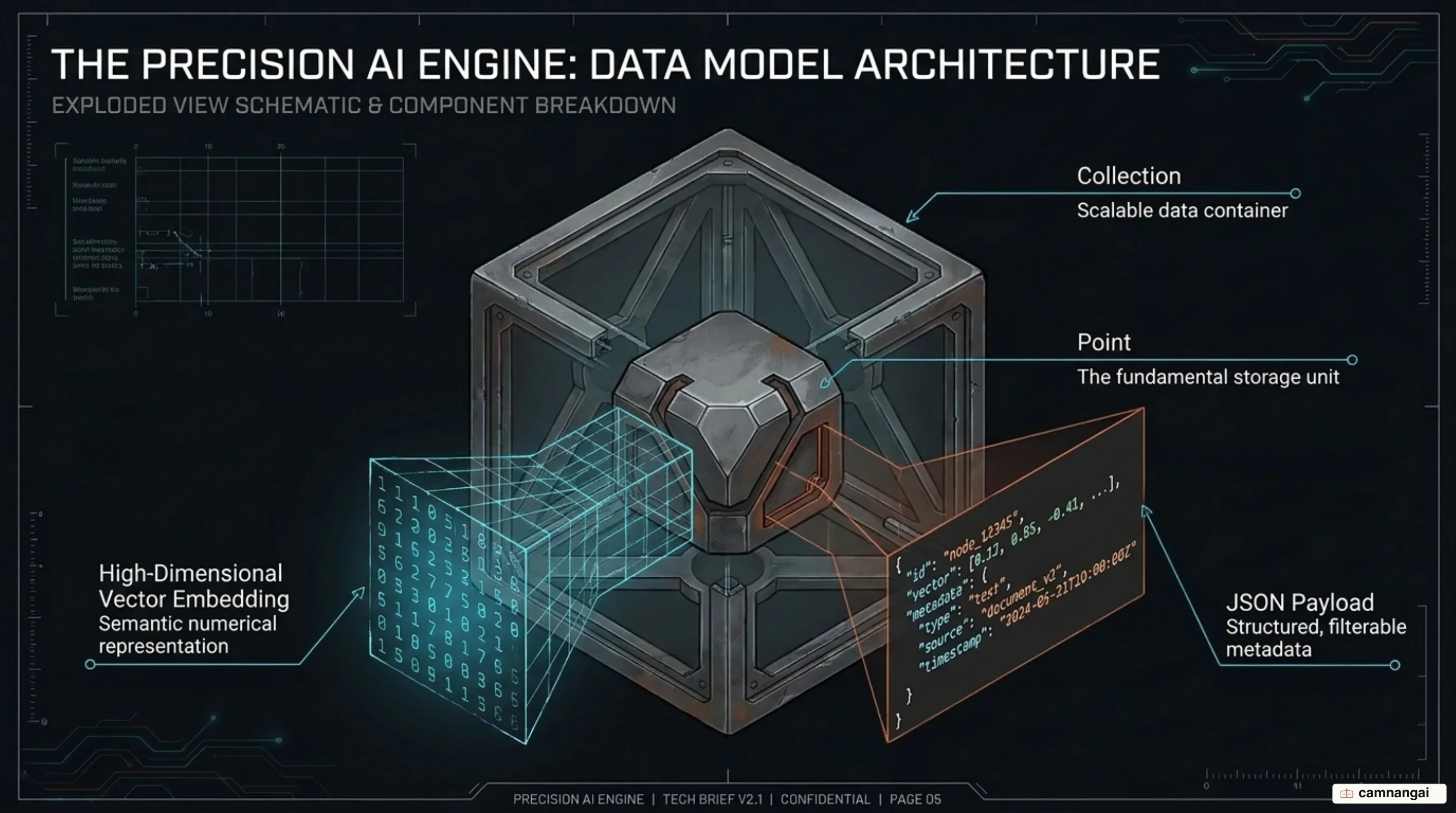
Qdrant structures vector datasets using three fundamental primitives: Points, Collections, and Payloads. A Point is the atomic data record in Qdrant, defined by a unique identifier (ID), one or more vector representations, and an optional attached JSON payload. Qdrant supports multiple vector types per point, including dense vectors for semantic matching, sparse vectors for lexical token scoring, and multi-vector representations for late-interaction models.
A Collection is a named container of points that establishes the structural rules and distance metrics for search execution. All points within a collection share configured distance metrics (Cosine, Dot, or Euclidean) and vector dimensionalities. Payloads are arbitrary JSON objects attached to points. Payloads allow you to bind operational metadata—such as product categories, price ranges, timestamps, or geo-coordinates—directly to vectors, enabling exact-match, range, full-text, and spatial filtering concurrently during vector evaluation.
To insert or update points in Qdrant Server using Python, you interact with the qdrant_client library to send an upsert payload containing point IDs, named vector arrays, and structured JSON metadata:
from qdrant_client import QdrantClient, models

client = QdrantClient(url="http://localhost:6333")

client.upsert(
    collection_name="products",
    points=[
        models.PointStruct(
            id=1,
            vector={"dense": [0.1, 0.45, 0.67, 0.89]},
            payload={"category": "electronics", "price": 299.99, "in_stock": True}
        )
    ]
)
Internal architecture: Rust engine, Segments, and I/O optimization
Qdrant is written in Rust (comprising 89.6% of the primary codebase), choosing manual memory management and zero-cost abstractions over garbage-collected runtime environments. This eliminates non-deterministic garbage collection pauses under high concurrent query loads, ensuring predictable low-latency search execution.
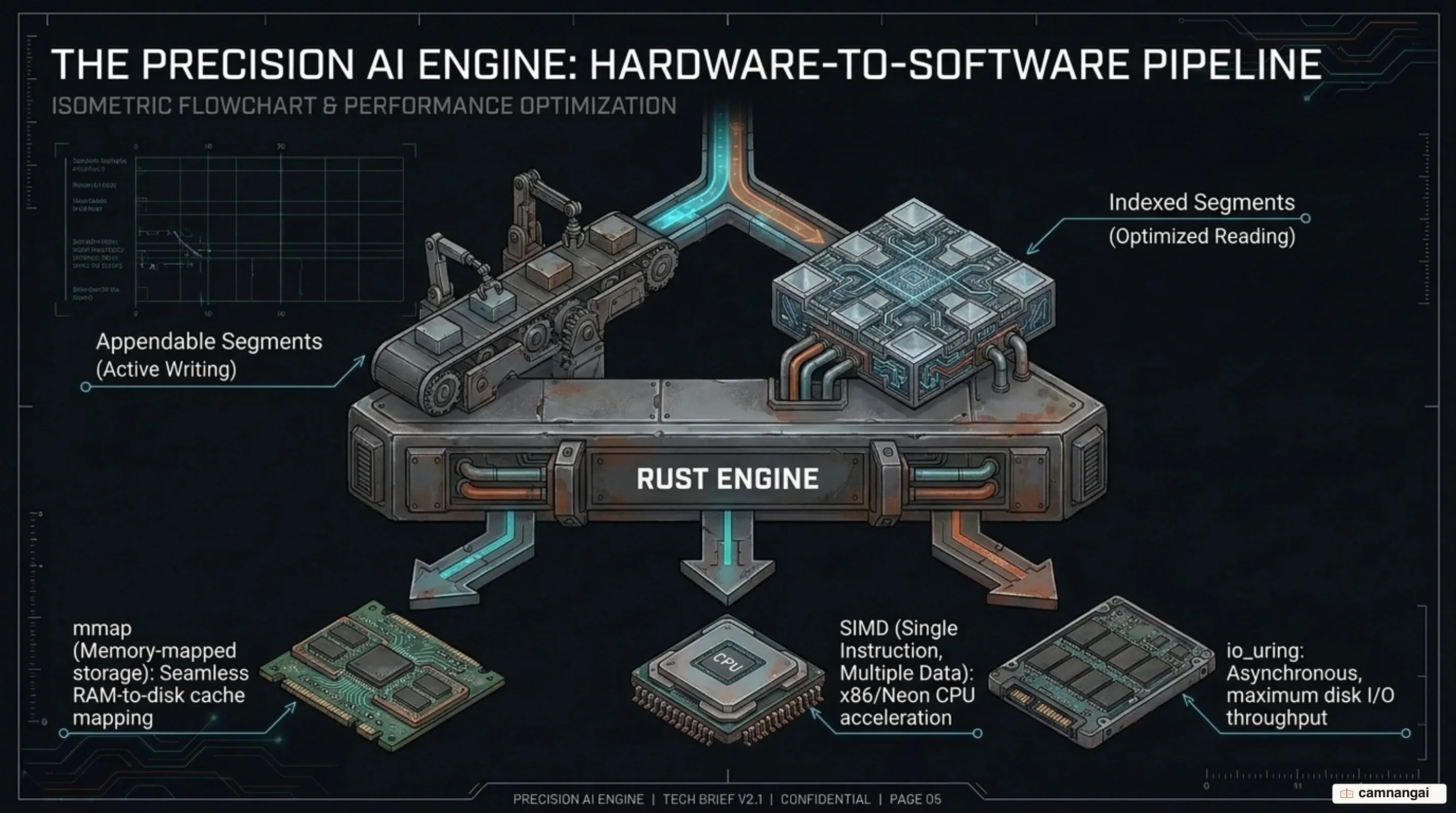
The storage engine processes write and read queries through a durable pipeline: incoming write requests enter via REST or gRPC, append immediately to a Write-Ahead Log (WAL) to guarantee durability across hardware crashes, and write into memory segments. Points are committed into immutable storage segments, while asynchronous background threads continuously manage segment merging, HNSW index generation, and storage cleanup without acquiring locks on active read channels.
To maximize disk and CPU throughput, Qdrant implements system-level hardware accelerations across the I/O path:
- Asynchronous Disk I/O: Employs
io_uringon modern Linux kernel versions, bypassing synchronous syscall overhead and maximizing network-attached or local NVMe storage IOPS. - SIMD Hardware Acceleration: Uses modern CPU vector instructions (x86-x64 AVX and ARM Neon) to parallelize floating-point vector distance calculations.
- GPU Index Building: Supports NVIDIA and AMD GPU hardware acceleration to speed up large-scale vector index construction.
- Memory-Mapped Storage Tiers: Provides memory-mapped (
mmap) file storage tiers, allowing datasets that exceed available system RAM to execute ANN searches directly off disk-backed storage.
Filterable HNSW: Combining metadata filtering with vector search
Standard Hierarchical Navigable Small World (HNSW) graph algorithms build multi-layer proximity graphs across vector datasets. During query processing, standard HNSW executes a greedy graph traversal, evaluating distance metrics between neighbor nodes to navigate toward the closest vector cluster relative to the query embedding.
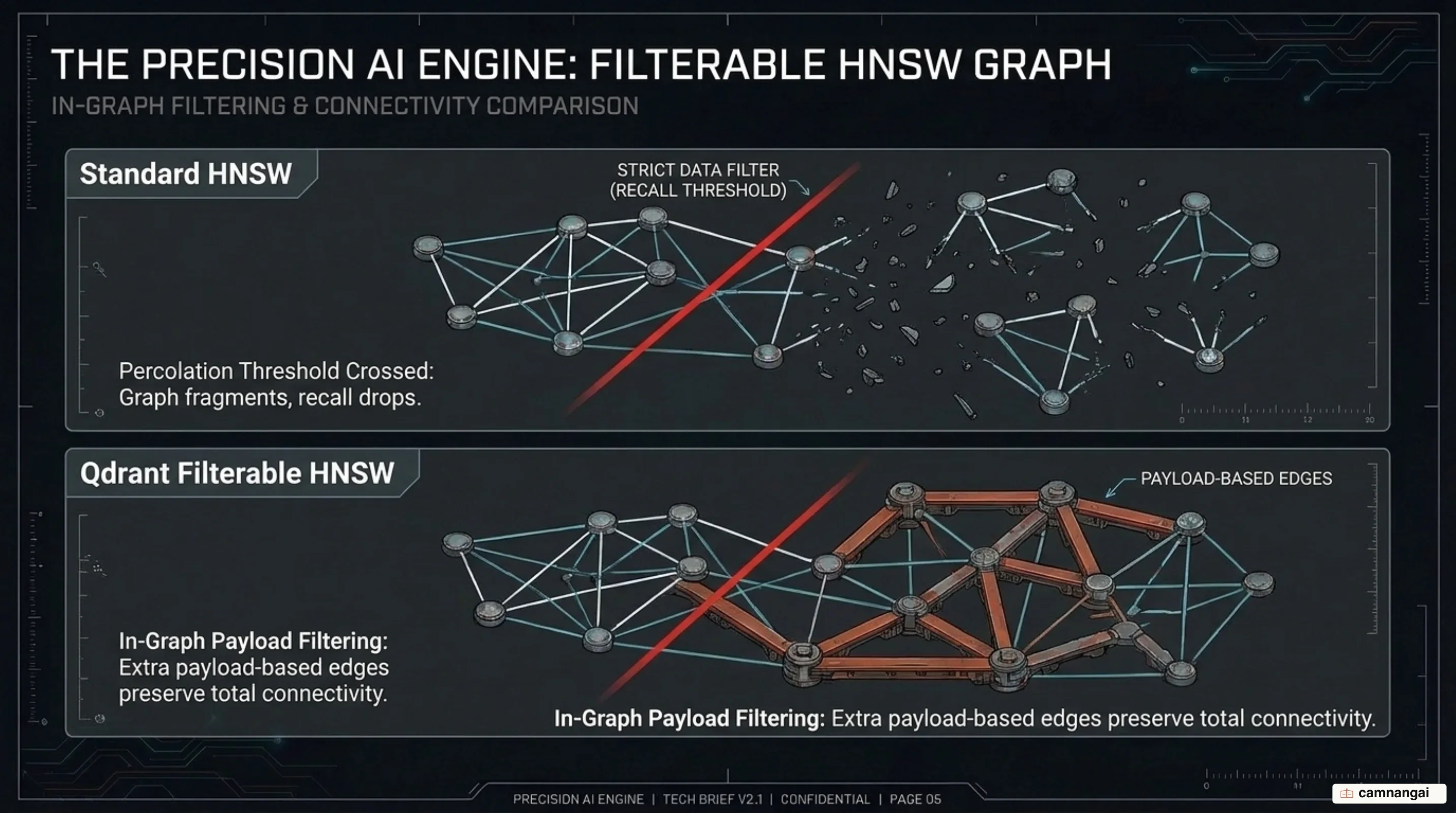
Executing naive post-filtering or standard node masking on HNSW graphs causes severe recall degradation. According to Percolation Theory, removing nodes from a random graph with average degree ⟨k⟩ disrupts global graph connectivity once remaining nodes fall below the critical percolation threshold p_c = 1 / ⟨k⟩. When metadata filters remove non-matching nodes on the fly during greedy traversal, the HNSW graph fragments into isolated components. Traversal paths get trapped in disconnected sub-graphs, causing precision@10 recall to drop precipitously.
Naive Filtering Graph Disconnection:
[Entry Point] ---> [Node A (Matches Filter)] ---> [Node B (Filtered Out)] -X-> [Node C (Matches Query)]
                                                         ^
                                           Traversal halts at Node B
Qdrant solves graph fragmentation by maintaining a filterable HNSW index architecture. During index construction, Qdrant builds explicit category-specific sub-graph edges across payload metadata attributes (which increases total edge overhead by no more than 2×) and establishes geohash neighbor bridges for spatial queries. During search execution, graph traversal navigates these pre-linked metadata bridges, maintaining complete graph connectivity across filtered attribute subsets without dropping precision recall.
Resource optimization: Vector Quantization and Hybrid Search
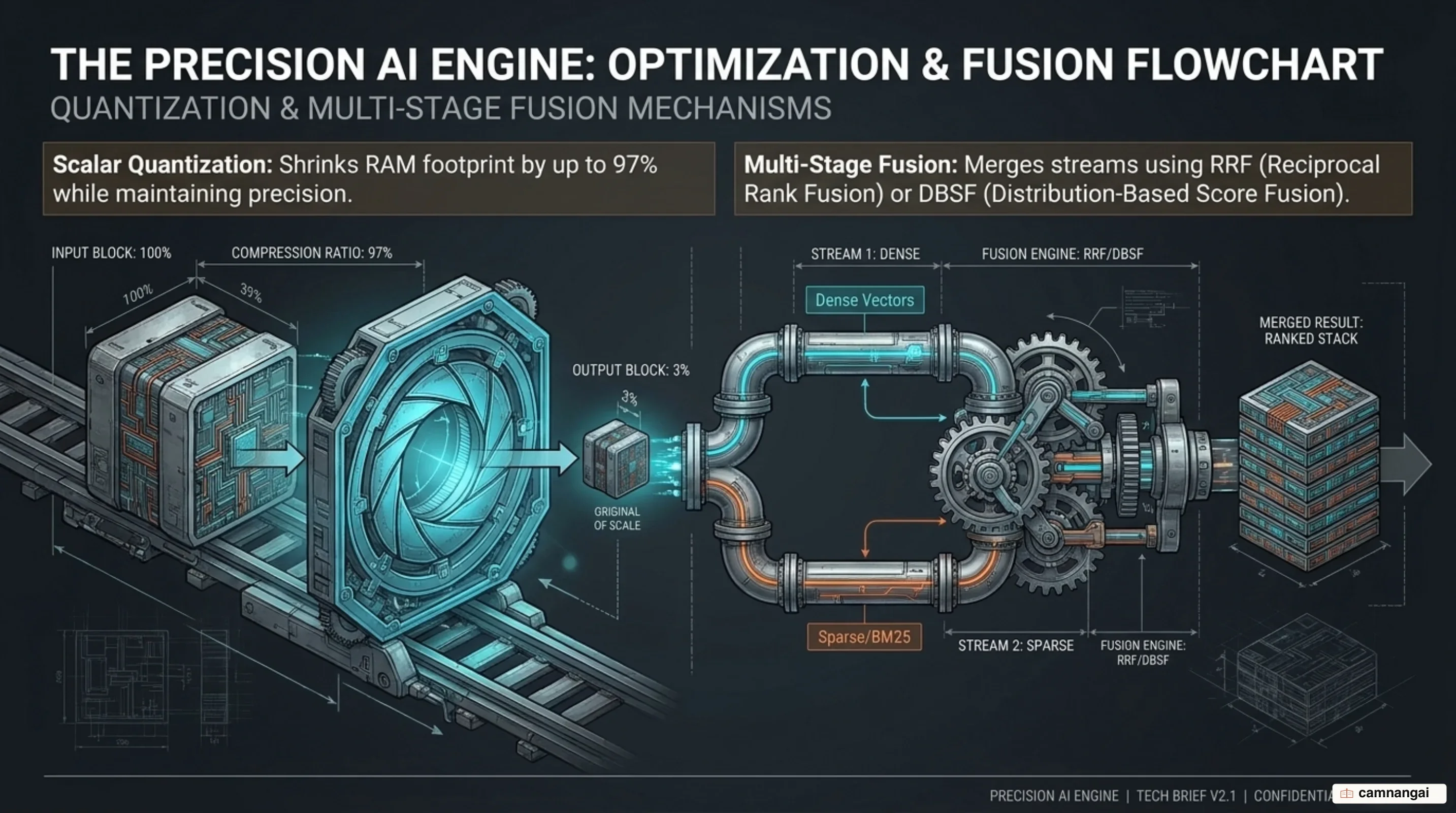
Storing millions of high-dimensional float32 vectors in system memory presents severe RAM cost constraints. Qdrant addresses memory scaling using built-in Vector Quantization, compressing float32 representations down to lower-bit formats (such as scalar or product quantization). Quantization reduces memory consumption by up to 97%, enabling you to balance memory footprint, query latency, and retrieval accuracy based on hardware limits.
Modern retrieval pipelines often require combining dense semantic vectors with sparse lexical tokens (such as SPLADE++) or BM25 text queries over payload fields with full-text indexes. Qdrant supports multi-stage hybrid search through its Query API using the prefetch parameter. Sub-requests defined in prefetch run candidate generation queries independently across vector fields, after which the main query fuses and re-scores candidate lists.
Prefetch Query Flow:
├── Prefetch 1: Sparse Vector / BM25 Query ──┐
│                                            ├──> Fusion Engine (RRF / DBSF) ──> Top Results
└── Prefetch 2: Dense Vector Query ──────────┘
Qdrant implements two mathematical scoring strategies for hybrid query fusion:
- Reciprocal Rank Fusion (RRF): Evaluates point rank positions (
r_d) across prefetch result lists. Qdrant uses zero-based rank indexing, where the top-ranked point hasr_d = 0. The scoring formula isscore(d) = \sum (w_r / (k + r_d)), wherekis a constant (defaulting to 2 or configured, e.g.,k=60) andw_rrepresents optional relative ranker weights. - Distribution-Based Score Fusion (DBSF): Normalizes raw scores across retrievers using the sample mean (
μ) and standard deviation (σ) within3σextreme bounds:ŝ = (s - (μ - 3σ)) / (6σ). Normalized scores are summed without clipping to[0,1], preserving relative score magnitude differences.
Selecting the correct fusion strategy depends on your evaluation infrastructure:
- Weighted RRF: Use when an evaluation dataset (query-document relevance pairs) is available to tune relative weights
w_ron a train/validation split. - DBSF: Use when retrievers produce well-calibrated raw score distributions and no ground-truth evaluation dataset exists.
- Standard RRF: Use as a zero-config baseline when score scales across retrievers are incompatible or uncalibrated.
The following Python snippet executes a hybrid query combining sparse and dense prefetch requests fused via parameterized RRF (k=60):
from qdrant_client import QdrantClient, models

client = QdrantClient(url="http://localhost:6333")

results = client.query_points(
    collection_name="text_collection",
    prefetch=[
        models.Prefetch(
            query=models.SparseVector(indices=[1, 42], values=[0.22, 0.8]),
            using="sparse",
            limit=20,
        ),
        models.Prefetch(
            query=[0.01, 0.45, 0.67],
            using="dense",
            limit=20,
        ),
    ],
    query=models.RrfQuery(rrf=models.Rrf(k=60)),
    limit=10,
)
Comparing Qdrant with Milvus, Pinecone, and Weaviate: Trade-offs and decision matrix
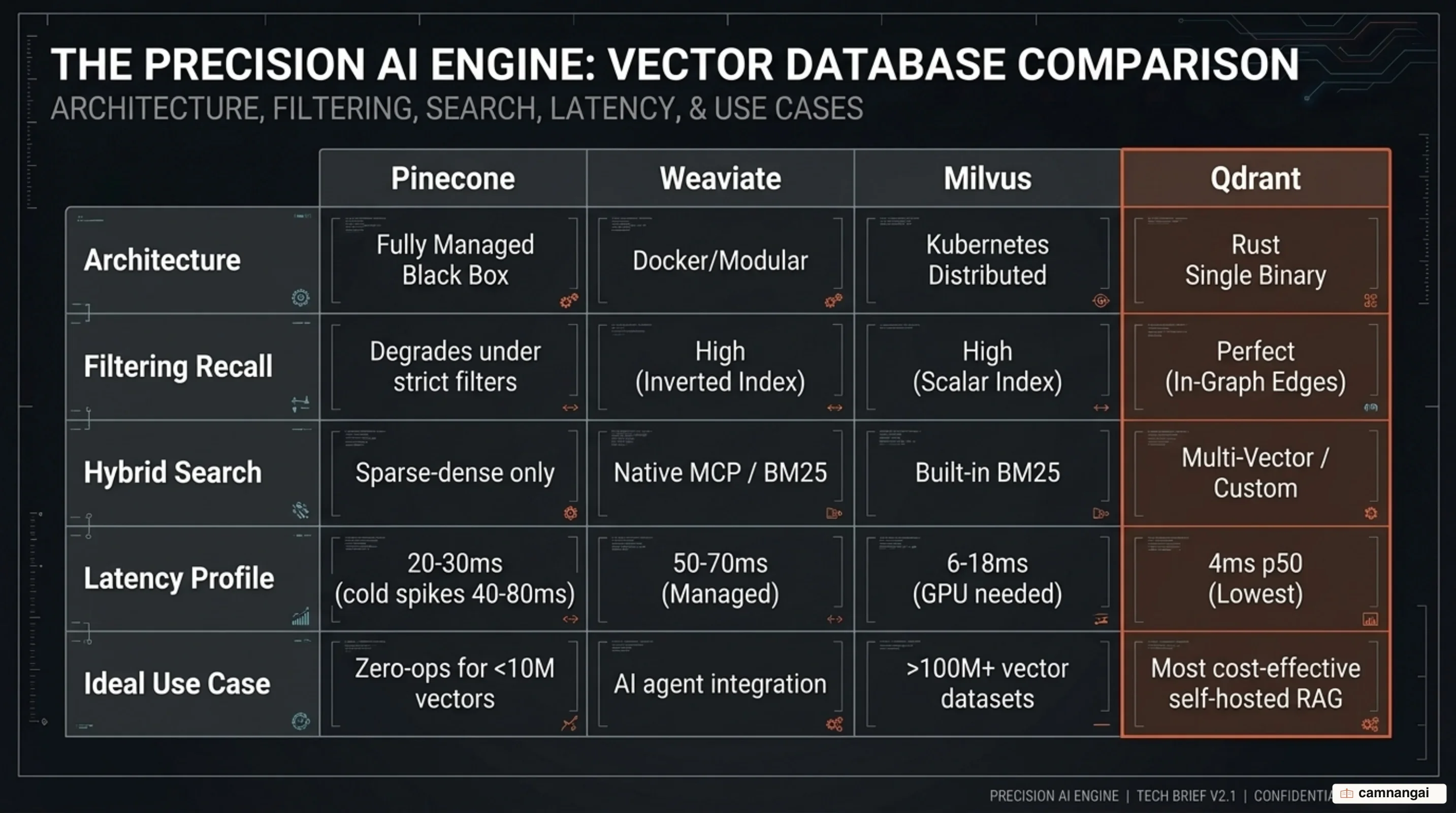
System architecture dictates operational complexity and resource consumption in vector database deployments. Qdrant operates as a unified, single-binary engine implemented in Rust, contrasting with multi-component microservice clusters like Milvus that require external orchestration layers, or managed-only platforms like Pinecone. This compiled single-binary design ensures low resource consumption, straightforward local debugging, and predictable search performance without garbage collection pauses.
Qdrant provides deployment flexibility across infrastructure boundaries, supporting self-hosted container environments (Docker, Kubernetes) alongside managed Qdrant Cloud tiers. For embedded or edge deployments, Qdrant Edge executes vector search in-process using EdgeShard, maintaining strict data locality on local hardware while supporting snapshot replication back to central Qdrant Server clusters.
| Feature / Architecture | Qdrant | Milvus | Pinecone | Weaviate |
|---|---|---|---|---|
| Core Language | Rust (89.6%) | C++ / Go | Proprietary | Go |
| Deployment Mode | Self-hosted, Cloud, Embedded Edge | Self-hosted (Kubernetes), Managed | Fully Managed (SaaS) | Self-hosted, Managed Cloud |
| In-Process Engine | Supported (EdgeShard) | Lite (local file) | Not supported | Embedded mode |
| RAM Quantization | Supported (Up to 97% reduction) | Supported (SQ8, PQ) | Proprietary Serverless | Supported (PQ, BQ) |
| Hybrid Search Fusion | RRF & DBSF | Reciprocal Rank Fusion | Hybrid alpha weighting | BM25 + Dense vector fusion |
| Native API Protocols | REST (OpenAPI 3.0) & gRPC | gRPC / REST | REST SDKs | GraphQL, REST, gRPC |
Getting started with Qdrant: From Docker to Python queries
Deploying Qdrant for development or production requires choosing between server-based container execution and in-process edge execution. Local server deployments spin up inside Docker containers, presenting immediate REST and gRPC endpoints for client connection.
The standard local workflow involves starting the container instance, connecting via the qdrant_client Python SDK, and running hybrid queries across indexed dense or sparse collections.
Step 1: Starting Qdrant Server with Docker
Run the official Qdrant Docker container to expose REST endpoints on port 6333:
docker run -p 6333:6333 qdrant/qdrantStep 2: Querying Qdrant Server with Python
Connect to the running container using qdrant_client to execute a multi-stage prefetch query fused via reciprocal rank fusion:
from qdrant_client import QdrantClient, models

client = QdrantClient(url="http://localhost:6333")

response = client.query_points(
    collection_name="articles",
    prefetch=[
        models.Prefetch(
            query=models.TextQuery(text="time travel"),
            using="title",
            limit=20,
        ),
        models.Prefetch(
            query=[0.01, 0.45, 0.67],
            using="dense",
            limit=20,
        ),
    ],
    query=models.RrfQuery(rrf=models.Rrf(k=60)),
    limit=10,
)
Step 3: Embedded Local Execution with Qdrant Edge
For resource-constrained, offline, or embedded applications, use qdrant_edge to initialize an in-process local shard without running an external server process:
from qdrant_edge import Distance, EdgeConfig, EdgeVectorParams, EdgeShard, Point, UpdateOperation

shard = EdgeShard.create("./shard", EdgeConfig(
    vectors={"my-vector": EdgeVectorParams(size=4, distance=Distance.Cosine)}
))

shard.update(UpdateOperation.upsert_points([
    Point(id=1, vector={"my-vector": [0.1, 0.2, 0.3, 0.4]}, payload={"color": "red"})
]))
Where Qdrant fits in modern AI infrastructure
Choose Qdrant when building systems that demand high-concurrency vector similarity search, deep JSON payload filtering without recall degradation, and strict memory efficiency. Its Rust engine architecture, transactional Write-Ahead Logging, and low-level optimizations (io_uring, SIMD, GPU-accelerated indexing, memory-mapped files) provide a durable infrastructure base for semantic retrieval, extreme classification, and RAG workloads.
Qdrant supports operational requirements from embedded on-device applications (qdrant_edge) to multi-node self-hosted clusters and fully managed Qdrant Cloud deployments. With built-in vector quantization reducing memory consumption by up to 97% alongside native RRF and DBSF query fusion, Qdrant delivers high performance and resource control across high-dimensional vector search applications.
References
- Overview — Qdrant Vector Search Engine Documentation
- Quickstart — Getting Started with Qdrant
- Filtrable HNSW: Fast Vector Search with Arbitrary Conditions — Qdrant
- Indexing & Storage Architecture — Qdrant Documentation
- Scalar Quantization for Vector Search — Qdrant
- Hybrid Queries & Search Combinations — Qdrant Documentation
- Qdrant: Open-Source Vector Search Engine & Vector Database (Rust)
- Pinecone vs Weaviate vs Milvus vs Qdrant: Which Vector DB in 2026? — DEV Community