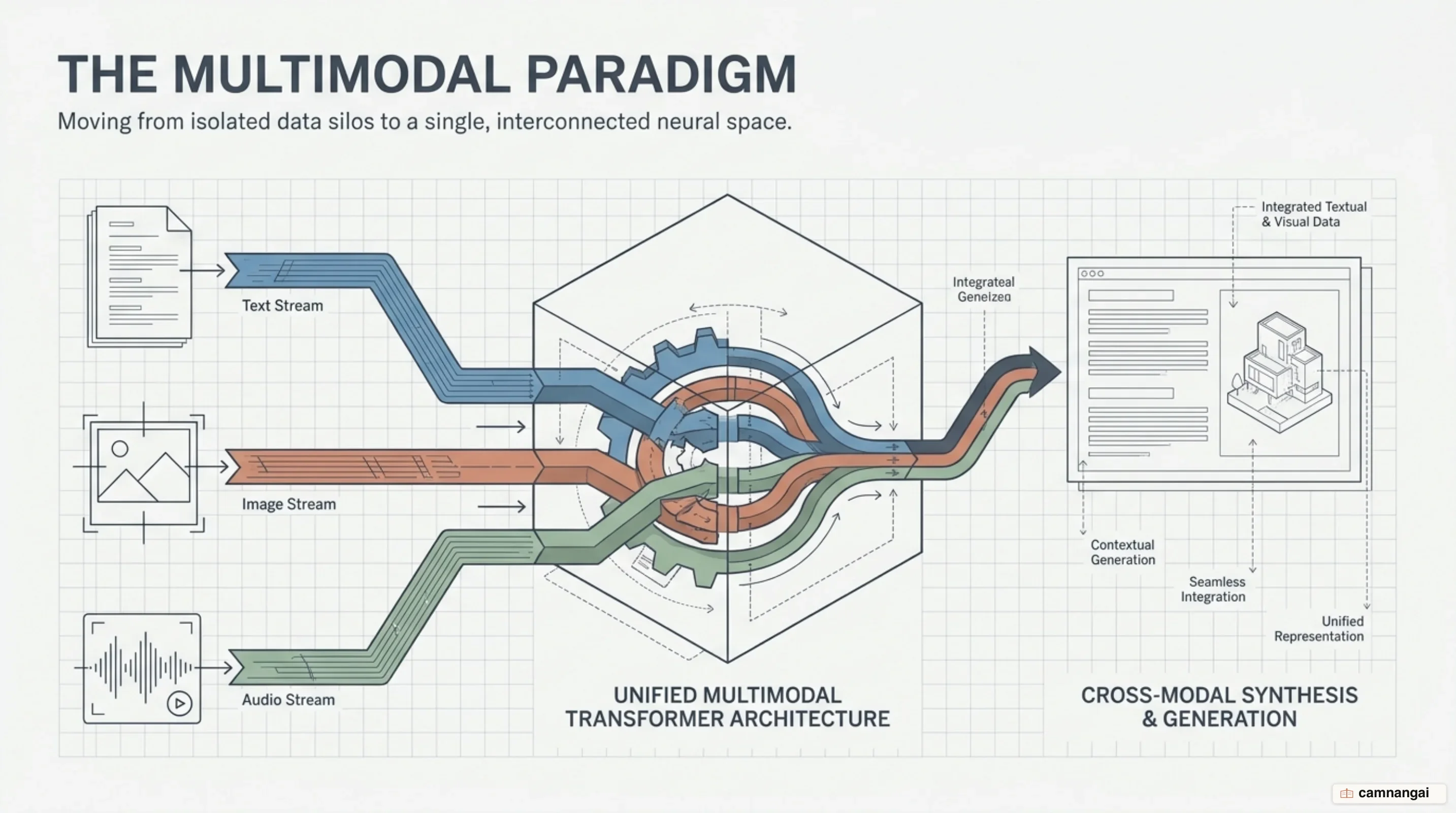
Multimodal AI refers to architectures engineered to process, align, and reason across multiple distinct modalities—including text, vision, and audio—within a unified neural framework.
Rather than relying on isolated text-only (LLMs), engineering teams deploy architectures to capture cross-modal context, allowing models to reason directly over visual layouts, architectural diagrams, and raw sensory signals alongside unstructured text.
As an AI engineer handling these systems in production, your operational objective shifts from stitching together discrete computer vision tools to evaluating unified multimodal transformers. This transition requires a firm technical grasp of patch tokenization, dynamic visual scaling, cross-modal alignment, and production economics.
Mastering patch tokenization, cross-modal embedding alignment, and visual token economics is what separates a fragile prototype from a performant, cost-effective multimodal system in production.
What is Multimodal AI? The Core Shift from Unimodal Systems
Traditional unimodal architectures operated exclusively on isolated data modes: text-only LLMs modeled token sequences, Convolutional Neural Networks (CNNs) detected objects on pixel grids, and Automatic Speech Recognition (ASR) engines transcribed waveforms into strings. In contrast, Large Multimodal Models (LMMs) ingest, align, and process multiple data modalities simultaneously within a unified neural framework.
At the hardware and data layer, any digital signal can ultimately be approximated as continuous vectors or discrete bitstrings:
- Audio signals can be converted into visual mel-spectrograms or discrete audio tokens.
- Images are partitioned into spatial patch vectors and projected into hidden vector dimensions.
- Video streams are ingested as temporal sequences of visual image frames synchronized with audio tracks.
Among these modalities, visual inputs represent one of the richest information channels because a single image can encode text, tabular layouts, mathematical diagrams, and spatial hierarchies simultaneously.
Multimodal engineering tasks divide into two primary operational domains:
- Generation: Text-to-image synthesis, visual question answering (VQA), and automated image captioning.
- Vision-Language Understanding (VLU): Non-generative tasks, including zero-shot visual classification, text-based image retrieval (TBIR), and image-to-text cross-modal search over large .
Deploying multimodal models allows software teams to build natural human-computer interfaces—letting users interact via speech, screen captures, or real-time camera streams in a single unified session.
From Stitched Pipelines to Native Multimodality
Early multimodal applications relied on chained pipelines. In those legacy architectures, an isolated Optical Character Recognition (OCR) library or computer vision model extracted raw text strings from an image, which were subsequently concatenated into a standard LLM prompt window.
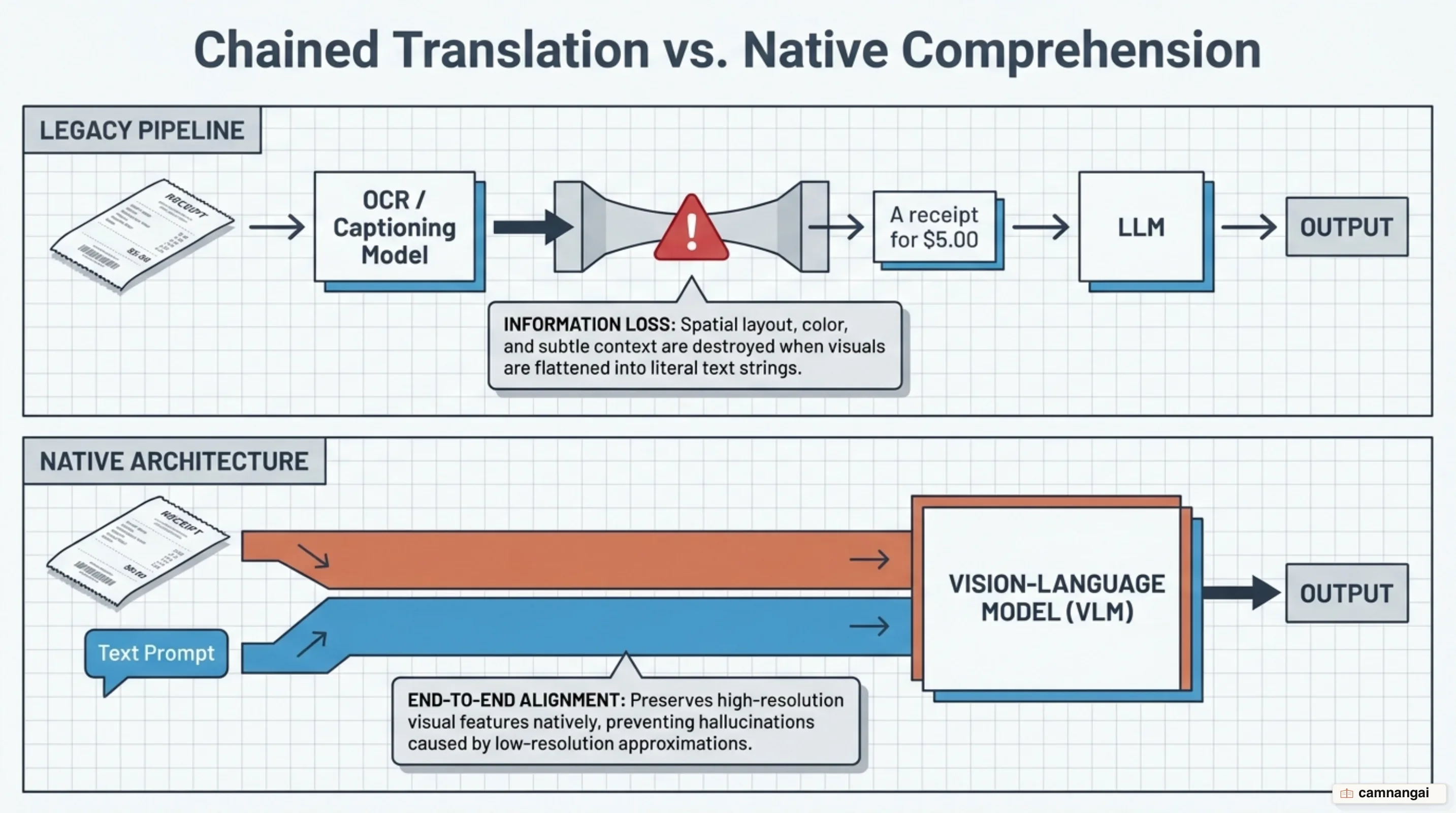
Chained pipelines present three severe structural failure modes:
- Error Propagation: If the upstream OCR tool misreads numerical coordinates or characters in a financial chart, the downstream language model reasons over flawed premises with no way to inspect the original pixels.
- Latency Penalties: Passing data sequentially through multiple discrete models, network hops, and serialization formats dramatically inflates time-to-first-token (TTFT).
- Destruction of Visual Context: Pure text strings completely discard spatial relationships, font weights, color coding, coordinate alignments, and graphical cues.
| Technical Dimension | Chained Pipelines (Stitched Architecture) | Native Multimodal (Integrated Architecture) |
|---|---|---|
| Processing Paradigm | Independent Vision/OCR tools $\to$ Text LLM | Unified Transformer attention mechanisms |
| Context Retention | Low (discards layout, styling, and geometry) | High (preserves spatial coordinates and visual attributes) |
| Payload Latency | High (sequential multi-model inference hops) | Optimized (direct end-to-end tensor forwarding) |
| Zero-Shot Reasoning | Constrained by individual sub-tool capabilities | Superior generalization across unseen vision-language tasks |
Foundational research like OpenAI's CLIP (2021) and DeepMind's Flamingo (2022) established the blueprint for Native Multimodal architectures. Instead of relying on intermediate text approximations, native multimodal systems ingest visual tokens directly into self-attention and cross-attention layers, reasoning over images and text concurrently.
Inside the VLM Architecture: How Visual Inputs Become Tokens
To feed 2D images into an autoregressive transformer decoder, Vision-Language Models (VLMs) deploy dedicated vision encoders—most commonly Vision Transformers (ViT, e.g., ViT-L/14@336px) or NormalizerFree ResNets (such as NFNet-F6).
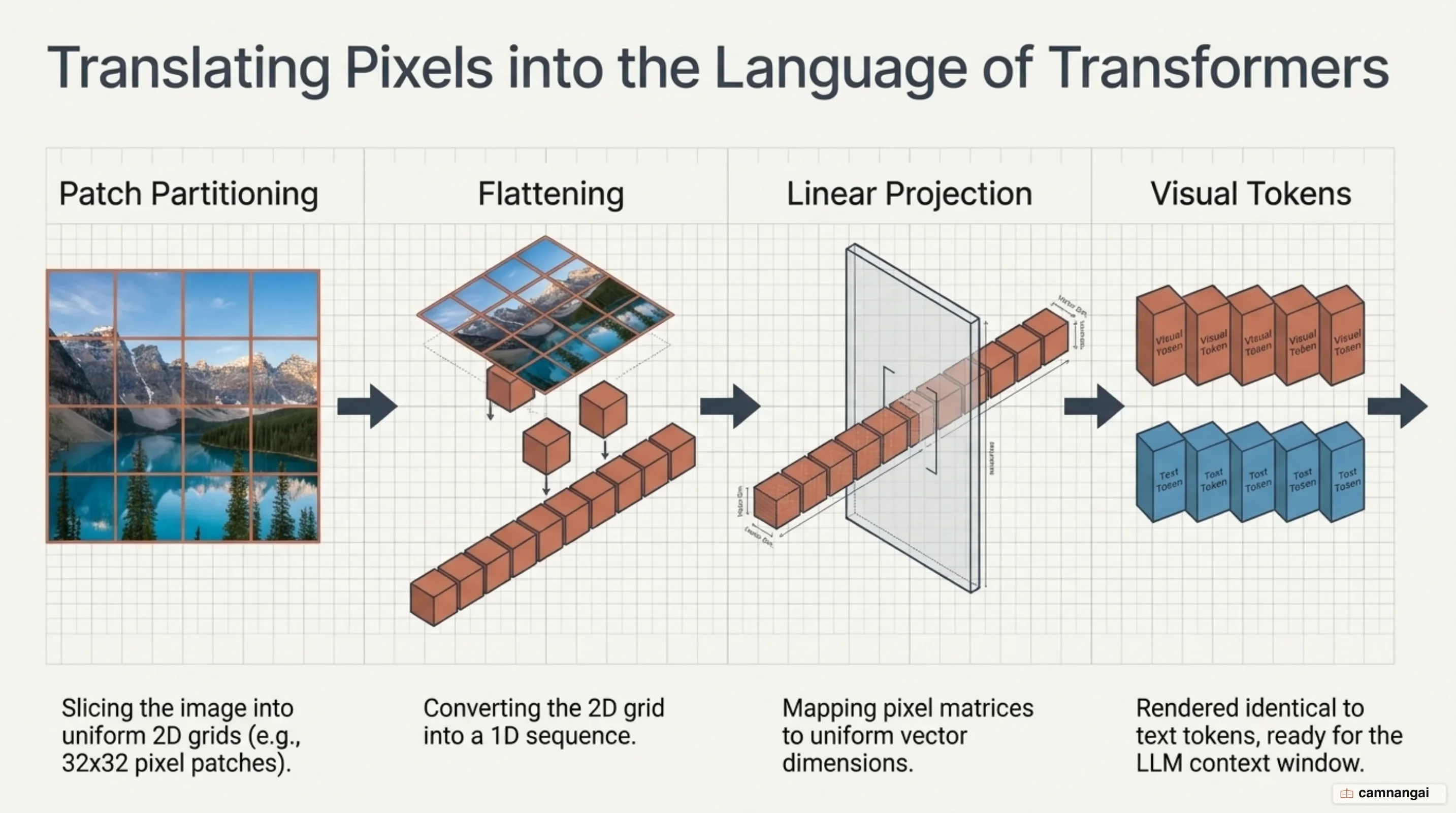
The transformation of continuous image pixels into discrete transformer tokens follows four mathematical steps:
- Tensor Ingestion: An image enters the pipeline as a 3D tensor of shape
C x H x W, whereCrepresents channels (3 for RGB),His height, andWis width. - Spatial Patching: The image is partitioned into
Nnon-overlapping spatial patches of sizeP x Ppixels (typically14 x 14or32 x 32), whereN = floor(H / P) * floor(W / P). - Patch Flattening: Each patch of dimension
C x P x Pis unrolled into a 1D vector of lengthP^2 * C. Flattening all patches creates an input matrix of shapeN x (P^2 * C). - Linear Embedding Projection: A linear projection matrix
Wof dimension(P^2 * C) x Dmaps each flattened patch vector into the language model's hidden dimensionD. Adding learnable spatial positional embeddings produces a visual token sequence of tensor shapeN x D.
patch_count = ceil(image_width / patch_size) * ceil(image_height / patch_size)In production, resizing high-resolution documents to fixed square dimensions (such as 336px x 336px) destroys fine details and induces severe OCR . To solve this, architectures like LLaVA-NeXT implement Dynamic High Resolution (AnyRes). AnyRes divides high-resolution images into flexible patch grids matching natural aspect ratios—such as 2x2, 1x2, 2x1, 1x3, 3x1—alongside a downscaled thumbnail overview. This preserves small diagram labels without quadratic computational blowups.
However, generating thousands of visual tokens rapidly consumes Key-Value (KV) cache memory. A single dense document image can yield over 2,000 visual tokens, consuming as much KV-cache context as a 1,500-word text prompt. To prevent memory exhaustion during long-context or video processing, architectures like Flamingo incorporate a Perceiver Resampler, which applies cross-attention over learned latent queries to compress arbitrary visual feature maps into a fixed grid of exactly 64 visual tokens per frame.
Cross-Modal Alignment: Shared Vector Spaces and Projection Layers
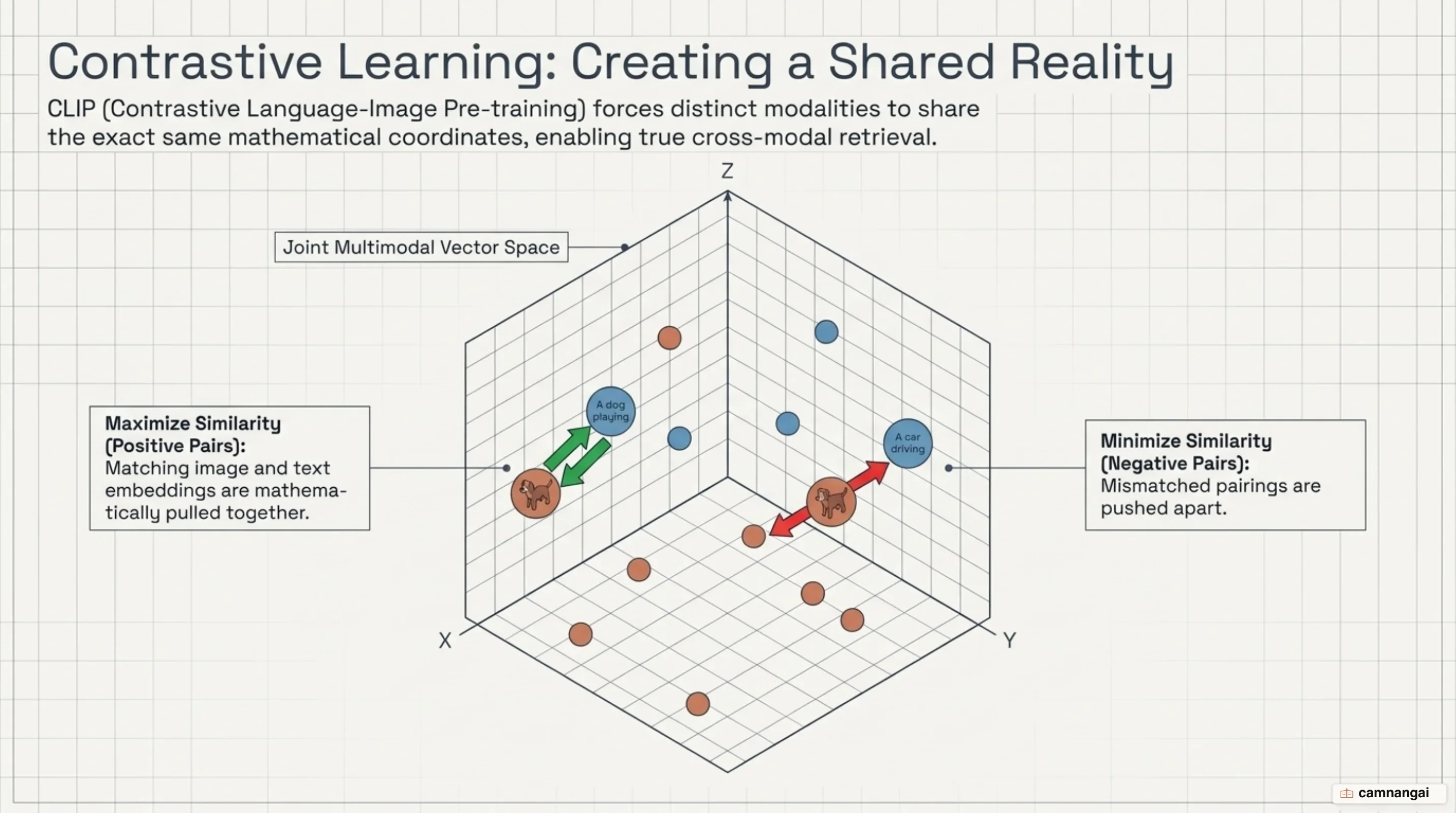
The central engineering challenge of Multimodal AI is aligning representations across disparate modalities so that the visual embedding of an object maps to the semantic neighborhood of its text description.
Contrastive Learning with CLIP
CLIP achieved zero-shot visual alignment by pre-training a text transformer and a vision transformer across 400 million image-text pairs. Projection matrices W_v and W_l project visual features V_i and textual features L_i into a normalized vector space.
Across a mini-batch of N pairs (N = 32,768), the model maximizes the cosine similarity of the N true pairs while penalizing N^2 - N incorrect combinations using symmetric cross-entropy loss functions parameterized by inverse temperature beta:
L_txt2im = -(1/N) * sum_i log( exp(L_i^T * V_i / beta) / sum_j exp(L_i^T * V_j / beta) )
L_im2txt = -(1/N) * sum_i log( exp(V_i^T * L_i / beta) / sum_j exp(V_i^T * L_j / beta) )
Connector Topologies: Projecting Features into LLMs
To feed vision encoder outputs into a generative LLM backbone, engineers employ three primary projection connector patterns:
- Linear Projections & MLPs: Used in LLaVA to project vision features directly into the token embedding dimension of the language model. While lightweight and parameter-efficient, achieving strong instruction following requires fine-tuning the underlying language model backbone.
- Gated Cross-Attention (Flamingo): Keeps both the vision encoder and language model backbone completely frozen during training. Gated cross-attention layers (
GATED XATTN-DENSE) interleaved throughout the language transformer allow the model to attend to visual tokens without overwriting pretrained linguistic weights. - Q-Formers & Adapters: Bottleneck transformer networks (such as BLIP-2's Q-Former) that use a set of learned query vectors to selectively query the visual features, translating them into dense conditioning prefixes for frozen LLMs.
Cost and Performance in Production: Image Token Math and Dynamic Tiling
In production APIs, visual payloads are converted into billable input tokens that consume rate limits (Tokens Per Minute / TPM) and context memory.
Patch-Based Image Tokenization
Modern multimodal model APIs utilize 32px x 32px patch grids. Initial patch counts follow spatial coverage:
patch_count = ceil(width / 32) * ceil(height / 32)When an image exceeds the detail level's patch budget (e.g., 2,500 patches for high detail), the API resizes the image using a calculated shrink_factor:
shrink_factor = sqrt((32^2 * patch_budget) / (width * height))After integer rounding adjustments via adjusted_shrink_factor, the final patch count is multiplied by the provider's token multiplier (typically 1.2x):
billable_tokens = ceil(resized_patch_count * model_multiplier)| Image Dimensions | Detail Parameter | Patch Grid Count | Approximate Billable Tokens |
|---|---|---|---|
| 512 x 512 px | low | 256 patches | 85 – 307 tokens |
| 1024 x 1024 px | high | 1,024 patches | ~1,229 tokens |
| 2048 x 2048 px | high | 2,500 patches (scaled) | ~3,000 tokens |
Hard Limits and Pre-Processing: If an image requires more than 30,000 patches after processing, API endpoints reject the request with an HTTP 400 error. Production pipelines must deploy upstream microservices (using Pillow, Sharp, or OpenCV) to inspect incoming image dimensions, calculate patch footprints, and downscale oversized assets before dispatching API requests.
Legacy Tile-Based Calculations
Older vision models calculated billing using base overhead tokens plus fixed costs per 512px x 512px tile (e.g., 85 base + 170 tokens per tile). Images were scaled within a 2048px x 2048px bounding box, then scaled such that the shortest edge measured 768px before tiling.
Engineering Multimodal Applications: Prompts, API Payloads, and Multimodal RAG
Building production multimodal applications involves structuring multipart JSON payloads, ordering prompt contents, and architecting retrieval systems.
Standard API Payload Structure
The snippet below demonstrates a structured JSON payload for a multimodal endpoint accepting interleaved text instructions and visual inputs:
{
  "model": "gpt-6-astra",
  "messages": [
    {
      "role": "user",
      "content": [
        { "type": "text", "text": "Analyze this system architecture diagram:" },
        {
          "type": "image_url",
          "image_url": {
            "url": "data:image/jpeg;base64,...",
            "detail": "high"
          }
        }
      ]
    }
  ]
}
In multimodal prompt engineering, content ordering matters: always place image content blocks before text instruction blocks. Positioning visual tokens ahead of text allows the model's attention mechanism to fully ingest the visual grounding context before parsing specific queries.
Multimodal Retrieval-Augmented Generation (RAG)
When building RAG systems over visual corpora (such as technical manuals, diagrams, and slide decks), engineers select between two primary retrieval designs:
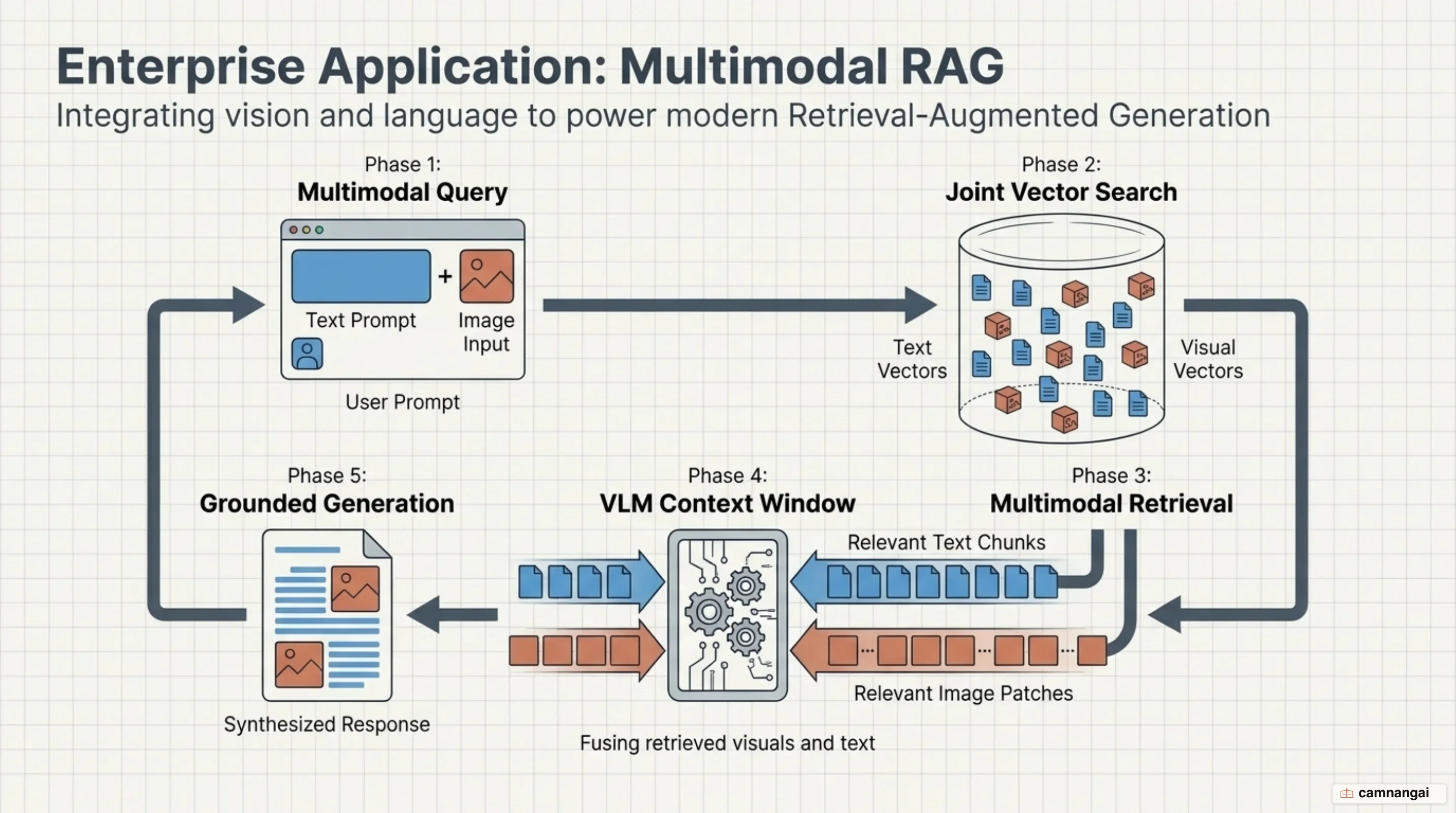
- Captioning & Metadata Extraction Pipelines: Pass visual assets through dedicated VLM captioners to generate dense text descriptions, tables, and OCR strings, indexing the output into standard text vector databases. This leverages existing search infrastructure but sacrifices nuanced spatial and aesthetic information.
- Joint Vector Search (Shared Embedding Space): Embed raw images and text queries into the same vector space using multimodal models like CLIP. When a user submits a query, cosine similarity search retrieves the top-$k$ relevant visual nodes directly, passing the raw image blocks to the downstream multimodal LLM for final synthesis.
Technical Pitfalls and the Multimodal Attack Surface
Deploying multimodal systems introduces distinct technical failure modes and security risks absent from text-only pipelines:
- Small Text and Non-Latin Characters: Model OCR accuracy drops significantly on complex scripts (such as Japanese, Arabic, and Korean) or fine document print.
- Spatial Reasoning and Precision: Models frequently struggle with fine-grained coordinate mapping, distinguishing solid vs. dashed chart curves, or outputting exact pixel bounding boxes.
- Geometric Distortions: Panoramic images, wide-angle fisheye lenses, and inverted orientations frequently confuse visual reasoning modules.
On the security frontier, Multimodal AI introduces critical attack vectors:
- Visual Prompt Injections: Adversaries can embed white-on-white text, micro-scale instructions, or subtle adversarial perturbations inside uploaded images. When processed by the vision encoder, these hidden instructions override system prompts and hijack model execution.
- Visual PII and Data Leakage: Uploaded images often contain unredacted personal information, faces, or confidential internal screen captures. Pipelines must implement client-side or gateway-level redaction before forwarding visual assets to external APIs.
- Automated Abuse Guardrails: Commercial API providers maintain active filters that automatically detect and reject CAPTCHA images to prevent automated bot exploitation.
When Should an AI Engineer Deploy Multimodal Models?
Deploy Native Multimodal models when application logic depends on:
- Spatial document understanding (multi-column layouts, tables, and receipts where text-only parsing fails).
- Direct chart, diagram, and architectural schematic analysis.
- Visual agent automation (Computer Use / GUI Agents) where screen coordinates and visual state transitions dictate decision logic.
Conversely, stick with text-only LLMs when your input data is already structured, tabular, or purely textual. Ingesting unnecessary visual assets inflates API token costs five- to ten-fold, introduces multi-second latency overheads, and expands the system's attack surface.
References
- Multimodality and Large Multimodal Models (LMMs) — Chip Huyen
- Vision Language Models Explained — Hugging Face
- Gemini: A Family of Highly Capable Multimodal Models — arXiv
- LLaVA-NeXT: Improved reasoning, OCR, and world knowledge — LLaVA
- Vision with Claude — Anthropic Documentation
- Images and Vision Guide — OpenAI Platform
- Multimodal Concepts — LangChain Documentation
- What is Multimodal AI? — IBM Think