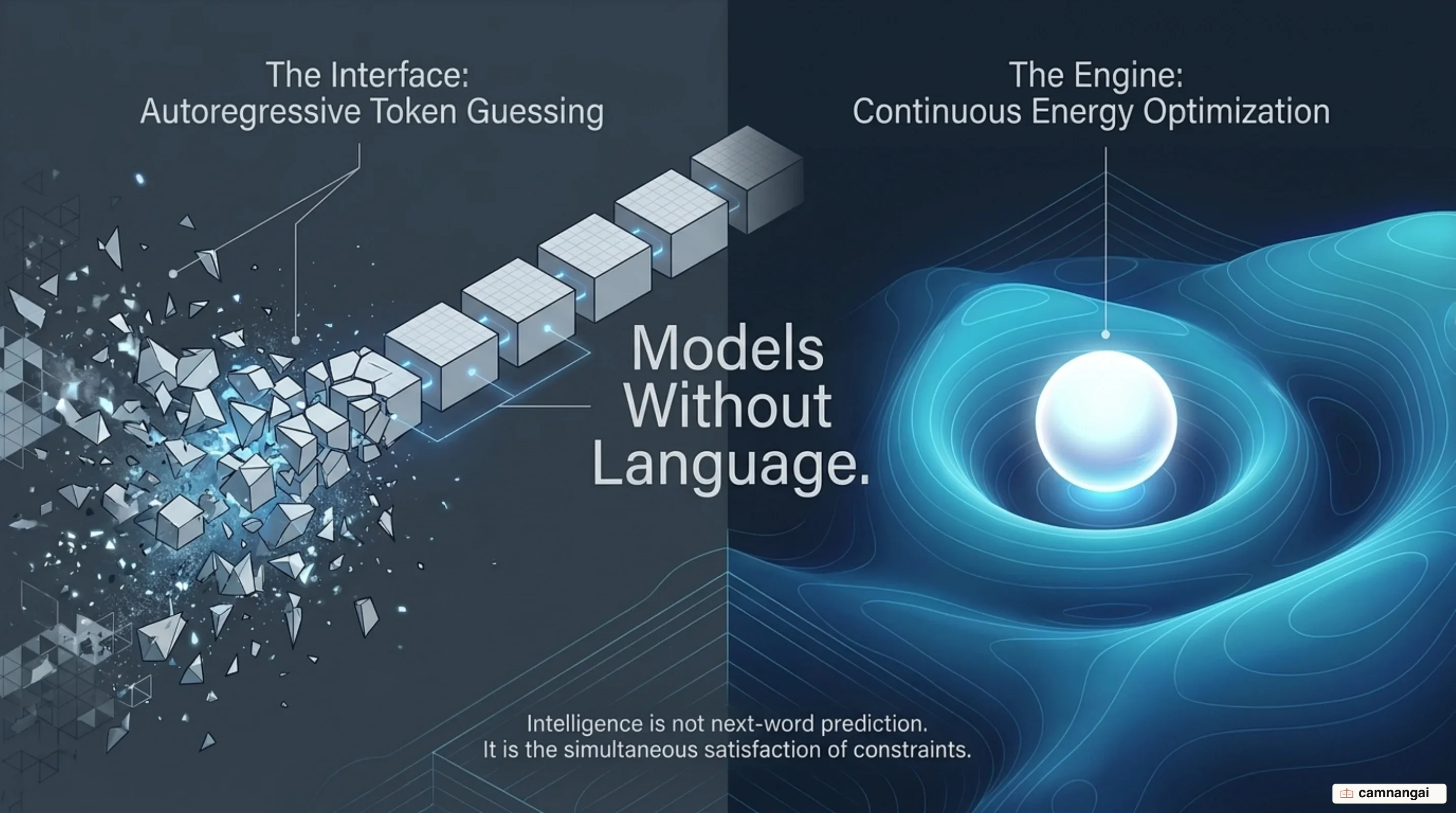
To achieve non-linguistic reasoning without autoregressive token generation, you must replace step-by-step token prediction with continuous optimization over energy-based models, evaluating the global compatibility of input states X and candidate solution states Y by computing a scalar energy E(Y, X). Instead of factorizing joint probabilities into a causal sequence of discrete dictionary tokens, energy-based models score entire configurations simultaneously. Inference becomes an explicit energy minimization problem, such as running gradient descent directly within representation space to locate state vectors that minimize energy, eliminating cumulative token-decoding errors in constrained logical and spatial domains.
Autoregressive architectures impose an artificial unidirectional temporal sequence on problems that are fundamentally non-sequential. When you force a system to express multi-dimensional spatial layouts, formal proofs, or physical control paths as string tokens, the underlying dependencies are obfuscated. Non-linguistic architectures avoid this abstraction layer by operating directly on structured representations.
By optimizing a continuous scalar energy surface rather than sampling discrete probability distributions over text tokens, energy minimization allows for deterministic, highly scalable constraint satisfaction. Reasoning is executed as a dynamical search through latent spaces, establishing a foundation for autonomous systems and verified logical engines.
Why autoregressive language models fail at constraint satisfaction
Autoregressive language models formulate inference as sequence generation, factorizing joint output probabilities into a product of conditional probabilities over discrete tokens:
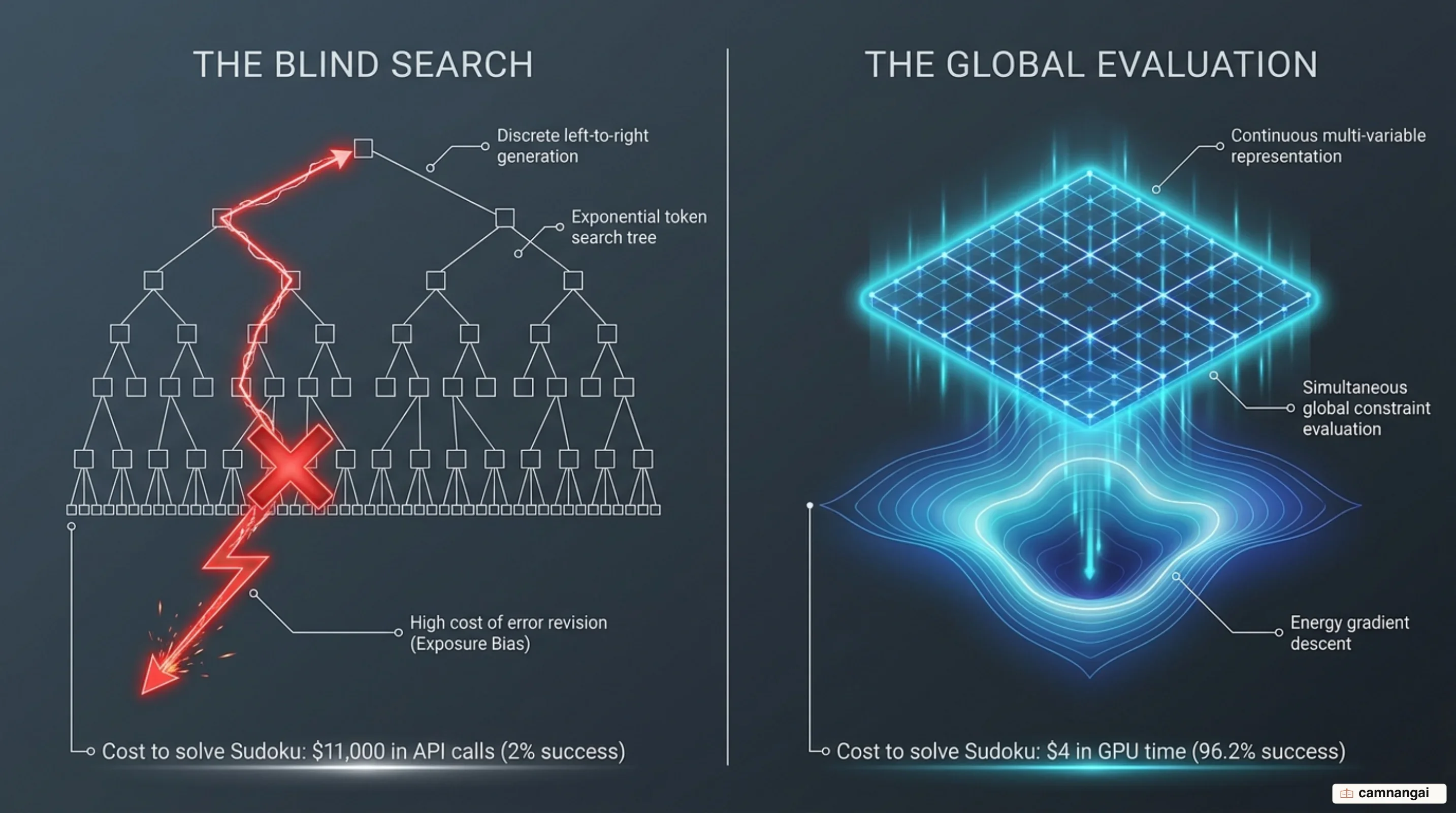
P(Y|X) = ∏ P(y_t | y_0, ..., y_{t-1}, X)When you apply this paradigm to hard constraint satisfaction problems—such as Sudoku grids, multi-step formal logic, or physical trajectory planning—the architecture encounters fundamental structural limits. Token-by-token decoding forces a strict causal sequence that cannot natively evaluate global compatibility across complex, interconnected constraint sets. The model cannot backtrack or revise previously emitted tokens without generating auxiliary natural language tokens, turning spatial and structural reasoning into a high-dimensional text generation search problem.
This sequential factorization induces severe error accumulation during extended inference. In a long token generation sequence, a single misallocated token generated early in the decoding process permanently alters the attention context window. Because autoregressive transformers optimize for probabilistic sequence likelihood P(y_t | y_0, ..., y_{t-1}) rather than functional correctness or structural constraint validity, the probability of selecting an invalid token grows exponentially with sequence depth. The model continues to generate syntactically plausible sequence continuations conditioned on its own prior missteps, cascading into logical fallacies, physical impossibilities, and hallucinated proofs.
Non-probabilistic scoring systems handle global constraints by decoupling candidate generation from probability distribution normalization. Structured tasks—including image restoration, face detection, sequence alignment, and combinatorial puzzle solving—require evaluating prospective multi-dimensional solutions Y holistically against inputs X. By evaluating inputs X and prospective outputs Y simultaneously, energy gradients can propagate across all spatial, physical, or logical variables concurrently. This holistic evaluation eliminates the artificial requirement to impose a causal, left-to-right ordering on variables that are fundamentally non-sequential, ensuring that every global constraint in the problem space is satisfied before producing an output state.
Energy-based models: mathematical foundations and the energy landscape
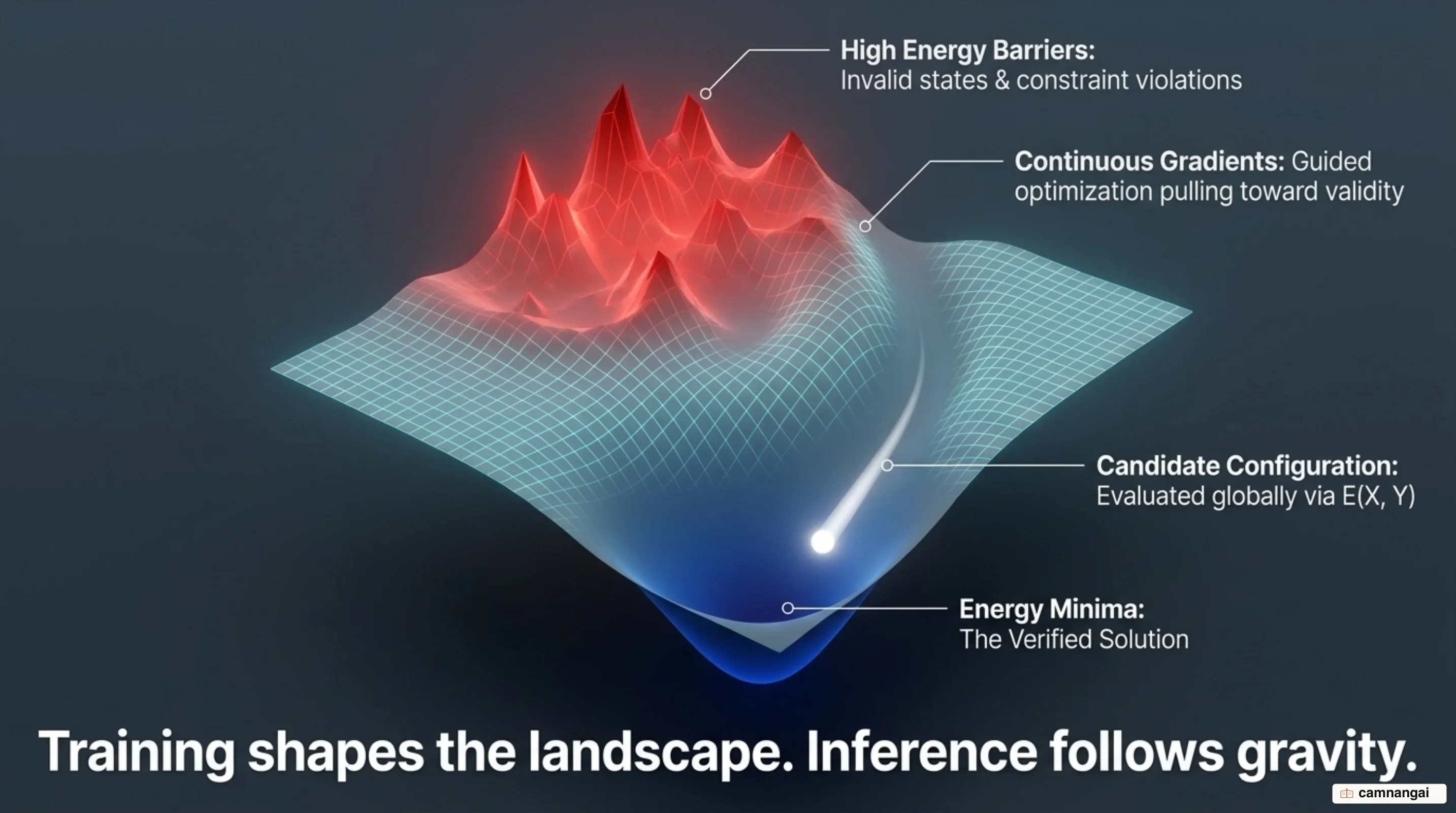
Energy-Based Models (EBMs) capture dependencies between observed variables X and output variables Y by defining a scalar energy function E(W, Y, X), where W represents trainable system parameters. The magnitude of the energy measures incompatibility: low energy values indicate highly compatible configurations, while high energy values designate incompatible or invalid configurations. Within this framework, inference is formally defined as finding an output configuration Y* from the domain 𝒴 that minimizes the energy function for an observed input vector X:
Y* = argmin_{Y ∈ 𝒴} E(W, Y, X)To convert an unnormalized scalar energy surface into a probabilistic framework, you map the energy values to a conditional probability density using the Gibbs distribution:
P(Y|X) = exp(-β · E(W, Y, X)) / ∫ exp(-β · E(W, y, X)) dyIn this formulation, β represents a positive constant inverse temperature, and the integral in the denominator defines the partition function. Computing the Helmholtz free energy F_β(W, 𝒴, X) = (1/β) · log ∫ exp(-β · E(W, y, X)) dy requires integrating across the entire output space 𝒴. When 𝒴 is continuous or high-dimensional, evaluating this partition function becomes computationally intractable. Non-probabilistic EBMs deliberately eliminate the partition function entirely, bypassing normalizability constraints to preserve flexible loss formulation and efficient optimization.
Training an EBM requires shaping the energy landscape over W so that correct answer pairs (X_i, Y_i) receive low energy while all incorrect configurations receive significantly higher energy. Naive loss formulations, such as the Energy Loss L_energy = E(W, Y_i, X_i), fail because pushing down exclusively on correct answer energies causes energy collapse, where the model outputs zero everywhere. The Generalized Perceptron Loss L_perceptron = E(W, Y_i, X_i) - min_{Y ∈ 𝒴} E(W, Y, X_i) addresses this by pulling up on the model's preferred output, but lacks a margin to enforce energy gaps. To prevent collapse, you must utilize Generalized Margin Losses—such as Hinge Loss, Square-Square Loss L_sq-sq, or Negative Log-Likelihood Loss L_nll—which actively push down on E(W, Y_i, X_i) while pulling up on incorrect answer energies, specifically targeting the most offending incorrect answer Y_bar_i. The mathematical definition of Y_bar_i adapts depending on whether the output domain is discrete or continuous:
Discrete domain:   Y_bar_i = argmin_{Y ∈ 𝒴, Y ≠ Y_i} E(W, Y, X_i)
Continuous domain: Y_bar_i = argmin_{Y ∈ 𝒴, ||Y - Y_i|| > ε} E(W, Y, X_i)import torch
import torch.nn as nn
import torch.optim as optim
class EnergyNetwork(nn.Module):
def __init__(self, input_dim: int, output_dim: int):
super(EnergyNetwork, self).__init__()
self.fc1 = nn.Linear(input_dim + output_dim, 128)
self.relu = nn.ReLU()
self.fc2 = nn.Linear(128, 1)
def forward(self, x: torch.Tensor, y: torch.Tensor) -> torch.Tensor:
xy = torch.cat([x, y], dim=-1)
energy = self.fc2(self.relu(self.fc1(xy)))
return energy.squeeze(-1)
def square_square_loss(energy_pos: torch.Tensor, energy_neg: torch.Tensor, margin: float = 1.0) -> torch.Tensor:
"""
Implements Square-Square Loss:
L_sq-sq = E(W, Y_i, X_i)^2 + (max(0, m - E(W, Y_bar_i, X_i)))^2
Pins correct energy E(W, Y_i, X_i) to 0 while pushing incorrect energy E(W, Y_bar_i, X_i) above margin m.
"""
loss_pos = torch.pow(energy_pos, 2)
loss_neg = torch.pow(torch.clamp(margin - energy_neg, min=0.0), 2)
return torch.mean(loss_pos + loss_neg)
# Concrete execution setup
x_input = torch.randn(16, 32) # Input vector X_i
y_correct = torch.randn(16, 8) # Target correct answer Y_i
y_offending = torch.randn(16, 8) # Most offending incorrect answer Y_bar_i
model = EnergyNetwork(input_dim=32, output_dim=8)
optimizer = optim.Adam(model.parameters(), lr=1e-3)
# Evaluate scalar energies
e_pos = model(x_input, y_correct)
e_neg = model(x_input, y_offending)
# Calculate margin loss and execute optimization step
loss = square_square_loss(e_pos, e_neg, margin=2.0)
optimizer.zero_grad()
loss.backward()
optimizer.step()How EBM inference works: gradient descent in continuous space
When the target variable Y is a high-dimensional continuous vector, energy minimization converts inference from a generative token sampling procedure into a continuous space optimization problem. Rather than executing forward passes through a transformer to emit discrete vocabulary indices, the model initializes an initial estimate Y^{(0)} within the continuous space 𝒴. Inference computes the gradient of the scalar energy with respect to Y, executing gradient descent to locate local or global minima:
Y^{(t+1)} = Y^{(t)} - η · (∂E(W, Y^{(t)}, X) / ∂Y)Optimization mechanics adapt to the discrete or continuous structure of the variable set. For smooth continuous architectures, second-order optimization or projected gradient algorithms traverse the energy manifold directly. For discrete variables structured over factor graphs—where the total energy decomposes into a sum of localized factor energies ∑_k E_k(W, Y_k, X)—inference employs exact or approximate message-passing techniques, such as the min-sum algorithm. When variables map to directed acyclic graph structures, dynamic programming algorithms (such as Viterbi or A* search) isolate minimal energy paths efficiently.
Continuous Variable Inference:
  Initialization: Y^(0) ~ Normal(0, I)
  Gradient Steps: Y^(t+1) = Y^(t) - η * (∂E / ∂Y)
  Output: Minimal Energy Configuration Y*

Discrete Variable Inference (Factor Graphs):
  Graph Structure: E(Y, X) = ∑_k E_k(Y_k, X)
  Optimization: Min-Sum Algorithm / Dynamic Programming (A*, Viterbi)
  Output: Path/Node Combination with Minimized Total Energy
Empirical infrastructure implementations demonstrate the efficiency of non-generative, energy-based modeling. The Energy-Based Joint-Embedding Predictive Architecture (EB-JEPA) library delivers lightweight single-GPU training workflows that bypass pixel generation and autoregressive decoding. Benchmarks show EB-JEPA representations reaching 91% linear probing accuracy on standard datasets. On video temporal modeling tasks using Moving MNIST, EB-JEPA scales multi-step state prediction without autoregressive degradation. Furthermore, in action-conditioned world models, EB-JEPA achieves a 97% planning success rate on the Two Rooms navigation task, optimizing continuous trajectories directly in latent space without generating raw image frames or text tokens.
Latent reasoning: logical thinking without language tokens
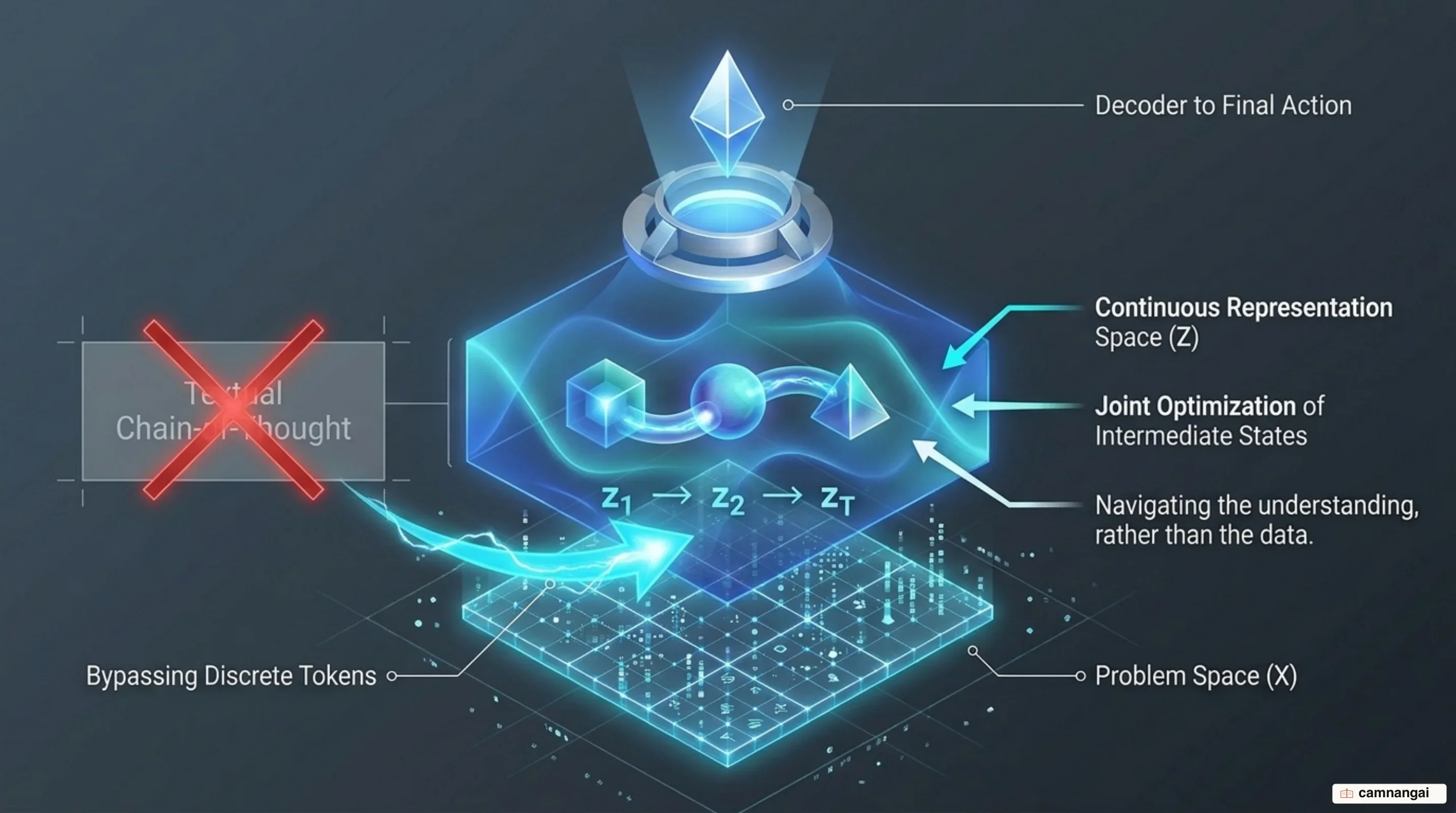
To process complex physical, structural, or logical dependencies without explicit step-by-step human annotations, you incorporate latent variables Z ∈ 𝒵 into the energy formulation. Latent Variable Energy-Based Models define energy as a joint minimization over both internal representations Z and target states Y:
E(Y, X) = min_{Z ∈ 𝒵} E(Z, Y, X)The latent variable Z captures unseen intermediate features—such as spatial frame-to-frame alignment, abstract sub-goals, object pose variations, or unstated logical invariants—that are never directly provided in training data. During inference, the architecture optimizes over Z and Y simultaneously:
(Y*, Z*) = argmin_{Y ∈ 𝒴, Z ∈ 𝒵} E(Z, Y, X)Hierarchical Joint-Embedding Predictive Architectures (H-JEPA) deploy this mechanism to perform multi-step prediction directly in abstract latent spaces. Rather than attempting to predict high-entropy pixel details or generating descriptive token streams, H-JEPA uses joint encoders to map inputs X and targets Y into embedded representations s_x and s_y. A trainable predictor network then operates strictly inside this continuous latent space, predicting future representation states s_y conditioned on latent variables Z representing actions or abstract context.
       +------------+                 +------------+
       |  Input X   |                 | Target Y   |
       +-----+------+                 +-----+------+
             |                              |
             v                              v
       +-----+------+                 +-----+------+
       | Encoder Sx |                 | Encoder Sy |
       +-----+------+                 +-----+------+
             |                              |
             v                              v
          s_x                            s_y
             |                              |
             +-----> [ Predictor P ] <------+
                          ^
                          |
                      Latent Z
                          |
                          v
                Min Energy E(s_y, P(s_x, z))
This optimization over continuous latent vectors constitutes non-linguistic "latent reasoning." Solving constraints through continuous trajectory optimization in vector space Z completely replaces discrete textual "chain-of-thought" generation. Industrial architectures implement latent reasoning engines to build deterministic world models. These systems evaluate environmental constraints, solve multi-step trajectory conditions, and plan control actions without generating natural language tokens, eliminating context window degradation and token sampling randomness.
Formal verification and Lean 4: ensuring deterministic correctness
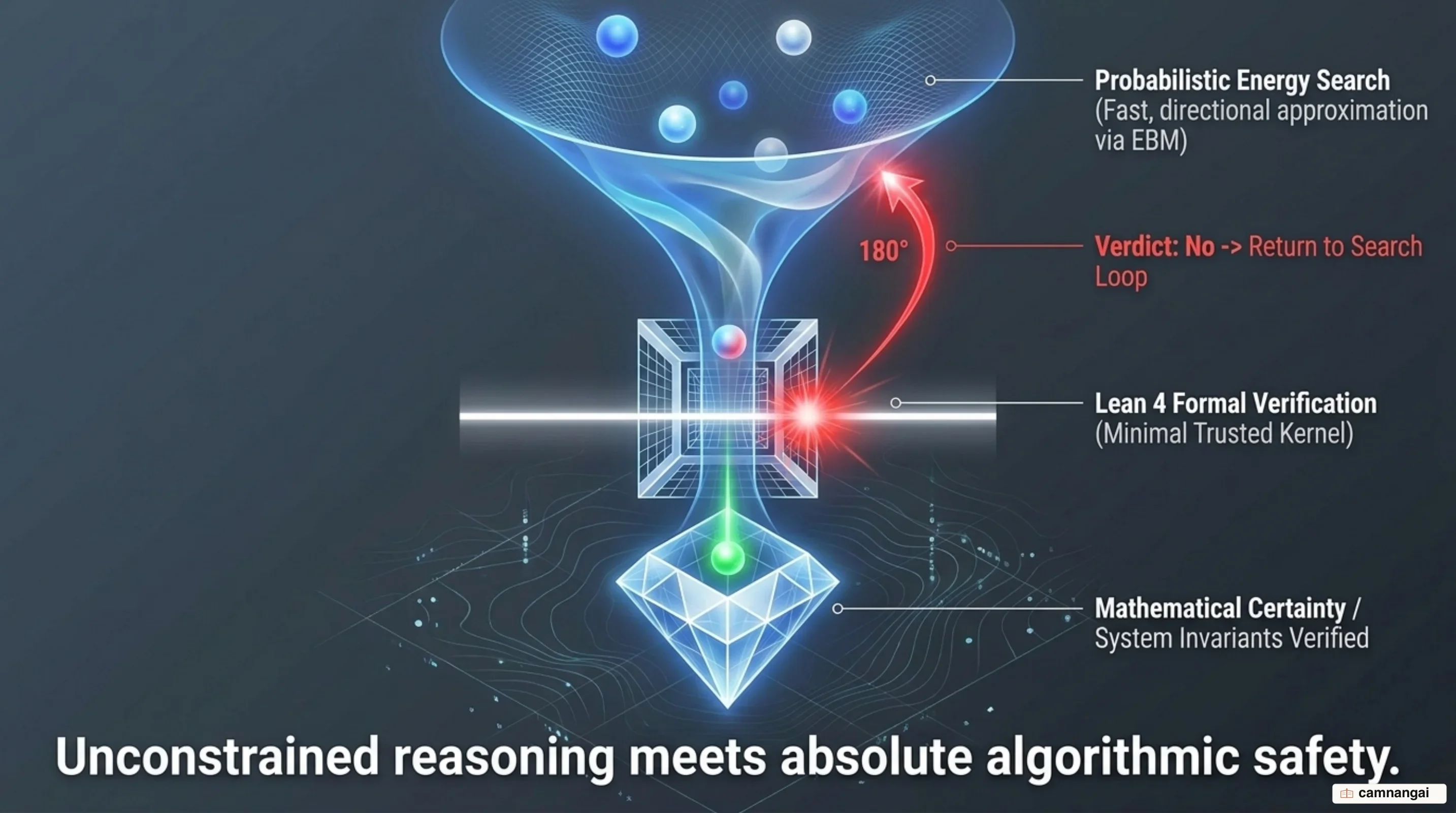
While continuous energy minimization computes globally compatible latent representations, deterministic industrial AI requires absolute mathematical correctness. Formal verification proof assistants—most notably Lean 4—complement continuous neural architectures by providing machine-checked mathematical proofs of system invariants.
Lean 4 relies on a minimal trusted kernel that checks logical derivations down to fundamental axioms. Its proof engine incorporates automated proof search capabilities, such as the grind tactic. The grind tactic manages complex pattern matching, linear inequality systems, case analyses, and recursive structure evaluations, proving mathematical claims automatically.
/-- A prime is a number larger than 1 with only trivial divisors -/
def IsPrime (n : Nat) := 1 < n ∧ ∀ k, 1 < k → k < n → ¬ k ∣ n

/-- Every number larger than 1 has a prime factor -/
theorem exists_prime_factor : ∀ n, 1 < n → ∃ k, IsPrime k ∧ k ∣ n := by
  intro n h1
  by_cases hprime : IsPrime n
  · grind [Nat.dvd_refl]
  · obtain ⟨k, _⟩ : ∃ k, 1 < k ∧ k < n ∧ k ∣ n := by simp_all [IsPrime]
    obtain ⟨p, _, _⟩ := exists_prime_factor k (by grind)
    grind [Nat.dvd_trans]
Industrial software engineering and mathematical verification frameworks deploy Lean 4 across critical infrastructure domains. Amazon Web Services formally verifies its Cedar authorization policy language in Lean 4, using differential testing against production Rust code to eliminate runtime overhead. Microsoft Research leverages the Aeneas toolchain to verify production cryptographic algorithms in SymCrypt, utilizing Rust's type system to bypass direct memory reasoning. In decentralization, ArkLib provides machine-checked specs and formal proofs for Succinct Non-Interactive Arguments of Knowledge (SNARKs) under Ethereum Foundation support. Furthermore, Lean 4 powers frontier research formalizations, including projects on Navier-Stokes and the verification of complex combinatorial bounds.
Dividing the architecture: EBMs for reasoning, LLMs for the interface
To build reliable enterprise AI systems, you must segregate natural language user interaction from core logical and physical reasoning. Autoregressive language models excel at unstructured text parsing, conversational dialogue, multi-lingual translation, and string formatting, but fail at exact multi-step logic. Continuous Energy-Based Models and formal verification frameworks excel at deterministic reasoning and constraint optimization. A hybrid architecture combines these approaches, placing LLMs strictly at the system boundary while offloading core execution to EBMs and formal verification tools.
  +------------------+         +----------------------------+
  |  Human User Query|  ---->  |  Autoregressive LLM        |
  +------------------+         |  (Interface Translator)    |
                               +--------------+-------------+
                                              |
                                              | Translates to
                                              v
                               +--------------+-------------+
                               | Structured Constraints     |
                               | & Formal Energy Specs      |
                               +--------------+-------------+
                                              |
                                              v
                               +--------------+-------------+
                               | Energy-Based Model / JEPA   |
                               | (Latent Reasoning Engine)  |
                               +--------------+-------------+
                                              |
                                              v
                               +--------------+-------------+
                               | Lean 4 Formal Verifier     |
                               | (Deterministic Safety Check)|
                               +----------------------------+
In this decoupled operational pipeline, execution moves through three distinct phases without relying on generative token loops for internal computation. First, the autoregressive LLM acts purely as an interface translator, taking unstructured human language queries and translating them into structured, machine-readable energy functions, formal logic assertions, or system objective vectors. Second, the latent reasoning engine—powered by a latent-variable EBM or JEPA architecture—receives these structured assertions and executes continuous space energy minimization to solve the underlying state space, outputting optimal control trajectories or multi-step logical invariants. Third, the resulting solution vectors pass to an automated formal verifier, such as a Lean 4 execution kernel or SMT solver, to execute deterministic safety checks before final system execution.
This division of labor solves the core reliability bottleneck in industrial AI implementations. By removing autoregressive transformers from internal reasoning loops, systems eliminate hallucination risks, context window saturation, and cascading token errors in critical business logic while retaining natural language accessibility for human operators.
When your engineering problem needs an energy-based model over an LLM
Use autoregressive language models when your deployment requirements center on flexible natural language interface translation, unstructured text extraction, or unconstrained conversational interaction.
Transition to energy-based models, JEPAs, and formal verification engines when your system demands precise multi-variable constraint satisfaction, continuous trajectory optimization, high-dimensional non-probabilistic representations, or zero-tolerance for logical hallucinations in safety-critical infrastructure.
References
- A Tutorial on Energy-Based Learning — Yann LeCun et al.
- How to Build Models Without Language, with Logical Intelligence — ByteByteGo
- Introduction to Latent Variable Energy-Based Models: A Path Towards Autonomous Machine Intelligence — Dawid & LeCun (arXiv:2306.02572)
- A Lightweight Library for Energy-Based Joint-Embedding Predictive Architectures — Terver, LeCun et al. (arXiv:2602.03604)
- Logical Intelligence · AI Certainty for Critical Systems — Logical Intelligence
- The Lean 4 Programming Language and Theorem Prover — Lean Community