Chain of Thought prompting is a prompt engineering technique that guides Large Language Models (LLMs) to output intermediate logical reasoning steps before producing a final answer.
By explicitly decomposing complex problems into sequential steps, this technique allows models to resolve multi-step logic, symbolic tasks, and arithmetic calculations with greater precision.
Standard direct prompting forces an LLM to predict a final answer immediately from an input prompt. In contrast, prompting for intermediate reasoning gives you a clear view into the model's trajectory, replacing opaque single-token leaps with explicit, step-by-step deduction.
Understanding how to construct, parse, and optimize these reasoning chains is critical for engineering reliable AI systems, optimizing token consumption, and controlling latency across production LLM workflows.
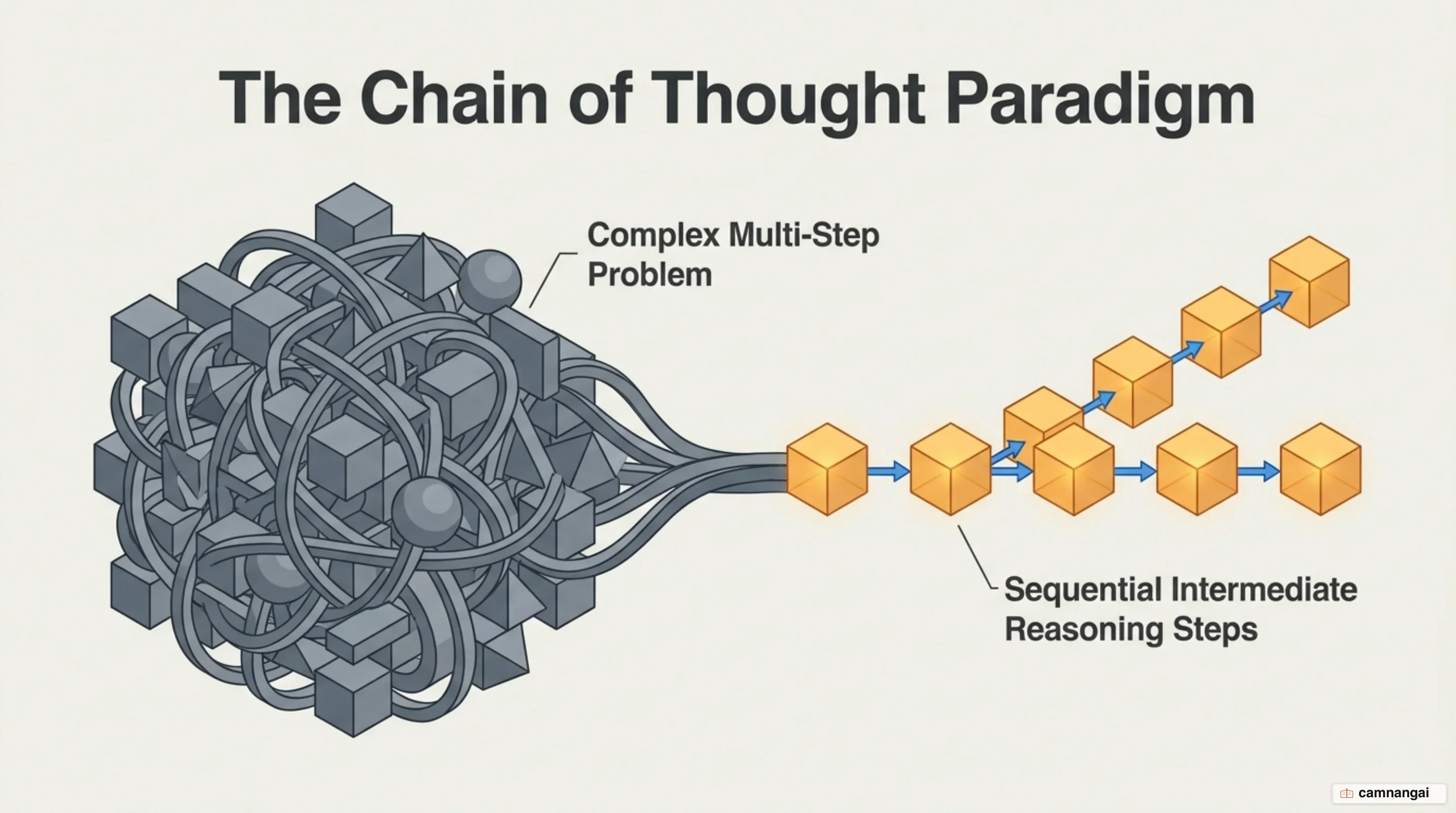
What is Chain of Thought and why LLMs struggle with direct reasoning
Standard autoregressive language models predict target responses token by token based on conditional probability distributions learned during pre-training. When you evaluate complex, multi-step queries—such as multi-digit arithmetic, symbolic manipulation, or complex logical reasoning—standard direct prompting forces the model to jump directly from the input query to the final answer. Because the model is given no intermediate computational space or "scratchpad" tokens before generating the final token, it must execute all underlying computations within a single forward pass. This structural bottleneck frequently leads to logical leaps, hallucinated tokens, and incorrect terminal outputs.
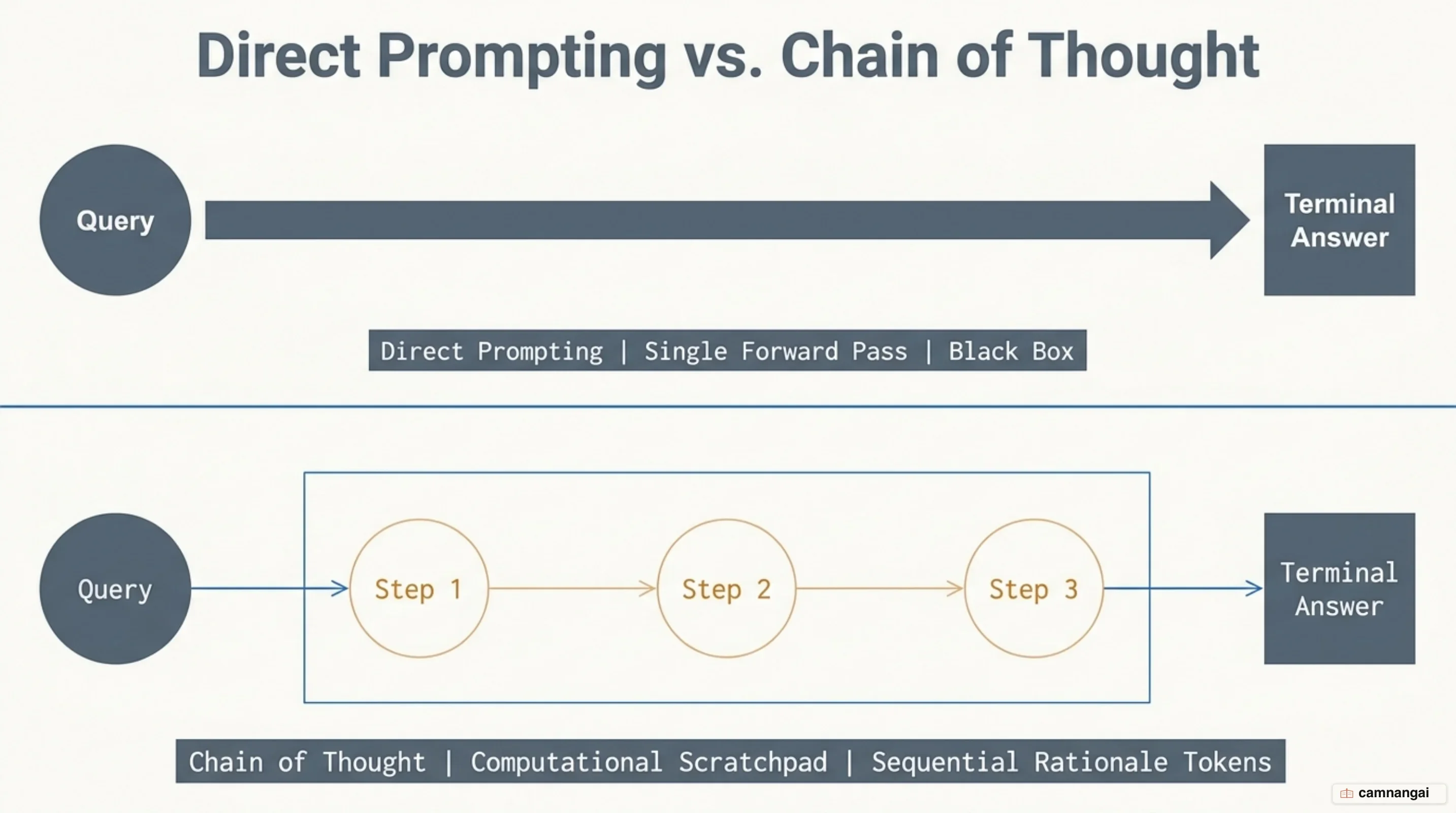
Chain of Thought prompting solves this bottleneck by forcing the model to generate a coherent sequence of intermediate natural language reasoning steps before outputting its final conclusion. When introduced by Wei et al. (2022), reasoning via chain of thought was identified as an "emergent ability" in large language models. As model parameter scales increase, the network gains the capacity to learn subtle reasoning patterns and structured problem-solving trajectories from massive pre-training corpora. Larger parameter counts allow the model to maintain context and execute multi-stage inference reliably across prolonged generations.
However, parameter scaling is not the sole driver of multi-step reasoning performance. Advances in instruction tuning and fine-tuning allow smaller, specialized architectures to execute chain of thought reasoning effectively. For instance, IBM Granite Instruct models achieve robust reasoning by undergoing fine-tuning on specialized instructional datasets containing high-quality exemplars and structured reasoning chains. This demonstrates that target alignment and instructional dataset curation enable efficient reasoning execution even on constrained parameter budgets.
To illustrate the operational difference, consider the contrast between direct generation and reasoning generation. If you ask a model a simple factual question like "What color is the sky?", standard single-step generation yields "Blue" directly. However, if you ask the model to analyze a complex atmospheric question, standard prompting may fail. Prompting the model to construct an explicit reasoning chain requires it to evaluate light absorption, primary color definitions, and atmospheric scattering step by step. Providing this intermediate computational space significantly increases final answer accuracy while delivering transparent, auditable outputs.
How it works: Decomposing problems into intermediate reasoning steps
The execution pipeline of Chain of Thought operates by structurally decomposing an incoming multi-step query into manageable logical sub-tasks. When presented with a complex prompt, the reasoning framework systematically divides the operational workload into clear sub-routines: fact extraction, mathematical translation, intermediate logic evaluation, and final synthesis. By structuring the generation process as a pipeline of smaller inferences, the model avoids evaluating compound logical dependencies simultaneously.
From a mechanism perspective, sequential token generation alters the model's internal attention context. In transformer architectures, every generated token immediately appends to the context window and serves as input for subsequent token predictions. By prompting the model to emit explicit intermediate reasoning steps, each newly generated rationale token becomes part of the attention context for future steps. This sequential generation continuously anchors the model's attention trajectory, constraining the search space and preventing compounding logic errors from propagating to the terminal output.
Architecturally, direct prompting and Chain of Thought prompting process complex inputs through fundamentally different generative paths:
[Direct Prompt Pipeline]
Input Query ---> [Transformer Forward Pass] ---> Final Answer (High Risk of Failure)

[Chain of Thought Pipeline]
Input Query ---> Step 1: Fact Extraction
            ---> Step 2: Intermediate Calculation
            ---> Step 3: Logic Verification
            ---> Step N: Final Synthesis ---> Final Answer (High Accuracy)
The following code block demonstrates the practical difference between a direct prompt failure mode and a Chain of Thought prompt that yields a correct, step-by-step solution:
================================================================================
DIRECT PROMPT (FAILURE MODE)
================================================================================
User:
I went to the market and bought 10 apples. I gave 2 apples to the neighbor and 2
to the repairman. I then went and bought 5 more apples and ate 1. How many apples
did I remain with?

Model Output:
11 apples

================================================================================
CHAIN OF THOUGHT PROMPT (SUCCESSFUL EXECUTION)
================================================================================
User:
I went to the market and bought 10 apples. I gave 2 apples to the neighbor and 2
to the repairman. I then went and bought 5 more apples and ate 1. How many apples
did I remain with?

Let's think step by step.

Model Output:
First, you started with 10 apples.
You gave away 2 apples to the neighbor and 2 to the repairman, so you had 6 apples left (10 - 2 - 2 = 6).
Then you bought 5 more apples, so now you had 11 apples (6 + 5 = 11).
Finally, you ate 1 apple, so you remain with 10 apples (11 - 1 = 10).
The answer is 10.
Foundational paradigms: Few-shot CoT and Zero-shot CoT
Few-shot Chain of Thought prompting, formalized by Wei et al. (2022), relies on passing explicit in-context exemplars within the system or user prompt. Each exemplar consists of a question, a hand-crafted step-by-step rationale explaining the underlying logic, and the target answer. By processing these structured input-output pairs in its context window, the model learns the required reasoning template via in-context learning, replicating the intermediate reasoning structure when evaluated on new queries.
Zero-shot Chain of Thought prompting, introduced by Kojima et al. (2022), eliminates the need for manual exemplar creation. Instead of providing full Q&A examples, you append a simple trigger phrase—such as "Let's think step by step"—to the end of the user query. This instruction triggers the model's pre-trained logical sequencing capabilities, instructing it to output an intermediate rationale prior to generating its final response without requiring custom in-context demonstrations.
To resolve the manual burden of hand-crafting exemplars in Few-Shot CoT while maintaining higher accuracy than Zero-Shot CoT, Zhang et al. (2022) developed Automatic Chain-of-Thought (Auto-CoT). Auto-CoT automates demonstration construction using a two-stage pipeline:
- Question Clustering: The framework partitions a dataset's target questions into distinct clusters based on semantic similarity to capture diverse problem domains.
- Demonstration Sampling: The system selects a representative question from each cluster and generates its reasoning chain using Zero-Shot CoT. Simple heuristics are applied to ensure quality—such as restricting question length (e.g., maximum 60 tokens) and limiting rationale steps (e.g., target 5 steps)—producing clean, diverse, and automated exemplars.
================================================================================
FEW-SHOT COT PROMPT TEMPLATE
================================================================================
Q: The odd numbers in this group add up to an even number: 4, 8, 9, 15, 12, 2, 1.
A: Adding all the odd numbers (9, 15, 1) gives 25. The answer is False.

Q: The odd numbers in this group add up to an even number: 17, 10, 19, 4, 8, 12, 24.
A: Adding all the odd numbers (17, 19) gives 36. The answer is True.

Q: The odd numbers in this group add up to an even number: 15, 32, 5, 13, 82, 7, 1.
A:

================================================================================
ZERO-SHOT COT PROMPT TEMPLATE
================================================================================
Q: The odd numbers in this group add up to an even number: 15, 32, 5, 13, 82, 7, 1.
A: Let's think step by step.
Advanced extensions: Self-Consistency, Least-to-Most, and Tree of Thoughts
Self-Consistency is an advanced decoding strategy that enhances Chain of Thought performance by replacing single-pass greedy decoding. Instead of taking the single path generated at temperature 0, you sample a diverse set of reasoning paths from the model at a higher generation temperature. The system then aggregates these independent reasoning chains and applies a majority vote (or marginalizes over the intermediate rationale paths) to select the most consistent terminal answer. This process reduces stochastic generation errors and significantly improves final accuracy.
Tree of Thoughts (ToT) and prompt chaining expand upon linear CoT by altering the structural orchestration of reasoning. While linear CoT elicits step-by-step reasoning within a single prompt's execution pass, prompt chaining breaks down complex workflows into multiple sequential API calls, passing the structured output of one prompt as input to the next. In contrast, Tree of Thoughts organizes intermediate reasoning into a non-linear tree search space. Under ToT, the model generates, evaluates, and traverses discrete intermediate units of thought across multiple branches, executing lookahead and backtracking operations when a specific operational path proves invalid.
Least-to-Most Prompting uses sequential prompt decomposition to solve complex multi-tier dependencies that saturate standard context windows. The core mechanism involves two main phases: first, decomposing a complex problem into an explicit list of simpler, ordered sub-problems; second, solving these sub-problems sequentially. The output of each resolved sub-problem is appended as context to assist in solving the subsequent sub-problem, enabling the model to handle problems of higher complexity than those presented in initial prompt exemplars.
+---------------------+---------------------------------------+---------------------------------------+
| Paradigm            | Operational Mechanism                 | Ideal Primary Use Case                |
+---------------------+---------------------------------------+---------------------------------------+
| Linear CoT          | Single sequential pass of tokens      | Standard multi-step logic & math      |
| Prompt Chaining     | Sequential, multi-call API pipeline   | Multi-stage modular workflows         |
| Self-Consistency    | Multi-path sampling + Majority vote   | High-accuracy mathematical tasks      |
| Tree of Thoughts    | Non-linear tree search + Backtracking | Heuristic planning & complex games    |
| Least-to-Most       | Sequential sub-problem decomposition  | Deep hierarchical dependencies        |
+---------------------+---------------------------------------+---------------------------------------+
Selecting among these extensions requires balancing compute availability against problem complexity. Linear CoT is computationally efficient for standard operational requests within a single API turn. However, when tasks demand complex heuristic evaluation, intermediate state inspection across API boundaries, or multi-tiered problem decomposition, paradigms like Prompt Chaining, Self-Consistency, or Tree of Thoughts become necessary despite their higher execution costs.
Engineering implementation: Prompt structure, thinking tags, and output parsing
When building production system prompts, structured role hierarchies establish clear behavioral boundaries and instruction prioritization. Modern API structures enforce operational permissions via specific roles: developer (or system) messages define the foundational identity, system constraints, guardrails, and business logic, while user messages contain dynamic payload inputs. System-level instructions take priority over user-level inputs, protecting the execution path from prompt injection vulnerabilities.
To maximize instruction adherence and enable clean programmatic parsing, you should demarcate distinct prompt components using Markdown headers and XML tags. Enclosing instructional blocks, reference context, exemplars, and inputs within explicit tags (e.g., <instructions>, <context>, <examples>, <thinking>, and <user_query>) establishes structural clarity for the model. This markup hierarchy prevents ambiguous input boundaries, isolates user payloads, and allows your backend services to strip or parse specific prompt sections reliably.
Production Prompt Markup Hierarchy:
+-------------------------------------------------------+
| <instructions> System rules & restrictions </instructions>|
| <context> Source documents / RAG payload </context>   |
| <examples> <example> Few-shot CoT </example> </examples>|
| <user_query> Dynamic runtime query </user_query>      |
+-------------------------------------------------------+
Managing output reasoning tokens requires structured API handling. Modern architectures isolate reasoning processes into native thinking blocks or explicit markup tags, allowing systems to manage context state across multi-turn sessions while extracting clean terminal payloads. For structured downstream application consumption, you can enforce output constraints using Structured Outputs (JSON Schema validation) or by parsing target responses out of explicit XML output tags (e.g., <answer>).
The following Python snippet demonstrates how to configure an API payload using structured system instructions, XML tags, and reasoning configuration parameters using the OpenAI SDK:
import os
from openai import OpenAI

client = OpenAI(api_key=os.environ.get("OPENAI_API_KEY"))

# Define structured developer instructions using Markdown and XML delimiters
developer_instructions = """
# Identity
You are an enterprise technical support specialist analyzing system logs.

# Instructions
1. Analyze the user's error trace provided inside <user_log> tags.
2. Formulate your internal diagnostic steps inside <thinking> tags.
3. Provide the final customer-facing remediation plan inside <remediation> tags.
4. Keep the remediation plan concise, actionable, and structured as a numbered list.

# Examples
<example>
  <user_log>ERR_CONN_REFUSED on 127.0.0.1:5432</user_log>
  <thinking>
  - Identify error code: ERR_CONN_REFUSED indicates target port is actively refusing connection.
  - Identify host and port: 127.0.0.1 is localhost, 5432 is default PostgreSQL port.
  - Cause: Database service is likely stopped or firewall is blocking local interface.
  </thinking>
  <remediation>
  1. Verify the PostgreSQL service is running: `systemctl status postgresql`.
  2. Check local port binding: `netstat -plnt | grep 5432`.
  </remediation>
</example>
"""

user_payload = "<user_log>FATAL: Database connection failed: Connection timed out on 10.0.4.12:5432</user_log>"

# Create response with specific model snapshots and reasoning configurations
response = client.responses.create(
    model="gpt-6-astra",
    instructions=developer_instructions,
    reasoning={"effort": "low"},
    input=user_payload
)

print(response.output_text)
Technical trade-offs: Token economics, latency, and unfaithful reasoning
Implementing Chain of Thought prompting in enterprise architectures introduces clear operational trade-offs across financial, operational, and accuracy dimensions:
+-----------------------+---------------------------------------+---------------------------------------+
| Operational Axis      | Direct Prompting                      | Chain of Thought Prompting            |
+-----------------------+---------------------------------------+---------------------------------------+
| Token Overhead        | Minimal (Input + Direct Answer)       | Substantial (Input + Rationale + Ans) |
| Latency Profile       | Low Time-to-Last-Token (TTLT)         | High TTLT due to generated step tokens|
| Financial Cost        | Low API cost per transaction          | Higher cost driven by output volume   |
| Verification Quality  | Opaque (Black-box single output)      | Transparent (Auditable intermediate)  |
+-----------------------+---------------------------------------+---------------------------------------+
Token economics present a primary financial constraint. Because CoT prompts require models to output sequential intermediate steps, generation token counts increase significantly per call. Output tokens are priced higher than input tokens across commercial API providers. Consequently, generating long reasoning chains increases operational cost per request and consumes available context window capacity, requiring context management strategies in multi-turn applications.
The latency impact of intermediate reasoning tokens directly affects system responsiveness and total turn duration. Total transaction time is governed by the volume of generated output tokens. Emitting dozens or hundreds of intermediate reasoning tokens inflates the Time-to-Last-Token (TTLT) metric, extending complete turn delivery. While response streaming delivers a fast Time-to-First-Token (TTFT) as soon as the initial rationale token emits, the visible final answer remains delayed until generation finishes. In real-time interfaces, this generation delay creates performance bottlenecks unless managed asynchronously or streamed progressively.
Another major technical risk is unfaithful reasoning. LLMs can generate rationale chains that sound plausible yet remain factually incorrect, or arrive at a correct terminal answer through invalid intermediate logic. Additionally, forcing verbose CoT reasoning on straightforward, low-complexity tasks can cause "overthinking," leading the model to over-complicate simple lookups, make unnecessary tool calls, or fail due to over-verification.
To mitigate these trade-offs, engineers must implement dynamic execution parameters. You should restrict explicit CoT prompting to high-complexity domains (such as code synthesis, advanced math, or multi-step logic) while routing low-complexity tasks to direct generation. In systems leveraging reasoning models, tuning native effort parameters (effort: "low" vs. effort: "high") allows you to align token consumption with acceptable latency SLA thresholds.
From manual CoT to native reasoning models and test-time compute
Prompt engineering practices have evolved from manual phrase injection to native model reasoning. Early implementations relied on manual user-level prompts like "Let's think step by step" or hand-crafted few-shot exemplars to induce reasoning. Modern reasoning architectures (such as OpenAI reasoning models and Claude adaptive thinking models) internalize this capability, generating internal thinking tokens automatically before emitting terminal outputs.
Modern inference engines feature adaptive thinking capabilities that operate via explicit effort parameters (e.g., effort: "low", effort: "medium", effort: "high"). Instead of requiring manual token budgets (like fixed budget_tokens caps, which are deprecated or rejected with 400 errors in newer APIs), these adaptive systems analyze input query complexity dynamically. The engine automatically expands or contracts internal thinking token volume based on the requested effort tier and query difficulty, preventing overthinking on trivial tasks while allocating deeper search depth to complex queries.
This paradigm shift centers on test-time compute. Historically, model capability scaling focused almost exclusively on pre-training compute (increasing parameter sizes and dataset volumes). Test-time compute shifts computational effort to the inference phase. By allocating extra compute cycles at runtime for internal thinking tokens, search traversal, and self-correction, the model evaluates complex logic at inference time, solving harder problems without requiring exponentially larger base model parameters.
[Historical Approach: Pre-Training Compute Shift]
Massive Parameter Base Model + Minimal Direct Inference ---> Fixed Output

[Modern Approach: Test-Time Compute Allocation]
Targeted Base Model + Dynamic Test-Time Compute (Inference Thinking) ---> Optimized Output
Native reasoning models fundamentally transform system prompting requirements. You no longer need to write explicit instructions telling the model to "think step by step" or manually structure step-by-step reasoning blocks. In fact, aggressive manual CoT prompting on native reasoning models can cause degraded performance or prompt refusals. Prompting for native reasoning models now focuses on defining broad high-level goals, establishing precise system constraints, setting operational parameters, and defining clear output format schemas.
Production best practices for AI engineers
To operationalize Chain of Thought effectively in enterprise engineering workflows, version all production system prompts directly within application source code rather than relying on external API prompt management objects. Deprecations across provider ecosystems highlight the necessity of code-managed prompts, where prompts are maintained as version-controlled, typed functions subjected to automated unit testing, pull request code reviews, and staged deployment pipelines. You must pair these prompt builders with rigorous evaluation suites to benchmark logic, execution latency, and accuracy across model snapshot updates.
When deploying reasoning pipelines, enforce clear role hierarchies using system/developer messages for core constraints, and bound context payloads with structured XML tags. Calibrate reasoning depth using native effort parameters to balance latency against answer precision, and maintain strict append-only context histories when handling thinking blocks in multi-turn conversations—passing generated thinking blocks back unchanged to prevent context state errors and API validation failures. By treating reasoning prompts as deterministic, testable software artifacts, you establish robust, performant, and cost-effective AI systems.
References
- What is chain of thought (CoT) prompting? — IBM
- Chain-of-Thought Prompting Elicits Reasoning in Large Language Models — Wei et al. (2022)
- Large Language Models are Zero-Shot Reasoners — Kojima et al. (2022)
- Chain-of-Thought Prompting — Prompt Engineering Guide (DAIR.AI)
- Chain of thought prompting — Claude Documentation
- Prompt engineering guide: Give models time to think — OpenAI
- Self-Consistency Improves Chain of Thought Reasoning in Language Models — Wang et al. (2022)