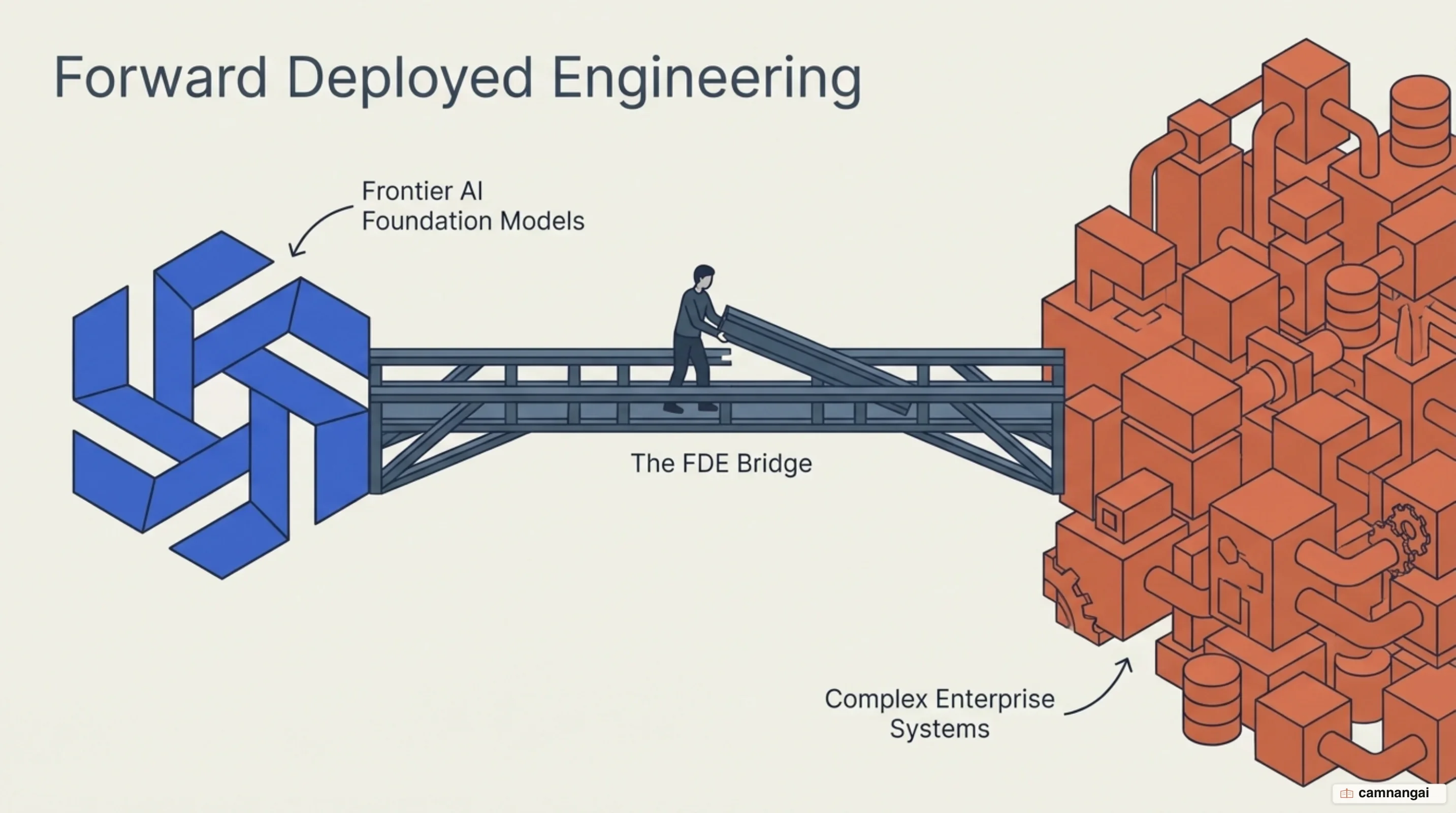
A Forward Deployed Engineer (FDE) is a customer-facing software engineer embedded inside client environments to bridge the gap between raw AI models or core products and production enterprise deployment.
You write production code, construct Retrieval-Augmented Generation (RAG) pipelines, build orchestration layers, integrate legacy APIs, and ship functional software directly within a customer's security perimeter.
Rather than working exclusively on centralized platform features, you operate at the frontline of engineering integration. You sit directly alongside client engineering teams and enterprise leadership to diagnose operational bottlenecks, turning ambiguous business requirements into explicit technical specifications and reproducible evaluation benchmarks.
Your mandate centers on total outcome ownership: ensuring an enterprise AI system survives contact with messy legacy schemas, strict compliance boundaries, and unoptimized live production traffic.
Origins at Palantir and the "Delta vs. Dev" Philosophy
Palantir Technologies popularized the Forward Deployed Engineer title by 2009, deriving "forward-deployed" from U.S. military jargon. Palantir established the operational model of embedding software engineers directly alongside client personnel for extended engagements to customize complex data architectures and solve high-stakes operational challenges within the customer's physical or network perimeter.
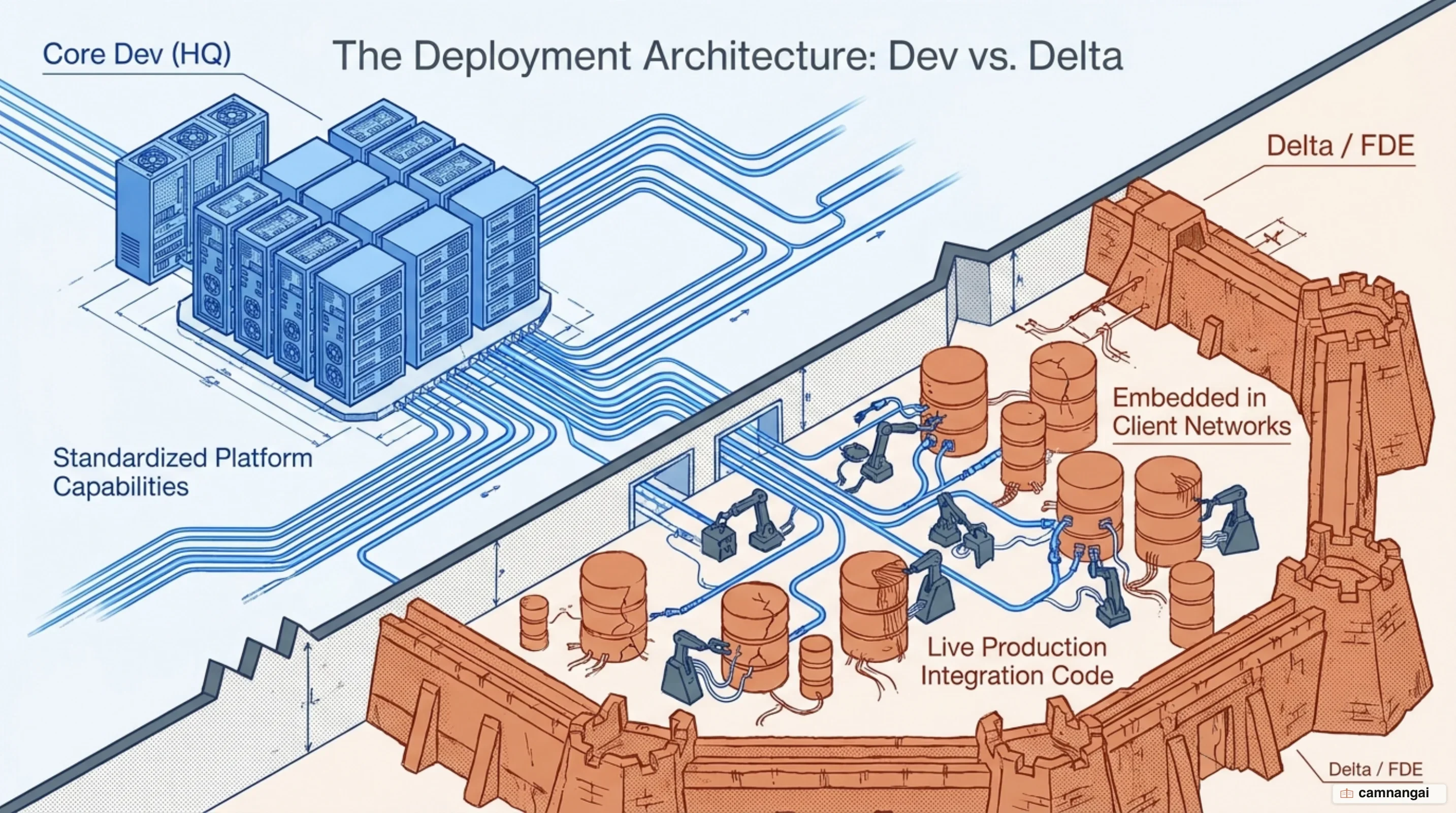
When you examine the structural foundation of the role, it rests entirely on the architectural boundary between "Dev" and "Delta." In this engineering framework, "Dev" represents the standardized core product, platform, or developed by central engineering teams. "Delta" encompasses the customer-specific codebase, custom API integrations, pipeline adaptations, legacy schema transformations, and specialized security logic required to make the core product operational inside a client's specific landing zone. Core software engineers own the Dev platform, while Forward Deployed Engineers build and own the Delta codebase.
Venture capital firms such as Andreessen Horowitz categorize the title as "title arbitrage"—a strategic elevation of traditional solutions engineering, field engineering, or integration roles into a high-agency software engineering discipline.
This framing projects an operational identity that signals deep code ownership, attracting senior technical talent capable of shipping production systems into enterprise environments rather than running pre-sales product demonstrations.
Why the Generative AI Boom Made FDE a Critical Role
A severe deployment gap has emerged across enterprise and AI agent initiatives. While research indicates that 79% of enterprises have adopted in some capacity, only 11% have successfully deployed them into production—a 68-percentage-point gap between initial experimentation and operational execution.
Industry data reveals that 88% of AI proofs-of-concept fail to reach widescale enterprise deployment, while Gartner projects that over 40% of agentic AI projects will be canceled by late 2027 due to unclear business value, escalating operational costs, and inadequate risk controls. This failure rate stems from a fundamental structural shift: unlike traditional single-call, stateless chatbots that receive a prompt and return text through an isolated interface, agentic systems are stateful, multi-step environments operating across legacy enterprise APIs. In these complex environments, unhandled state exceptions, data schema drift, and silent cascading errors inevitably break production pipelines.
To solve this integration bottleneck, major technology providers initiated massive structural investments in customer-embedded engineering units throughout 2026. Amazon Web Services (AWS) allocated $1 billion to establish a specialized unit engineers directly within enterprise accounts, while Microsoft committed $2.5 billion and 6,000 employees to a dedicated AI implementation unit. Concurrently, Google Cloud expanded its engineering organization to hire hundreds of customer-facing engineers focused on generative and agentic deployments, and OpenAI established a $4 billion Deployment Company staffed with approximately 150 FDEs acquired from Tomoro to focus entirely on enterprise integration.
When you analyze labor market data, this corporate capital movement has generated unprecedented demand for specialized technical talent. US job listings for Forward Deployed Engineers grew by 729% year-over-year—expanding from 643 open positions in April 2025 to 5,330 in April 2026. This surge continues a multi-year expansion, following a 42-fold increase in role listings between 2023 and 2025 as enterprise organizations recognized that model weights are a commodity, but deployment execution is scarce.
The Project Lifecycle of a Forward Deployed Engineer
As an FDE, you drive customer engagements through a structured six-phase lifecycle designed to move AI models into secure production while eliminating scope creep. The engagement begins with Discovery, where your entry criterion requires confirmed access to customer technical stakeholders. You conduct structured interviews with domain experts and client engineers to map actual data flows and security boundaries, exiting only when you establish a falsifiable definition of success. The output of this phase is a comprehensive discovery summary detailing the core problem, operational constraints, and success criteria. Next, you enter MVP Scoping, using the signed discovery summary as entry criteria to define the smallest functional implementation that proves value. You explicitly document what is out of scope to maintain technical discipline, delivering a signed MVP plan with rigid technical boundaries.
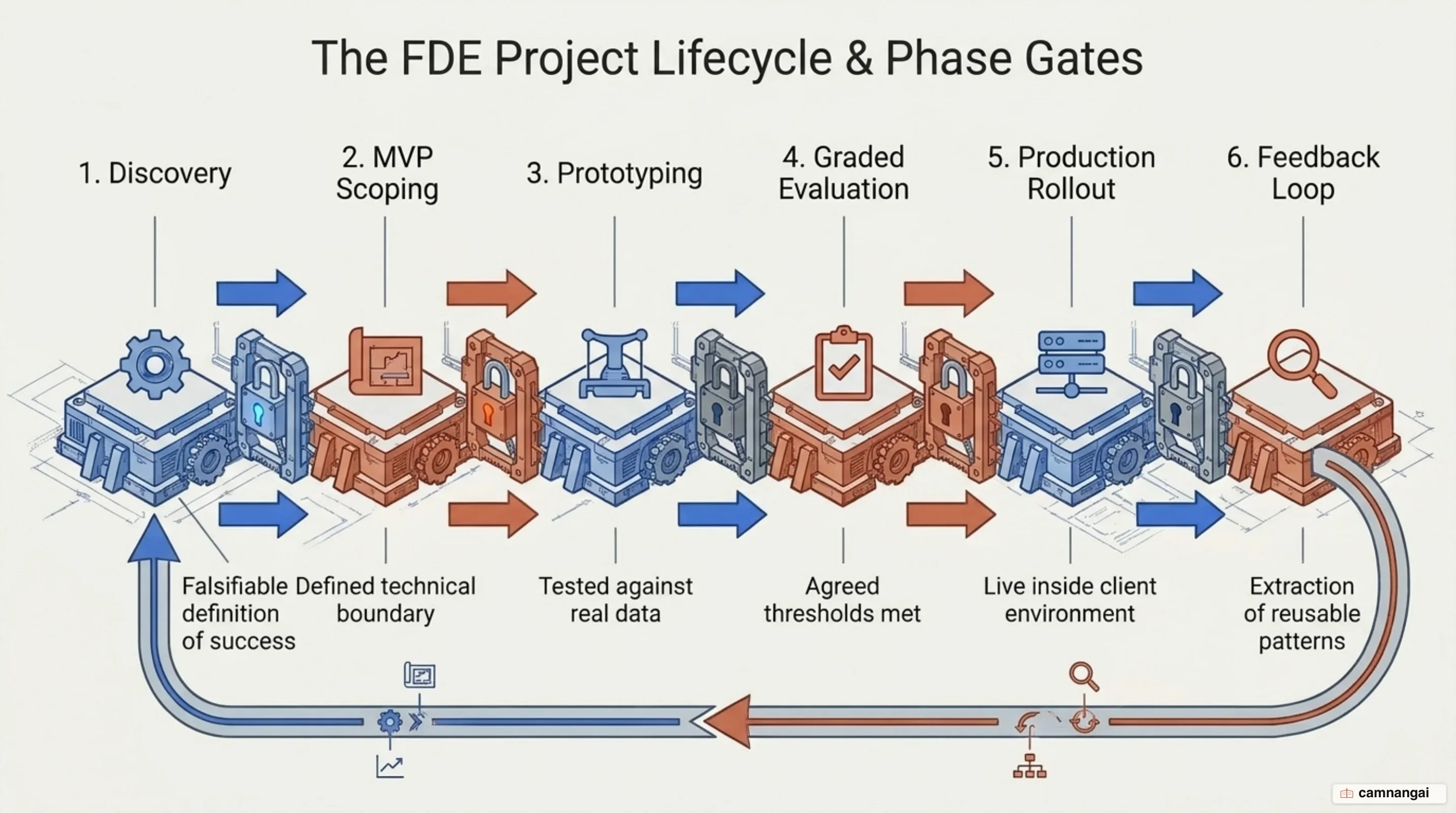
You then transition to Prototyping Against Real Data, where you build the core system against messy, uncleaned customer data exports containing missing fields, schema inconsistencies, and formatting edge cases, rather than sanitized sample datasets. You exit this phase when the software handles real-world variance without crashing, producing a working prototype alongside a documented log of data anomalies and remediation rules. Next, you execute the Evaluation phase, replacing qualitative spot-checks with an explicit evaluation harness featuring graded test cases, quantitative rubrics, and strict pass/fail thresholds. Once test results meet agreed target metrics, you deliver a formal evaluation report.
The engagement moves into Production Rollout as you deploy the validated system directly into the customer's landing zone under their change control policies and network security perimeters. You exit when end-users operate the live system under real traffic, delivering a hardened production deployment alongside a complete monitoring and incident-response runbook. Finally, you execute the Feedback Loop, remaining engaged through initial stabilization to observe live failure modes and extract reusable code patterns, pipeline abstractions, and integration tools. You complete the lifecycle by delivering a final engagement summary and contributing reusable modules back to your core engineering team's shared platform library.
This lifecycle enforces Scale AI's core deployment principle: enterprise systems must lock into specific use-case requirements and evaluation metrics rather than specific foundation model providers. Because you engineer the surrounding evaluation harness, data models, and context pipelines to be modular, you ensure that underlying model weights can be swapped in days without rebuilding the enterprise application.
The FDE Skill Stack: Technical Breadth and High-Agency Execution
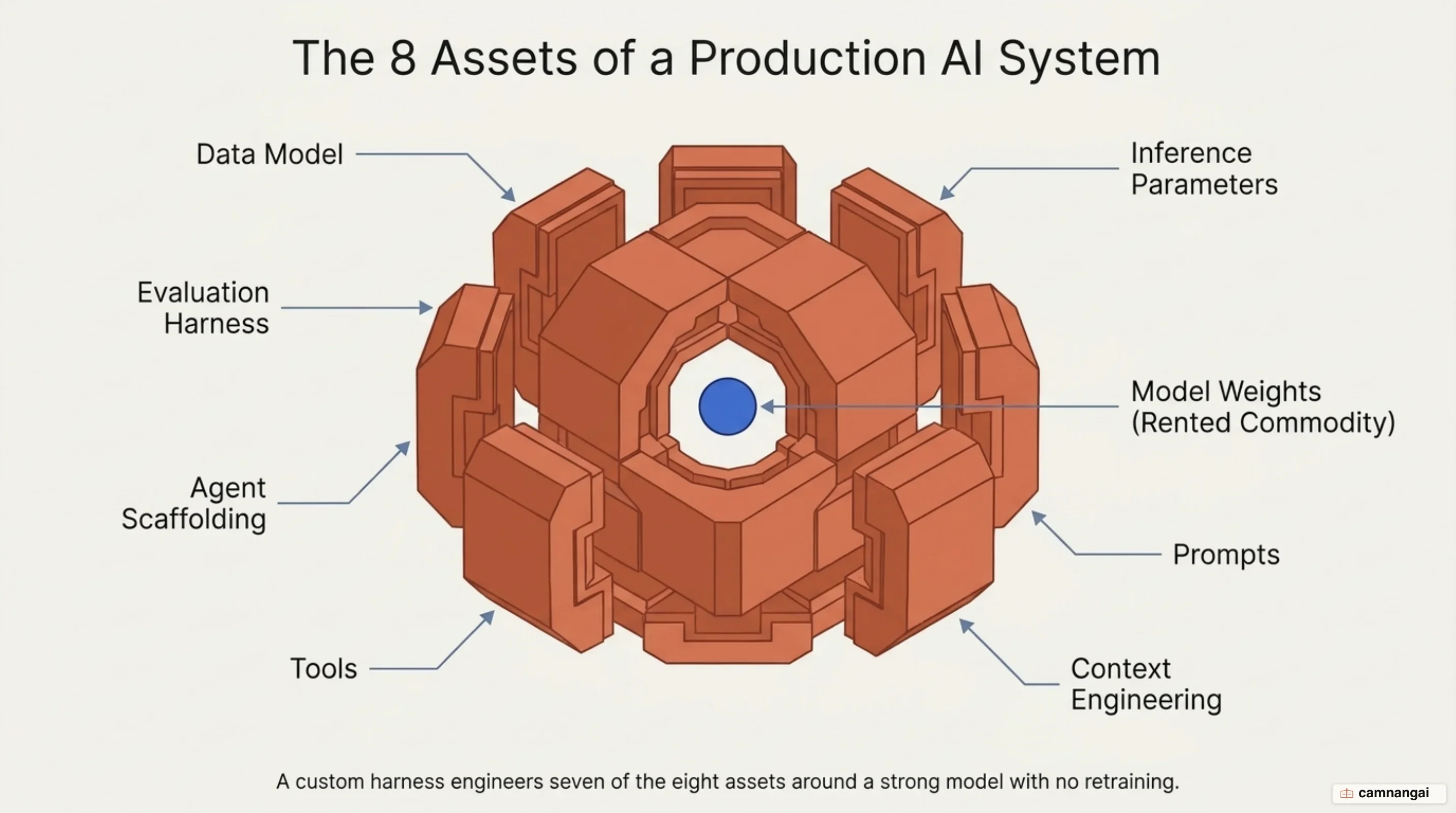
Operating effectively as an FDE requires mastering the 8 Assets Framework that governs production AI architectures. A critical architectural insight established by Scale AI is that foundation model weights represent just 1 of 8 system assets—and because weights are disposable commodity assets swapped every few months, they do not constitute durable enterprise value. As an FDE, you engineer and control the remaining seven assets that form the client's true IP: the domain data model (the most durable asset that outlives individual models), system prompts, context engineering pipelines, agent scaffolding, external tool integrations, inference parameters, and the custom evaluation harness.
       +-------------------------------------------------------+
       |             ENTERPRISE AI SYSTEM ASSETS               |
       +-------------------------------------------------------+
       | [1] Model Weights (Disposable Licensed Asset)         |
       +-------------------------------------------------------+
       | [2] Data Model (Durable IP) [5] Agent Scaffolding     |
       | [3] Prompts                 [6] Tools & APIs          |
       | [4] Context Engineering   [7] Inference Parameters    |
       |            [8] Evaluation Harness                     |
       +-------------------------------------------------------+
       |   ^ Engineered & Owned by Forward Deployed Engineer ^ |
       +-------------------------------------------------------+
Your technical stack spans agent infrastructure, inference optimization, enterprise cloud security, and data pipeline auditing. On the infrastructure layer, you build stateful multi-step agent workflows using LangGraph, CrewAI, AutoGen, and LlamaIndex, while managing like Pinecone and pgvector using hybrid search (BM25 combined with dense vectors) fused via Reciprocal Rank Fusion (RRF). For inference optimization, you implement (GGUF) and deploy serving engines such as vLLM, Ollama, SGLang, and TensorRT-LLM, configuring KV cache management, paged attention, continuous batching, and speculative decoding to minimize latency budgets.
Inside client cloud perimeters, you deploy secure landing zones utilizing Google Cloud Shared VPCs, VPC Service Controls (VPC-SC), private GKE clusters, and Kubernetes Workload Identity, while validating data integrity using dbt assertions and recursive CTEs.
Crucially, Human-in-the-Loop (HITL) architecture is not treated as a static security add-on, but engineered as a core orchestration asset. You build stateful pause-and-resume execution gates directly into agent workflows, ensuring that autonomous systems stop for explicit human approval before executing high-risk API calls, financial transfers, or compliance-bound operational changes via the Model Context Protocol (MCP). You pair this technical execution with advisory frameworks: applying Stakeholder Diplomacy to align client SecOps and DBAs, MECE (Mutually Exclusive, Collectively Exhaustive) problem structuring to eliminate logic gaps, and Barbara Minto's Pyramid Principle to deliver executive communications led by clear summary recommendations.
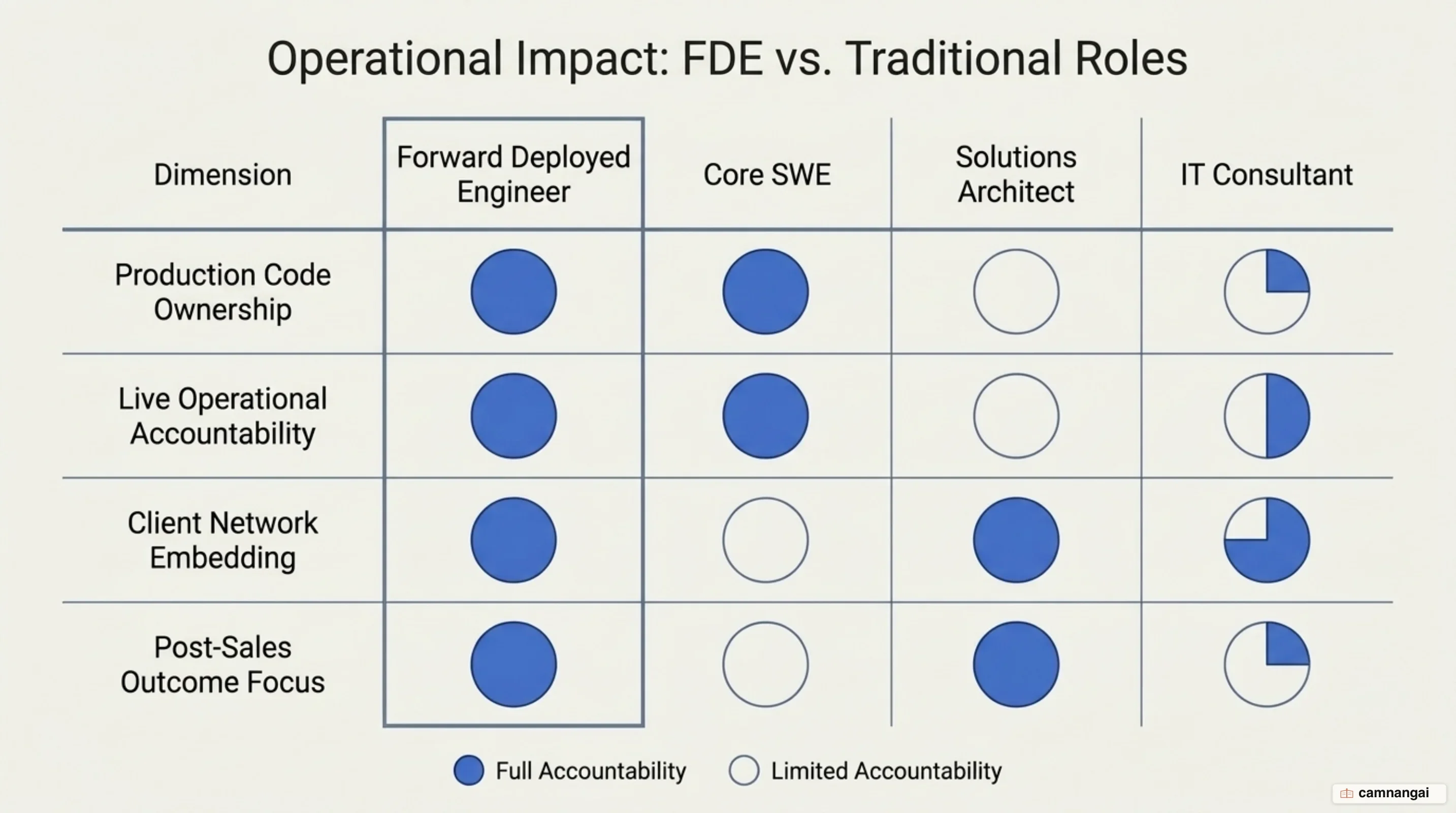
How FDE Differs from Core SWE, Solutions Architect, and Consultant
The Forward Deployed Engineer role is distinguished from adjacent engineering and consulting positions by direct code ownership and complete outcome accountability inside client compliance perimeters:
- FDE vs. Core Software Engineer: Core SWEs build standardized platform features ("Dev") within internal development environments. FDEs write client-embedded code ("Delta") that interfaces directly with external customer infrastructure and legacy databases.
- FDE vs. Solutions Architect / Sales Engineer: Solutions Architects run technical demonstrations, configure temporary proofs-of-concept, and answer RFPs to drive sales velocity. FDEs own the deployment outcome end-to-end, writing production code that runs under client compliance controls.
- FDE vs. IT Consultant: IT Consultants deliver strategic playbooks, slides, or organizational recommendations. FDEs ship functional software systems directly into live production landing zones.
Compensation Benchmarks
The elevated technical breadth and production accountability of the FDE role generate a distinct compensation profile across US and global technology markets:
| Role / Level | Region | Base / Total Compensation Range | Source & Benchmark Data | Core Output & Scope |
|---|---|---|---|---|
| AI Solutions Engineer (Mid-Level) | US | $130,000 – $185,000 Base | KORE1 Staffing Data | Technical demos, RFPs, light configuration |
| AI Solutions Engineer (Senior) | US | $190,000 – $260,000 Base | KORE1 Staffing Data | Pre-sales support, technical onboarding |
| AI Solutions Engineer (Blended Avg) | US | $101,500 – $140,500 Base (Avg: $123,284) | ZipRecruiter Aggregator Data | Broad tech sales & support postings |
| Forward Deployed Engineer (Median Base) | US | $190,000 – $210,000 Base | Recruiting From Scratch (135 postings) | Live production code in customer perimeters |
| Forward Deployed Engineer (Mid-Level) | US | $180,000 – $260,000 Total Comp | FDE Portal Data | End-to-end deployment ownership |
| Forward Deployed Engineer (Senior/Staff) | US | $300,000 – $550,000+ Total Comp | Paraform / Frontier AI Labs | Embedded architecture & scale (Palantir staff > $630K) |
| Forward Deployed Engineer (0–2 yrs) | India | ₹18 – 28 LPA Total Comp | OwnYourCareer Labs | Production RAG and agent integrations |
| Forward Deployed Engineer (3–6 yrs) | India | ₹28 – 55 LPA Total Comp | OwnYourCareer Labs | Advanced orchestration & infrastructure |
| Forward Deployed Engineer (Senior / Remote) | India | ₹55 – 90+ LPA Total Comp | OwnYourCareer Labs | Enterprise architecture & global delivery |
Forward Deployed Engineers out-earn traditional Solutions Engineers by 30% to 60%+ at equivalent experience levels. This market premium is driven by three structural factors: direct code accountability within live production environments, a scarce candidate pool capable of simultaneously debugging legacy cloud infrastructure and communicating with client executives, and equity-heavy compensation structures (where equity and performance bonuses comprise 50% to 70% of total compensation at frontier AI labs).
Is Forward Deployed Engineering the Right Path for You?
Pursuing a career as a Forward Deployed Engineer involves clear professional trade-offs. You exchange predictable internal sprint cycles, static codebase boundaries, and isolated feature development for elevated total compensation, rapid skill acquisition across production AI infrastructure, and founder-level operational autonomy. However, the role requires navigating frequent travel, aggressive delivery timelines, intense executive client pressure, and highly unoptimized legacy IT environments.
This path is ideal for high-agency engineers who prefer shipping customer-facing production impact over pure theoretical research or isolated feature maintenance.
References
- Forward Deployed Engineer — Wikipedia
- The Anatomy of AI Deployment — Scale AI
- The Rise of Agentic AI and Forward Deployed Engineers — FDE Academy
- FDE Project Lifecycle: From Discovery to Deployment — FDE Academy
- Forward Deployed Engineer Roadmap — Amit Shekhar (GitHub)
- AI Solutions Engineer Salary vs Forward Deployed Engineer — FDE Academy
- FDE Handbook: A Production-Ready Handbook for FDEs — GoDay (GitHub)
- Awesome FDE Resources — Global FDE (GitHub)