While large language models () have advanced from basic conversational chatbots to persistent autonomous workers, the core agent loop—comprising reasoning, execution, and observation—has remained structurally static.
System capabilities have expanded not by altering this foundational inner engine, but by engineering sophisticated architectural layers around it. Modern production infrastructure wraps the core processing cycle in advanced memory management, durable execution runtimes, background event triggers, standardized environment harnesses, and self-improving feedback mechanisms.
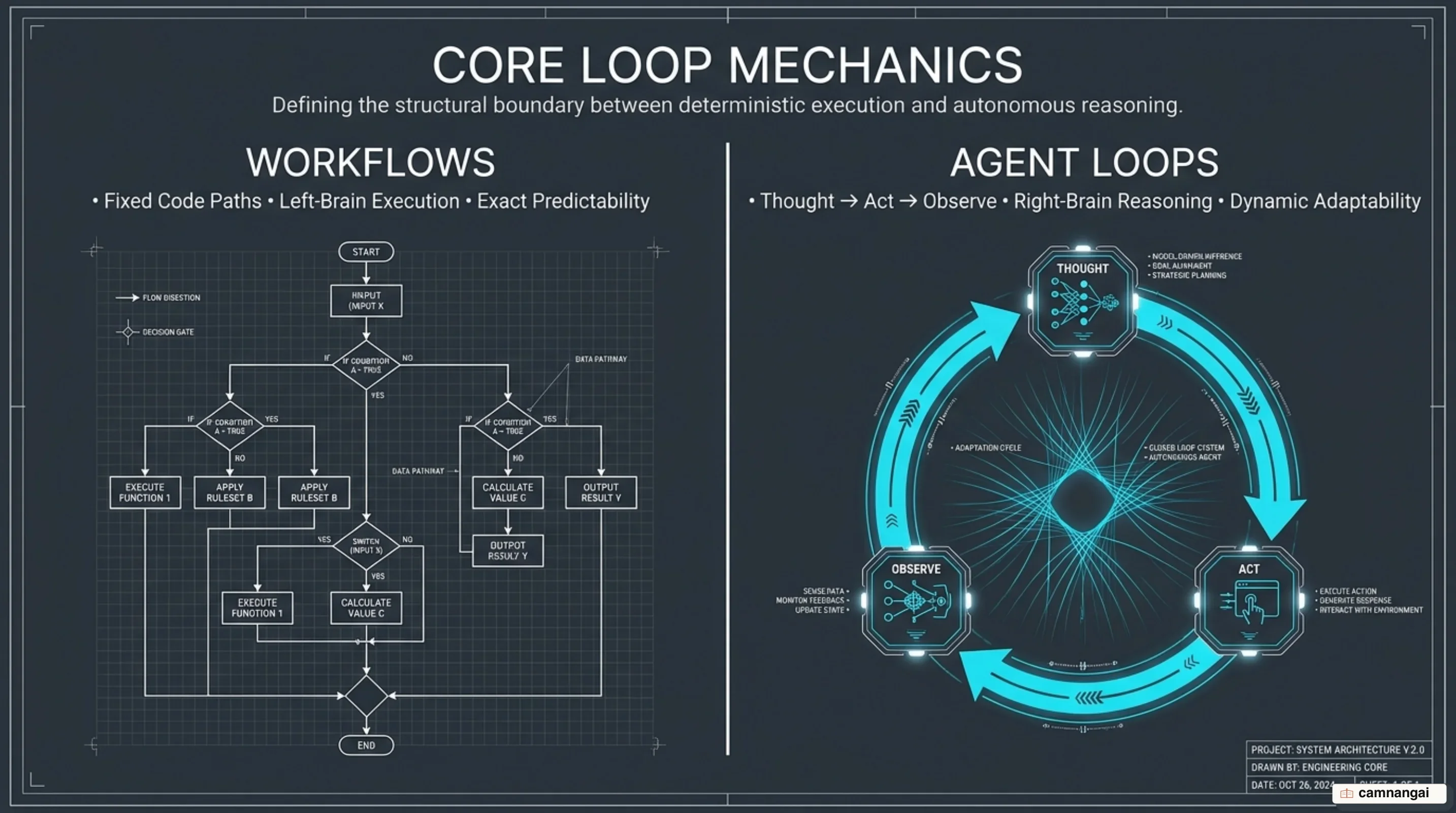
When designing LLM-powered applications, you must maintain a clear distinction between simple workflows and fully autonomous agents. Workflows orchestrate models and external tools through rigid, predefined code paths, maximizing predictability for structured tasks. In contrast, autonomous agents allow LLMs to dynamically determine their own execution paths, select tools, and iterate based on environmental feedback.
This autonomy introduces non-trivial operational trade-offs: agentic systems inherently exchange lower latency and efficiency for task flexibility and model-driven decision-making. You should always evaluate your engineering requirements against the simplest possible architecture (such as single augmented LLM calls or deterministic chains) before introducing higher-tier agentic complexity.
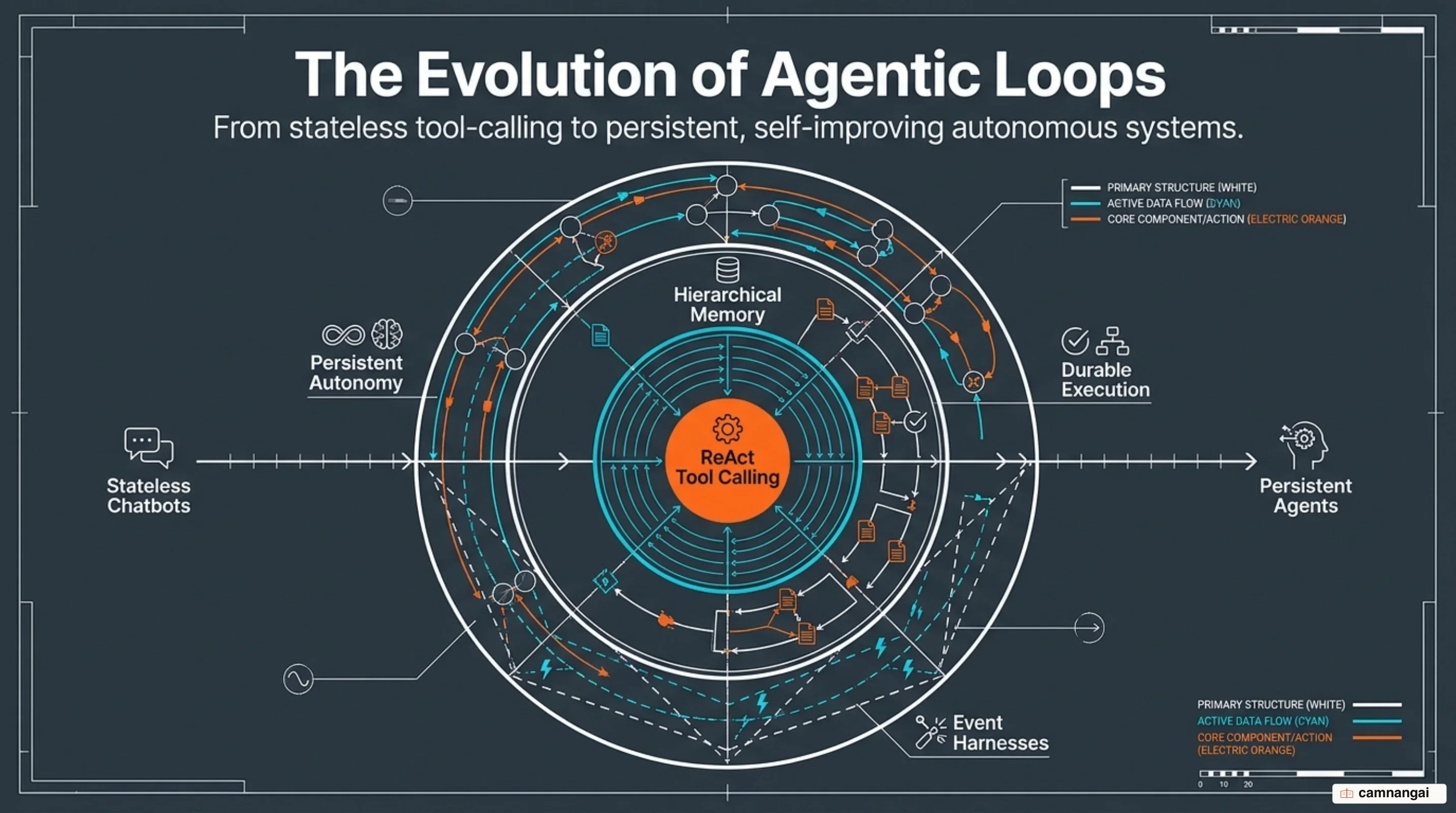
The Core Agent Loop: Why the Inner Cycle Remained Static While the Surrounding Architecture Evolved
At the foundation of every agentic architecture lies an invariant three-step inner cycle: Propose Action (where the LLM performs reasoning and planning), Execute Action (where software runtimes, APIs, or tools are invoked), and Observe (where the agent receives real-time feedback from the execution environment). Despite rapid advancements in model context sizes and raw intelligence, this core processing sequence has remained unchanged. Because language models operate as general-purpose problem solvers, they rely on ground truth observations from tool outputs to verify task progression, recover from execution errors, and dynamically plan subsequent steps.
While the inner loop remains static, developers structure control flows around it using predictable workflow building blocks. As detailed in Anthropic's architectural guidance, complex tasks are frequently composed using fundamental patterns before resorting to full autonomy:
decomposes a task into sequential LLM invocations where each step processes the output of the prior step, often gated by programmatic validation checks. Routing classifies incoming payloads to direct them to specialized prompts, specific tool sets, or distinct model tiers (such as routing high-volume queries to lightweight models like Claude Haiku 4.5 while reserving complex reasoning for models like Claude Sonnet 4.5).
Parallelization executes concurrent LLM calls via sectioning (e.g., running separate guardrail evaluation alongside response generation) or voting (e.g., executing multiple prompt variations to detect code vulnerabilities). Higher-level patterns like Orchestrator-Workers employ a central model to dynamically break down and delegate subtasks to worker nodes, while Evaluator-Optimizer loops use an evaluator model to critique and iteratively refine generated responses against explicit quality criteria.
The classic ReAct (Reasoning and Acting) trajectory illustrates this foundational loop in its rawest form, interleaving internal reasoning steps with external environment interactions:
Thought: I need to query the database for customer order status.
Act: SearchOrder[order_id="10923"]
Observation: Order #10923 shipped on Nov 10 via FedEx.
Stages 1 & 2: From Basic Tool Calling to Statefulness and Hierarchical Memory
The operational evolution of agents began with Stage 1: Basic Tool Calling. Introduced conceptually by Yao et al. in the ReAct framework (October 2022) and standardizing in enterprise APIs via OpenAI's (June 2023), tool integration allowed LLMs to interface directly with external APIs, databases, and local runtimes. By exposing structured functional interfaces to the model, tool calling mitigates and enables real-time data retrieval. However, early implementations operated strictly in stateless environments, requiring the client to resend full interaction histories on every turn.
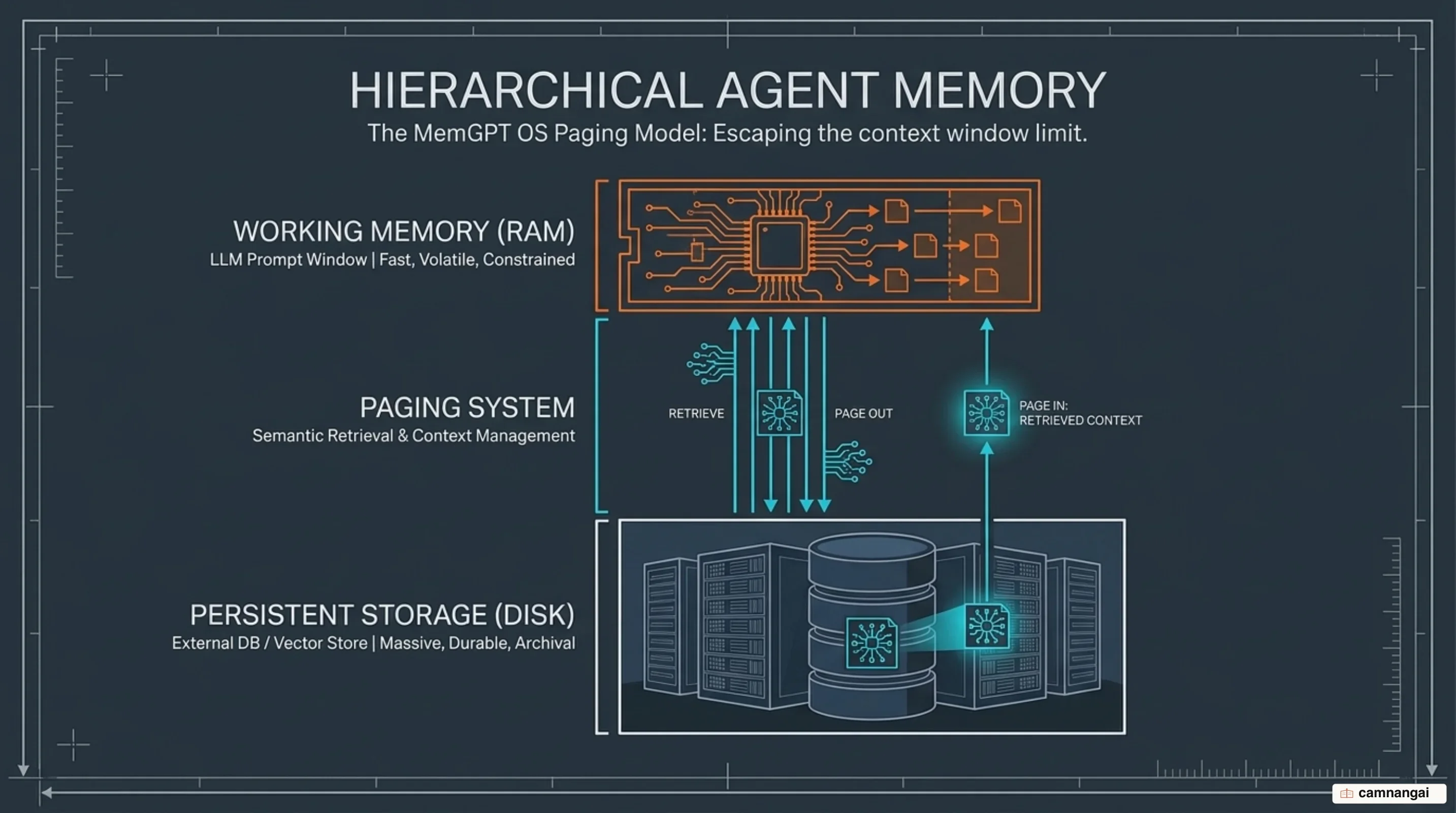
As interactions expanded into multi-turn conversations, Stage 2 introduced stateful agents to overcome limits and exponential token cost growth. Architecturally, you must distinguish between physical context windows (in-prompt tokens) and external persistence layers (such as PostgreSQL, key-value stores, or ). Basic session management patterns, such as state persistence in LangGraph or server-side state tracking via OpenAI's Responses API, preserve raw interaction histories across turns. Advanced implementations separate ephemeral session state from long-term memory, as demonstrated by Google ADK and Mem0, extracting core factual assertions rather than replaying raw text transcripts.
Research from Oracle on database-native highlights the efficiency of structured memory state over naive transcript replaying. Their benchmark demonstrates that database-native memory achieves a 93.8% score on LongMemEval while consuming 10.7$\times$ fewer estimated input tokens compared to full transcript replaying at turn 80.
To handle massive context boundaries, MemGPT (Packer et al.) introduced an operating-system-inspired virtual context management architecture. MemGPT treats the LLM's physical context window as primary memory (RAM) and external persistence stores as secondary storage (disk). Operating system primitives like interrupts, paging, and page faults map directly to LLM context limits: the model uses explicit tool calls and system interrupts to dynamically page context in and out of its active prompt window, moving data between fast main context and slow archival or recall memory tiers.
The code snippet below demonstrates a basic tool-calling interface using Pydantic AI, where tool execution feeds deterministic data back into the agentic runtime:
from pydantic_ai import Agent

agent = Agent("openai:gpt-5-mini", instructions="Use the weather tool for forecasts.")

@agent.tool_plain
def get_weather(city: str) -> str:
 """Look up demo weather for a city."""
 return {"paris": "18°C and cloudy"}.get(city.lower(), "No demo data")

print(agent.run_sync("What's the weather in Paris?").output)
Stage 3: Durable Execution: Making Loops Crashproof and Preventing Duplicate Side Effects
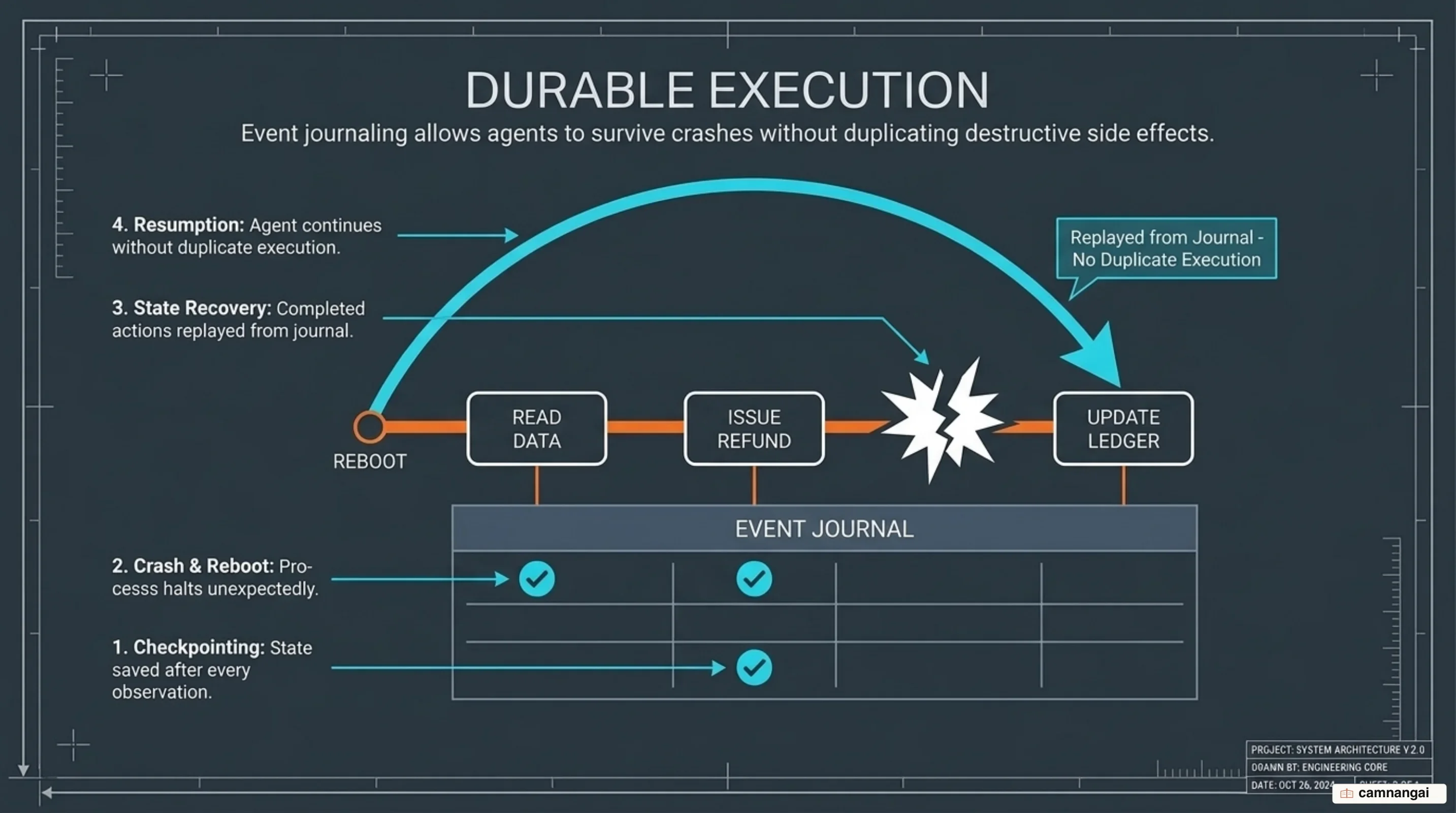
A critical architectural flaw in pure stateful memory systems is the conflation of conversational context with operational state. Remembering past chat messages is fundamentally distinct from recording executed side-effecting operations. If an agent worker crashes mid-execution during an e-commerce return process (after initiating a ledger modification but prior to issuing a refund), simply re-running the conversation thread risks duplicate execution, potentially charging or refunding the customer twice.
Stage 3 resolves this vulnerability through Durable Execution. Durable execution runtimes persist every LLM decision, API invocation, and tool response to an external append-only audit event log. If an infrastructure node fails or a process restarts mid-loop, the runtime reconstructs the exact execution state, resuming from the precise point of disruption without re-prompting the model or re-executing previously completed side effects. Frameworks implement this pattern through dedicated runtimes: Dapr Agents recovers workflow state across worker node restarts, Inngest persists step state via wrappers like step.run() while supporting human-in-the-loop pauses, and systems like Restate, DBOS, and Temporal provide native event-driven fault tolerance. To prevent vendor lock-in across heterogeneous environments, adapters like Diagrid extend durable execution capabilities to over 10 agentic frameworks, while orchestrators like Kestra manage agent tasks across organizational boundaries using the Agent2Agent (A2A) protocol.
Enterprise architectures operationalize durability by pairing adaptive "right-brain" agentic reasoning with deterministic "left-brain" workflows. Systems such as Temporal and Temporal Nexus establish a durable execution backbone: agents handle intent interpretation, dynamic routing, and exception resolution, while deterministic workflows execute critical transaction logic (such as Accounts Payable payment runs or travel booking reconciliations). Temporal Nexus connects these layers bidirectionally across teams and namespaces, allowing an agent to trigger a long-running business process or enabling a workflow to invoke an agent for exception handling.
Also, all external tool integrations that produce real-world side effects must strictly enforce idempotency keys. Passing idempotency tokens to underlying APIs guarantees that execution retries performed by the durable runtime never result in duplicated external state changes.
Stage 4: Ambient Loops: Shifting from Synchronous Chat to Event-Driven Background Execution
The transition to Stage 4 marks an architectural paradigm shift away from user-initiated, synchronous chat interfaces where a human actively awaits an immediate model response. Systems are increasingly deployed as headless, asynchronous background execution units that operate silently within production infrastructure environments.
These Ambient Agents are initiated automatically by system events (such as incoming webhooks, database record insertions, pub/sub messages, or cron schedules) rather than explicit human prompts. Upon activation, an ambient agent initializes its inner loop, executes required tools asynchronously to process background workloads (e.g., parsing incoming emails, drafting support replies, monitoring queue latency, or auditing system transactions), commits output to a system of record or escalation queue, and immediately returns to an idle state.
Operating long-running background loops introduces rigorous infrastructure requirements. Runtimes must manage long background execution timeouts, implement exponential backoff policies for external service outages, and isolate operational failures. When an ambient loop encounters an unrecoverable edge case or low-confidence decision, it must gracefully pause execution and surface human-in-the-loop approval checkpoints, resuming execution only after receiving verified human input.
Stage 5: The Harness Layer: Standardizing Skills, Subagents, and the Model Context Protocol
As agents assumed broader technical capabilities, such as navigating repository file trees, executing arbitrary shell scripts, and deploying code, the need emerged for a structured boundary framing the inner loop. Stage 5 introduces the Harness Layer: an execution environment that supplies project-level metadata, sandboxed runtimes, reusable skill definitions, specialized subagent delegation pathways, and standardized context protocols.
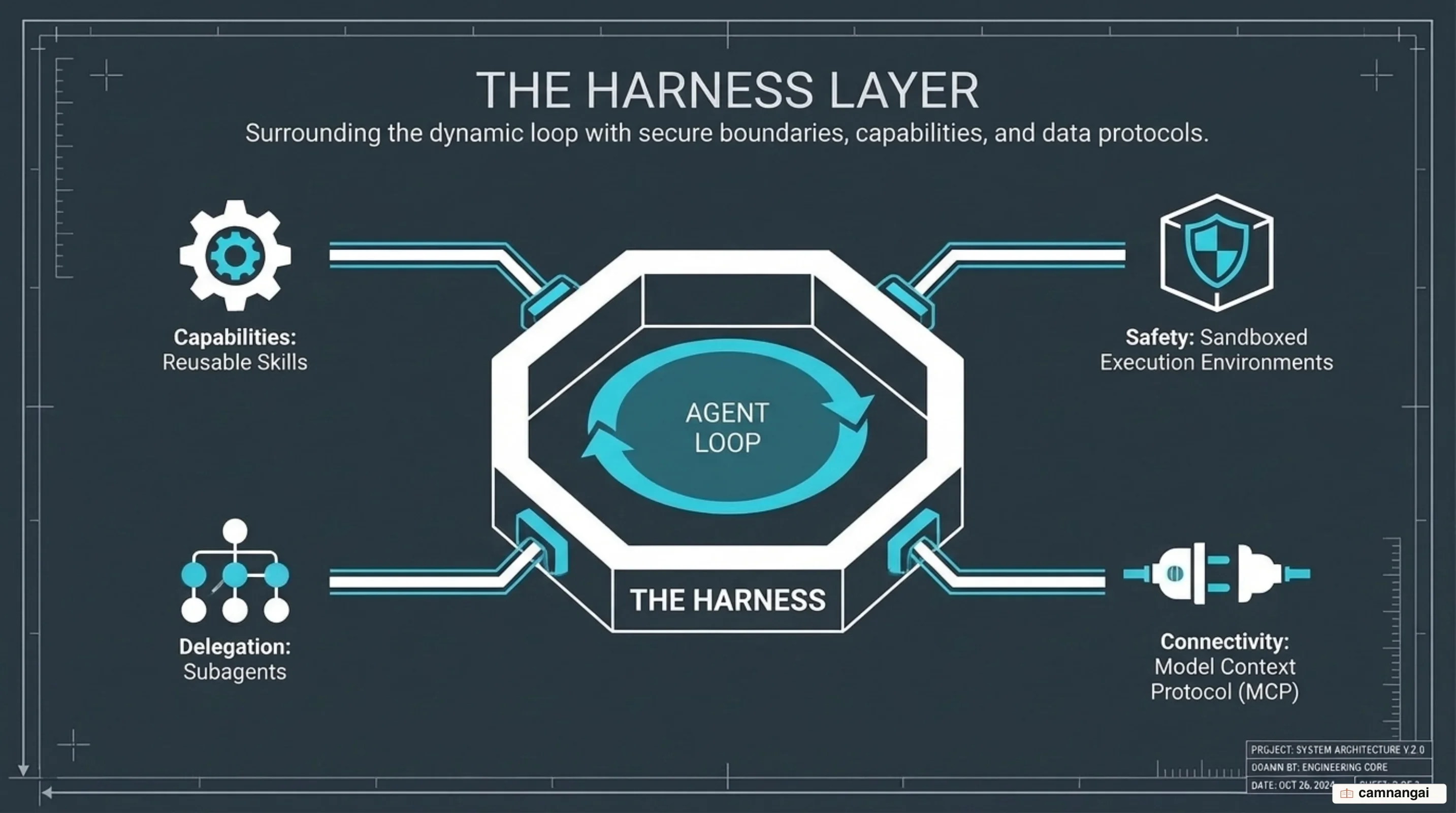
A key milestone in harness standardization is Anthropic's Model Context Protocol (MCP), open-sourced in November 2024. MCP replaces fragmented, point-to-point tool integrations with an open client-server architecture, allowing agents (clients) to seamlessly query arbitrary data sources and tools (servers) over a unified specification. The ecosystem features enterprise MCP servers across platforms like GitHub, Git, Postgres, Puppeteer, Google Drive, and Slack, with core platform adoption spanning tool providers like Block, Apollo, Zed, Replit, Codeium, and Sourcegraph.
The harness layer enforces Agent-Computer Interface (ACI) principles to maximize LLM tool reliability. First, it eliminates formatting overhead: tool signatures avoid taxing model tokenization by omitting line-count headers in diffs or nested JSON string escaping inside code blocks. Second, it implements Poka-yoke tool design to prevent predictable failure modes. For instance, in Anthropic's SWE-bench coding harness, file-system tools enforce strict absolute filepaths rather than relative paths, preventing navigation drift when agents modify working directories.
Beyond code environments, harness abstractions manage cloud operations natively. For example, kagent on Kubernetes abstracts agent deployment using declarative custom resource definitions including AgentTemplates, runtime Harness specifications, and strict network egress policies.
Modern repositories define their execution environment using standardized configuration files. While Claude Code architectures standardize on CLAUDE.md, Codex harnesses utilize AGENTS.md to define operational parameters, skills, and subagent structures:
project/
├── CLAUDE.md
├── AGENTS.md
├──.claude/
│ ├── settings.json
│ ├── skills/
│ │ └── release-check/
│ │ └── SKILL.md
│ └── agents/
│ └── test-investigator.md
└──.mcp.json
Stage 6: Persistent Autonomy: Standing Goals, Continuous Responsibility, and Consolidation Cycles
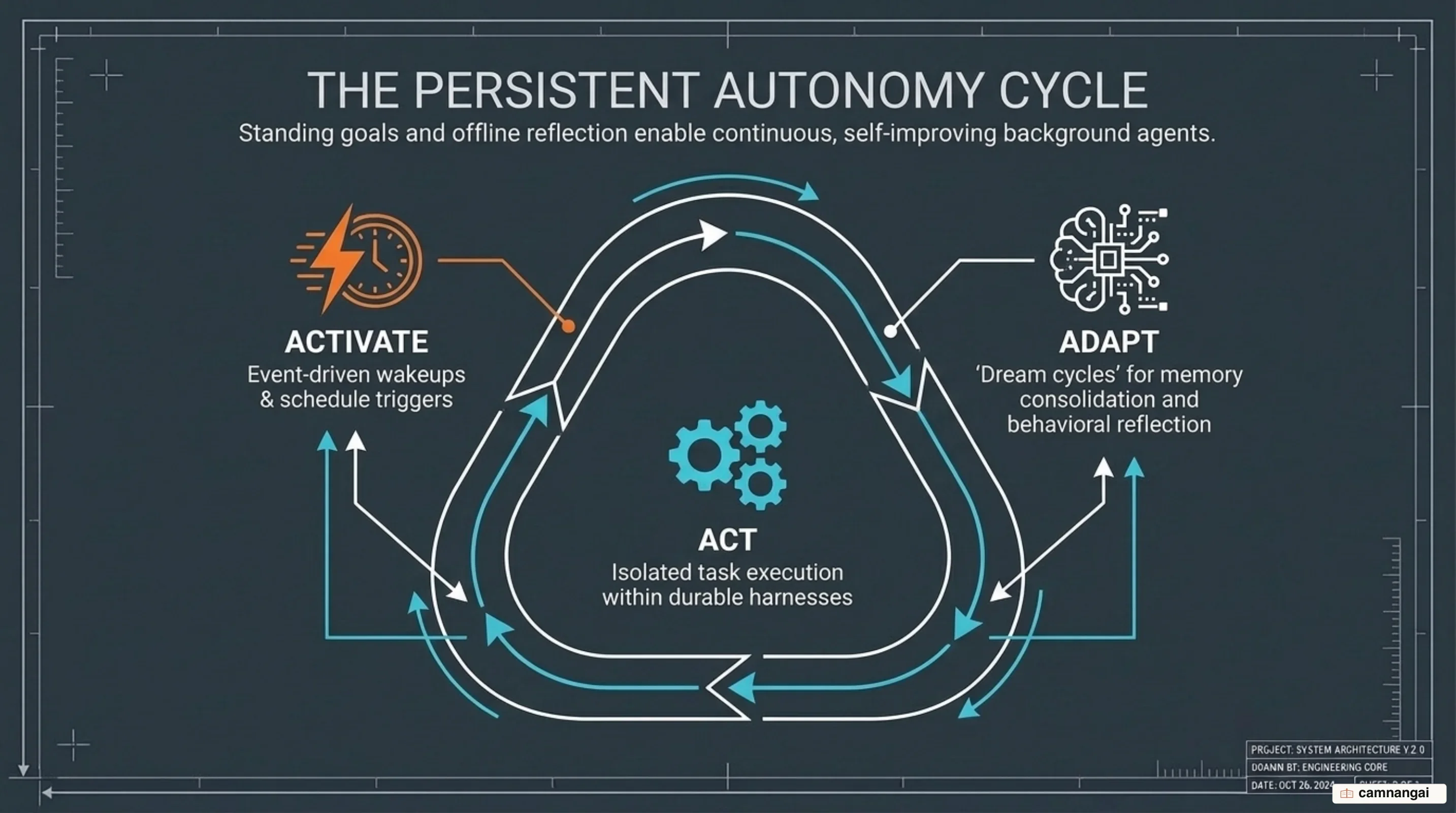
Stage 6 moves beyond discrete task completion to establish Persistent Agents. Rather than terminating upon delivering a single answer, persistent agents are assigned long-term standing goals and continuous domain responsibilities, such as multi-week system monitoring, ongoing backlog maintenance, or customer feedback analysis.
These systems operate via a continuous Activate $\rightarrow$ Act $\rightarrow$ Adapt lifecycle:
- Activate wakes the persistent agent from an idle state via event triggers or scheduled cron intervals.
- Act initializes isolated worker sub-sessions, queries external endpoints, executes relevant tool loops, and aggregates intermediate findings.
- Adapt executes an offline consolidation step before terminating the active turn, updating its persistent memory, pruning stale facts, and recording updated system learnings to inform future activations.
 +-----------------------------------------------+
 | |
 v |
[ ACTIVATE ] --------> [ ACT ] --------> [ ADAPT ]
 (Events/Cron) (Worker Loops) (Memory Update)
Production environments leverage this pattern across platforms such as Grok Bot, Meta Muse, and Kiro Crew Bots. In enterprise environments, this model is exemplified by customer feedback agents such as "Scout." Assigned a standing mandate to track user friction, Scout ingests continuous feedback streams, cross-references user requests against active product roadmaps, identifies systemic multi-week trends, and tracks issues across isolated execution runs while preserving operational context over months.
The Next Frontier: Self-Improving Loops, Verbal Reflection, and Eval-Gated Evolution
The frontier of agentic design focuses on Self-Improving Loops, where agents modify their own internal prompts, tool declarations, memory organization, and harness settings based on operational metrics. Rather than updating core model weights, these architectures utilize verbal reinforcement learning, structural memory consolidation, and runtime extensions.
The foundational paradigm for verbal adaptation is Reflexion (Shinn et al., March 2023). When a Reflexion agent fails an execution cycle or unit test, it generates an explicit linguistic self-reflection analyzing its mistake, writes this feedback into an episodic memory buffer, and re-attempts the task. This verbal feedback mechanism achieved a 91% pass@1 accuracy on the HumanEval coding benchmark compared to a baseline GPT-4 score of 80%, without updating underlying model weights.
To optimize plan generation and execution speed, LangChain research highlights two key Plan-and-Execute optimizations: ReWOO and LLMCompiler. ReWOO (Xu et al.) formulates plans using explicit variable assignment (#E1, #E2), decoupling multi-step planning from tool execution observations to eliminate intermediate LLM reasoning calls. LLMCompiler (Kim et al.) streams task Directed Acyclic Graphs (DAGs) to an asynchronous Task Fetching Unit, executing independent tool calls concurrently to achieve up to 3.6$\times$ execution speedups. Crucially, LLMCompiler incorporates a Joiner component—a dedicated LLM step that evaluates the execution history and output DAG to dynamically decide whether to stream a final response or return control to the planner for another iteration.
Plan: Query Super Bowl contenders for the current season.
E1: Search[Who is competing in the superbowl?]
Plan: Identify the starting quarterback for the first team.
E2: LLM[Quarterback for team #E1]
Plan: Fetch stats for the identified quarterback.
E3: Search[Stats for #E2]
Following plan execution, a ReWOO Solver node resolves the trajectory: it parses the variable tokens (#E1, #E2, #E3), substitutes each placeholder with the exact observation returned by its corresponding tool step, and passes the fully grounded payload to the final model call to generate the final response.
Self-improvement patterns are actively migrating into open-source agent runtimes. Frame-works such as Hermes Agent and OpenClaw analyze task execution feedback to autonomously learn and update runtime skills. Similarly, Letta Code enables agents to modify and extend their execution harness at runtime by installing or updating modular extensions ("mods").
These adaptive capabilities are complemented by Anthropic's research on agent memory "dreaming cycles," where persistent agents periodically evaluate interaction histories, eliminate redundant memory nodes, consolidate structural knowledge, and rewrite runtime skills. To prevent agent drift, all self-modifications to prompts, tools, skills, or harness code must be gated by automated continuous integration evaluations and bounded by strict, human-defined permission boundaries prior to production deployment.
Navigating the Evolution: Choosing the Right Architectural Tier Without Over-Engineering
When architecting LLM-backed applications, avoid premature abstraction by adopting the simplest pattern that satisfies your operational requirements. Begin with single augmented LLM calls or deterministic prompt chains; introduce state persistence, durable execution, event-driven background runtimes, or persistent autonomy only when explicit constraints (such as multi-turn state requirements, fault-tolerant transaction safety, asynchronous execution triggers, or open-ended task paths) mandate that additional complexity.
References
- The Evolution of AI Agent Loops — Bilgin Ibryam
- Building Effective AI Agents — Anthropic Research
- ReAct: Synergizing Reasoning and Acting in Language Models — Yao et al.
- Who Needs Workflows When You Have Agents? — Temporal
- Plan-and-Execute Agents — LangChain
- MemGPT: Towards LLMs as Operating Systems — Packer et al.
- Introducing the Model Context Protocol — Anthropic
- Reflexion: Language Agents with Verbal Reinforcement Learning — Shinn et al.