In the trenches of system design, failing to distinguish between different levels of architecture is a direct path to strategic misalignment and paralyzing technical debt. For a senior architect, levels of architecture define the varying scopes of structural responsibility and long-term consequence that dictate how a software system evolves over time. Failure to apply the correct architectural thinking at the right level results in "lift persons" who inhabit the elevator between floors but never understand the realities of either the engine room or the penthouse.
An architect's primary responsibility is to identify the "important stuff" — those decisions that are fundamental to system viability and difficult to change later. By recognizing these levels, engineering organizations ensure that technical decisions support both immediate delivery velocity and multi-year organizational survival. Each scope requires a specific lens: from the internal quality of a single codebase to the strategic roadmaps that govern an entire global enterprise.
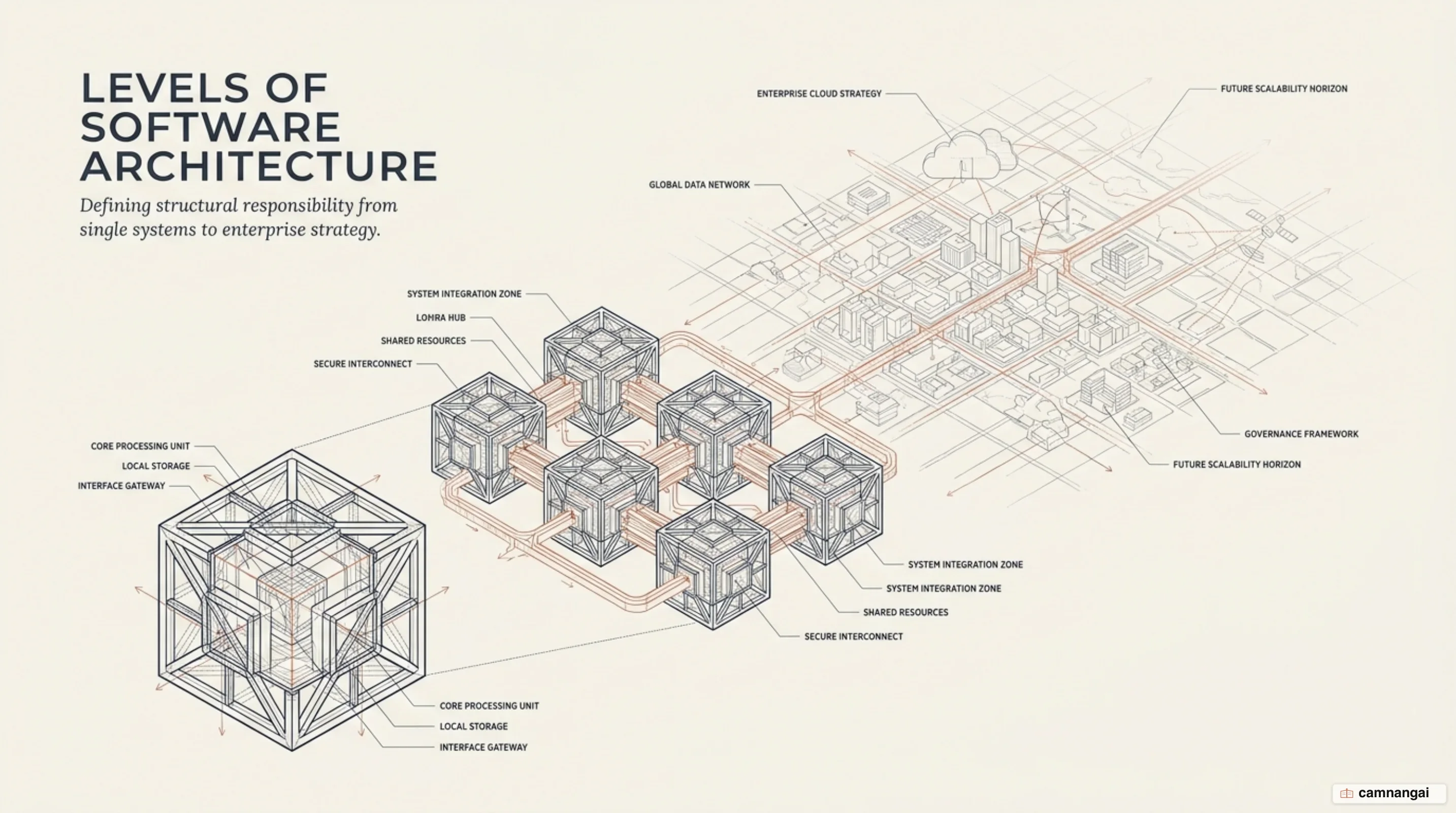
Three scopes of architecture: The urban planning model
The scope of architectural design is best understood through the metaphor of urban planning. Application architecture represents the individual "building," focusing on the internal structure, materials, and floor plans of a single site. Solution architecture functions as the "neighborhood," coordinating how various buildings, transport links, and utility networks interact to provide a cohesive service, such as a commercial district or residential complex. Enterprise architecture is the "city" level, where high-level zoning laws, transit spines, and multi-decade growth strategies govern every neighborhood and structure within the municipality.
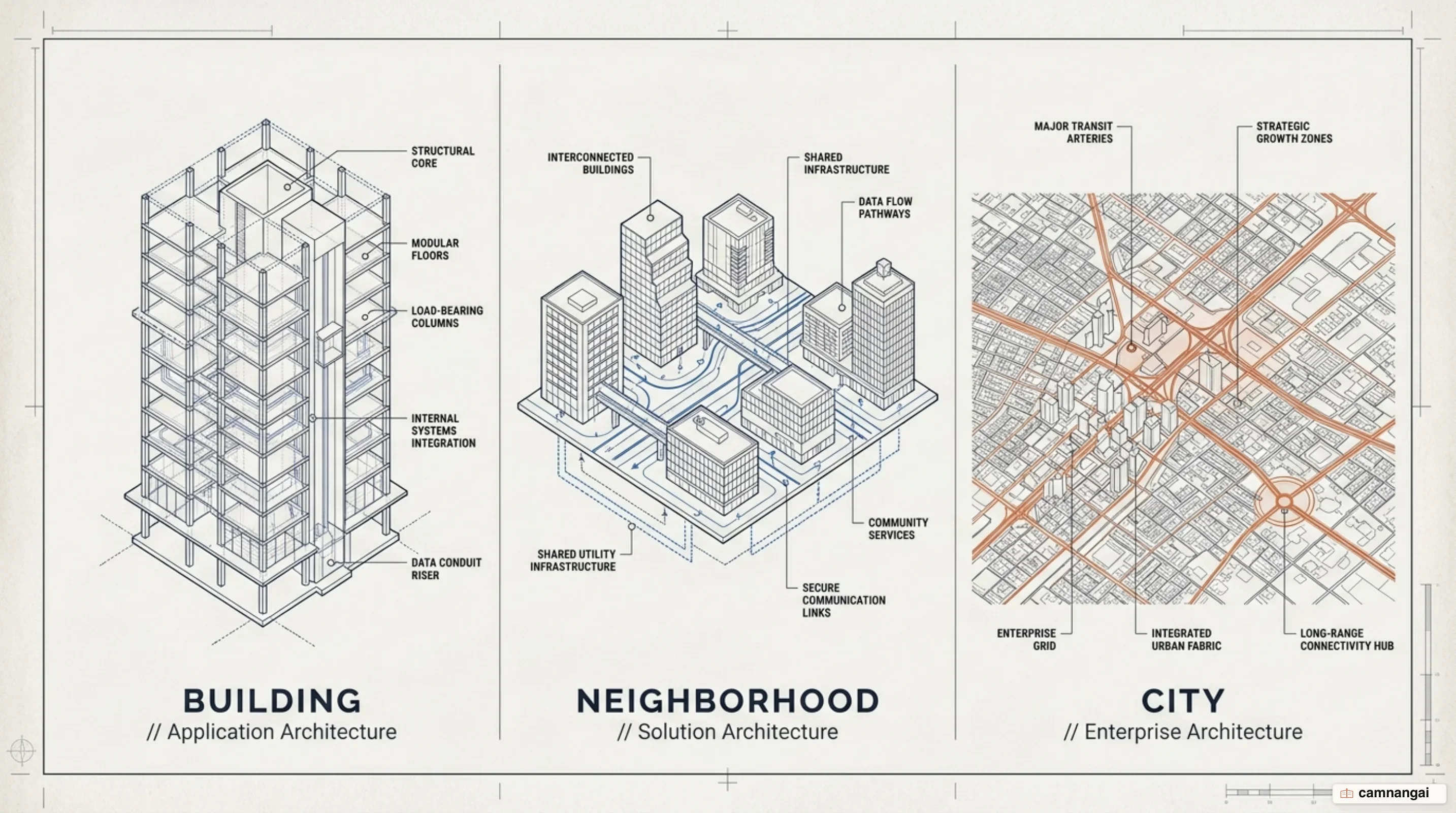
Architecture is fundamentally a social construction where boundaries are often defined by team topology, business units, and budget allocations rather than code artifacts alone. What a software engineer sees as an isolated component, a product manager sees as a user journey, and a business executive sees as a operational capability on a balance sheet. These socio-technical structures dictate the blast radius of decisions and establish the boundaries that an architect must navigate to deliver dependable systems.
Ultimately, architecture consists of the decisions you wish you could get right as early as possible. At the application level, this might involve choosing a data persistence pattern or modular boundary; at the enterprise level, it involves selecting global identity providers, data governance standards, or cross-system integration contracts. Without rigorous boundary separation across these three tiers, organizations accumulate crippling "cruft" — internal friction and technical debt that slows development to a crawl and turns every minor modification into an expensive rewrite.
Application architecture: Designing the internals of a system
Application architecture represents the "how" of technical execution, focusing on the internal structure, modularity, and operational integrity of a single software system. Under the Design Stamina Hypothesis, rigorous attention to internal software quality and the proactive elimination of technical cruft pays off in weeks rather than months. By maintaining high internal design quality, engineering teams preserve their ability to release new capabilities continuously without being dragged down by a decaying codebase.
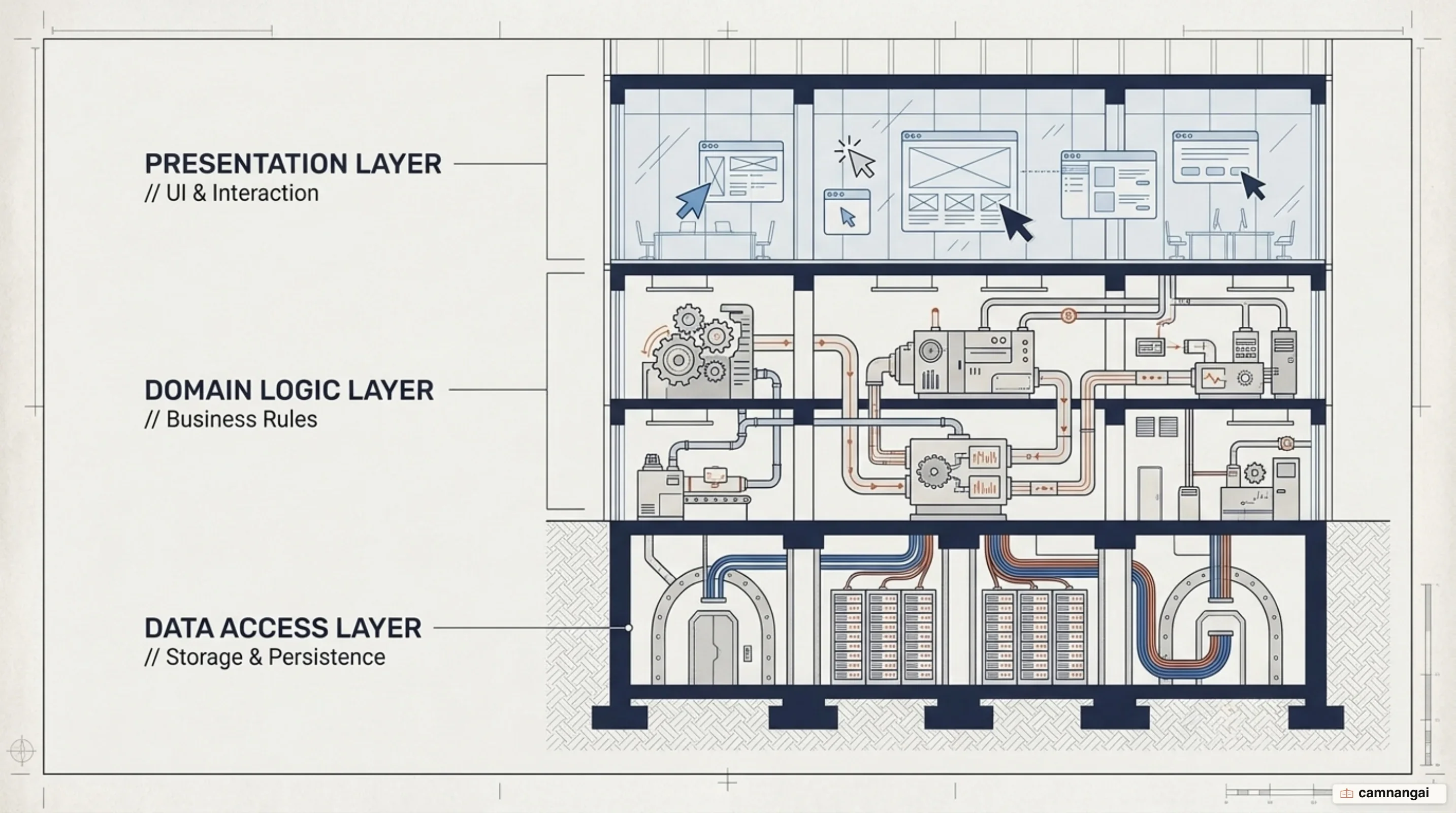
To manage internal complexity, applications typically separate concerns across distinct conceptual layers: Presentation (user interfaces, API gateways, and request serialization), Domain Logic (business calculations, domain rules, and entity state transitions), and Data Access (persistence abstraction, queries, and external messaging). This structural separation ensures that changes to UI frameworks or database drivers do not contaminate core business rules or break validation pipelines.
At this tier, concrete architectural styles (such as N-tier, Web-Queue-Worker, or Microservices) act as design constraints that restrict unbounded developer choices so predictable systemic properties emerge. For instance, in a microservices style, private data stores per service enforce strict boundary isolation and independent deployability. Complementary principles like statelessness further harden the application: stateless application tiers can scale horizontally on demand and survive sudden container restarts with near-zero downtime.
Solution architecture: Bridging business problems and multiple systems
Solution architecture translates a concrete business problem into an end-to-end, multi-system technical implementation. While application architecture focuses on the internals of a single deployment unit, the solution architect coordinates systems across application boundaries, ensuring that the assembled components fulfill stakeholder expectations. This role operates as the connective tissue between business requirements, development teams, infrastructure engineers, and operational support.
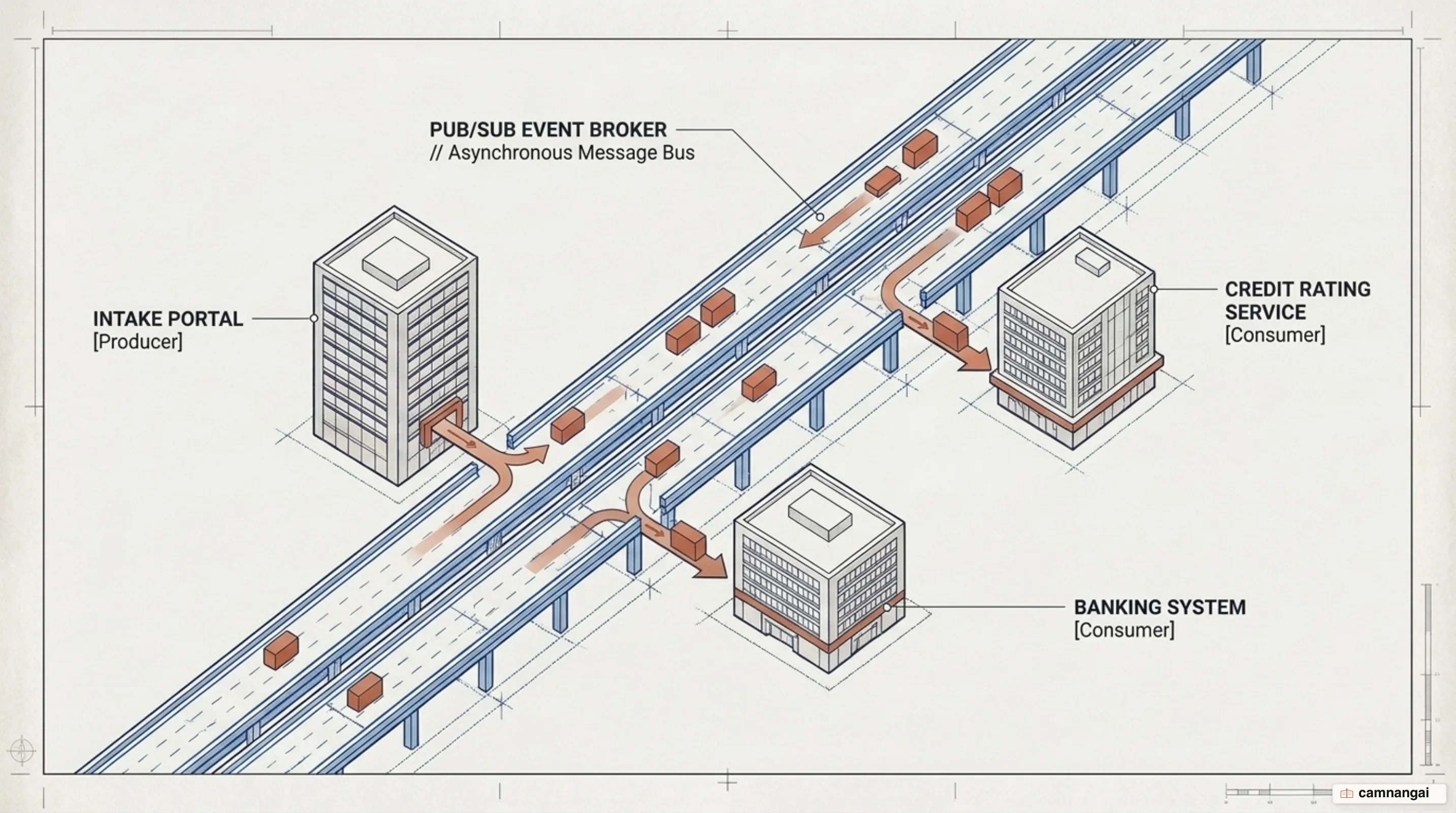
A foundational technique in solution architecture is the reuse of Enterprise Building Blocks. Rather than reinventing authentication, payment gateways, or notification pipelines for each initiative, the solution architect composes established platform services and shared capabilities into an integrated whole. This requires synthesizing multiple architectural facets, including business workflows, integration topologies, security perimeters, and data lifecycles, into an operational design tailored to a specific project.
Consider the classic loan broker integration pattern as a concrete illustration. When a borrower requests a loan, a broker solution must coordinate between customer intake portals, external credit rating bureaus for risk enrichment, and multiple competing banking systems for loan quotes. The solution architecture specifies the messaging topologies, relying on publish-subscribe channels and asynchronous message routers to decouple third-party dependencies. It coordinates timeout handling, compensation transactions, and quote aggregation so the customer receives an optimal offer without exposing internal system vulnerabilities.
Enterprise architecture: Aligning technology strategy with the organization
Enterprise architecture (EA) provides the strategic alignment between organizational vision, business processes, and technology investments. It guides high-level decisions across the enterprise, determining what problems require investment and establishing architectural guardrails that reduce technical duplication across independent business units. Enterprise architecture operates at the highest altitude, focusing on the strategic "What" and "Who" across multi-year planning horizons.
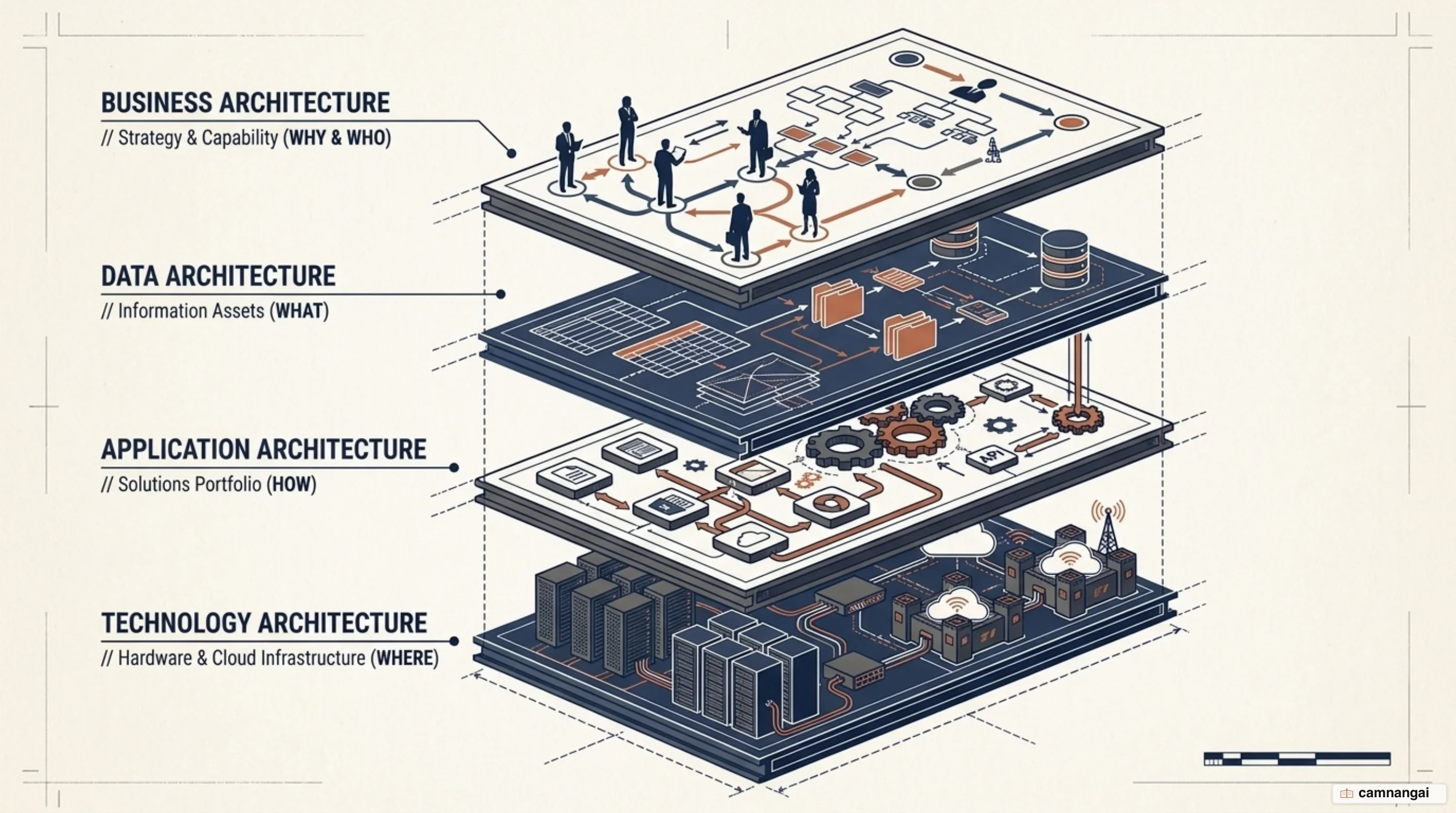
The enterprise architecture discipline typically balances four interconnected domains to maintain comprehensive organizational alignment:
- Business Architecture. Defines core business capabilities, value streams, organizational structures, and strategic objectives.
- Data Architecture. Governs enterprise data models, master data management, analytical pipelines, and regulatory data compliance.
- Application Architecture. Catalogs the enterprise application portfolio, identifying redundancies, lifecycle states, and system boundaries.
- Technology Architecture. Establishes cloud platforms, network topology, infrastructure standards, and shared developer toolchains.
Enterprise architects translate macro-level business trends into actionable technology roadmaps and capability models. Rather than producing static, ivory-tower documentation that disconnects from engineering reality, modern enterprise architects act as scouts. They identify organizational capability gaps, enforce compliance frameworks, and benchmark infrastructure against well-architected pillars to protect long-term agility and operational resilience.
Comparing the levels: Scope, time horizon, and audience
| Level | Scope | Primary Audience | Key Deliverables | Time Horizon |
|---|---|---|---|---|
| Application Architecture | Single application or microservice | Software engineers, technical leads | Component diagrams, API contracts, domain models, code standards | Iteration to sprint (Weeks) |
| Solution Architecture | Specific business initiative across multiple systems | Product managers, project sponsors, operations | End-to-end solution designs, integration patterns, non-functional requirement (NFR) trade-off matrix | Project lifecycle (from 6 to 18 months) |
| Enterprise Architecture | Entire enterprise technology portfolio | C-suite (CIO, CTO), business unit leaders | Strategic roadmaps, capability maps, governance policies, technology radars | Multi-year vision (3 to 5+ years) |
The financial and operational payoff of decisions varies sharply across these three tiers. At the application level, decisions regarding layering, clean interfaces, and automated test coverage yield tangible feedback within sprints. Developers maintain velocity because clean boundaries make bug localization trivial and refactoring safe.
At the enterprise level, decisions shape the organization's technical posture and operational expenditure over three to five years. While a software engineer evaluates thread safety and query optimization in the engine room, an enterprise architect evaluates whether adopting a multi-region cloud strategy or retiring a legacy enterprise resource planning (ERP) platform minimizes corporate risk. Without explicit coordination, well-intentioned local decisions at the application level can aggregate into enterprise-wide fragmentation and unmaintainable sprawl.
Riding the architect elevator: Navigating across architecture levels
Effective architects understand how to ride the "Architect Elevator," navigating freely between the executive penthouse and the technical engine room. Staying exclusively in the penthouse produces detached, theoretical architecture that fails the moment it meets production traffic. Conversely, remaining trapped in the engine room blinds engineers to business strategy, leading to technically elegant systems that solve the wrong commercial problems.
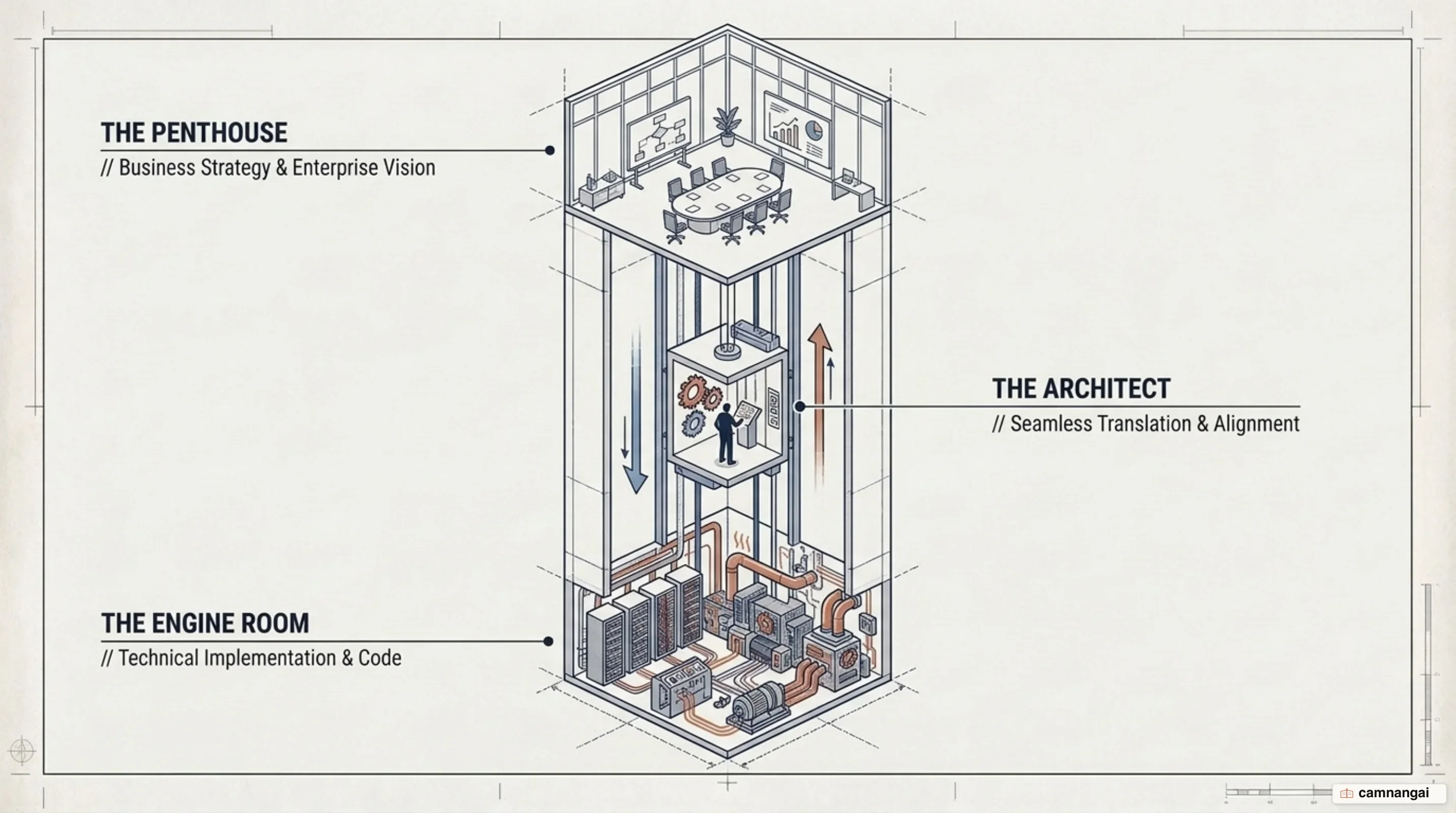
In my own experience building and reviewing complex systems, the ultimate failure mode is becoming a "lift person" — an individual who rides the elevator up and down, parroting vocabulary between teams without adding domain insight or understanding technical constraints. To maintain architectural credibility, senior leaders must periodically get their hands dirty by pairing with engineering teams, reviewing pull requests, and inspecting production failure modes. Granular implementation details (such as JSON serialization discrepancies, Identity and Access Management permission boundaries, or connection pool exhaustion) frequently make or break multi-million-dollar digital transformation initiatives.
Successful organizations cultivate architects who view these levels as complementary perspectives rather than hierarchical status symbols. By translating business imperatives into resilient system designs and feeding operational realities back into strategic roadmaps, architects ensure that the entire technology stack moves in unison from codebase to corporate vision.
References
- AWS Well-Architected Framework — AWS Documentation
- Architecture Styles — Azure Architecture Center | Microsoft Learn
- Back from the Engine Room — The Architect Elevator
- Enterprise Architects vs Solution Architects vs Domain Architects — Visual Paradigm
- Architectural Thinking — IBM Developer
- Google Cloud Architecture Framework — Google Cloud Documentation
- Software Architecture Guide — Martin Fowler