The profession is undergoing a fundamental structural transition. While generative tools can now produce syntax in seconds, the role of a software engineer in the age of AI has moved away from manual code execution. Automation now handles repetitive boilerplate, but engineering value has shifted entirely to system design, deterministic guarantees, and the management of complex failure modes.
In previous decades, professional worth was often measured by the ability to manually author thousands of lines of code. Today, code is increasingly a byproduct of thought rather than the primary deliverable. The human role has expanded to encompass accountability and the orchestration of probabilistic systems that machines cannot govern independently.
The following sections detail the specific technical and economic mechanics of this industry-wide transition.
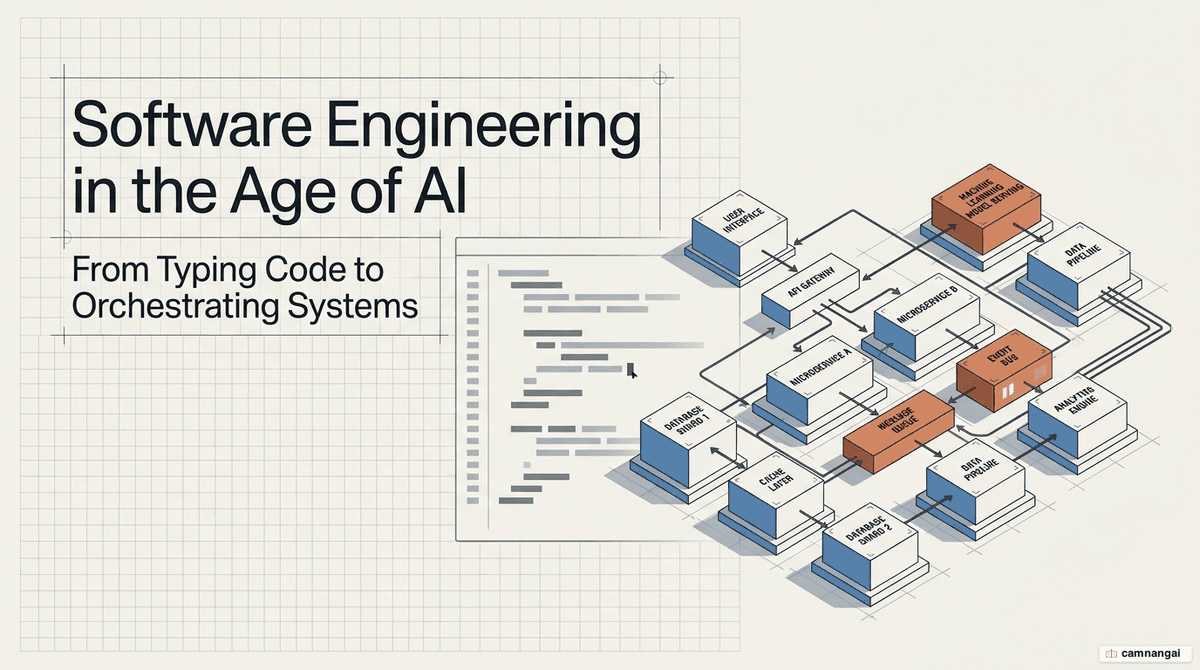
What actually changes for a software engineer when AI can write the code?
The industry has shifted from a "writer of syntax" model to a "reviewer of logic" model. During the tutorial-driven era (2010–2023), the benchmark for an emerging developer was the ability to build clones of popular platforms like YouTube or Spotify. These projects demonstrated a basic grasp of libraries and API integration.
Today, these clones are mere warm-up exercises. AI can scaffold React components, Express servers, and SQL queries instantly, effectively devaluing effort-based metrics. When a machine performs surface-level tasks faster and cheaper than a human, the software engineer's focus must shift to system invariants—the rules and logic that must remain true regardless of the tools used. This loss of value in the physical act of typing code necessitates a new definition of professional worth based on higher-level system reasoning.
Why is writing code no longer the most valuable part of the job?
Syntax is now a commoditized resource. We have entered a period where source code is viewed as a byproduct of thinking rather than the primary output. While AI can generate vast volumes of code, it lacks engineering discipline; LLMs consistently produce 1,000+ line React components that mix state management, UI rendering, and business logic into unmaintainable monoliths.
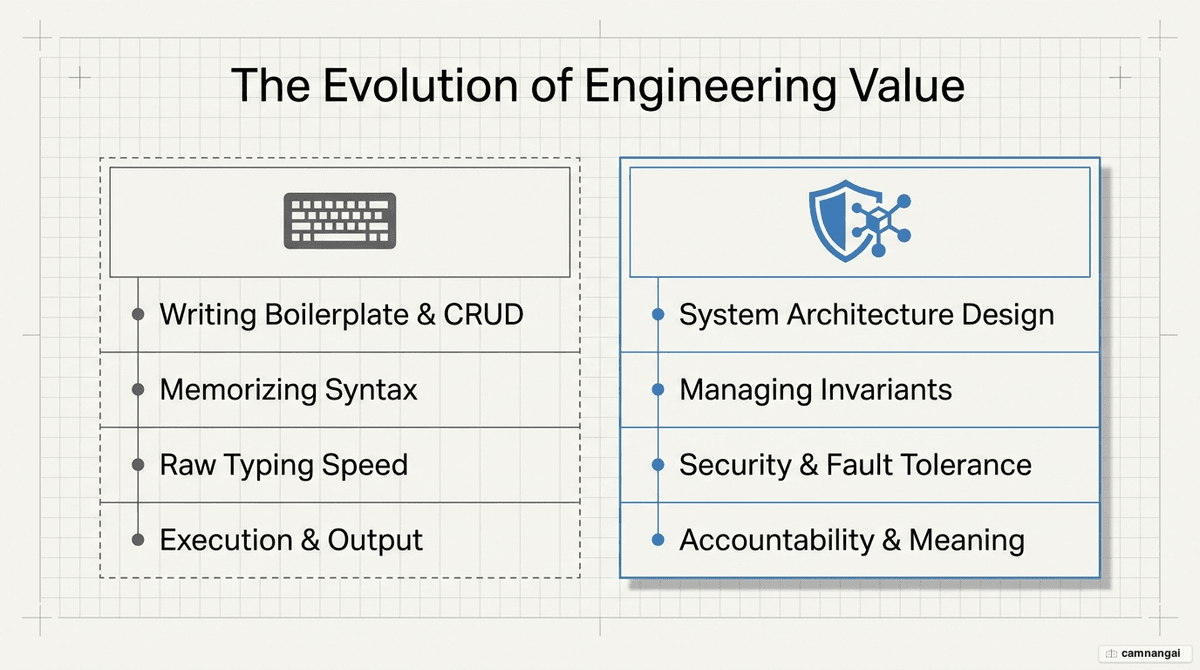
The differentiator is accountability. AI can write an API at high execution speed, but it cannot take responsibility for a production database failure, manage backpressure, or explain architectural trade-offs to a client. The engineer's value lies in providing a human "guarantee" over the system, refining raw AI output into a production-ready, scalable architecture that adheres to legal and safety frameworks.
How does the engineer's role shift?
The role is moving from deterministic thinking to probabilistic thinking. Engineers must now manage components that provide "likely" rather than "certain" outputs. This is quantified by a shift in time allocation: engineers are moving from spending 60% of their time writing code to spending 40% or more on architecture and validation.

New disciplines have emerged to manage these boundaries:
- Semantic Engineering: Preventing prompt injection and managing how AI interprets context at scale.
- Boundary Engineering: Managing the interface where deterministic, reliable code meets probabilistic AI outputs to ensure state synchronization.
This creates a divide between the vibe coder, who ships features quickly but cannot explain why they work, and the architect who understands system invariants.
What new skills and responsibilities does AI create?
Modern engineering requires mastering system composition and intelligence economics—calculating cost per token, managing latency versus inference quality, and implementing production RAG architectures with hybrid retrieval. Engineers must now apply the "Three Laws" of AI engineering: translating messy requirements into invariants, building deterministic guarantees around probabilistic cores, and debugging meaning flow when AI misses context.
Classical principles like SOLID and Factory patterns are transforming:
- The Factory Pattern: Now used to create model pipelines rather than simple objects.
- Semantic Caches: Implementing caches that understand "similar" queries to reduce costs.
- Observability Stacks: Specialized tools designed to track semantic drift rather than just latency.
- Cascade & Shadow Deployment: Chaining specialized models and testing them in production without impacting end-users.
What does this mean for junior vs. senior engineers?
The industry is facing a "missing middle." Juniors face a nightmare where the routine tasks used for training are now automated, leading companies to skip junior hiring and risk the long-term talent pipeline. Without juniors today, there are no seniors in ten years.
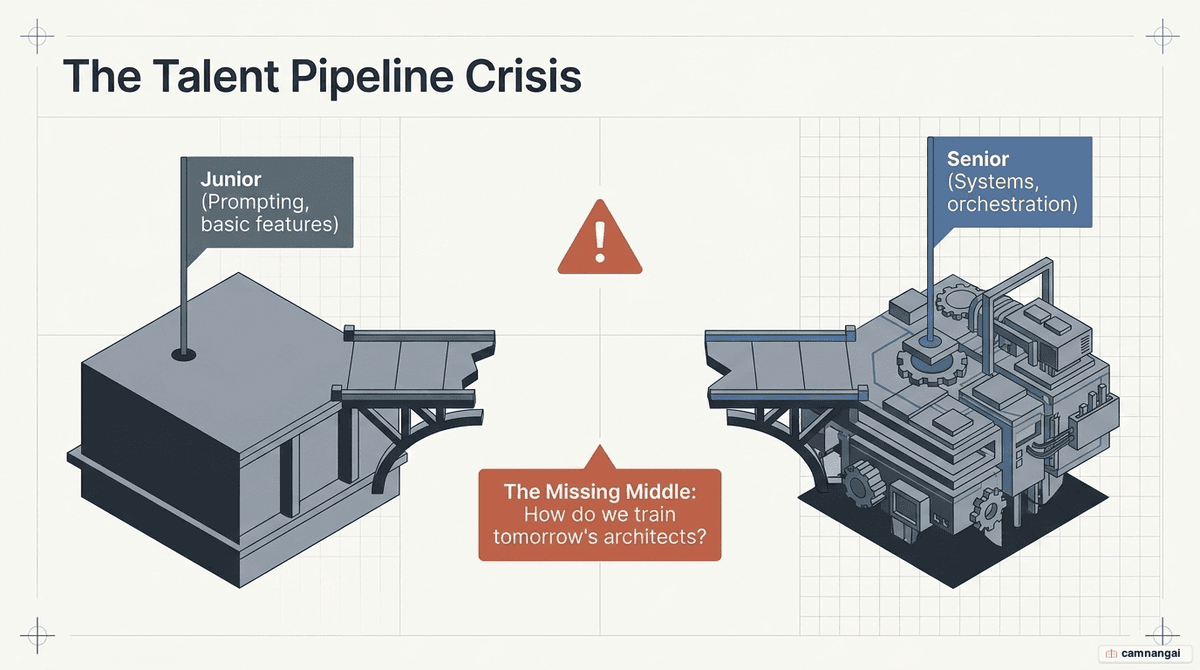
Seniors face their own nightmare: decades of syntax knowledge are being commoditized. AI frequently hallucinates architectural decisions, meaning the "elite" senior must act as an orchestrator who maintains rigorous standards for security and performance. The vibe coder may ship fast, but they cannot debug the concurrency issues or memory leaks inherent in unvetted AI-generated systems. Survival in either role depends on an aggressive roadmap for growth.
How do you stay valuable as a software engineer in the age of AI?
Value is now found in impact-driven engineering rather than tutorial-following. Judgment has become the primary differentiator over speed. To maintain a competitive edge, a software engineer in the age of AI should follow a specialized roadmap:
- Strengthen fundamentals. Deep mastery of networking, event loops, and memory management to debug issues AI cannot see.
- Build "uncomfortable" systems. Move beyond CRUD to build systems that handle real failures, such as payment webhooks, retries, and row-level security.
- Master debugging. Use structured logging and profiling to resolve race conditions in distributed systems.
- Use AI as a tool, not a crutch. Review every line of generated code for Big O complexity and tech debt.
- Establish "proof of work." Contribute to open source and write architectural READMEs that explain the "why" behind technical decisions.
The modern engineer no longer asks "Can I build this?" but "Why should I be the one to oversee what is built?"
FAQ
Is software engineering dead? No, it is evolving. AI handles routine syntax, but the need for a software engineer to design architectures, manage system invariants, and take accountability for failure is higher than ever.
Can AI debug distributed systems? AI is effective at isolated errors but struggles with complex issues like race conditions or state mismatches across microservices. Human intervention is required for these "messy" architectural problems.
What is the "missing middle"? It refers to a potential talent gap. If companies stop hiring juniors for automated tasks, the industry loses the pipeline of experienced developers needed for future senior roles.
References
- How AI Will Change Software Engineering – with Martin Fowler — The Pragmatic Engineer
- Software Engineering at the Tipping Point — Google for Developers
- Software Engineering Isn't Dead — Nate's Newsletter
- The New Definition of Software Engineering in the Age of AI Is Already Here — Medium
- The New Definition of Software Engineering in the Age of AI — freeCodeCamp