The traditional coding interview has lost its utility because AI models now solve isolated programming challenges faster and more reliably than human candidates.
Felix Rieseberg, Engineering Manager at Anthropic—who led engineering for Claude.ai, Claude Code Desktop, and Cowork—retired the traditional coding interview because LLMs like Claude perform better at isolated coding challenges than human applicants, making simple algorithm tests a dead predictor of job performance.
Before joining Anthropic, Rieseberg built software across major technology organizations, including Notion, Stripe, Slack, and Microsoft. His structural shift in candidate evaluation reflects the operational reality at Anthropic, where the company reports that Claude now writes 80% of its own production code.
When synthetic systems write the vast majority of software syntax and solve isolated challenges effortlessly, benchmark tests like writing isolated React components or solving whiteboard puzzles cease to provide useful signal.
When execution becomes cheap, engineering impact is no longer bounded by years spent memorizing syntax and framework boilerplate.
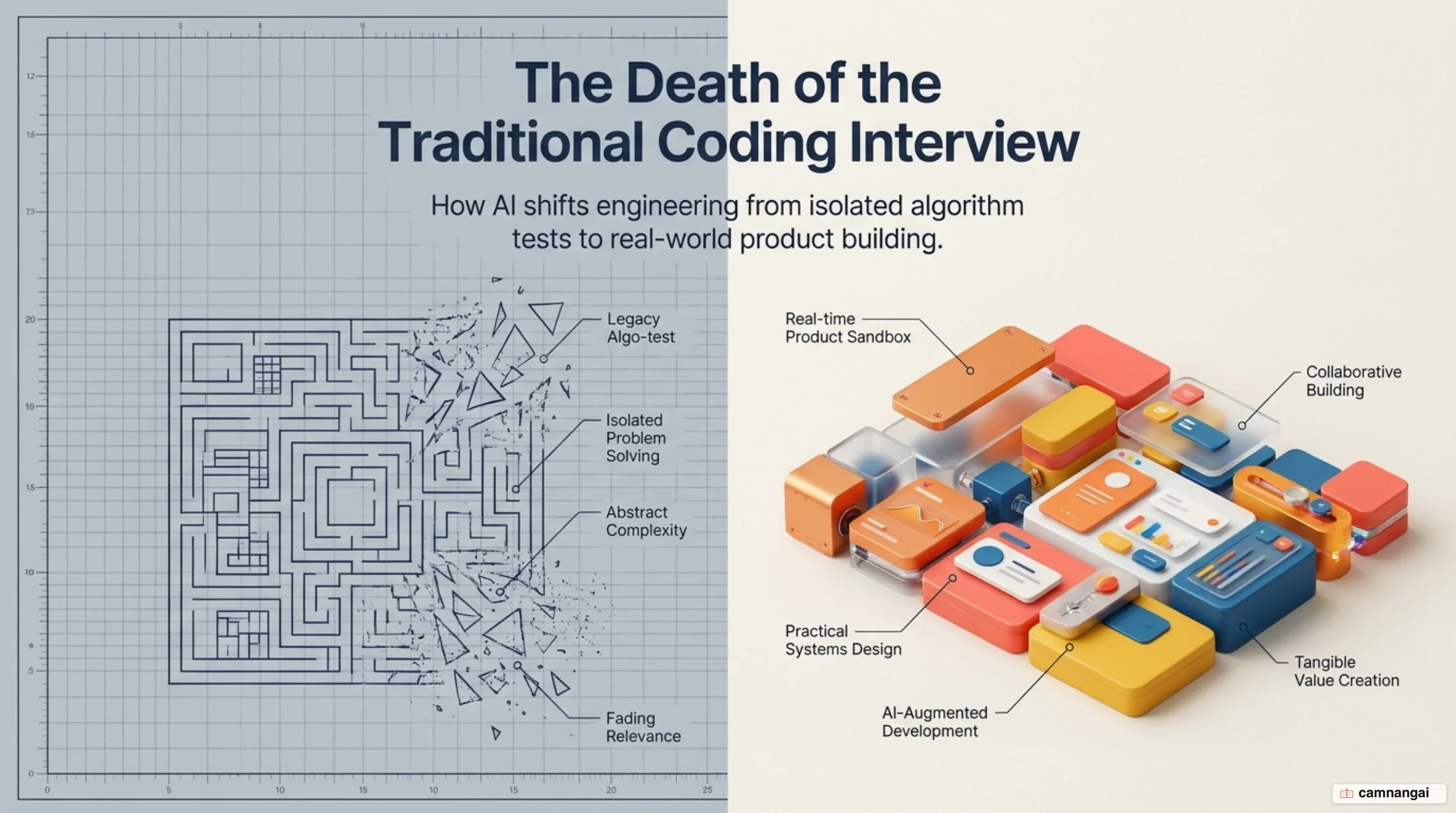
Why Anthropic Dropped the Traditional Coding Interview
In corporate software development, asking your candidates to write isolated React components or quizzing them on low-level concepts like assembly is obsolete when models like Claude outperform humans at both tasks. For years, small live-coding challenges functioned as a weak but useful predictor of candidate success on engineering teams. They provided a baseline signal regarding whether an engineer could define a problem and structure an elegant solution in code. That correlation no longer holds. Your most impactful builders will succeed on production engineering teams regardless of how they score on isolated syntax tests.
This decision reflects a broader structural reality across the technology sector. As language models take over raw code output, legacy screening tools fail to differentiate capable system builders from rote memorizers. Industry peers are making parallel adjustments: Google has expanded pilot programs that explicitly allow candidates to use Gemini during engineering interviews, while Amazon recently issued explicit internal guidance warning its developers against chasing raw AI token generation metrics, a practice termed "tokenmaxxing", in place of meaningful engineering outcomes.
When isolated code generation costs approach zero, testing an engineer on small algorithmic tasks yields no useful data. As an engineering leader, you must stop screening for skills that models handle natively and focus instead on how candidates reason through real-world system constraints, manage context, and deliver functional software.
"Hunger Beats Tenure": When Execution Is No Longer Expensive
Your core value proposition as a software engineer has fundamentally shifted because the cost of execution has dropped to near zero. Historically, tech corporate structures forced junior engineers through layers of middle management to grind for social capital and status before an organization would take a bet on their ideas. Company org charts moved at a glacial pace, treating senior tenure and accumulated knowledge of specific frameworks or libraries as hard bounds on an engineer's potential impact. That structural bottleneck has dissolved. Impact is no longer bounded by years spent memorizing library APIs, allowing hungrier, newer engineers to fly past senior coders who rely solely on tenure.
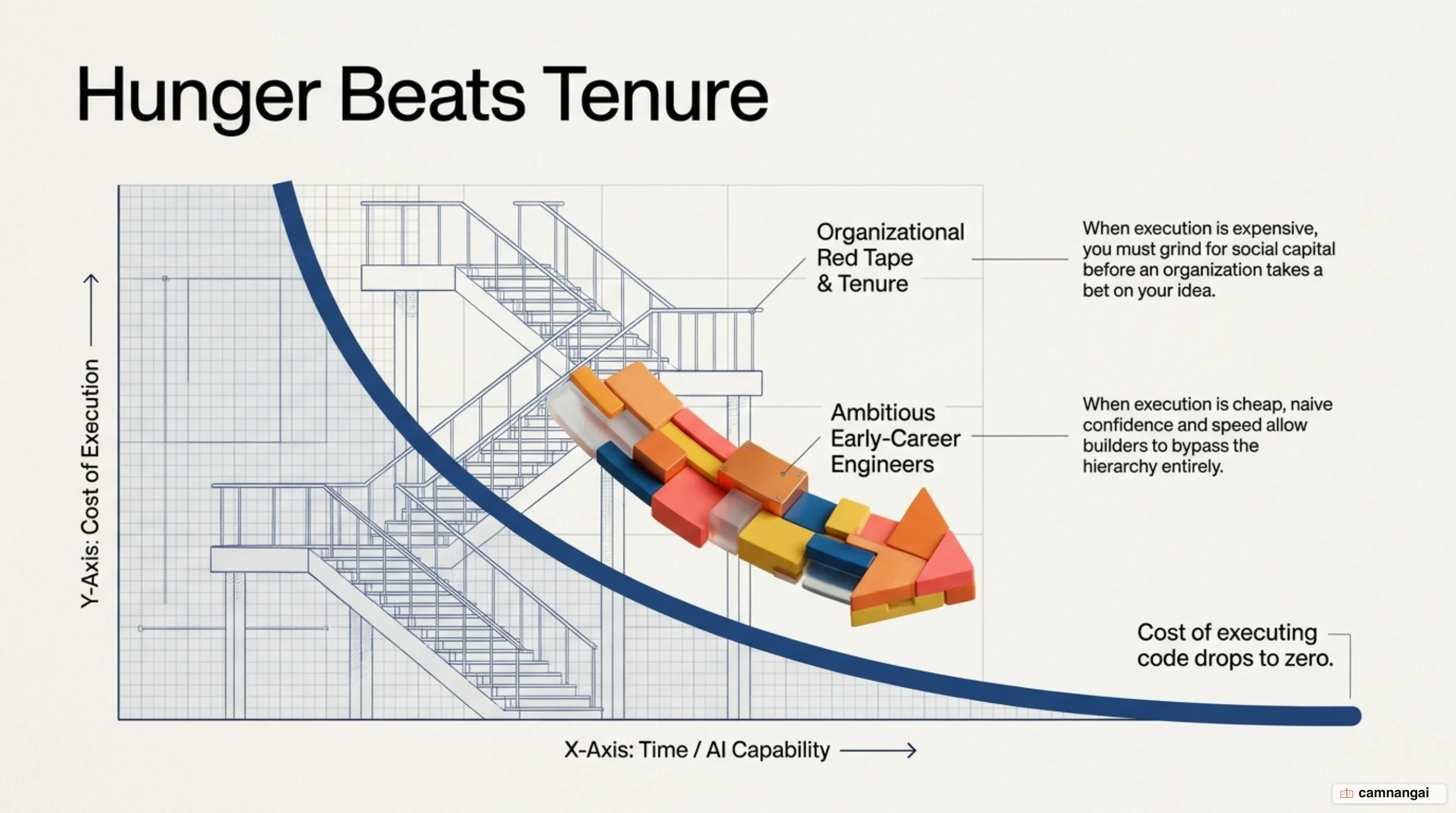
Fresh, naive perspectives hold distinct organizational power when unburdened by legacy constraints. As James March noted in his 1991 organizational science paper, companies depend on "maintaining an influx of the naive and ignorant" to innovate. Orson Welles similarly observed that sheer ignorance drives confidence where experienced professionals become overly timid and careful. At Stripe, founder Patrick Collison explicitly instructed new hires to spot friction that veteran engineers had grown blind to. Felix Rieseberg observed this dynamic directly at Notion: while an offline mode architecture was treated as a trick interview question because veterans considered it impossible, Rieseberg, as an ignorant newcomer, did not know better and simply asked the necessary questions to challenge institutional consensus. Later, when Rieseberg himself became the veteran scoffing at placing live dashboard TVs across office walls because he had previously tried and failed, new hire Ji Pei, unburdened by past failure, simply asked the right person and had the TVs installed the next day.
When execution was expensive, organizations could not afford to let unproven engineers attempt ambitious ideas without extensive buy-in. Today, because building functional software requires vastly less overhead, you do not need to wait for middle-management permission. Look at Anthropic's own team: when users grew accustomed to operating Claude Code exclusively as a command-line interface, two relatively new engineers, Anthony Morris and Alice Zhao, built a working graphical interface prototype over a single weekend. By wrapping terminal stream parsing and CLI event loops into a desktop GUI that visualizes model execution steps, state diffs, and context windows, they bypassed weeks of formal PRDs and alignment meetings. The team shipped the first public version roughly eight days later, delivering a major, highly popular product purely through rapid, unprompted execution.
What Hiring Managers Look for When LeetCode Loses Signal
While engineering managers across the industry are still establishing formal, standardized evaluation models for AI-native workflows, candidate evaluation is pivoting away from LeetCode platforms toward resumes and portfolios containing small, working prototypes. Historically, LeetCode persisted not because it was loved, but because it provided FAANG-scale pipelines screening tens of thousands of applicants with a normalized, binary, administratively scalable pass/fail filter. However, as AI renders algorithmic puzzles trivial, that administrative filter yields zero signal. When you evaluate engineers in an AI-native era, resume screens and portfolio reviews must target three non-negotiable candidate qualities: taste, empathy, and principled thinking.
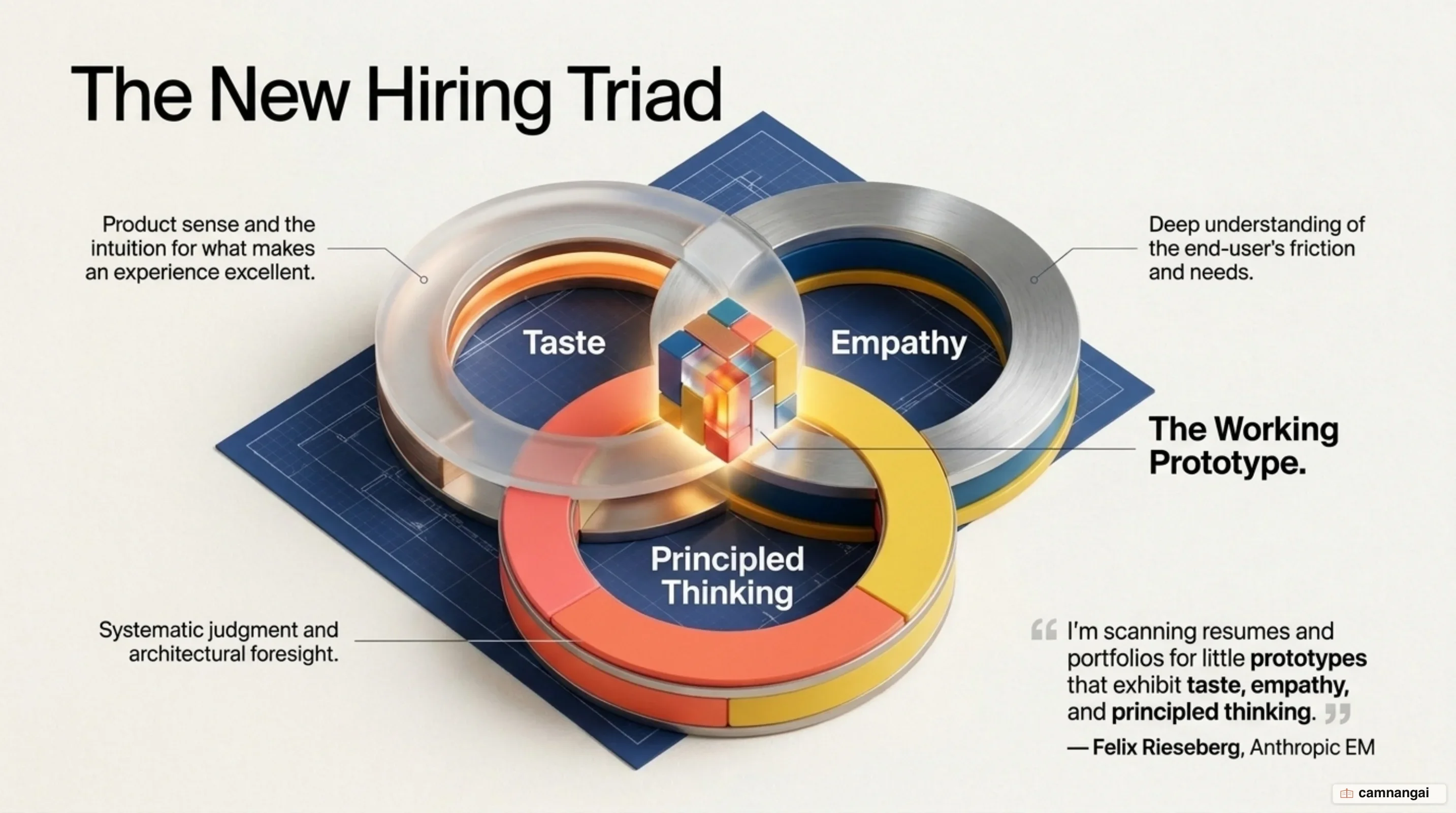
- Taste: Your ability to evaluate generated systems critically, spot architectural design flaws, and curate high-quality user experiences out of raw model outputs.
- Empathy: Your deep understanding of user friction, ensuring that the software you build directly solves a tangible human or operational problem rather than serving as a technical gimmick.
- Principled Thinking: Your capacity to reason through edge cases, system boundaries, and architectural trade-offs when AI code generation hits performance or logic walls.
This portfolio-centric approach contrasts directly with alternative interview formats proposed within the engineering community. Some organizations advocate for low-level design or machine coding rounds, where candidates build an extendable application from a spec in their own IDE using an AI assistant, testing code navigation, mental mapping, and rapid feature extension. Others favor mock code reviews, placing candidates in front of 400 to 600 lines of domain-specific code intentionally sprinkled with real codebase defects, such as unhandled promise rejections, state mutation race conditions, missing database index keys, and memory leaks in long-running Node processes. While machine coding and code reviews provide far richer signals than LeetCode, they require significant human evaluation time that traditional enterprise hiring funnels struggle to normalize at scale. Nevertheless, tangible proof of execution via clean, working prototypes remains your clearest signal of engineering capability.
Five Actionable Strategies for Engineers in the AI Coding Era
To maximize your career trajectory without relying on legacy status, organizational power, or corporate social capital, you must adapt to an environment where execution is cheap. The following five rules formulated by Felix Rieseberg allow you to convert fresh perspectives into a clear competitive edge:
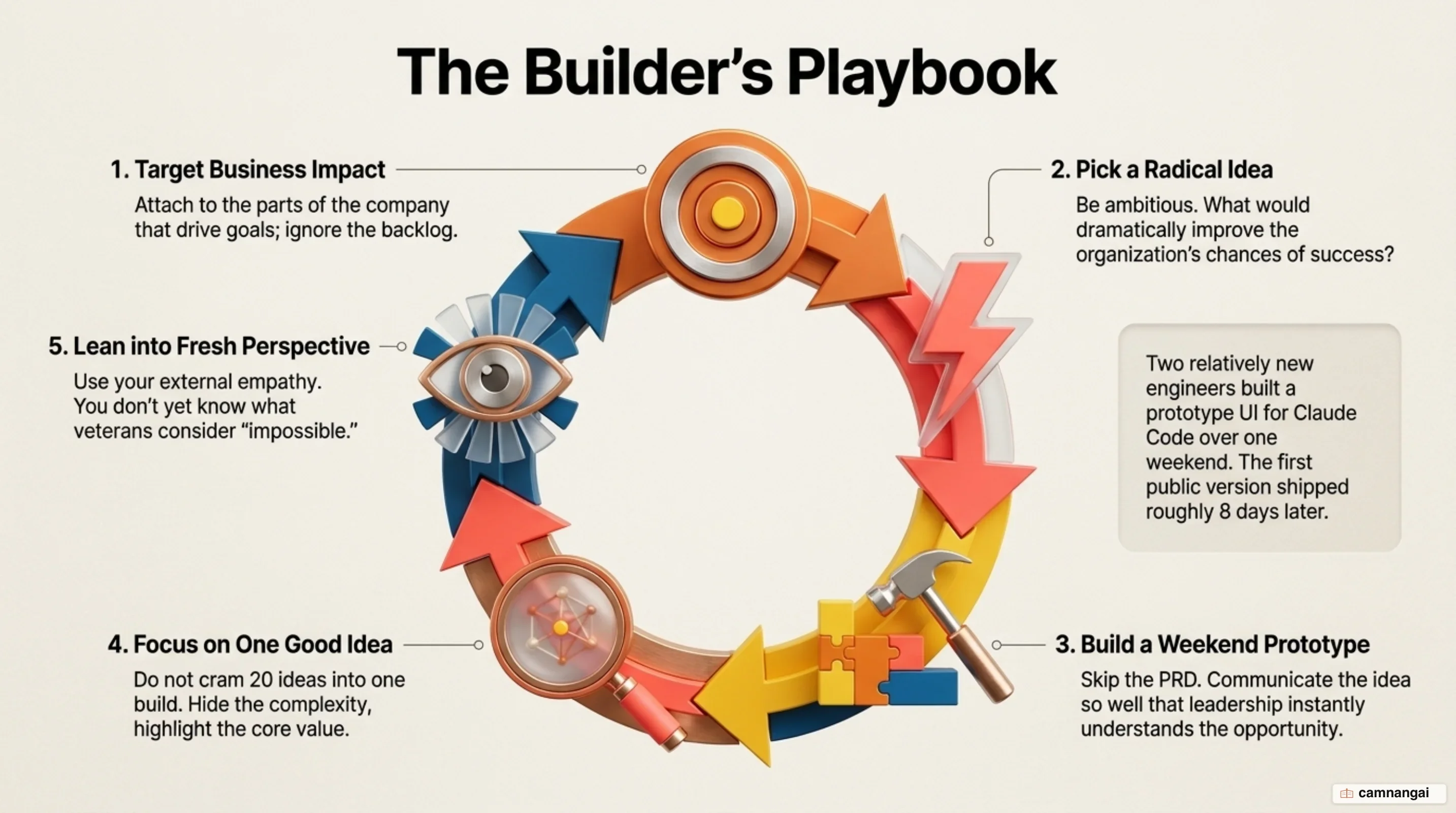
1. Pick Business Impact Over Backlog
Align your work directly with the primary goals of your company, department, or manager's manager. As Patrick McKenzie wrote in 2011, "engineers are hired to create business value, not to program things." Stop treating your JIRA backlog as your boundary; attach your efforts directly to revenue generation, operational efficiency, or core strategic metrics.
2. Pick a Radical Idea
Identify ambitious, high-impact concepts that would dramatically increase the odds of your organization achieving its core goals if successfully executed. Safe, incremental proposals get buried in middle-management review; radical ideas command attention when backed by working proof.
3. Build It Over a Weekend
Bypass formal product requirement documents (PRDs), prolonged committee consensus-building, and lobbying for designer or product manager bandwidth. Build a functional prototype over a weekend using AI acceleration to prove feasibility directly.
4. Focus on One Good Idea
Avoid the common mistake of cramming multiple competing concepts into a single prototype. If your demo requires inventing a custom programming language, a new backend architecture, and a mobile application simultaneously, your core message will fail. Deliver a sharp, hyper-focused prototype that clearly communicates one valuable idea so leadership immediately understands the opportunity and your ability to execute it.
5. Lean Into Your Fresh Perspective
If you build user-facing software, use your fresh eyes and user empathy to spot product friction that veteran engineers have stopped noticing. If you work on infrastructure or developer tooling, take advantage of your clean slate: you benefit from not knowing all the historical reasons why something was previously labeled "impossible."
Where Software Engineering Moves Next
Software engineering is executing a permanent shift up the abstraction layer. Your speed at manual syntax typing and memorized algorithmic traversals no longer dictates your value as an engineer. Modern software delivery centers on translating complex business problems into principled, user-empathic execution using AI-native capabilities.
When you adapt to this shift, you define product direction by delivering working, high-taste prototypes faster than legacy management hierarchies can draft specifications. Those who rely on traditional tenure and syntax memorization will find their signal increasingly diluted in an industry that rewards immediate business impact over manual code generation.