On November 23, 2026, Anthropic launched Claude Ship as an agentic suite for GitHub repositories that automates the post-pull-request pipeline. Available in beta for organizations on Claude Team and Enterprise plans, Claude Ship bundles three specialized agents designed to handle code reviews, push automated commit fixes, and execute policy-based approvals.
While AI coding tools like Claude Code have vastly accelerated initial code generation, the post-pull-request stage has emerged as the central operational bottleneck in engineering workflows. Reviewing diffs, fixing failing continuous integration (CI) checks, resolving merge conflicts, and waiting for human sign-offs routinely stall pipeline velocity. The goal is straightforward: review, fix, and merge code as fast as agents write it.
The Post-PR Bottleneck and Why Anthropic Built Claude Ship
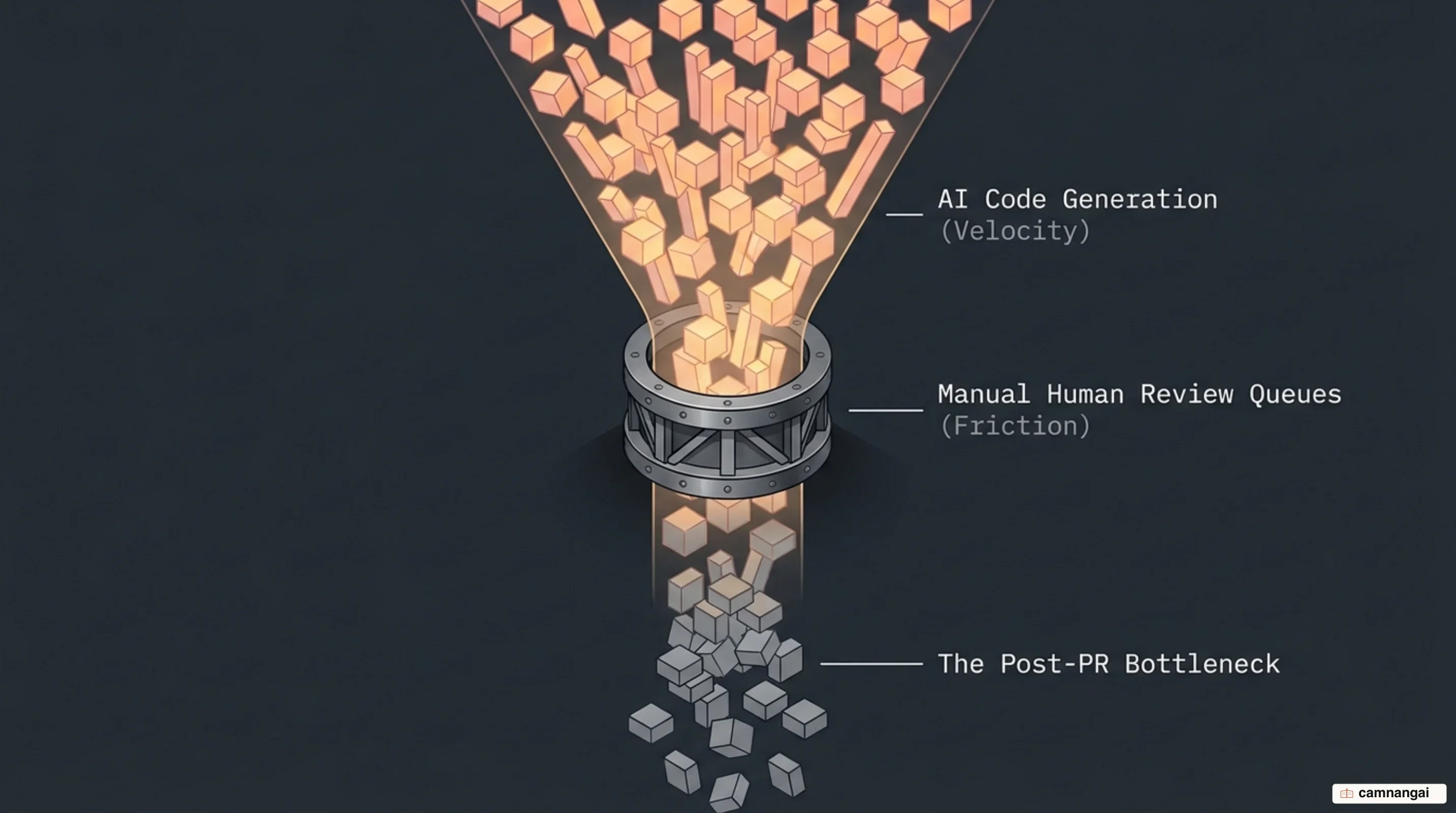
In traditional software development, human engineers write every line of code, allowing manual code reviews to keep pace with pull request volume. However, as engineering organizations adopt coding agents to generate substantial volumes of code, manual review queues quickly become overburdened. When developer output scales exponentially, requiring a human to manually inspect every line of code creates severe queueing delays that undermine the speed gained from automated generation.
Anthropic designed Claude Ship to eliminate friction across every operational step that occurs after you open a pull request. By coordinating automated code analysis, reactive commit fixes, and policy-driven approvals, the system allows your team to move through review and merge stages at the same speed as code writing.
The suite launched in beta on November 23, 2026, for GitHub repositories. You can access Claude Ship if your organization operates on a Claude Team or Claude Enterprise plan, provided your workspace meets specific enterprise security criteria.
The Three-Agent Architecture: Code Review, PR Steward, and Claude Approvals
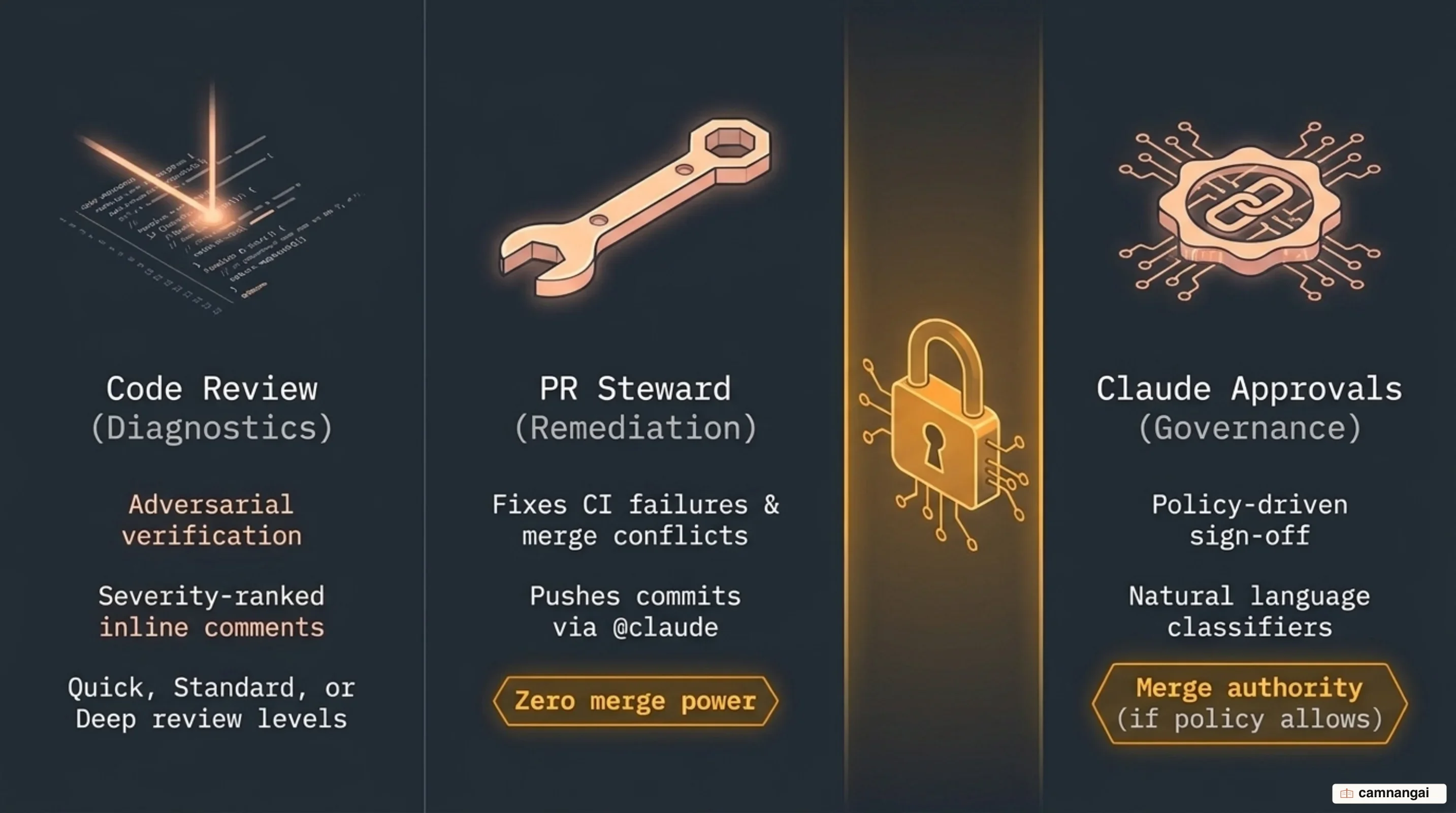
Claude Ship divides post-PR responsibilities across three specialized agents to maintain a strict separation of powers between fixing code and approving merges:
Code Review
Code Review is the diagnostic layer and is generally available (GA). It analyzes pull request diffs against the surrounding codebase through multiple architectural lenses. The agent gathers potential findings, adversarially verifies them to filter out false positives, categorizes issues by severity, and posts structured inline comments directly onto the affected lines of code. You can configure scrutiny levels per repository by selecting Quick, Standard, or Deep review passes.
PR Steward
PR Steward operates in public beta as an operational worker agent dedicated to automated CI remediation and diff reconciliation. It continuously monitors pull requests to resolve failing CI checks, fix merge conflicts, and address review feedback issued by Code Review, other review tools, or team members. After every push, PR Steward posts a comment explaining what changes it introduced and providing explicit instructions on how to roll them back. You can direct the agent's work in pull request threads by commenting with @claude instructions, or pause its activity entirely by issuing a @claude stop command. To prevent unauthorized changes, PR Steward is explicitly forbidden from approving or merging pull requests.
Claude Approvals
Claude Approvals acts as the authorization engine in public beta, determining whether a pull request meets team-defined criteria for automated approval. It parses a dedicated policy file stored in your repository's default branch to evaluate incoming changes. The agent operates as a dynamic rule engine that synthesizes multiple decision signals, combining findings from Code Review, custom natural language classifiers, and path-based approval constraints to grant or withhold sign-off.
Governance and Workflow: Policy Files, Observe Mode, and the /ship Command
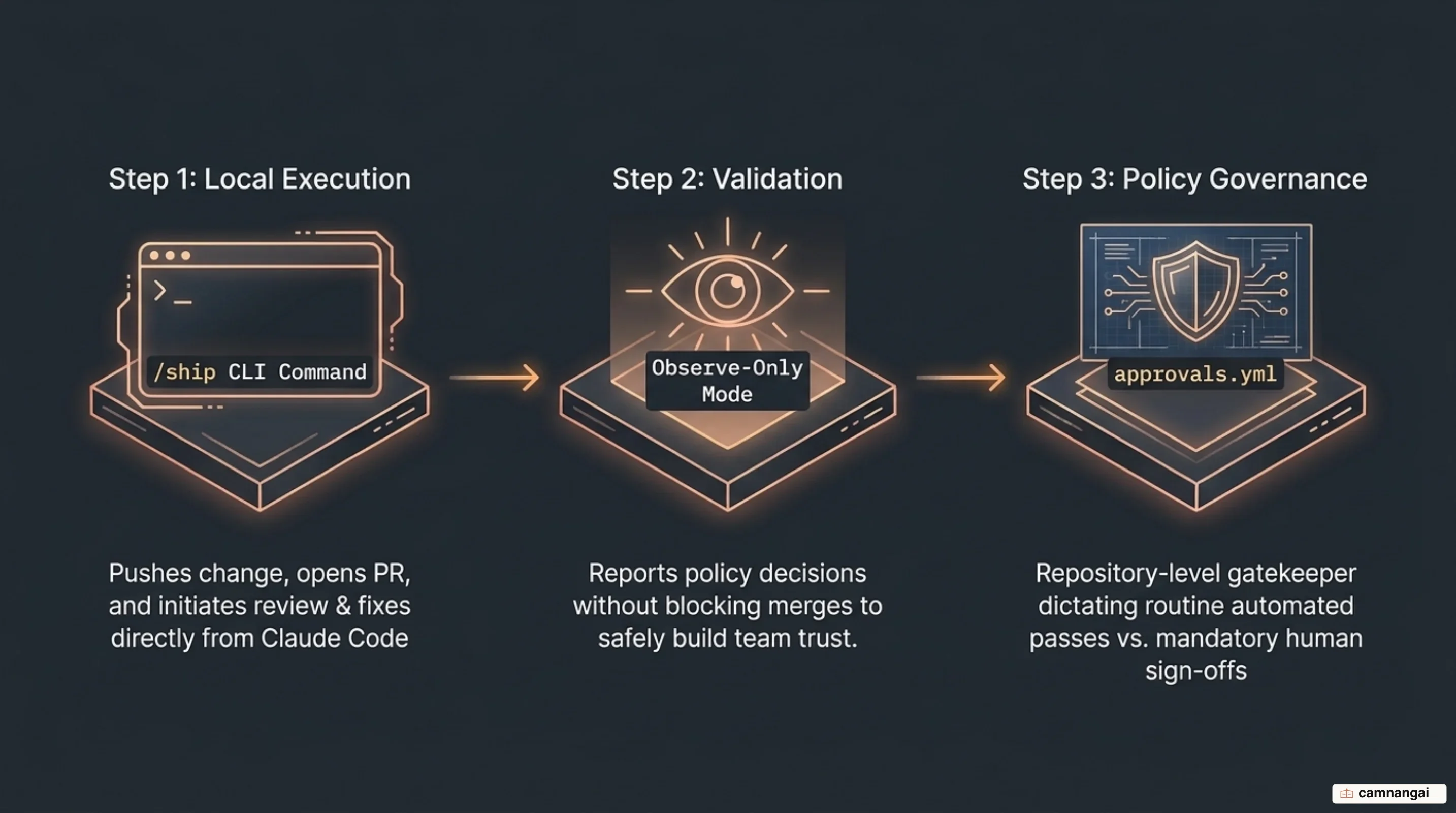
Developers can trigger the full automation loop directly from their terminal or desktop environment using the /ship command in Claude Code. When you execute /ship on a ready change, Claude pushes your branch, opens the pull request, triggers Code Review, and instructs PR Steward to address feedback or failing CI checks automatically. The actions available to /ship remain bounded by your explicit user permissions and your repository's branch protection rules. Alternatively, repository administrators can enable Claude Ship at the repository level, allowing the agents to run across all incoming team pull requests automatically without requiring manual CLI invocation.
Administrators maintain granular control over execution parameters and operational costs. For each repository, admins specify the review depth (Quick, Standard, or Deep), set the review frequency, and establish strict monthly spending limits for Code Review and PR Steward. When onboarding Claude Approvals, Anthropic recommends running the policy engine initially in observe-only mode. In observe mode, the agent logs what decision it would make without blocking merges or enforcing rules, allowing teams to calibrate natural language classifiers before configuring GitHub required checks.
Deploying policy-driven approvals requires careful consideration of security constraints and technical caveats. If your approval policy permits automated sign-off, GitHub auto-merge features or merge queues can merge pull requests into production without human intervention. Anthropic explicitly warns that Claude Ship may miss bugs, security vulnerabilities, or logic flaws. Furthermore, usage is billed strictly by consumption—factoring in PR size, review depth, review frequency, and PR Steward activity—separately from standard plan subscriptions. Claude Approvals itself has no base charge, but natural language classifier runs consume billed tokens, and any approval policy relying on Claude's review triggers a billable Code Review run, even while operating in observe-only mode. Claude Ship is unavailable for workspaces configured with Zero Data Retention, HIPAA compliance setups, or customer-managed encryption keys. Eligible Enterprise plans can claim $10,000 or more in Claude Ship credits by January 15, 2027, valid for 30 days from claiming.
# Representative repository approval policy logic (.claude/approvals.yaml)
version: 1
rules:
  - path: "docs/**"
    approve_if: "code_review.blocking_issues == 0"
  - path: "src/core/auth/**"
    require_human_approval: true
Real-World Performance and the "AI Approving AI" Dilemma
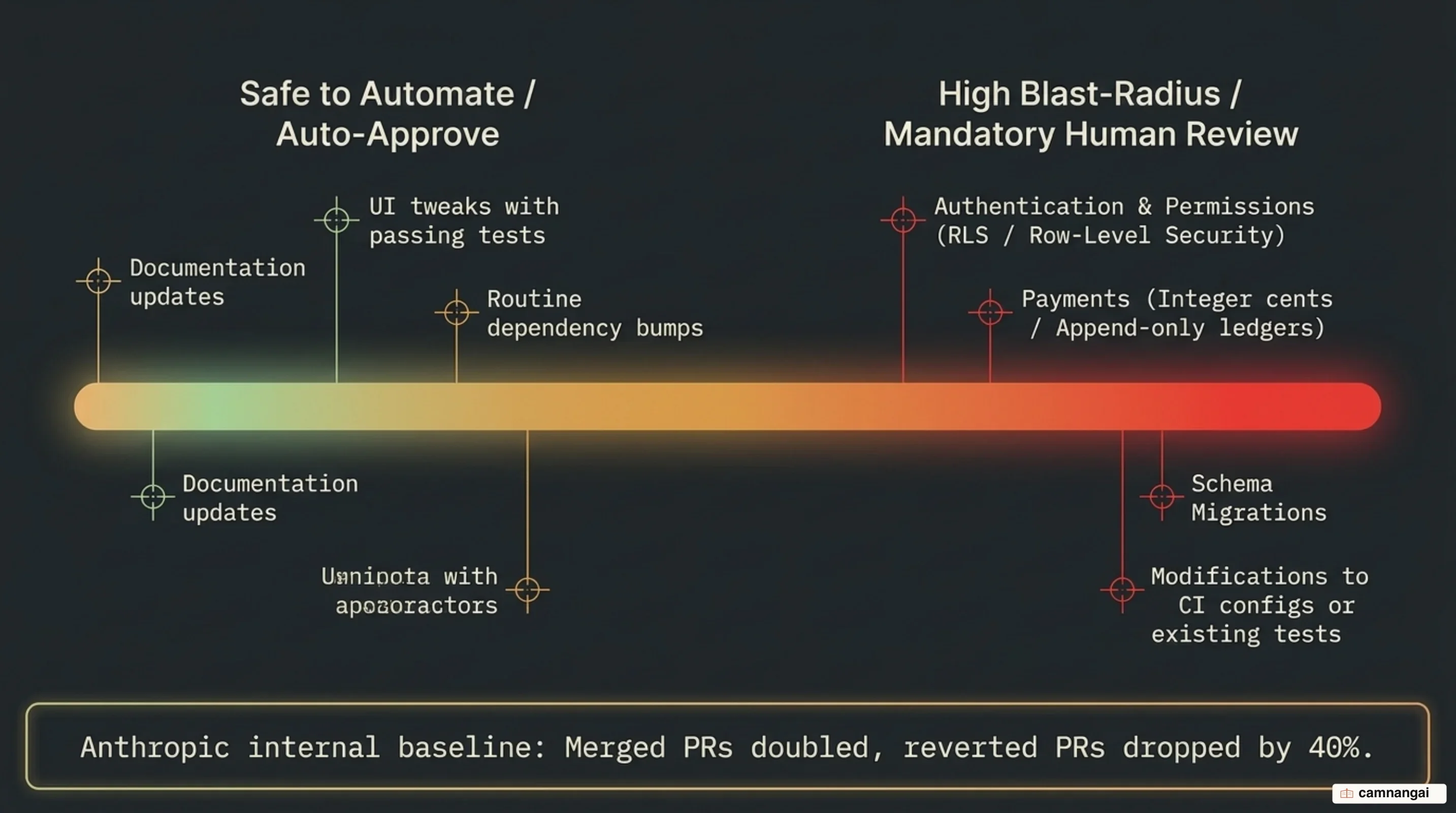
Internal dogfooding benchmarks from Anthropic's Claude Code engineering team—collected between June and September 2026 across their single internal codebase—demonstrate significant throughput improvements. By integrating Claude Ship into their development pipeline, the team more than doubled its volume of merged pull requests while simultaneously reducing the percentage of reverted PRs by over 40%.
Early enterprise pilot feedback indicates similar operational efficiencies in production environments. Industry leaders note that PR Steward helps teams spend less time working through routine code review feedback and more time building. Because human reviewers were already overwhelmed using AI tools to keep up with incoming PR volume, Code Review and PR Steward catch bugs and resolve feedback automatically, allowing scarce senior engineering attention to be concentrated exclusively on complex, high-risk changes.
Despite these efficiency gains, the emergence of automated approvals introduces an architectural debate over "AI approving AI." Software engineering teams are actively evaluating where to establish hard boundaries for automation. A consensus has emerged around blast radius and reversibility: routine tasks such as documentation updates, minor UI tweaks, and dependency updates with passing test suites are well-suited for automated approval. Conversely, high-risk operational domains—including authentication modules, row-level security policies, payment processing engines, database schema migrations, and modifications to CI configurations or self-testing suites—present severe silent failure risks and strictly demand mandatory human sign-off.
How Engineering Teams Should Approach Claude Ship
To adopt Claude Ship safely, you should prioritize risk containment and policy calibration over immediate end-to-end automation. Start by enabling the suite on a single, low-risk repository with conservative monthly spend limits. Configure Claude Approvals in observe-only mode to analyze historical pull requests, verifying that your natural language classifiers and path rules evaluate edge cases accurately before you grant the agent approval authority.
You must maintain strict human gatekeeping over high-blast-radius code paths. Hardcode policy constraints that mandate human sign-offs for authentication logic, database migrations, security rules, and pipeline configurations. By restricting automated approvals to routine, easily reversible diffs while reserving human oversight for critical infrastructure, you can eliminate post-PR bottlenecks without compromising system reliability.
References
- Introducing Claude Ship — Claude by Anthropic
- Anthropic Launches Claude Ship, Letting AI Agents Review, Fix, and Approve Code Changes — TechCrunch
- Anthropic Launches Claude Ship to Review, Fix and Approve PRs — Unite.AI
- Anthropic's Claude Ship Automates the Final Stage of the Software Development Pipeline — SiliconANGLE
- Claude Ship Launches: Three-Agent PR Review System — Emergent Mind
- Claude Ship Gives AI a Seat on Both Sides of Code Review — Help Net Security
- Claude Can Now Review, Fix, and Approve PRs: Community Discussion — r/ClaudeAI