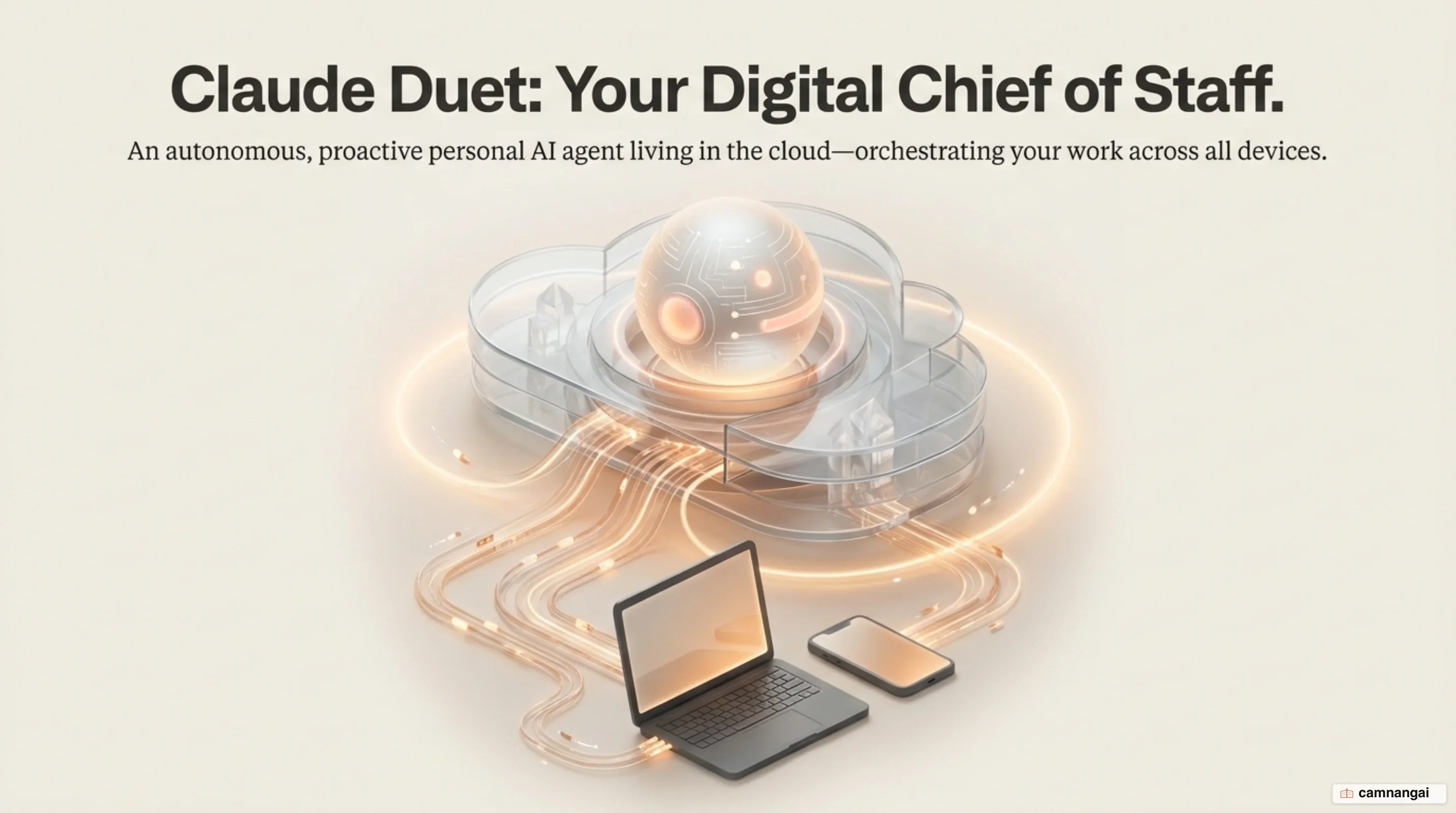
Anthropic released Claude Duet in research preview on October 21, 2026, as a standalone proactive AI agent application powered by the Claude Opus 5.5 model. Designed primarily for professionals and small business owners managing multi-app administrative workflows, the app shifts the core interaction model away from traditional prompt-driven chat interfaces. Instead of requiring you to log in, open a session window, and manually execute prompts, Claude Duet functions as an autonomous digital assistant that operates continuously in the background on dedicated cloud infrastructure.
Claude Duet is a standalone proactive AI agent application powered by Claude Opus 5.5, designed to execute multi-app administrative workflows autonomously in the background.
This architecture marks a transition from reactive AI systems to asynchronous operational proxies. The agent autonomously monitors your connected software tools, compiles aggregated daily operational briefs, tracks task state across long-running projects, and reaches out to you directly when input or explicit human approval is required. By operating on isolated cloud virtual machines, the platform maintains state and executes complex tasks regardless of whether your local phone or laptop is powered on.
By operating on isolated cloud virtual machines, Claude Duet maintains state and executes complex workflows regardless of whether your local device is powered on.
What is Claude Duet and How Does It Work?
Claude Duet is available as a standalone application on iOS, Android, and web (claude.ai), operating independently from the standard Claude conversational interface. Rather than treating every interaction as an isolated session, the platform carries over your existing Claude account context—including persistent system memory, custom skills, and connected application integrations—into a unified workspace. Interaction is structured through text or voice messages within one ongoing thread, allowing a quick inquiry and a week-long administrative project to coexist without requiring prompt engineering or re-establishing background context.

To maintain clear operational state and prevent output fragmentation, the user workspace is segmented into dedicated state-management boundaries. The main thread channel handles continuous natural language communication, while the Tasks tab acts as a real-time execution ledger, tracking background job progress and highlighting specific items awaiting user input. Delivered outputs—such as multi-page research briefs, financial models, slide decks, interactive dashboards, and web application prototypes—are automatically routed to the Make tab, where finished assets can be reviewed, exported, or edited. You can also instantiate dedicated project channels for isolated operational domains, all of which inherit access to the primary system memory.
Claude Duet runs on Claude Opus 5.5, relying on the model's reasoning capabilities to evaluate task complexity and determine execution trajectories autonomously. The voice and text interface lets you issue natural language goals without framing prompts around explicit context windows or schema structures. The agent evaluates the objective, maps the required tool endpoints, coordinates multi-step background operations, and continuously updates the workspace state as sub-task milestones are completed.
Proactive Capabilities: Moving Beyond Reactive Chat to Daily Briefs
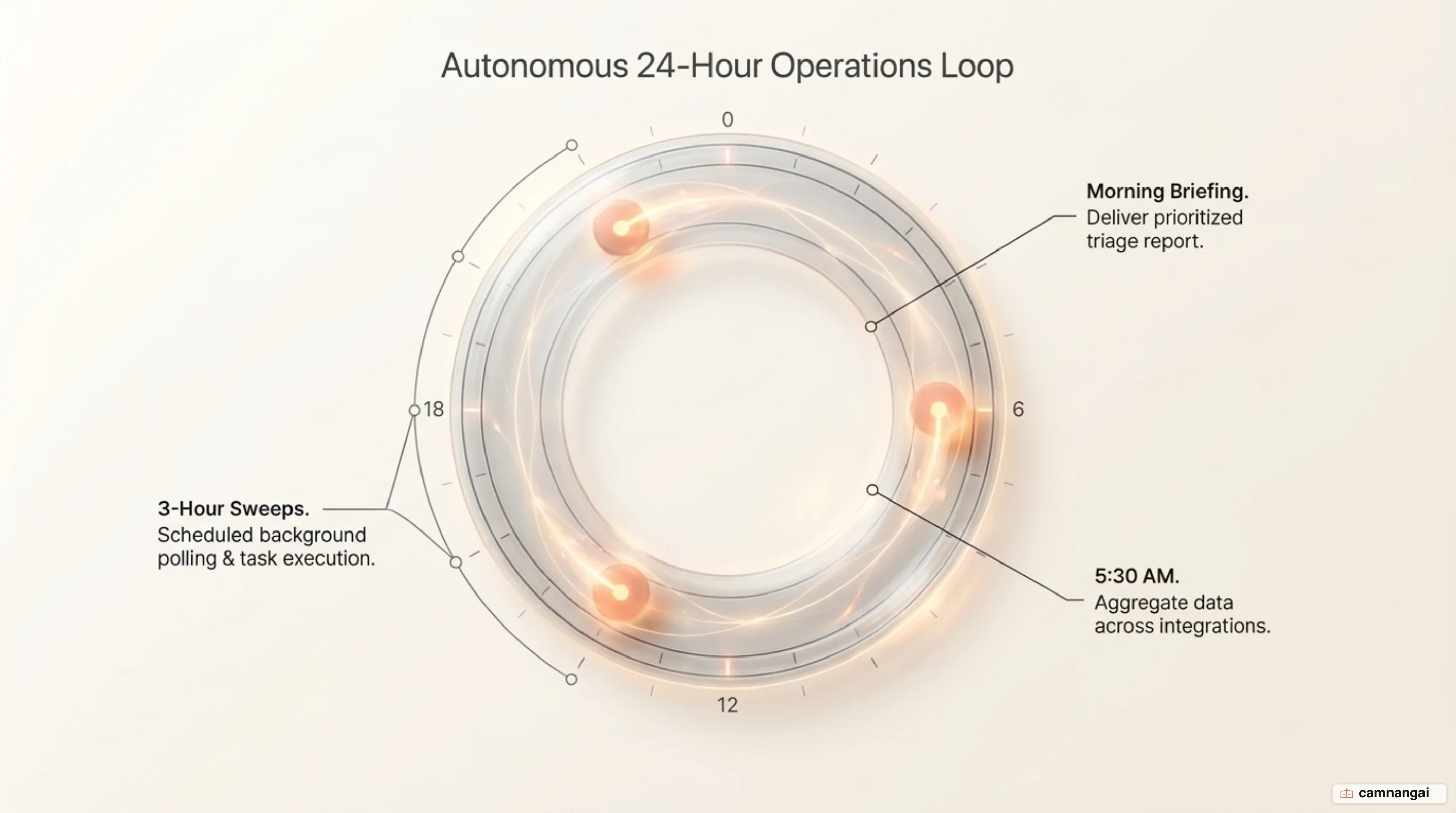
The central functional feature of Claude Duet is its proactive workflow execution, driven by scheduled background monitoring rather than real-time user triggers. Every morning, the agent generates an aggregated operational brief by scanning connected tools across your ecosystem, including Gmail, Google Calendar, Slack, Intuit QuickBooks, Gusto, and Stripe. To ensure data freshiness, the underlying metrics dashboard (such as the Marlo Pulse overview) auto-refreshes at 5:30 AM prior to generating the brief, synthesizing overnight events into an actionable rundown before your workday begins.
The morning briefing surface highlights concrete operational anomalies and time-sensitive milestones across your organization. For example, the system flags contract issues like Northfield's $410K renewal redline requesting Net 60 payment terms, alerts you to pending regulatory gates like a $640 county health permit fee expiring in 8 minutes for a new location opening, and aggregates customer fulfillment defects like 19 weekend delivery refund anomalies concentrated at a single retail site out of 27 overall errors. It also prepares investor presentation workflows, such as updating a Series A slide deck with Q3 figures ahead of a Thursday 10:00 AM partner meeting and flagging specific slides requiring visual review.
To optimize compute efficiency and adhere to API rate parameters, Claude Duet operates on an asynchronous check-in schedule. Rather than continuous real-time scraping, the agent polls connected software accounts at set intervals, defaulting to a 3-hour polling window. During these sweeps, the agent evaluates incoming messages, schedule changes, and transaction records, queueing background actions or drafting tentative email replies for high-priority threads while remaining quiet when non-urgent events occur. System responsiveness and signal calibration improve through continuous feedback: correcting the agent's urgency classification during the initial week trains its filtering heuristics to separate critical operational signals from background noise.
Cloud Virtual Machines and Independent Background Execution
Claude Duet executes background tasks within an isolated, persistent cloud virtual machine (VM) infrastructure hosted on Anthropic's network. Because the execution environment is completely decoupled from local hardware, long-running multi-step jobs continue processing continuously even if your mobile device or laptop is powered off or disconnected from the network. The cloud VM maintains execution state, manages task queue transitions, and retains session data across multi-day operations.
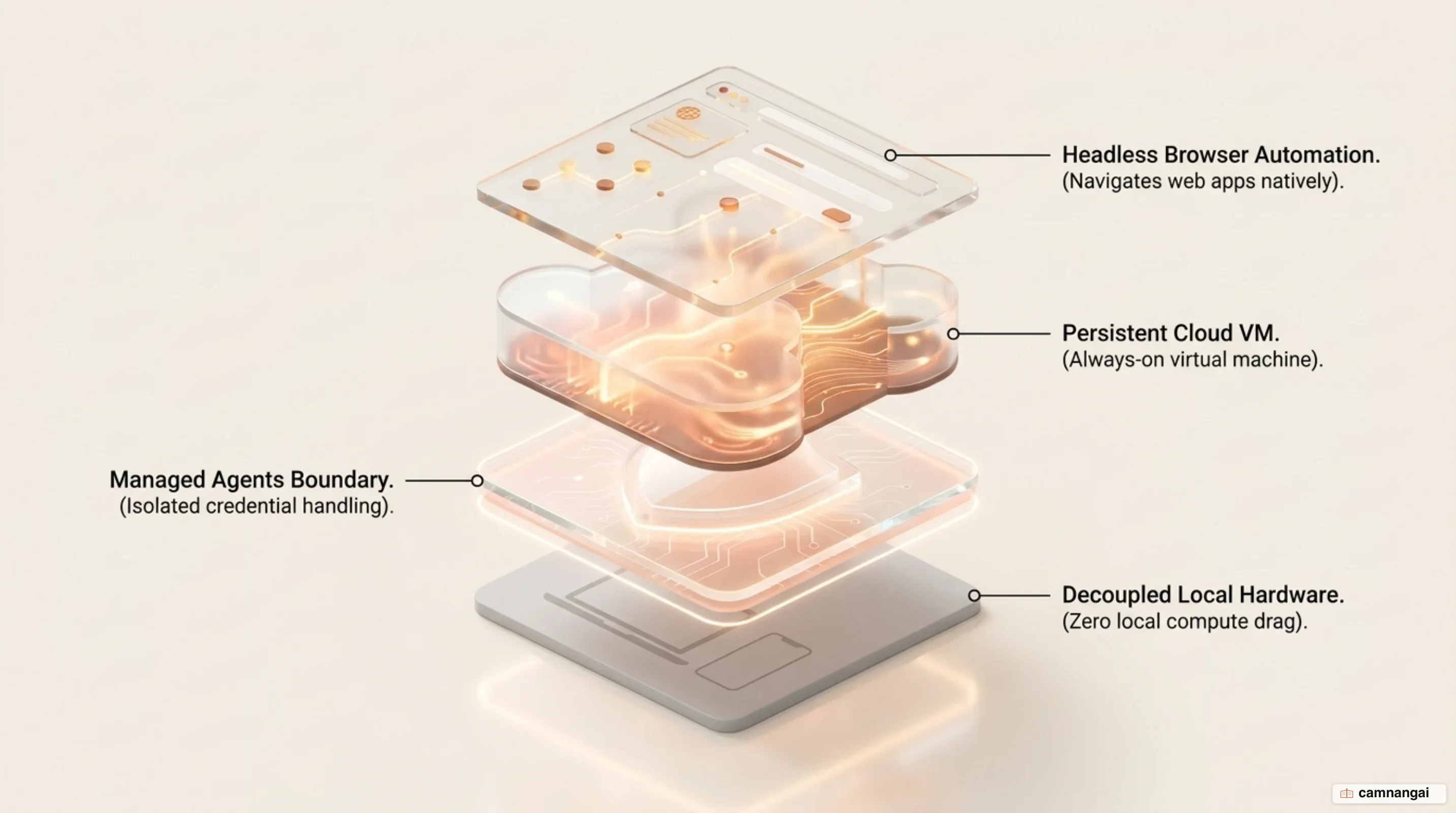
For target web platforms that lack native API connectors or open integrations, Claude Duet runs an integrated headless cloud browser. This browser allows the agent to navigate web interfaces, interpret DOM elements, interact with web forms, and retrieve information as a human user would within a desktop browser. Security is maintained through Anthropic's Managed Agents architecture, which isolates session tokens and DOM form interaction from raw LLM context windows to mitigate prompt injection risks. Passwords are entered via secure mobile UI forms directly into the cloud browser session, and upcoming capabilities will include direct integration with identity credential managers such as 1Password for automated authentication.
Despite this execution model, several technical limitations exist in the current preview environment. You cannot view a real-time streaming feed of the remote browser session or manually take control of the cloud browser instance. The agent also lacks access to your local device file system, cannot interact with offline local applications, and cannot place phone calls or send native SMS text messages to external parties. Integration gaps also remain; for instance, Microsoft 365 connectors are currently unavailable, and Slack integration functions with limited scope.
Human-in-the-Loop Safety Controls and Explicit Approvals
Anthropic's security architecture for Claude Duet incorporates strict human-in-the-loop approval thresholds to prevent unauthorized execution of consequential or irreversible operations. The agent is explicitly gated by hard safety controls: it must present a detailed execution preview and receive explicit user confirmation before sending external emails, processing financial payments, signing Docusign agreements, or deleting system files. If you do not respond to an approval prompt immediately, the agent pauses the affected sub-task, completes any non-blocked background work, and holds the approval request in queue until actioned.
Financial operations follow a secure payment framework designed to prevent credential exposure and unconstrained spending. When performing purchases or executing vendor transactions, Claude Duet routes payments exclusively through Link (Stripe) or Shop Pay using single-use virtual credit cards. These virtual cards mask your primary credit card numbers and are restricted strictly to the designated transaction amount and merchant. Every commercial transaction requires itemized confirmation and explicit authorization from you before funds are drawn.
Underlying security mechanisms draw from Anthropic's enterprise agent infrastructure. Credential management uses the Managed Agents architecture, ensuring that authentication tokens and passwords are stored securely within isolated containers without being exposed directly to the model context. Defenses against prompt injection and hidden malicious web instructions are integrated into the browser processing layer. Furthermore, a dedicated safety classifier and specialized system prompt evaluate all outbound messages, automatically blocking unauthorized disclosures of sensitive data such as credit card numbers and government IDs. Hard system boundaries forbid high-risk actions entirely, including security trading or inter-account funds transfers, even if explicitly requested by the user.
Connected Ecosystem, Pricing, and Access Tiers
Claude Duet interfaces with over 6,000 connectors and plugins available in the Claude Marketplace. Supported enterprise integrations include Intuit QuickBooks and Stripe for automated invoice tracking and payment reminders, Gusto for payroll preparation and execution, HubSpot for CRM record processing and follow-up generation, Docusign for contract routing, LinkedIn for automated job posting, Canva for marketing campaign production, and Shopify for store administration and inventory management. System connections are explicitly granted by the user and can be revoked individually at any time.
Access to Claude Duet is currently restricted to a waitlist-gated research preview for US-based subscribers on personal Claude Pro ($20/month) and Claude Max ($100+/month) tiers. Accounts tied to Team and Enterprise plans are excluded from this preview phase, and registration requires a US account paired with an iOS or Android device. Anthropic charges no additional subscription fee for Claude Duet during the preview window, integrating access directly into existing tier subscriptions.
Resource consumption operates on shared plan quotas rather than separate pricing meters. Background monitoring sweeps, periodic account polling, and multi-step reasoning tasks consume standard 5-hour session and weekly usage limits allocated to your Pro or Max account. Because intensive tasks—such as generating complex financial models or slide decks—require substantial model turns and VM background execution, overall session limits are depleted faster than during standard chat conversations. To offset this operational overhead during testing, newly admitted preview accounts receive a one-time full usage limit reset for both 5-hour and weekly quotas, valid for redemptions through November 30, 2026.
How Claude Duet Compares in the Personal AI Agent Race
The debut of Claude Duet signals a broader industry shift toward persistent, background-executing software agents, placing Anthropic in direct competition with rival tech offerings. OpenAI's Dots, built on the GPT-6 Astra model and available to ChatGPT Pro and Business Premium subscribers at $100/month, emphasizes deep integration into Slack scheduling workflows and multi-agent team configurations. Meta's Muse, powered by the Muse Spark model across web, mobile, and WhatsApp platforms, provides a rapid five-minute consumer onboarding process supported by a secondary "Sentinel" agent for security monitoring, spanning free tiers up to $100/month paid plans. Meanwhile, xAI's Grok Bot runs cloud computer virtual machines capable of directly logging into non-API web interfaces—such as WhatsApp Web and third-party LLM accounts—focusing on customizable, multi-bot setups.
| Agent System | Underlying Model | Target Audience | Pricing Structure | Key Structural Traits |
|---|---|---|---|---|
| Claude Duet | Claude Opus 5.5 | Professionals & Small Businesses | Included in Pro ($20/mo) & Max ($100+/mo) | Cloud VM, 6,000+ connectors, strict human approval gates, single-use payment cards |
| OpenAI Dots | GPT-6 Astra | Pro & Business Users | $100/mo (ChatGPT Pro / Business) | Embedded in Slack/ChatGPT/Codex, multi-agent collaboration, calendar rules focus |
| Meta Muse | Muse Spark | Everyday Consumers & Power Users | Free tier; Paid $20/mo & $100/mo | Consumer onboarding, WhatsApp reach, guarded by secondary Sentinel agent |
| xAI Grok Bot | Grok | Developers & Power Tinkerers | Tiered (SuperGrok Heavy / Cursor) | Cloud desktop VM, logs into non-API services (WhatsApp Web), multi-bot OS setup |
From a software engineering perspective, this launch demonstrates that the advancement of autonomous digital proxies relies on architectural safety design rather than model benchmark scores alone. While raw reasoning capabilities drive complex task planning, operational viability depends on hard human-in-the-loop security gates, managed credential isolation, and deterministic approval thresholds. A key architectural factor in this ecosystem is plain-text rule portability: custom instruction sets, system prompts, and calendar parameters (such as 20–25 scheduling rules) are stored as platform-agnostic plain text, enabling engineers and users to migrate complex logic between platforms without vendor lock-in.
Data ingestion architectures are also evolving through specialized research-to-decision scraping workflows. Tools like the Apify scraping connector—available within Claude and Grok Bot setups, but absent in ChatGPT—allow background agents to extract unindexed, real-time data from Reddit threads, YouTube comments, and social channels. Integrating these scraping pipelines directly into autonomous agents provides raw context that standard indexed web search engines miss, grounding operational decision-making in actual user sentiment before initiating automated workflows.
References
- Claude Duet Product Overview — Anthropic
- Introducing Claude Duet: Proactive AI Agent — Anthropic
- Meet Claude Duet, the Latest AI Agent — Mashable
- What is Claude Duet? Anthropic's Autonomous AI Agent Explained — Tatler Asia
- Claude Duet: Anthropic's Proactive Agent, Explained — Eigent AI
- Claude Duet: Proactive Agent Analysis — Cellcog
- Claude Duet vs Muse, Grok Bot, and Dots: Which AI Agent Fits You? — MindStudio
- Claude Duet: Release Date, Access, Price, and Architecture — Moe Lueker