Manual syntax writing has ceased to be the primary activity of software engineering across the tech industry in 2026. Lines of code are no longer treated as durable, carefully curated organizational assets; instead, they operate as disposable, regenerable materialized views derived from underlying system specifications.
When generating syntax becomes effectively free and instant, your primary bottleneck as an engineering leader shifts from manually typing logic to orchestrating concurrent autonomous agents, establishing automated validation mechanisms, and enforcing strict architecture boundaries.
When you treat application code as a disposable cache rather than an irreplaceable asset, the entire software engineering lifecycle changes.
As systems engineering relocates rigor from manual editing to production observability and automated verification, modifying complex code in place accumulates non-deterministic entropy; destroying stale implementations and regenerating them from verified behavioral requirements resets system entropy completely.
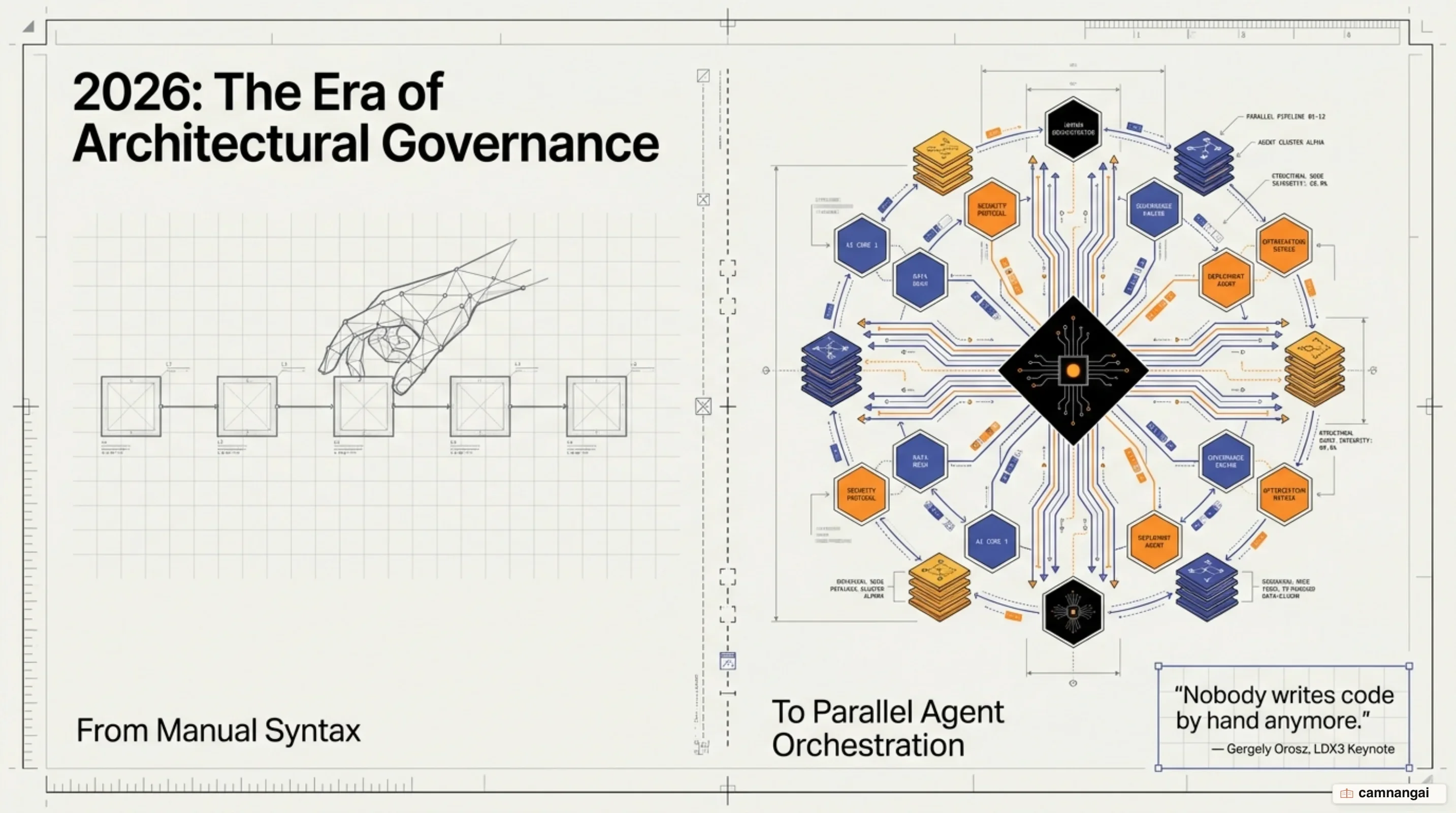
The Unprecedented Pace of the Tech Transformation in 2026
When you contrast the present AI shift against historical technological transitions, the velocity and magnitude stand entirely apart. You may have led engineering teams through the migration from on-premise servers to cloud infrastructure, navigated the mobile ecosystem boom, adapted to web platform expansion, or transitioned entire organizations to object-oriented programming (OOP) and Agile methodologies. Every prior architectural transformation required years of evangelical effort to overcome organizational inertia and persuade entrenched skeptics. In contrast, the integration of artificial intelligence (AI) into core engineering workflows occurred almost overnight.
The speed at which automated code generation advanced left no room for institutional denial, forcing engineering leaders across Big Tech and venture-backed startups to completely replace their operational playbooks within a matter of months.
This operational shift stems directly from an immediate inversion in the underlying economics of software production. For decades, writing source code was expensive, labor-intensive, and fundamentally constrained by human cognitive bandwidth. In 2026, code generation is effectively instant and zero-marginal-cost. When lines of code transition from prized organizational assets to regenerable materialized views, your mental model as a systems architect must adapt. Code is merely a temporary cache of underlying system understanding—valuable while current, but completely disposable once stale.
Legacy Model: [Human Understanding] ──> (Manual Typing / Expensive) ──> [Permanent Source Code]
2026 Model:   [Specs & Evals]        ──> (Instant Agent Generation) ──> [Ephemeral Code (Cache/View)]
This economic inversion has fundamentally reshaped language adoption across ecosystems. Data from GitHub Octoverse demonstrates that Python has overtaken JavaScript as the most heavily used language on GitHub after a ten-year run, fueled by machine learning and data science workloads. Simultaneously, Jupyter Notebook usage surged 92% year-over-year and 170% since 2022, signaling that non-traditional developers across STEM fields, academic research, and operational infrastructure now interact directly with software systems through agentic execution.
When Nobody Writes Code by Hand: The Era of Parallel Agents
As a senior engineering lead in 2026, you no longer manage developers locked into the traditional single-editor loop. The historical constraint of "one developer, one keyboard, one screen" has dissolved in favor of multi-agent round-robin execution. Operational workflows pioneered inside frontier AI labs have become standard practice across high-performing engineering organizations: engineers maintain five to ten local Git worktrees simultaneously, rotating between agent prompts, inspecting generated outputs, and executing local tests while subagents perform background refactoring. Following public debates over the "death of coding by hand," the industry has settled into an operational reality where manual typing is recognized as an archaic bottleneck.
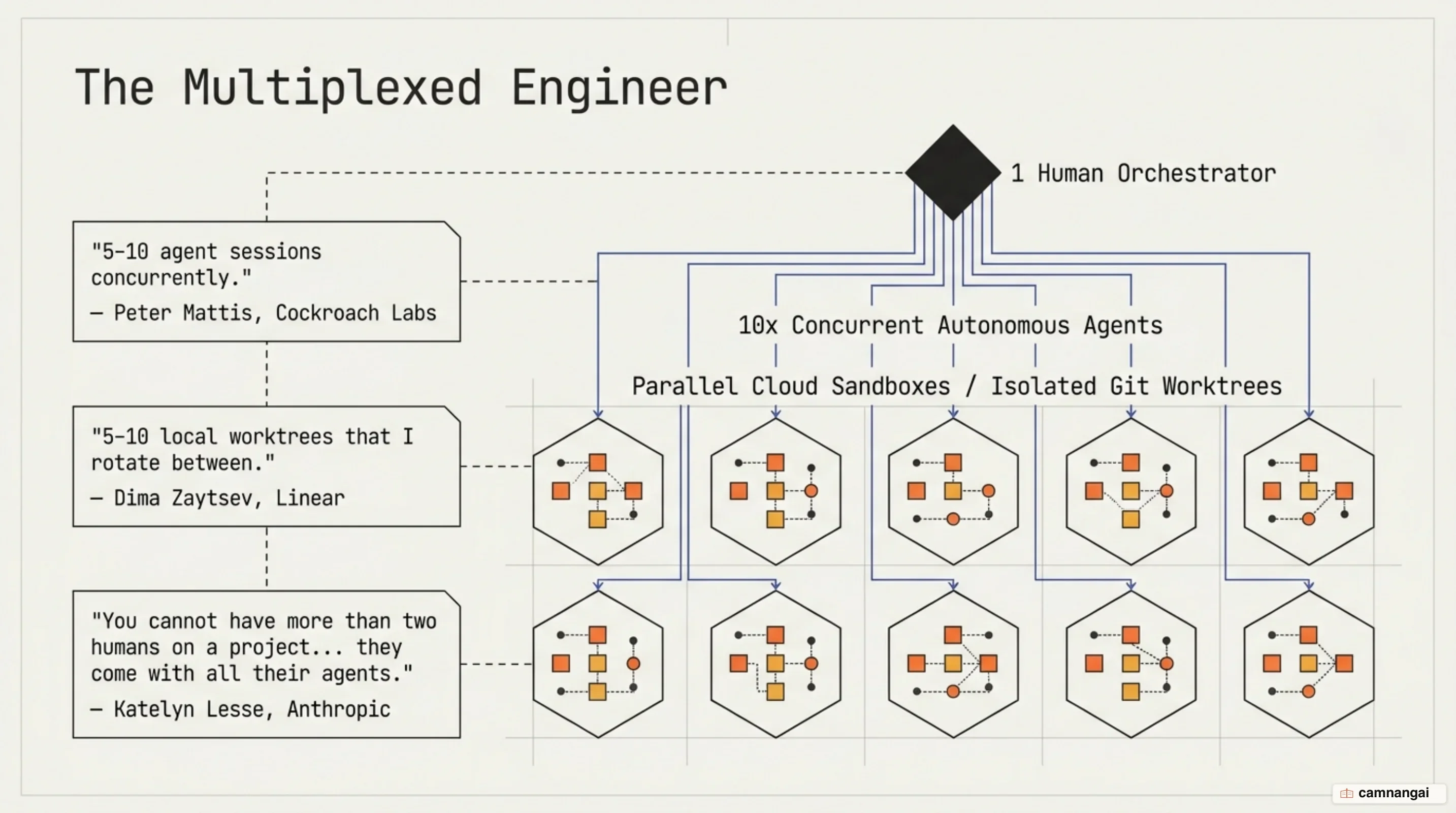
Production telemetry across developer platforms provides empirical proof of this transition. Data from GitHub records a ninefold increase in agent-authored Pull Requests over an eight-month period, culminating in an August 2026 crossover where monthly agent-authored PRs permanently surpassed human-authored PRs. By late 2026, autonomous agents generated upwards of 75 million PRs monthly—three times the total monthly output generated by human developers at the end of 2023 (25 million).
Platform metrics from Linear mirror this trend, showing that agent-created tracking issues have permanently outpaced human-created issues. Furthermore, data from Factory AI reveals that 83% of active developers systematically use specialized agent skills within their daily workflows, reflecting a 2.5-fold increase in recent months. When you examine these telemetry streams, the conclusion is clear: human developers no longer write the bulk of production syntax. Instead, your job is to define behavioral specifications, establish systemic invariants, supply architectural context, and evaluate generated artifacts against production constraints.
# Multi-agent worktree execution pattern
git worktree add ../feature-auth-migration feature/auth-migration
git worktree add ../feature-perf-fix feature/perf-fix

# Trigger autonomous agents across isolated workspaces
cd ../feature-auth-migration && claude "Migrate auth middleware to Rust"
cd ../feature-perf-fix && claude "Optimize database queries in user service"
To support this concurrent operational model, your local and remote development environments must be configured specifically for parallel agent execution. The single-checkout repository model breaks down when multiple agents attempt to modify the same working tree simultaneously. Modern engineering teams rely on local and remote Git worktrees paired with automated CLI harnesses, isolating each agent session within its own sandboxed context to prevent cross-agent collisions and working tree contamination.
The Fading IDE and the Rise of Custom Agent Harnesses
The traditional Integrated Development Environment (IDE) has ceased to be the central locus of software construction. Developer workflows have progressed from basic inline code assistance to unconstrained execution, CLI-first workflows, and complete IDE abandonment in favor of multi-agent orchestrators running dozens of concurrent sessions. The decline of the IDE is not driven by a reduced need for decision-making context, but rather by the reality that the nature of development context itself has fundamentally shifted.
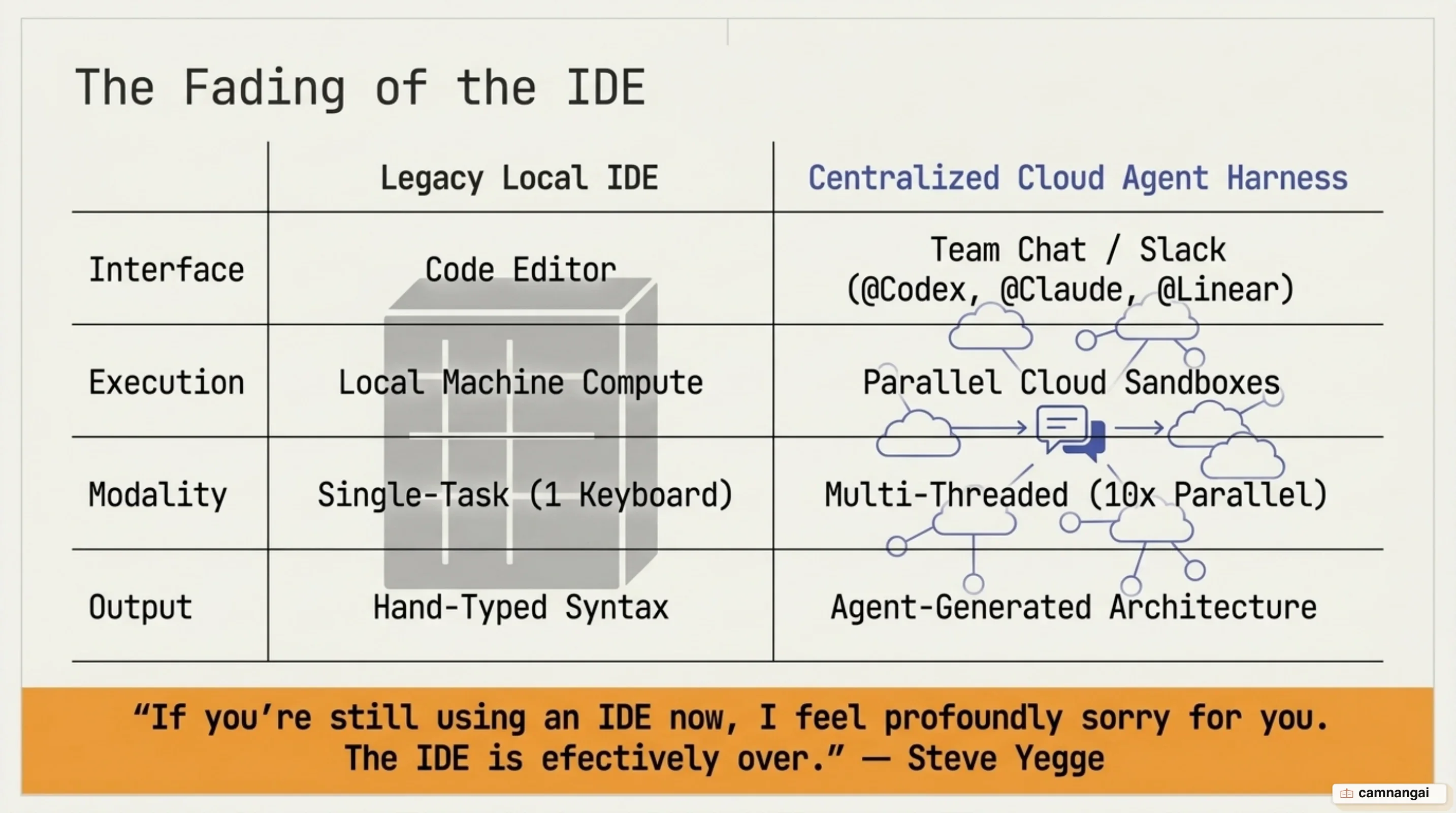
Tooling vendors have adjusted accordingly: Antigravity 1.0 launched as a VS Code fork in November 2025, but Antigravity 2.0 completely abandoned the IDE layout in May 2026. Codex launched natively as a non-IDE workspace, Cursor eliminated its traditional editor layout to focus on desktop agentic interfaces, and JetBrains pivoted heavily toward JetBrains Air. The modern interface is no longer a text pad for human typing; it is a real-time conversational, monitoring, and verification dashboard.
To run agents securely and efficiently at enterprise scale, mid-sized and large technology organizations have abandoned local execution in favor of proprietary cloud-based agent harnesses. These internal platforms encapsulate enterprise codebase context, enforce security boundaries, manage secrets, route requests across cost-optimized LLM backends, and execute agents inside isolated cloud sandboxes. Leading tech organizations have engineered specialized enterprise harnesses to power their development pipelines, including Ramp (Inspect), Stripe (Minions), Uber (Minion), Block (Goose), Shopify (River), and OpenAI (Agentic Software Factory).
| Organization | Internal Agent Harness |
|---|---|
| Ramp | Inspect |
| Stripe / Uber | Minions / Minion |
| Block | Goose |
| Shopify | River |
| OpenAI | Agentic Software Factory |
Development initiation has moved upstream into team collaboration hubs. Instead of opening a local editor to start a task, engineers kick off development directly inside messaging platforms using targeted triggers like @Codex implement this inside OpenAI, @Claude build this within Anthropic, or @Linear work on this at Linear. These Slack integrations tie directly into centralized agentic software factories, executing automated code reviews, running performance benchmarks, generating pull requests, and orchestrating automated canary deployments without requiring human engineers to touch a local text editor.
What Is Broken: The Review Theater, Degrading Quality, and Compute Shortages
The hyper-abundant generation of code has broken legacy software engineering processes, exposing critical operational vulnerabilities. Traditional human code review has collapsed under the sheer volume of agentic output. When developers are flooded with five to ten times more code than they managed in previous years, line-by-line manual audit becomes humanly impossible. To avoid blocking release pipelines, engineering teams across the industry default to "LGTM theater"—superficially rubber-stamping massive pull requests without meaningful evaluation.
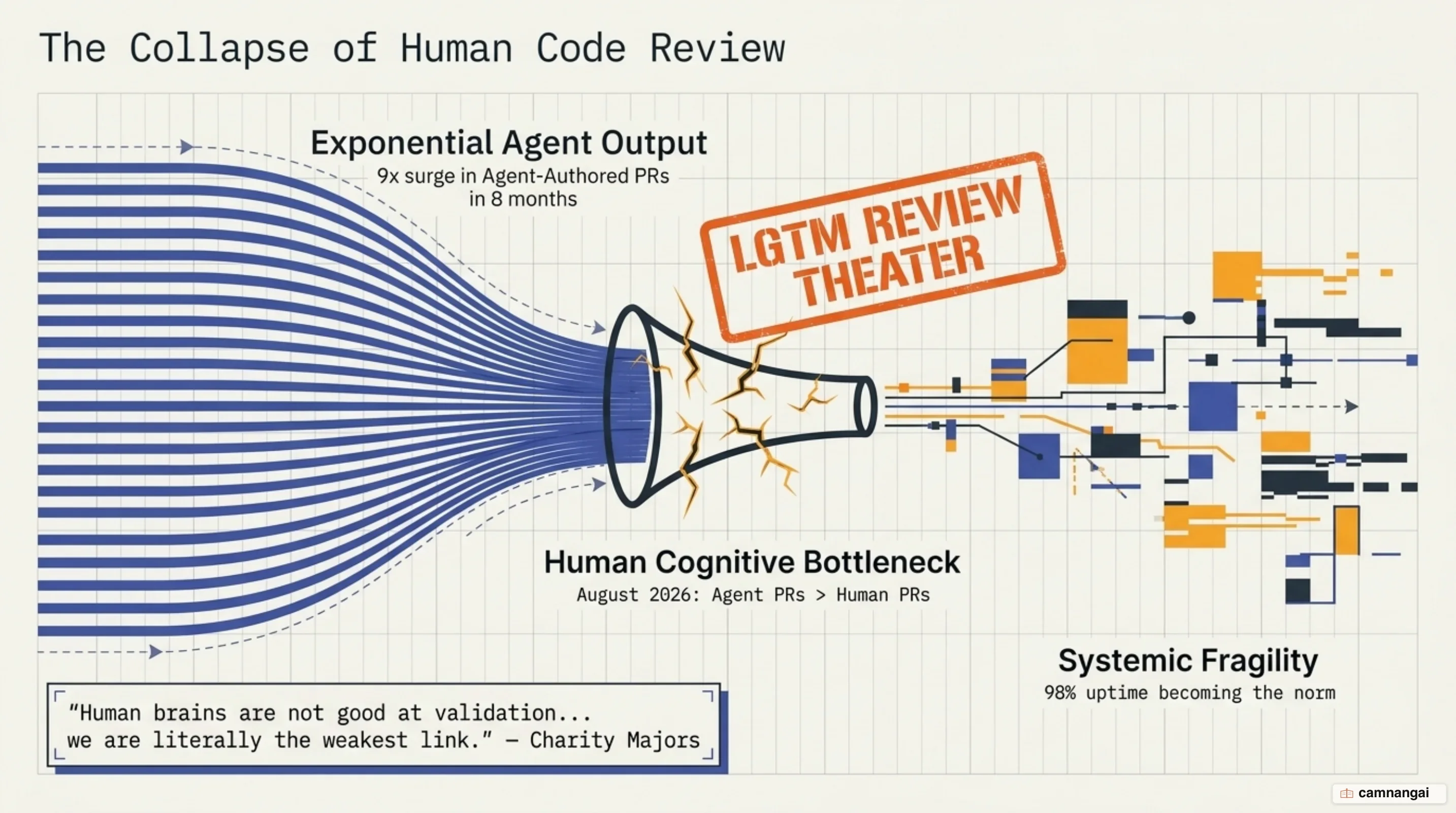
Organizations are responding by transitioning to automated verification, driving a rapid rise in pull requests reviewed exclusively by AI agents. However, swapping human rubber-stamping for unverified agent approvals merely masks underlying risks, allowing non-deterministic code to flow into production environments without adequate behavioral validation.
This breakdown in rigorous verification has caused a systemic decline in software quality and system reliability across the tech landscape. Digital services frequently exhibit brittle edge-case failures, non-deterministic bugs, and user interface regressions that historical QA workflows easily prevented. Digital software has increasingly devolved into a brittle state where 98% system uptime is becoming normalized across enterprise products. Compounding this quality crisis is severe developer cognitive exhaustion: managing multiple parallel agent sessions induces extreme context-switching fatigue, leaving engineers mentally drained and lacking the cognitive bandwidth to audit generated artifacts manually.
[Agent Code Hyper-Abundance]
              │
              ▼
[Human Review Capacity Exhausted] ──> [LGTM Theater / Stamp Approvals]
              │
              ▼
[Production Outages Surge]        ──> [98% Uptime Normalized]
Simultaneously, severe physical infrastructure bottlenecks are capping engineering output. Beyond widely reported GPU and memory scarcities, acute CPU capacity limits have hit cloud providers. Cloud vendors routinely turn down spot instance requests and refuse new compute leases in high-demand availability zones because physical hardware is fully exhausted. Organizations are forced to negotiate cloud capacity months in advance, pre-paying for reserved CPU allocations that will not come online for quarters.
What Remains Timeless: Architecture, Testing, and Engineering Discipline
As generating syntax becomes cheap and instant, classical software engineering discipline has re-emerged as the primary differentiator between durable platforms and fragile systems. Architectural frameworks apply concepts from immutable infrastructure directly to application code. Historically, immutable infrastructure solved server configuration drift by destroying and replacing running servers rather than editing them in place. When modifying existing code in place introduces subtle edge-case mutations and non-deterministic entropy, destroying stale code modules and regenerating them from verified specifications resets system state cleanly. Application code must be managed as a disposable, materialized view of system intent rather than a permanent asset.
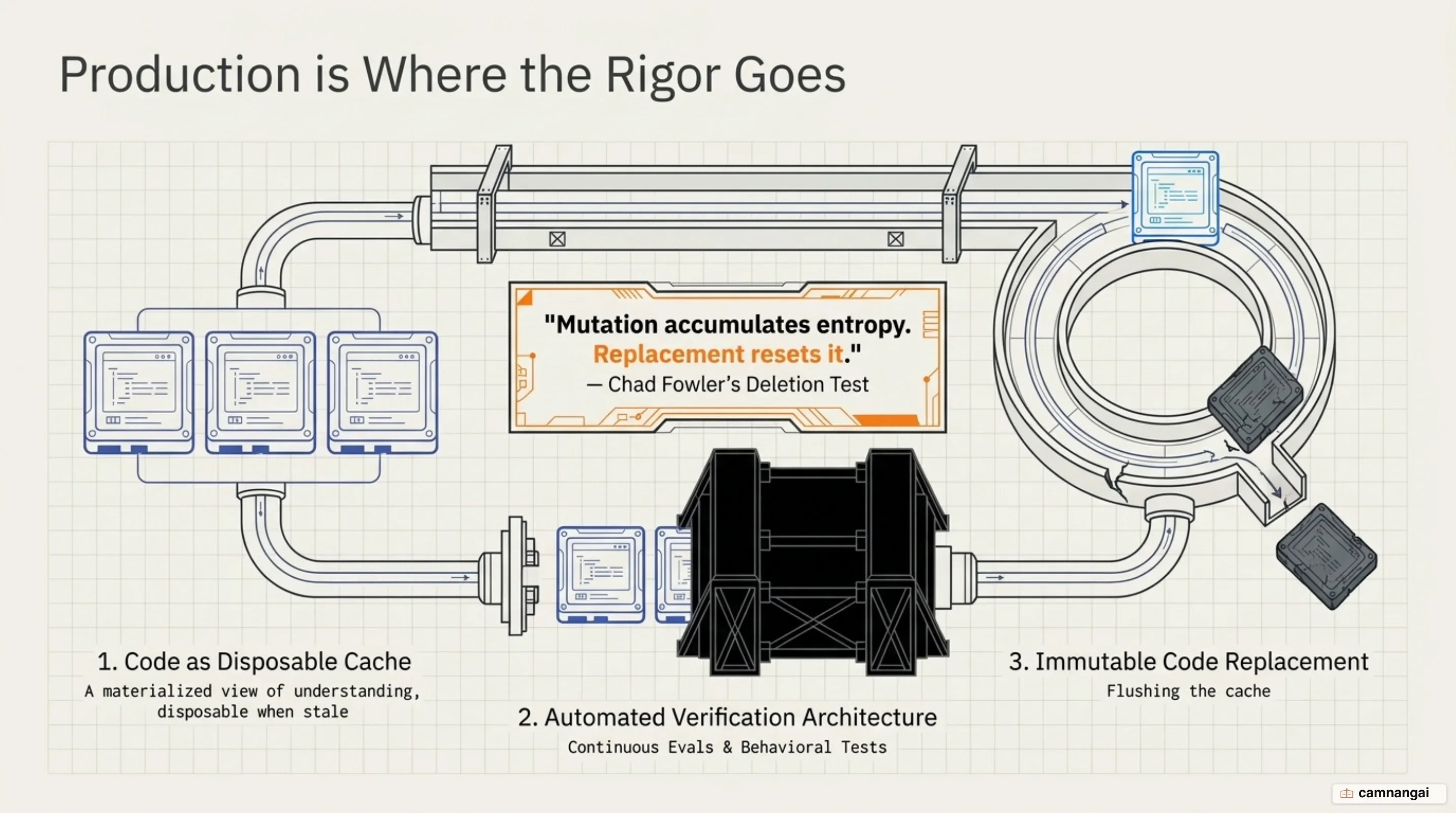
Because human brains are fundamentally incapable of performing repetitive, nitpicky validation across massive code volumes, engineering rigor has relocated permanently to automated testing and production observability. Building production software requires spending equal time on automated test suites regardless of whether syntax is written by a human or an AI. Autonomous agents excel at writing repetitive code, but they require strict verification boundaries to ensure correctness. Automated characterization tests, capture-and-replay frameworks, containerized sandbox evaluation, and production observability traces serve as your primary mechanisms for establishing trust.
Verification Architecture:
[Agent-Generated Code] <───> [Automated Test Suites & Evals]
                                         │
                                         ▼
                            [System Invariant Assertion]
To prevent autonomous agents from generating fragmented, unmaintainable code structures, engineers must enforce timeless software design patterns and system boundaries prior to code generation. Instructing agents to build systems using "tracer bullets"—constructing an explicit, end-to-end golden path through every architectural layer before expanding secondary feature sets—prevents models from getting trapped in architectural deadlocks between decoupled components. Furthermore, product managers and non-technical staff do not deploy directly to production; production safety and architectural accountability remain squarely the domain of professional software engineers.
The Evolving Role of Engineers: From Syntax Writers to System Orchestrators
The structure of engineering teams and the demand for technical skill sets have undergone a fundamental realignment. While two-pizza team organizational structures persist, individual project allocations have shrunk to one or two human engineers. Capping human allocation at one or two developers per project is necessary because each engineer manages multiple concurrent agents; adding more human developers causes parallel agents to overwrite worktrees and step on each other's implementation details. Simultaneously, narrow functional specializations—such as dedicated iOS, Android, and frontend engineers—are rapidly disappearing in favor of domain-focused generalists and Forward Deployed Engineers (FDEs).
This high-speed operational model enables technical debt liquidations and system migrations at scales that were previously unthinkable. Technical debt migrations that historically consumed years of manual labor now execute in days or weeks across major engineering organizations:
Codebase Migration Velocity:
- Bun (Zig -> Rust):             11 days  [█] (vs 1.5 engineering years)
- Airbnb (3,500 test files):      6 weeks  [██]
- Uber (600k tests / 15M LOC):    4 months [████]
Anthropic ported the Bun package manager from Zig to Rust in just 11 days, bypassing an estimated 1.5 engineering years of manual effort. OpenAI completed the migration of its core API layer from Python to Rust in 5 months. Airbnb migrated 3,500 end-to-end test files from Enzyme to React Testing Library in 6 weeks, while Uber successfully executed a massive migration converting 600,000 JUnit 4 test cases across 15 million lines of code to JUnit 5 in 4 months.
As baseline coding intelligence becomes cheap and ubiquitous, engineering advantage concentrates entirely in business domain wisdom and precise architectural specification. Grounded in the framework that divides technical capability into Intelligence (knowing how to implement), Wisdom (knowing what to build), and Charisma (persuading others), the democratization of syntax generation means raw intelligence is no longer a scarce commodity. Value has shifted to domain wisdom: understanding financial regulations, distributed systems consensus, edge-case operational constraints, and actual user needs. This high-impact building environment has also driven a pronounced career shift among senior leaders, with CTOs and VPs stepping down from management to return to individual contributor roles.
Where We Go From Here: Remembering Why We Build
Engineering has never been defined by the mechanical act of typing syntax into a text editor; it is the discipline of solving physical, operational, and human constraints through logical software systems. The technological transformation of tech industry in 2026 strips away the illusion that lines of code are precious assets, proving that true engineering value resides in system architecture, production determinism, and business domain wisdom.
The path forward requires directing rapid agentic execution to eliminate boilerplate, enforcing uncompromising automated test suites, and mastering production observability. By shifting your focus from manual syntax construction to system-level orchestration, you eliminate tedious maintenance overhead and reconnect with the fundamental joy of engineering: building resilient, reliable systems that solve real-world problems at scale.
References
- AI demands more engineering discipline. Not less — Charity Majors
- Octoverse: AI leads Python to top language as the number of global developers surges — The GitHub Blog
- 2026: The Year The IDE Died — Steve Yegge & Gene Kim
- The State of the Tech Industry in 2026 — Gergely Orosz (The Pragmatic Engineer)