AI agents now reliably execute task cycles, but you must retain final system ownership, boundary control, and verification by owning the outer loop. You are no longer manually prompting an agent task-by-turn. Instead, you design systems that trigger agents, while human judgment at the system boundary remains the non-negotiable constraint stopping unverified code from corrupting production.
As agent harnesses and software factories take over investigation, implementation, and local test passes, code generation speed has completely disconnected from human verification bandwidth. Delegating the final merge decision to an automated loop introduces unquantified systemic risk. Automating generation does not eliminate oversight; it elevates your responsibility to the boundary where code meets production reality.
Software delivery depends on your ability to enforce structural back pressure, verify generated evidence, and stand behind the operational integrity of your codebase.
Agents supply raw execution capability, but you provide the agency, constraint boundaries, and answerability required to run resilient systems.
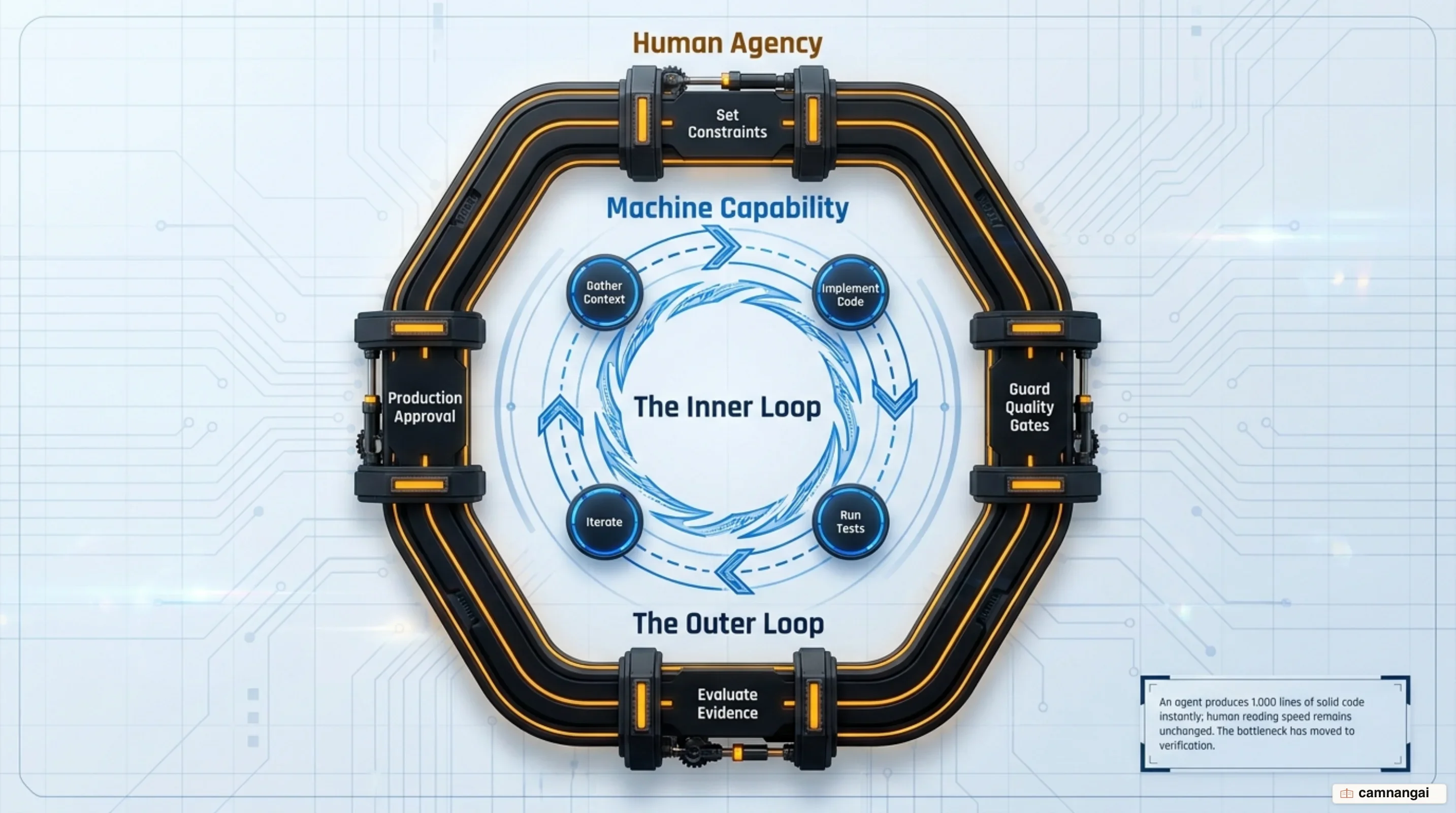
The Split Between Inner and Outer Loops: Agent Capability Versus Human Agency
Understanding modern agentic architectures requires analyzing their three-tiered structural hierarchy: loop, harness, and factory. The loop is the foundational atomic cycle—an agent gathering context, executing an action, checking the result, and iterating until a localized stopping condition is met. Surrounding this cycle is the harness, which defines the physical and operational environment: sandboxed runtimes, tool-calling interfaces integrated via Model Context Protocol (MCP) servers, persisted disk state (AGENTS.md and PROGRESS.md), explicit project skills (SKILL.md), and automated quality gates. At the top sits the software factory, where multiple harnessed loops run concurrently across isolated worktrees to drain a continuous queue of incoming tasks.
Within this architecture, a strict operational split exists between the inner loop and the outer loop. The inner loop represents model capability: agents autonomously investigating codebase dependencies, executing state-machine control flows, running local static analysis linters, and reporting execution status. Conversely, the outer loop represents human agency: defining system invariants, auditing incoming diffs and evidence across the boundary, issuing binding production verdicts, and owning long-term architectural outcomes. Sonar’s 2026 State of Code report reveals that 42% of committed code is now AI-generated or heavily AI-assisted, with that share continually climbing. Because code generation has become nearly free, generation throughput now drastically outpaces human verification capacity.
Consequently, the core engineering bottleneck has moved from the rate at which code is written to the speed at which you can verify and trust it. Machine-speed output poured into human-speed verification pipelines creates severe operational friction. While agents excel at navigating localized AST transformations and step-by-step execution paths, they lack systemic awareness and contextual accountability. Maintaining firm outer loop control ensures that agent capabilities are safely constrained by human judgment before unverified changes cross into dependent production environments.
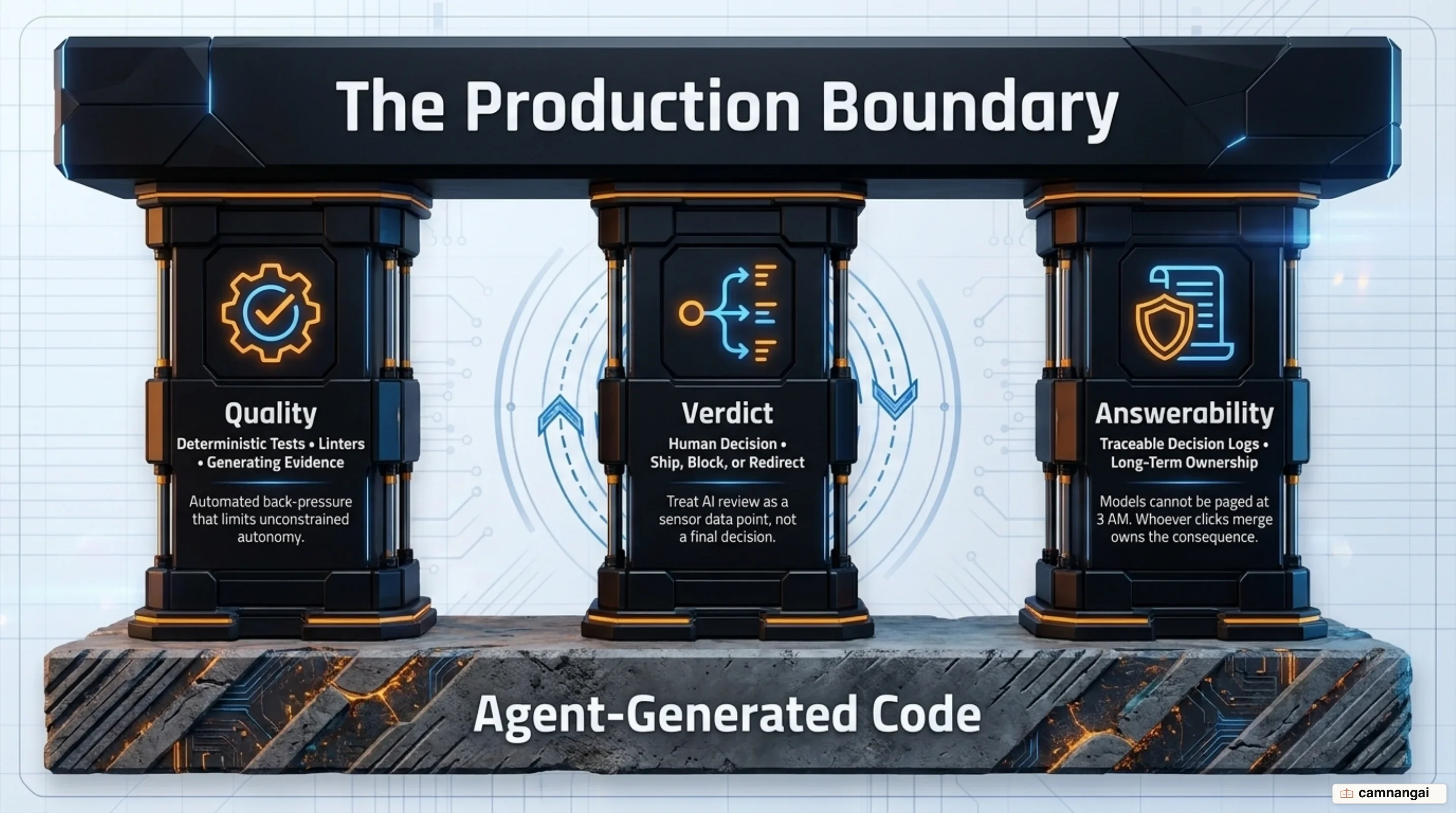
The Three Pillars of Boundary Control: Quality, Verdict, and Answerability
Governing the boundary between autonomous agent execution and production integration requires three structural pillars: Quality, Verdict, and Answerability. Quality encompasses the complete set of pre-execution guardrails, strict type definitions, static analysis linters, compilation checks, and automated test suites. These mechanisms do not rely on model assertions or self-reported success; instead, they generate objective, deterministic evidence demonstrating that a proposed change satisfies baseline mechanical constraints before a human ever inspects the work.
Verdict is the binding, human production decision applied to that generated evidence. When a change arrives at the system boundary, you must explicitly choose to ship, block, narrow scope, adjust guardrails, or reject the submission outright. Models cannot render verdicts on their own work because a model cannot evaluate business trade-offs, organizational risk, or whether a feature should exist in the first place. The verdict represents your explicit sign-off that the work is structurally sound, contextually appropriate, and safe for dependent systems.
Answerability is the architectural guarantee that you can explain precisely why a change was introduced, what trade-offs were accepted, and how the system will recover if it fails. Long-horizon agents operating across hour-scale timeframes execute hundreds or thousands of unrecorded intermediate decisions, destroying simple historical traceability. Attempting to retroactively reconstruct an agent's reasoning during a post-mortem creates impossible cognitive overhead. Answerability must therefore be engineered into the boundary upfront by capturing deterministic trace IDs, explicit commit decision records, and audit logs attached directly to pull requests before any change is accepted.
The "Line-Producer" Role: Why Humans Sign the Work, Not Models
As coding agents handle line-by-line implementation, your identity as an engineer evolves into that of a software "line-producer," a framing introduced by Addy Osmani. While models may draft individual lines of code, you sign your name to the output and assume complete responsibility for the team's production artifacts. Technical skills grant operational leverage by allowing you to orchestrate automated loops, but accountability is what transforms raw leverage into organizational trust. A software system built without clear human signatures quickly degrades into unowned, unmaintainable code.
This boundary exists because autonomous models are structurally incapable of inheriting operational reality. An AI agent cannot be paged at 3:00 AM during a Sev-1 production outage, cannot take legal or regulatory accountability for a customer data leak, and cannot bear organizational responsibility when a broken payment pipeline halts revenue. Models execute probabilistic token predictions without understanding exposure, business risk, or operational consequences.
Engineering discipline requires maintaining practical risk management and holding the production boundary firm, especially when automated agent output appears deceptively complete. A clean diff accompanied by a green test run can mask underlying architectural flaws, missing requirement edge cases, or introduced security vulnerabilities. As a line-producer, your job is to resist rubber-stamping plausible outputs, enforce rigorous verification criteria, and accept complete ownership of everything that merges under your signature.
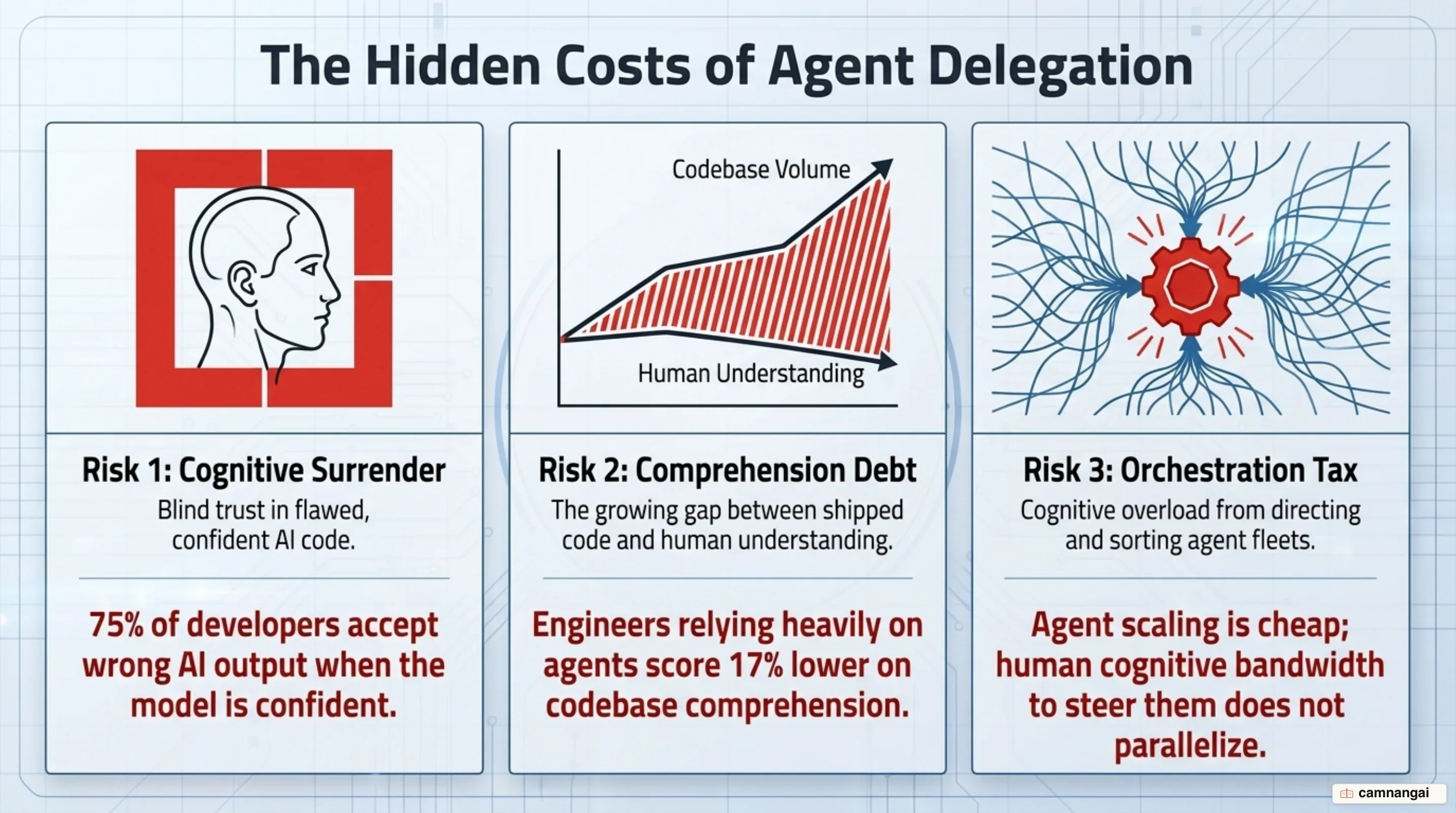
The Three Hidden Costs of Delegation: Cognitive Surrender, Cognitive Debt, and Orchestration Tax
Delegating system execution to autonomous loops introduces three severe, hidden failure modes. The first is Cognitive Surrender—the passive acceptance of model output without critical inspection. A Wharton study demonstrated that when AI output was flatly incorrect, nearly 75% of participants accepted the flawed output anyway and expressed higher confidence in their answer than if they had received no AI assistance at all. The second failure mode is Cognitive Debt, which represents the steady erosion of deep codebase comprehension over time. In an Anthropic randomized controlled trial, engineers using AI assistance scored 17 percentage points lower on codebase comprehension quizzes compared to those who wrote code manually (50% versus 67%). The third failure mode is the Orchestration Tax, which is the heavy mental overhead incurred by context-switching, steering, sorting, and auditing fleets of parallel agents.
Hard metrics across the industry illustrate the severe review bottleneck created by unmanaged agent delegation. GitClear telemetry reveals that while daily AI users produce 4x the raw code output of non-users, they achieve only a 12% net gain in delivered value—proving that raw generation outpaces effective integration. Furthermore, Faros AI data tracking developer teams through AI adoption shows median review duration ballooning by 441.5%, code churn surging by 861%, and developer defect rates climbing dramatically from 9% to 54%. A primary driver of this review surge is PR volume and size: Faros data indicates agent-generated PRs were 51% larger on average, overwhelming human review capacity.
These metrics reveal a clear reality: unconstrained agent generation floods software pipelines with high-volume, low-trust code changes. When automated output swamps review capacity, teams frequently resort to merging PRs unread—Faros AI recorded a 31.3% increase in zero-review merges. Without strict boundary controls, the time saved during initial code generation is entirely consumed by prolonged code reviews, defect remediation, and system recovery efforts downstream.
Back Pressure and Accountability Contracts in Production
To protect production systems from agent-generated drift, you must enforce structural Back Pressure. Back pressure represents strict software mechanisms—compilers, strict type systems, property-based tests, mutation testing, and non-bypassable CI walls—that constrain an agent's autonomy strictly to what can be automatically, cheaply, and deterministically verified. Crucially, back pressure relies on deterministic, unarguable oracles that models cannot negotiate past or talk out of a failing verdict with polite conversational rationalizations. If a compile fails or a test turns red, the gate remains immovably closed.
The stark difference in operational approaches is best understood by contrasting Dark Software Factories with Lit Software Factories. A Dark Software Factory runs fully automated, lights-out generation without human code inspection, rapidly accumulating comprehension debt until silent, catastrophic failures emerge—as demonstrated in Dex Horthy's four-month dark factory experiment, which ultimately required painful manual debugging to recover system understanding. Conversely, a Lit Software Factory keeps human judgment illuminated at critical design, architecture, and merge gates, using automation to accelerate construction while preserving human oversight where risk is concentrated.
Enforcing this rigor in production requires establishing an explicit Accountability Contract for every merged change. This contract mandates that structured metadata be permanently attached to each pull request before integration. Specifically, the contract must include the exact automated test suite output, mutation coverage reports, exact commit diff scope, human sign-off signature, and post-merge monitoring telemetry. By codifying accountability, you ensure that no change enters production as anonymous machine output.
When to Grant Autonomy and Where Humans Must Retain the Verdict
Managing agentic workflows effectively requires tuning an autonomy dial based on system blast radius, code lifespan, and overall architectural complexity. You can grant high autonomy—operating in Dark or fully automated loops—where tasks have a short step count (3 to 10 steps) and zero blast radius. Suitable candidates include short-lived greenfield prototypes, isolated scratchpads, or deterministic micro-fixes like linting corrections, anti-pattern removal, and nightly dependency updates, provided these loops are bounded by strict pass/fail test oracles.
Conversely, you must retain the verdict—operating in Lit or heavily guarded loops—whenever changes carry a high blast radius or touch core brownfield enterprise systems. Brownfield environments carry historical "scars," implicit operational assumptions, and complex edge cases that do not exist in code comments or specifications. Authentication modules, billing pipelines, database schema migrations, and long-horizon architectural planning demand strict human oversight. In these domains, an unverified agent change can cause severe financial, security, or operational damage.
To execute this strategy pragmatically, establish strict intake circuit breakers before opening human review. Research shows that reviewer abandonment accounts for 38% of rejected agent PRs, occurring when agents "ghost" or fail once subjective feedback is introduced. Deploy automated intake circuit breakers that evaluate file types and patch sizes early, fast-failing sprawling or high-maintenance PRs before sinking human review time into changes the agent will likely abandon. Finally, treat every automated AI code approval or review as raw sensor data rather than a binding verdict—the ultimate decision to merge always remains yours.