When choosing Claude model architecture for production systems, selecting the right model tier requires matching workload complexity against latency budgets, token expenditure, and reasoning depth.
Start with Claude Sonnet 5.5 as your daily operational default for general engineering, iterative coding, and structured analytical tasks. When high-volume processing requires sub-second execution with minimal token consumption, drop down to Claude Haiku 5.5. For dense architectural specs, systemic debugging, and deep technical research, deploy Claude Opus 5.5. For long-horizon, autonomous multi-day execution across massive codebases, deploy Claude Fable 5.1.
Aligning task complexity with the appropriate tier optimizes execution speed and token budgets. Operating a heavy reasoning model on lightweight text extraction wastes rate limits and inflates API costs with zero performance gain. Conversely, running a lightweight tier on complex multi-file refactoring leads to missed logic constraints and unhandled edge cases.
Understanding model profiles, rate limit consumption, pricing structures, safety classifier fallbacks, and effort parameters ensures predictable cost controls across infrastructure.
The Four Model Tiers in the Claude Ecosystem
Claude Haiku 5.5 (claude-haiku-5-5) is the fastest tier in the lineup, designed for high-throughput, latency-critical operations. Priced at $0.10 per million input tokens (MTok) and $0.50 per MTok output, it provides sub-second execution for log parsing, simple extractions, and input classification. Claude Sonnet 5.5 (claude-sonnet-5-5) functions as the versatile daily driver, delivering fast latency and strong logic capabilities for day-to-day software engineering, content generation, computer use, and vision processing. Priced at $2.00 per MTok input and $10.00 per MTok output, Sonnet 5.5 balances high execution speed with deep problem-solving skills across standard developer tasks.
Claude Opus 5.5 (claude-opus-5-5) is a large reasoning specialist for complex technical work, deep research, and multi-layered specification analysis. Operating at moderate latency, it is priced at $4.00 per MTok input and $20.00 per MTok output. Claude Fable 5.1 (claude-fable-5-1) represents the top-tier Mythos-class model, engineered for long-horizon autonomous project execution and demanding reasoning tasks. Priced at $10.00 per MTok input and $50.00 per MTok output, Fable 5.1 exhibits slower latency but uses adaptive thinking to plan multi-step implementations, execute long-running agents, and validate its own outputs with minimal mid-task human intervention.
All four tiers share uniform structural parameters: a 1M token context window, a maximum output limit of 128K tokens, and training and reliable knowledge cutoffs set to June 2026. Across both subscription platforms and API endpoints, matching workload demands to default effort parameters prevents premature limit exhaustion while maintaining execution speed.
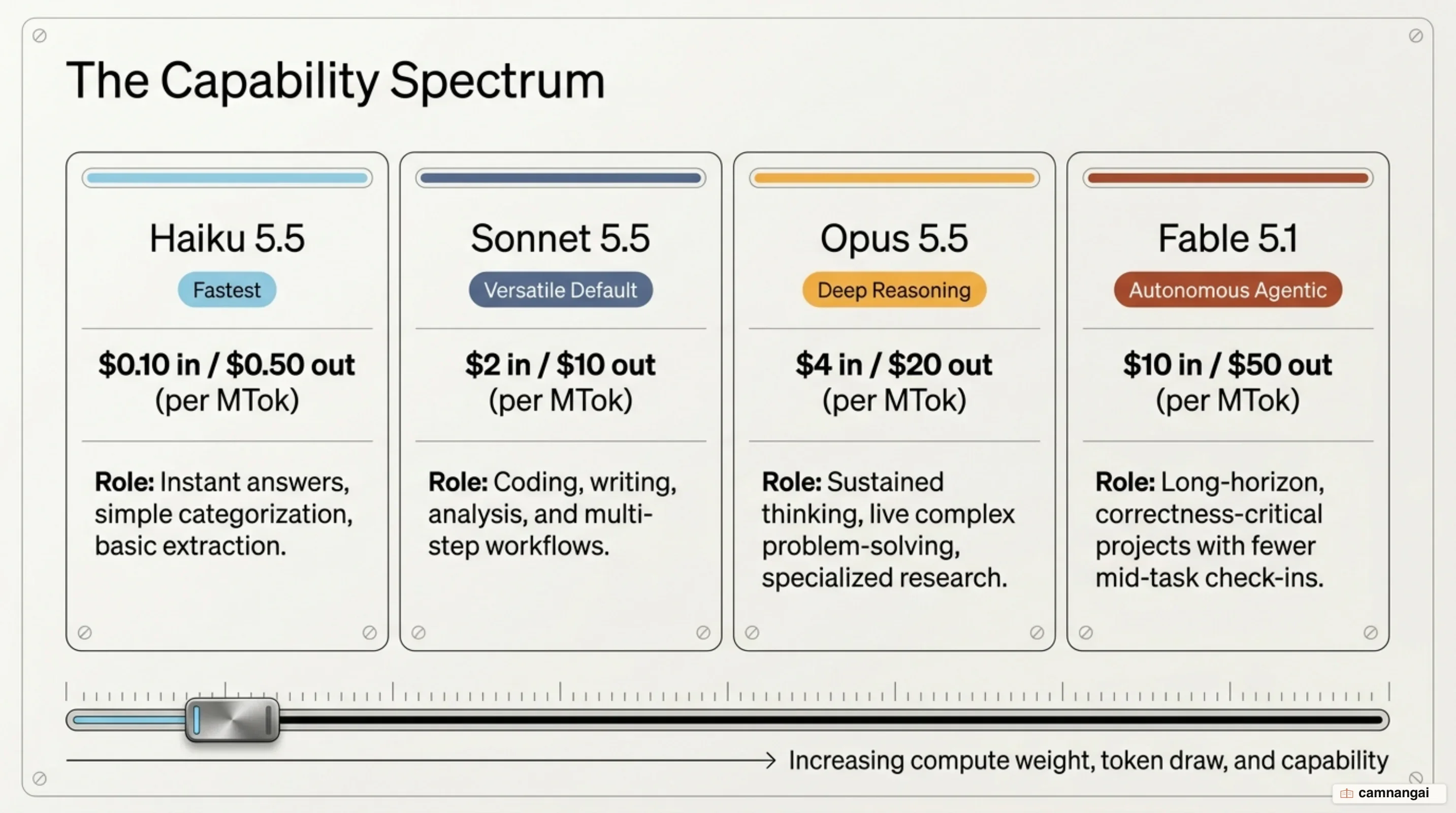
| Model Tier | API ID | Comparative Latency | Pricing (Input/Output per MTok) | Default Effort |
|---|---|---|---|---|
| Claude Haiku 5.5 | claude-haiku-5-5 | Fastest | $0.10 / $0.50 | Medium |
| Claude Sonnet 5.5 | claude-sonnet-5-5 | Fast | $2.00 / $10.00 | High |
| Claude Opus 5.5 | claude-opus-5-5 | Moderate | $4.00 / $20.00 | Medium |
| Claude Fable 5.1 | claude-fable-5-1 | Slower | $10.00 / $50.00 | High |
How Each Model Affects Your Rate Limits and Token Budget
Rate limit windows control the number of tokens your infrastructure or account consumes over specific time frames. Haiku 5.5 places the lightest load on your rate limit capacity, making it optimal for continuous, automated background services. Sonnet 5.5 draws down rate limits at a moderate pace, whereas Opus 5.5 consumes heavy headroom, and Fable 5.1 demands the heaviest token draw across the family. Account availability reflects these resource profiles: Free plans grant access to Haiku and Sonnet, while Pro, Max, Team, and Enterprise tiers unlock Opus and Fable with higher rate limit thresholds. Enterprise administrators can also enforce default models or restrict tier access based on user roles.
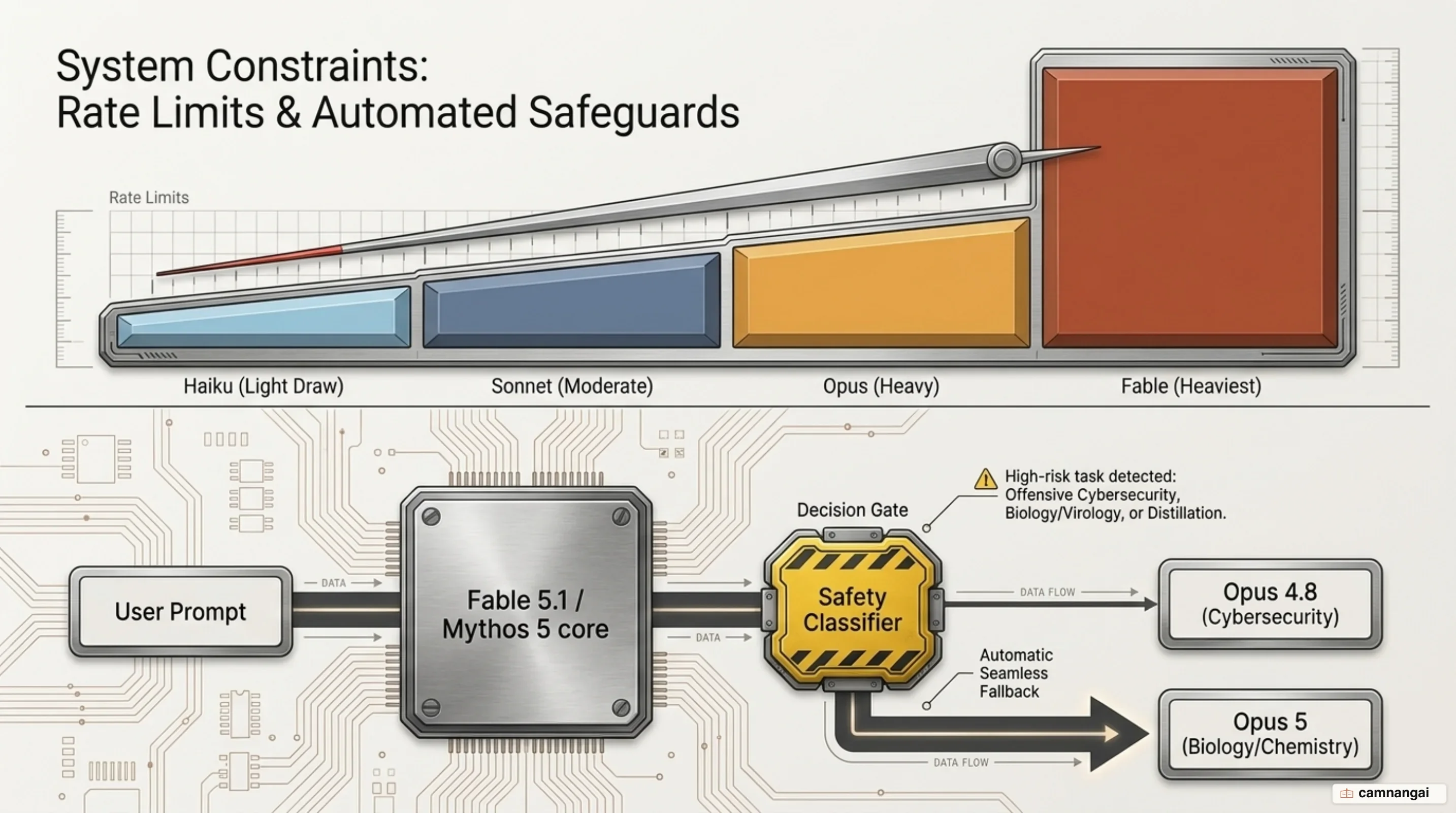
When deploying Fable 5.1, automated safety classifiers continuously evaluate prompts and read contexts across four distinct domains: offensive cybersecurity techniques, dual-use biology and life sciences, distillation attacks, and frontier LLM development tasks. When a request triggers these classifiers, system fallbacks redirect processing to non-Mythos models—specifically routing biology and life sciences tasks to Claude Opus 5, and offensive cybersecurity queries to Claude Opus 4.8. On web, mobile, and desktop interfaces, automatic model switching is active by default and smoothly transitions the conversation to Opus. However, on the Claude API, automatic model switching is not active by default. Unless API developers explicitly program fallback handlers, blocked API requests return an HTTP 200 response containing a specific stop_reason.
Token pricing applies to both pay-as-you-go API calls and subscription usage allowances, where internal thinking tokens count directly as generated output. Raising effort settings increases output token generation during extended reasoning, directly accelerating rate limit consumption and API charges. For fallback scenarios, billing mechanics depend on when the request is interrupted. Requests blocked before output generation under biology, distillation, or frontier LLM development classifiers are charged specifically to disrupt automated probing attacks on safety systems. Requests blocked midstream charge for input tokens and any streamed output tokens up to the block at the primary model's rate. When an automatic fallback occurs, the secondary Opus execution is billed at standard Opus rates, accompanied by a cache miss credit to offset the cost of re-processing the initial prompt context.
Model Selection Matrix for Software Development Tasks
Structuring model usage around development task complexity prevents API quota bottlenecks while preserving output quality. Haiku 5.5 is optimized for low-complexity developer tasks, including real-time log parsing, automated code labeling, inline syntax lookup, and simple regex extraction. For active, day-to-day software development, Sonnet 5.5 is the standard daily driver. It manages routine debugging, unit test generation, code refactoring, and multi-step feature implementations, providing the highest speed-to-intelligence ratio for interactive coding and live developer feedback loops.
Opus 5.5 excels at dense architectural evaluations, reviewing multi-file system specifications, and resolving complex, non-obvious systemic bugs across distributed software architectures. For long-horizon autonomous engineering and large-scale code modernization, Fable 5.1 delivers agentic performance. In production testing, Stripe used Fable 5.1 to complete a codebase-wide migration on a 50-million-line Ruby repository in one day—a task estimated at two months for a full engineering team. On Cognition's FrontierCode benchmark, Fable 5.1 achieves top scores even at medium effort, demonstrating token efficiency alongside state-of-the-art results on CursorBench and ViBench for vibe-coding applications. Beyond software engineering, Fable's reasoning extends to specialized domains, leading Hebbia's Finance Benchmark, acing IMC trading analysis, and outperforming dedicated biological language models on Dyno Therapeutics AAV viral shell assembly predictions.
Mapping development tasks to the appropriate model tier ensures that token budgets and rate limit allocations match the operational risk and reasoning requirements of each engineering workflow.
| Software Engineering Task | Recommended Model | Key Technical Rationale |
|---|---|---|
| Real-time log parsing, syntax queries, simple regex extraction | Claude Haiku 5.5 | Lowest latency and minimal token cost for single-turn structured processing without deep context dependencies. |
| Active feature development, unit testing, daily debugging, refactoring | Claude Sonnet 5.5 | Superior balance of execution speed and multi-turn logic for iterative, daily software development workflows. |
| Architectural specification review and systemic multi-file debugging | Claude Opus 5.5 | Advanced analytical reasoning across long technical documents and complex, multi-service code dependencies. |
| Codebase-wide migrations, long-horizon agentic development, multi-day autonomy | Claude Fable 5.1 | State-of-the-art agentic performance (FrontierCode, CursorBench, ViBench), self-validation, and long-horizon task stability. |
Testing the Same Task Across Two Models: A Practical Comparison
To determine the most cost-effective tier for a custom engineering workflow, implement a structured empirical test protocol. Select a representative technical task—such as summarizing a long system architecture document or refactoring an algorithmic function. Run the prompt first using Haiku 5.5 as your baseline. Next, initiate an entirely isolated chat session or API call to eliminate prompt-caching bias, select Sonnet 5.5, and execute the identical prompt with identical parameters.
Evaluate the generated outputs based strictly on functional accuracy, edge-case handling, and structural completeness rather than response length or output verbosity. A higher-tier model generating additional conversational text or longer explanations does not indicate superior technical utility if the lower-tier model produced syntactically correct and fully functional code. Look specifically for missed API constraints, subtle edge-case errors, or unhandled logic branches.
If Haiku 5.5 successfully identifies all edge cases and satisfies functional logic requirements, the workflow is Haiku-shaped and should remain on that tier to maximize throughput and preserve token budget. Only escalate to Sonnet 5.5, Opus 5.5, or Fable 5.1 when the baseline tier explicitly hallucinates logic, fails to maintain structural context, or misses critical technical constraints.
When to Adjust Effort Instead of Switching Models
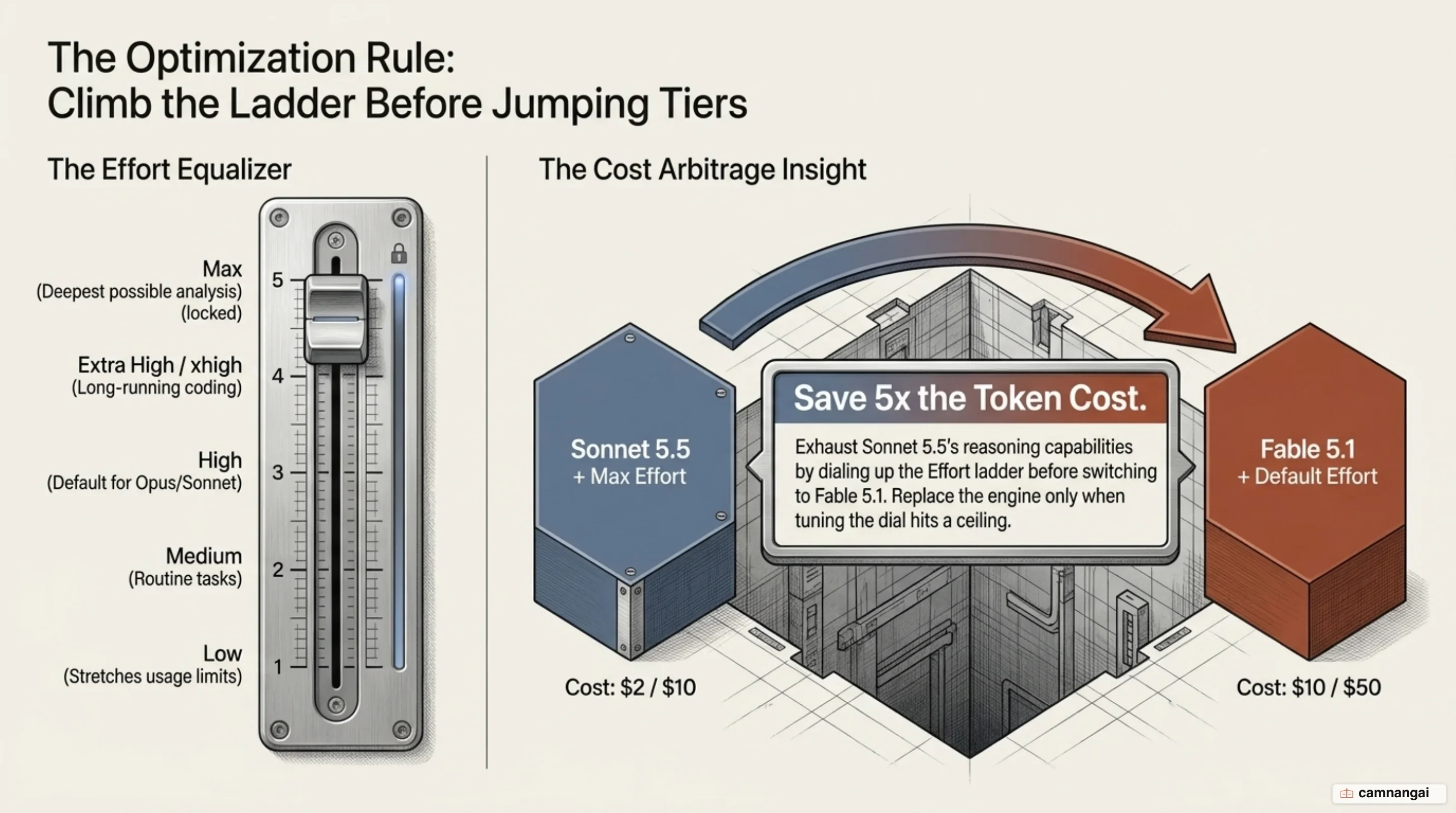
Before incurring the increased token costs and latency penalties of moving to a higher model tier, tune the internal reasoning parameters of your current tier. The Effort control (configurable as Low, Medium, High, Extra High / xhigh, and Max) is available across all current tiers, including Haiku 5.5, Sonnet 5.5, Opus 5.5, and Fable 5.1. Lower effort settings reduce output token count on routine tasks, extending usage budgets. Conversely, High, Extra High (available on Opus 4.7 and newer models), and Max compel deeper internal reasoning for competitive coding, complex proofs, and multi-step system planning. Working alongside effort, Extended Thinking allows Claude to break down logic and plan solutions in an expandable thinking block prior to rendering output.
Thinking behavior varies depending on the selected model and deployment interface. On Fable 5.1 and Opus 5.5, adaptive thinking is permanently enabled across all effort levels on both web interfaces and the Claude API. For Haiku 5.5, Sonnet 5.5, and Opus 5, effort levels remain fully adjustable, but API configurations require precise parameter handling. On the Claude API, Haiku 5.5 and Opus 5 permit disabling thinking at High effort and below, but attempting to disable thinking at Extra High or Max effort returns an error. For Sonnet 5.5 on the API, disabling thinking requires setting the between_tools parameter; submitting a request that disables thinking on Sonnet 5.5 without between_tools returns a 400 API error. The between_tools parameter disables upfront thinking prior to initial output while preserving intermediate reasoning between sequential tool calls, minimizing latency without breaking complex tool execution pipelines.
Increasing the effort setting on Sonnet 5.5 to Extra High or Max frequently solves complex coding and analytical tasks that fail at Medium or High effort. Because Sonnet 5.5 token pricing ($2.00 input / $10.00 output per MTok) is significantly lower than Fable 5.1 ($10.00 input / $50.00 output per MTok), bumping Sonnet's effort allows the model to apply deep extended reasoning to hard problems at a fraction of the cost and latency of jumping to a higher tier.
Decision Framework: Where to Start in Your Workflow
Default your daily software engineering and general workflows to Claude Sonnet 5.5, or start on Claude Opus 5.5 when conducting deep architectural research. If your evaluation benchmarks demonstrate that Sonnet or Opus fail on subtle logic constraints or require long-horizon, autonomous execution over extended periods, escalate the workload to Claude Fable 5.1. For high-volume, latency-sensitive tasks like log filtering, syntax lookup, or simple metadata extraction, reduce operational costs by deploying Claude Haiku 5.5.
Always tune effort and thinking parameters on your current tier before migrating to a higher model tier. Raising effort to Extra High or Max on Sonnet 5.5 frequently resolves complex multi-step coding challenges, maximizing task success while avoiding the higher token costs and latency overhead of Fable 5.1 or Opus 5.5.
References
- Change the model, effort, and thinking settings — Claude Help Center
- Choosing the right Claude model: Haiku, Sonnet, Opus, or Fable — Claude Academy
- Claude Fable 5 and Claude Mythos 5 — Anthropic
- Models overview — Claude Platform Docs
- Why Claude switched models in your conversation with Fable 5 or Fable 5.1 — Claude Help Center