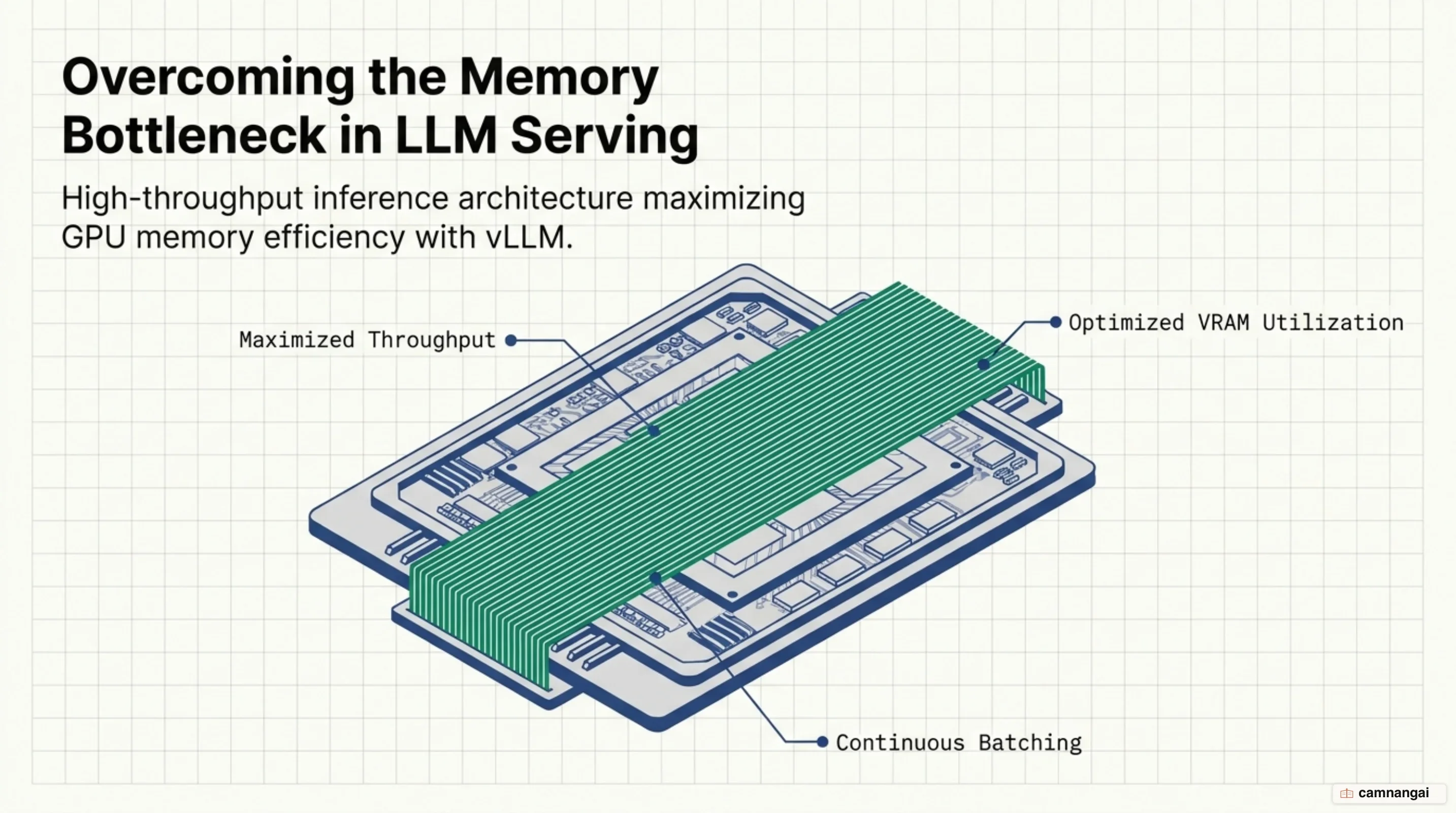
vLLM is an open-source high-throughput Large Language Model (LLM) inference and serving engine originally created at UC Berkeley's Sky Computing Lab. Designed for production environments, it delivers high-concurrency token generation by resolving the memory bottlenecks that limit traditional deep learning serving stacks.
When you deploy LLMs at scale, your primary systems challenge is managing the memory throughput and allocation of the Key-Value (KV) cache. Inefficient KV cache management leads to high latency, memory fragmentation, and low GPU occupancy, which caps the number of concurrent requests your infrastructure can process.
vLLM solves these bottlenecks through dedicated system architectures: continuous batching for iteration-level scheduling, PagedAttention for non-contiguous KV cache allocation in VRAM, and multi-GPU parallelism across Tensor Parallelism (TP) and Pipeline Parallelism (PP).
What problem does vLLM solve in LLM serving?
When you serve LLMs, request processing is divided into two phases with distinct hardware resource demands: the prefill phase and the decode phase. The prefill phase takes prompt tokens and processes them concurrently in compute-bound matrix operations. The decode phase generates output tokens sequentially in an auto-regressive loop. Decoding is strictly memory-bandwidth-bound at the hardware level because generating every single token requires streaming all model weights from High Bandwidth Memory (HBM) into on-chip SRAM alongside loading and updating dynamic KV vectors for every active sequence.
When you run traditional serving engines, KV caches are allocated statically in contiguous VRAM based on the model's maximum possible context length (max_model_length). Because request lengths vary, this static approach wastes 60% to 80% of GPU memory through internal fragmentation, external fragmentation, and dynamic over-reservation for tokens that may never be generated. This artificial memory constraint caps your maximum batch size, leaving GPU compute cores underutilized while waiting for memory transfers.
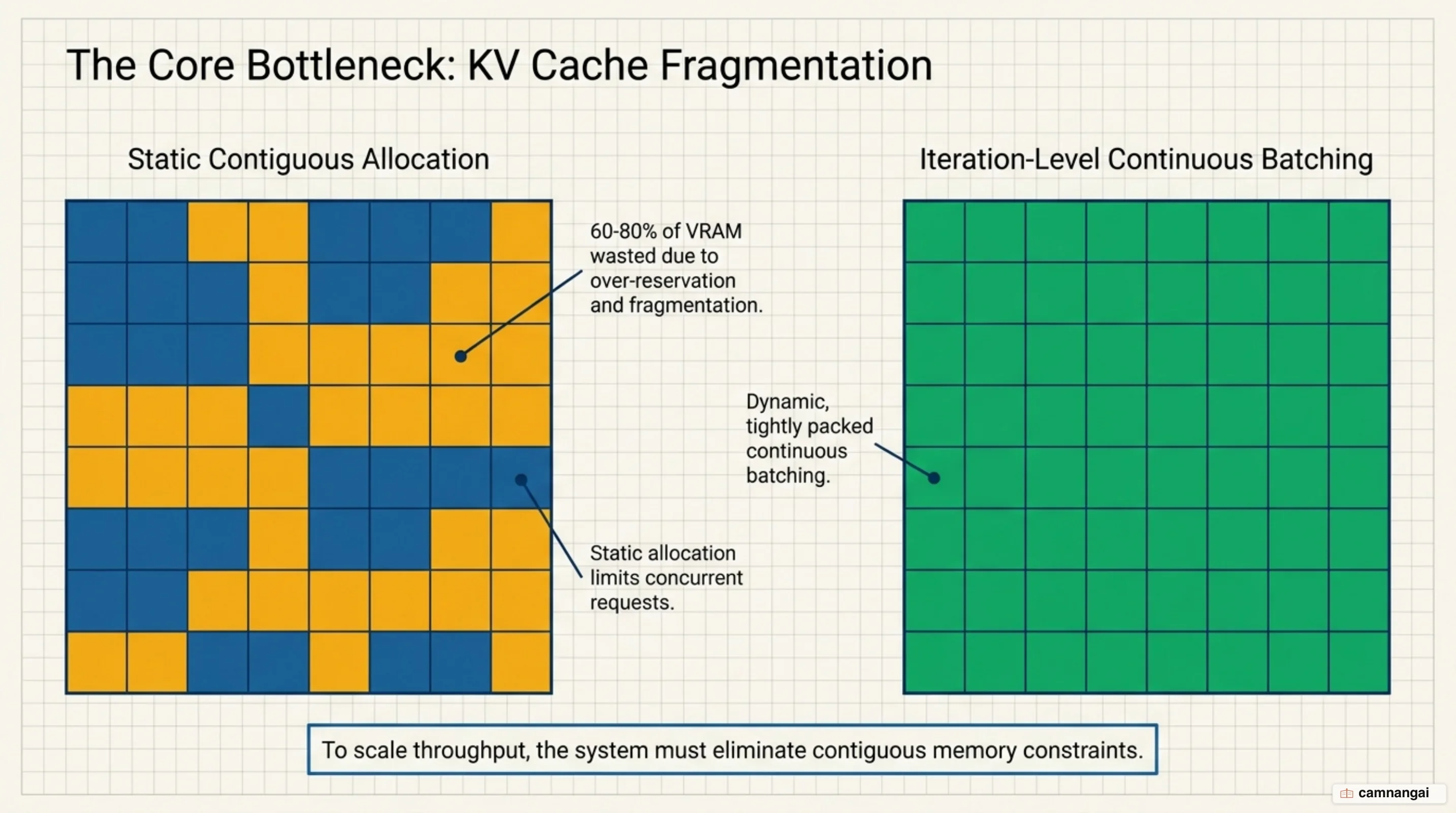
vLLM eliminates these memory barriers by combining flexible physical allocation with continuous batching (iteration-level scheduling). Traditional static batching forces all requests in a batch to synchronize with the longest sequence, requiring you to insert padding tokens for shorter requests. Continuous batching flattens heterogeneous request sequences into a single continuous tensor during forward passes. This allows the engine to immediately schedule new incoming requests and free memory resources as soon as individual sequences finish, eliminating zero-padding overhead and maximizing token throughput.
The core of vLLM: How does PagedAttention work?
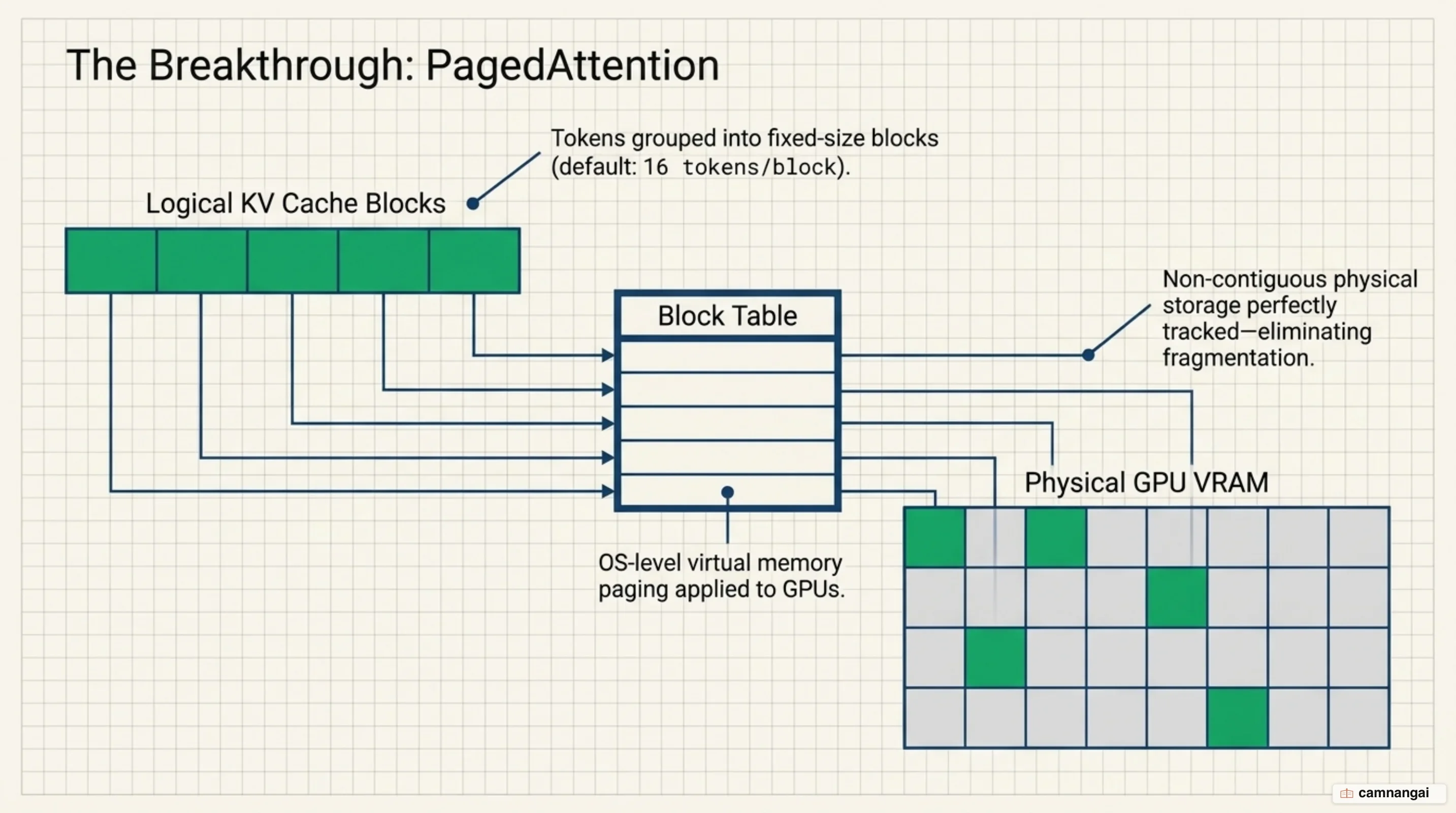
To solve memory fragmentation in your GPU stack, PagedAttention introduces an architecture inspired by virtual memory and paging in operating systems. Instead of storing a sequence's KV cache in contiguous VRAM, PagedAttention partitions the KV cache into fixed-size physical memory blocks, defaulting to 16 tokens per block.
The KV-Cache Manager tracks available VRAM using a doubly linked list pool (free_block_queue). When your requests demand memory for incoming tokens, the engine fetches unallocated blocks from this pool without requiring physical contiguity. During execution, slot_mapping translates logical token offsets into physical block IDs and block offsets inside custom CUDA kernels. Logical-to-physical hash mappings (BlockHash) map active sequences to their corresponding physical pages, keeping VRAM waste near zero—confined only to potential internal fragmentation in a sequence's final block.
from vllm import LLM, SamplingParams

# Configure engine with explicit PagedAttention and memory parameters
llm = LLM(
    model="TinyLlama/TinyLlama-1.1B-Chat-v1.0",
    block_size=16,
    enable_prefix_caching=True,
    gpu_memory_utilization=0.90,
)
This block-level abstraction allows you to implement complex memory-sharing workflows without duplicating KV data:
- Prefix Caching — The engine generates cryptographic hashes for completed token blocks. When new requests arrive with identical system prompts or shared context prefixes, vLLM hits existing
BlockHashentries and reuses physical KV blocks directly, skipping redundant prefill computation. - Parallel Sampling / Beam Search — Multiple generation branches originating from a single prompt share the same physical KV blocks for prompt tokens. When output paths diverge, the engine manages block reference counts (
ref_count) to execute efficient copy-on-write allocations only when sequence branches write new tokens.
Inside vLLM V1: Overcoming technical debt and eliminating CPU overhead
If you deployed early iterations of vLLM (V0), your workloads were susceptible to host CPU overhead. In V0 architectures, sequential request validation, Python object manipulation, and inter-process serialization frequently caused host CPU threads to stall. While evaluating request loops and building execution descriptors, the CPU left the GPU idling, degrading token generation rates under high request concurrency.
The vLLM V1 engine overhaul restructures the execution pipeline to eliminate CPU bottlenecks. V1 offloads host-worker inter-process communication (IPC) to a dedicated Zero-Copy Shared-Memory Tensor Arena for MessageQueue, bypassing Python serialization overhead. On the CPU side, V1 constructs unified input structures using InputBatch and captures CUDA graphs across discrete batch dimensions during engine initialization. When running forward passes, vLLM replays these pre-captured graphs to launch GPU kernels with minimal CPU scheduling latency.
To prevent long prompt prefills from delaying latency-sensitive decode steps, V1 supports chunked prefill by capping prompt processing to a configurable token threshold (long_prefill_token_threshold). Furthermore, rather than relying on dynamic runtime tuning loops, V1 manages operational efficiency through static VRAM profiling during KV cache initialization combined with offline benchmarking CLI parameter sweeps (vllm bench serve, vllm bench latency, and vllm bench throughput) to determine optimal execution parameters for your Target Service Level Objectives (SLOs).
Deploying vLLM in production: From quickstart to multi-GPU clusters
You can set up vLLM in your environment using modern package managers like uv or standard pip. You can also fetch precompiled kernels to minimize engine startup latency during deployment.
uv pip install vllm
vllm download-kernels
For offline batch processing or direct script execution, you can instantiate the LLM class alongside SamplingParams to run batch generation directly in Python.
from vllm import LLM, SamplingParams

prompts = [
    "Summarize the history of distributed computing.",
    "Explain memory bandwidth bottlenecks in GPUs.",
]
sampling_params = SamplingParams(temperature=0.7, max_tokens=100)

llm = LLM(model="TinyLlama/TinyLlama-1.1B-Chat-v1.0")
outputs = llm.generate(prompts, sampling_params)

for output in outputs:
    print(f"Prompt: {output.prompt}")
    print(f"Generated: {output.outputs[0].text}\n")
For production web services, launch vLLM's OpenAI-compatible HTTP server using vllm serve <model-name>. This exposes FastAPI endpoints including /v1/completions, /v1/chat/completions, /v1/models, and specialized pooling routes.
When scaling your models across multiple GPUs, vLLM coordinates distributed execution through its MultiProcExecutor. You can apply Tensor Parallelism (--tensor-parallel-size) for intra-node model sharding and Data Parallelism (--data-parallel-size) to scale throughput across nodes. MultiProcExecutor uses shared-memory queues (rpc_broadcast_mq and worker_response_mq) alongside IPC pipes to dispatch work descriptors from driver processes (rank 0) to worker processes across GPUs in lockstep.
Comparing vLLM with Ollama, TGI, and TensorRT-LLM
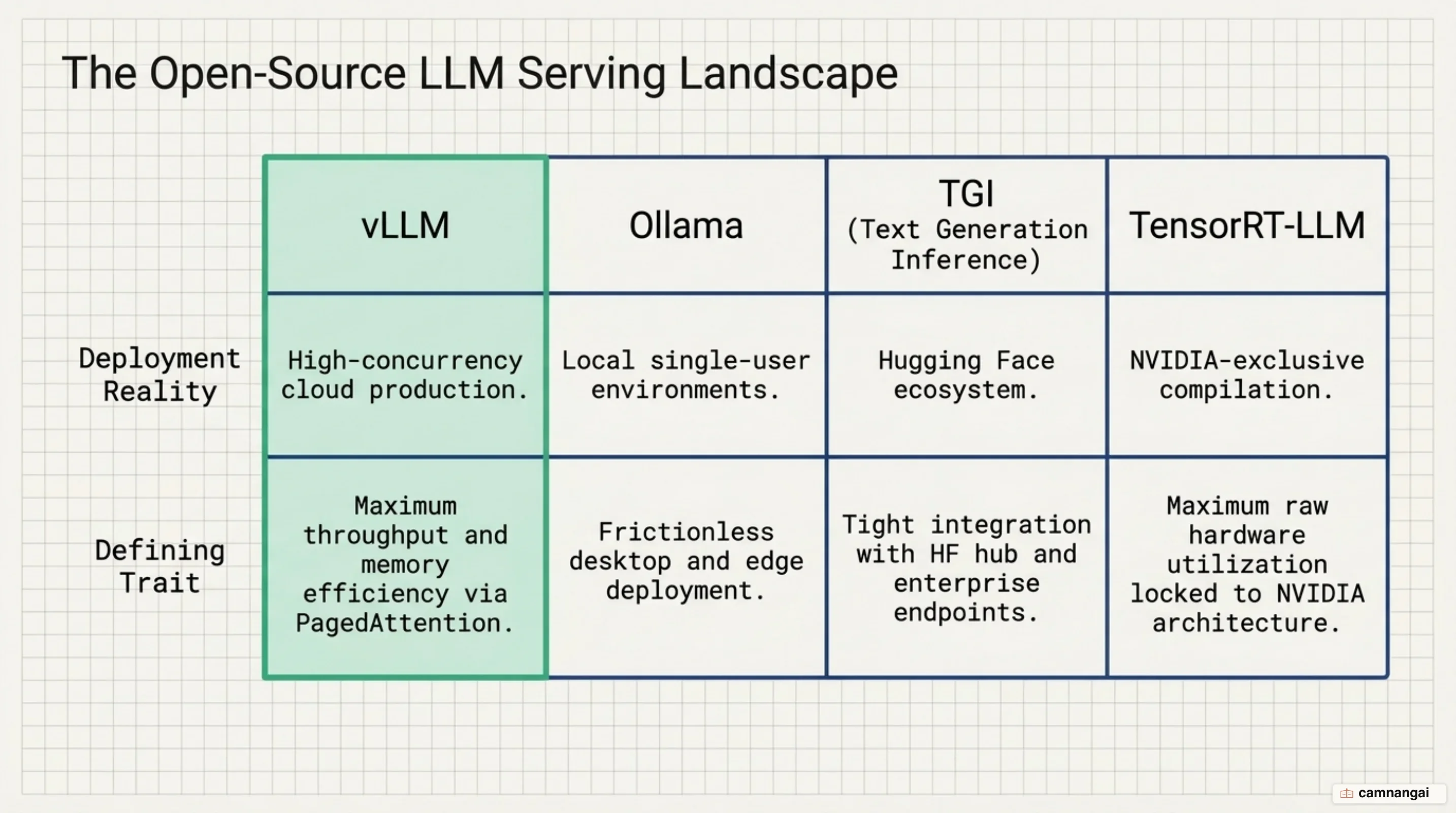
When evaluating LLM serving options, your architecture requirements determine the right engine. Runtimes like Ollama target single-user local developer workflows on desktop CPUs or single GPUs. In contrast, vLLM is structured for multi-tenant, high-concurrency cloud environments, using asynchronous request processing, dynamic page management, and multi-GPU cluster scaling to handle concurrent API connections.
In production comparisons against Hugging Face TGI and NVIDIA TensorRT-LLM, vLLM delivers performance without vendor lock-in. TensorRT-LLM is optimized specifically for NVIDIA hardware, whereas vLLM provides native cross-hardware support across NVIDIA GPUs, AMD ROCm GPUs, Intel GPUs/Gaudi, Google TPUs, and host CPUs (x86, ARM, PowerPC). Through its community plugin system, vLLM also integrates with AWS Neuron, IBM Spyre, Huawei Ascend, Rebellions NPU, and Apple Silicon.
vLLM supports over 200 Hugging Face model architectures out of the box—including dense decoders, Mixture-of-Experts (MoE), and multi-modal models—and provides advanced production mechanics:
- Disaggregated Prefill/Decode (P/D) — Disaggregated P/D isolates compute-heavy prefill nodes from memory-bound decode nodes. Your cluster transfers KV caches between prefill and decode instances using specialized transport connectors (such as NIXL or
ExampleConnector), allowing you to autoscale prefill and decode pools independently to satisfy strict Time-To-First-Token (TTFT) and Inter-Token Latency (ITL) SLOs. - Guided Decoding & Structured Outputs — By integrating external libraries like
xgrammar, vLLM applies grammar-constrained Finite State Machines (FSMs) directly to forward-pass logits. The engine expands 32-bit bitmasks to match vocabulary dimensions, masking disallowed tokens to $-\infty$ without incurring CPU decoding bottlenecks during JSON or schema enforcement. - Multi-LoRA Support — You can serve multiple fine-tuned LoRA adapters dynamically on top of a single base model without incurring duplicate memory overhead for base model weights.
When should you choose vLLM for your AI stack?
Select vLLM when you build high-concurrency enterprise API endpoints, design AI agent systems that depend on long system prompts with shared context, or operate multi-tenant infrastructure where maximizing request density is critical. By combining PagedAttention, prefix caching, and continuous batching, vLLM achieves 2x to 4x throughput gains compared to traditional engines like FasterTransformer and Orca while keeping latency predictable under high load.
If your use case is limited to single-user local execution where deployment simplicity outweighs concurrent batching efficiency, desktop runtimes like Ollama may be sufficient. However, for enterprise production workloads requiring broad hardware compatibility, extensive Hugging Face model coverage, and high token throughput per dollar of GPU infrastructure capital cost, vLLM provides a dependable production engine.
References
- Efficient Memory Management for Large Language Model Serving with PagedAttention — Woosuk Kwon et al.
- vLLM: Easy, Fast, and Cheap LLM Serving with PagedAttention — vLLM Blog
- vLLM V1: A Major Upgrade to vLLM's Core Architecture — vLLM Blog
- Inside vLLM: Anatomy of a High-Throughput LLM Inference System — vLLM Blog
- vLLM Documentation — Official Docs
- OpenAI-Compatible Server Guide — vLLM Docs
- vLLM Repository and Ecosystem — GitHub