Machine learning inference is the process where your trained model finally generates value by processing new, unseen data to produce usable outputs like predictions, classifications, or scores.
When you move a machine learning model into a production environment, you are entering the inference phase. This is the transition from learning to acting: the training phase is about discovering patterns, while inference is about applying those patterns to live situations so your downstream systems can make decisions.
Whether it is detecting fraud in milliseconds or refreshing customer churn scores overnight, inference is where the model does its actual job.
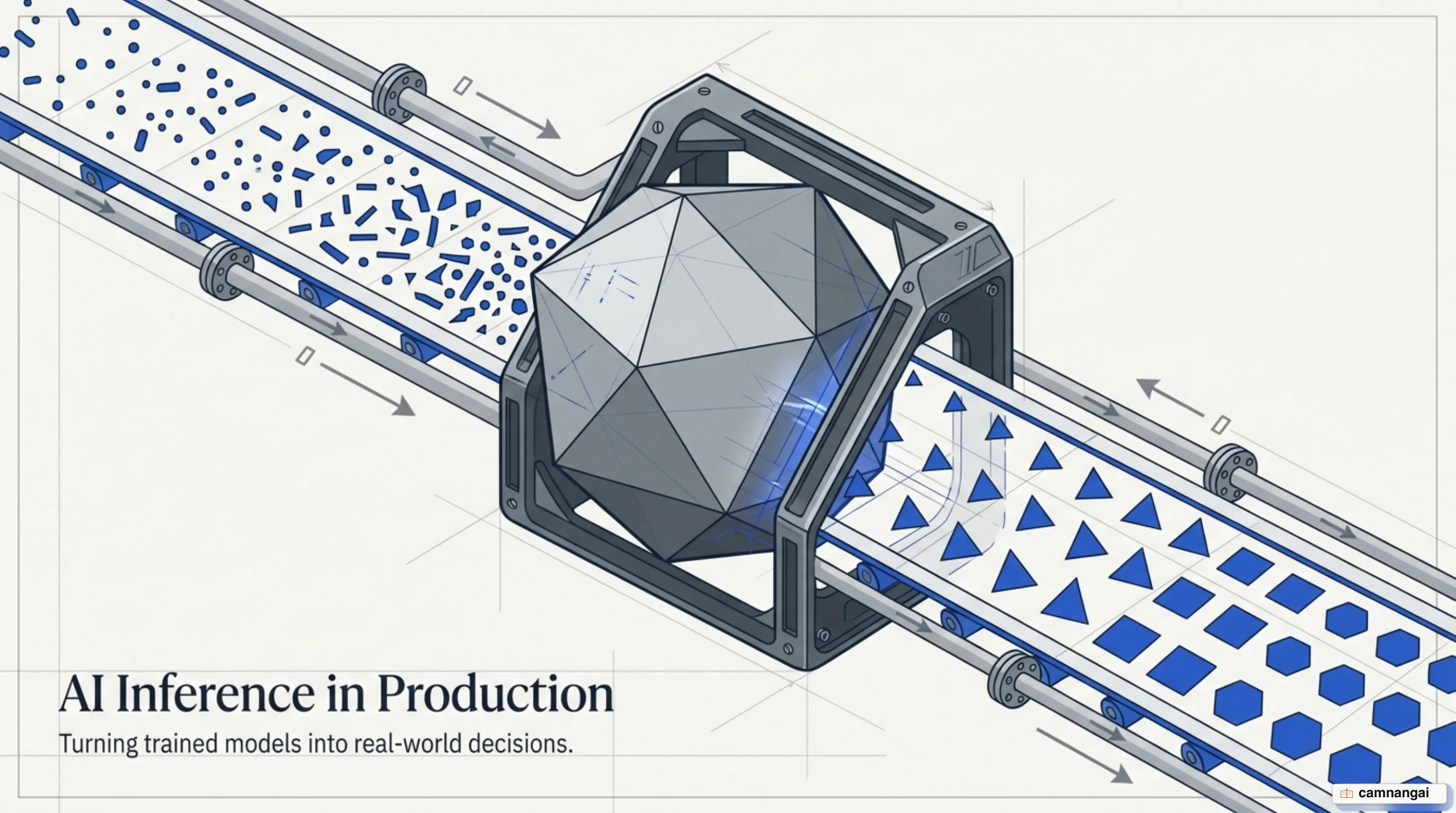
What is machine learning inference?
In technical terms, inference is the execution of a machine learning model on live data. Once your model has been trained on a historical dataset, it is deployed to handle production-time inputs. These inputs can range from a single user prompt in a chatbot to millions of image files for classification. The goal is to generate a usable output — such as a probability score, a business category, or an embedding — that a downstream system can immediately act upon.
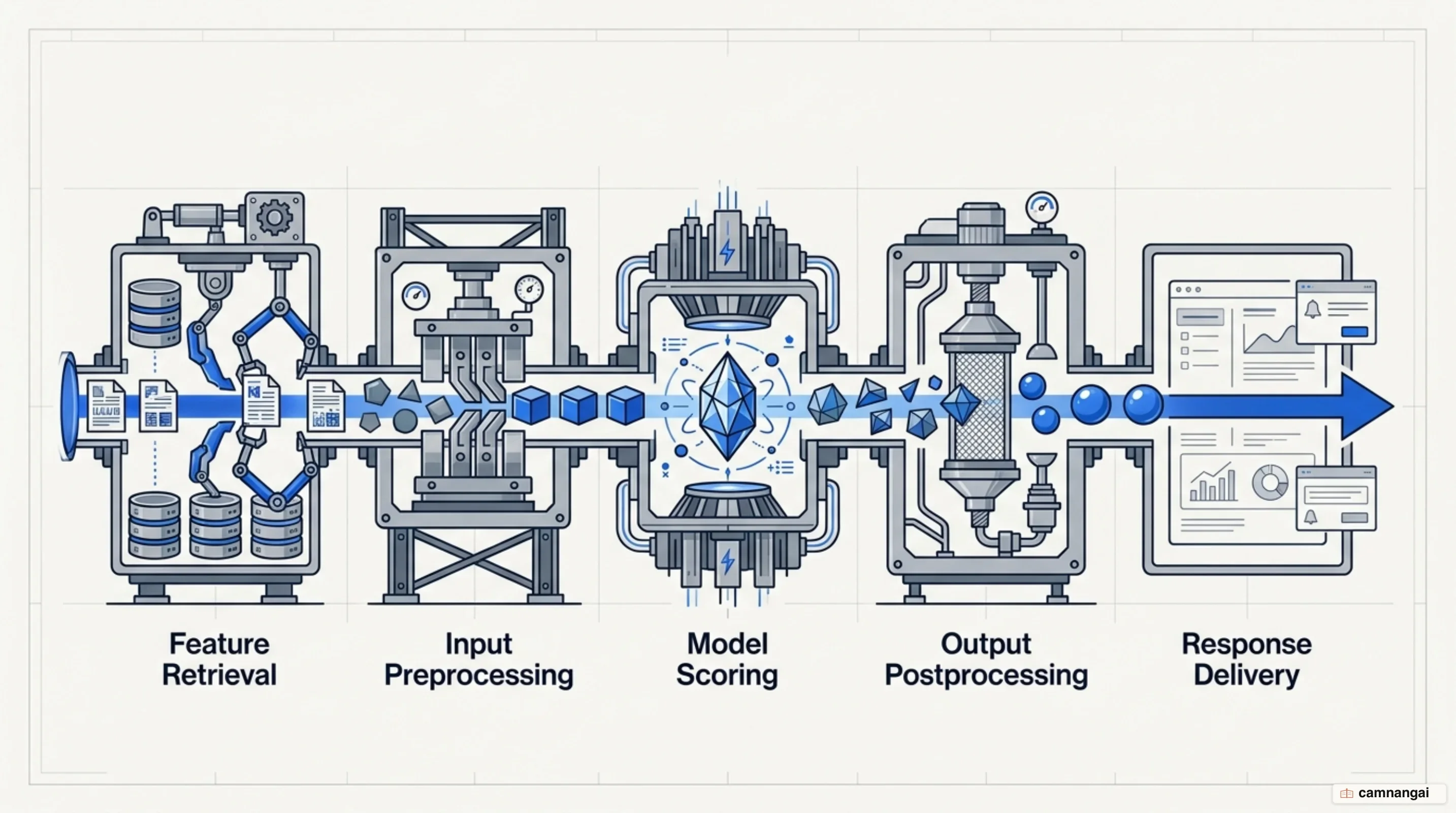
Getting a reliable output takes more than one step. The system starts with feature retrieval, gathering the specific data points the model requires, then hands off to input preprocessing, where raw data is cleaned, tokenized, or encoded to match the format used during training. Model scoring comes next, applying the learned weights to the prepared input, and output postprocessing turns the raw scores into something a person or a downstream service can use. Throughout this flow you have to keep the feature logic identical on both sides, because a difference between the training and production environments is enough to make every result that follows unreliable.
The cleanest way to picture the shift is Sherlock Holmes and Dr. Watson. During the training phase, the algorithm is like Watson — observing, learning, and refining its understanding of the world. Once the model is fully trained and deployed for inference, it becomes the Sherlock Holmes of your infrastructure: a machine designed to observe new data and draw immediate, logical conclusions based on its prior training.
How is inference different from training?
The primary difference between training and inference is what each one is for. Training is an experimental, iterative process where a base algorithm is taught to make correct decisions. During this phase, you feed the model large volumes of labeled historical data to adjust its internal parameters, or weights. In contrast, inference is the production phase where the model no longer learns but instead applies its fixed weights to new, unseen data to generate a specific result. That line is what separates machine learning in the lab from machine learning in a product.
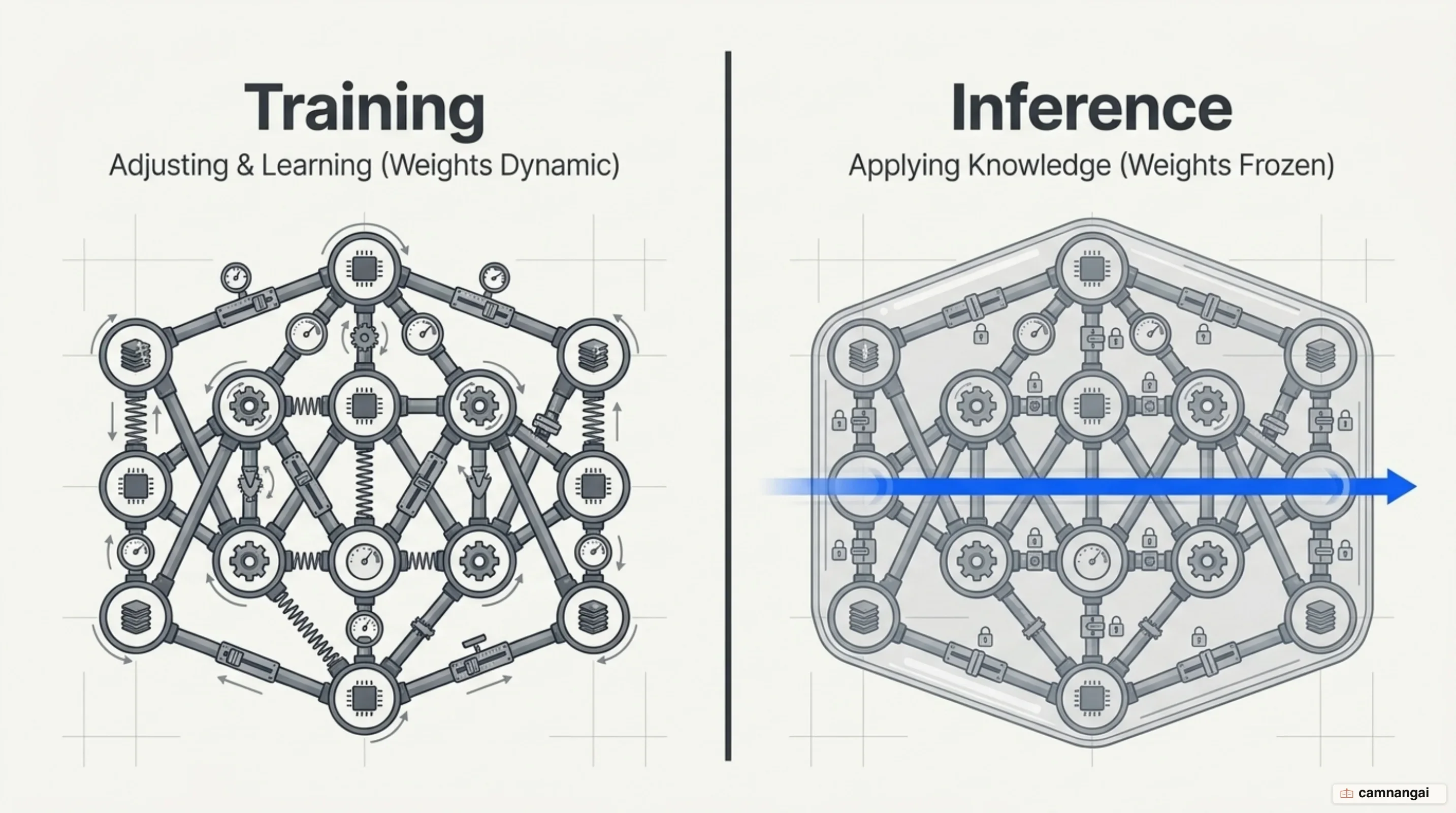
Infrastructure requirements also vary significantly between the two. Training is often a massive, compute-intensive event that runs periodically — for example, when performance degrades or new training data becomes available. Inference, however, is a continuous process that runs for the entire lifecycle of the model. While a single inference request requires far less power than a training run, the cumulative demand is much higher because inference must handle a constant stream of requests with strict latency budgets and service level objectives.
You can visualize the outcome of training through the dropout method. When an algorithm is effectively trained, it develops heavier weights between specific nodes in a neural network. This means the trained model prefers certain significant paths over others. During inference, the model essentially uses these established paths to draw conclusions, often deprioritizing or eliminating less significant relationships it identified during the training phase.
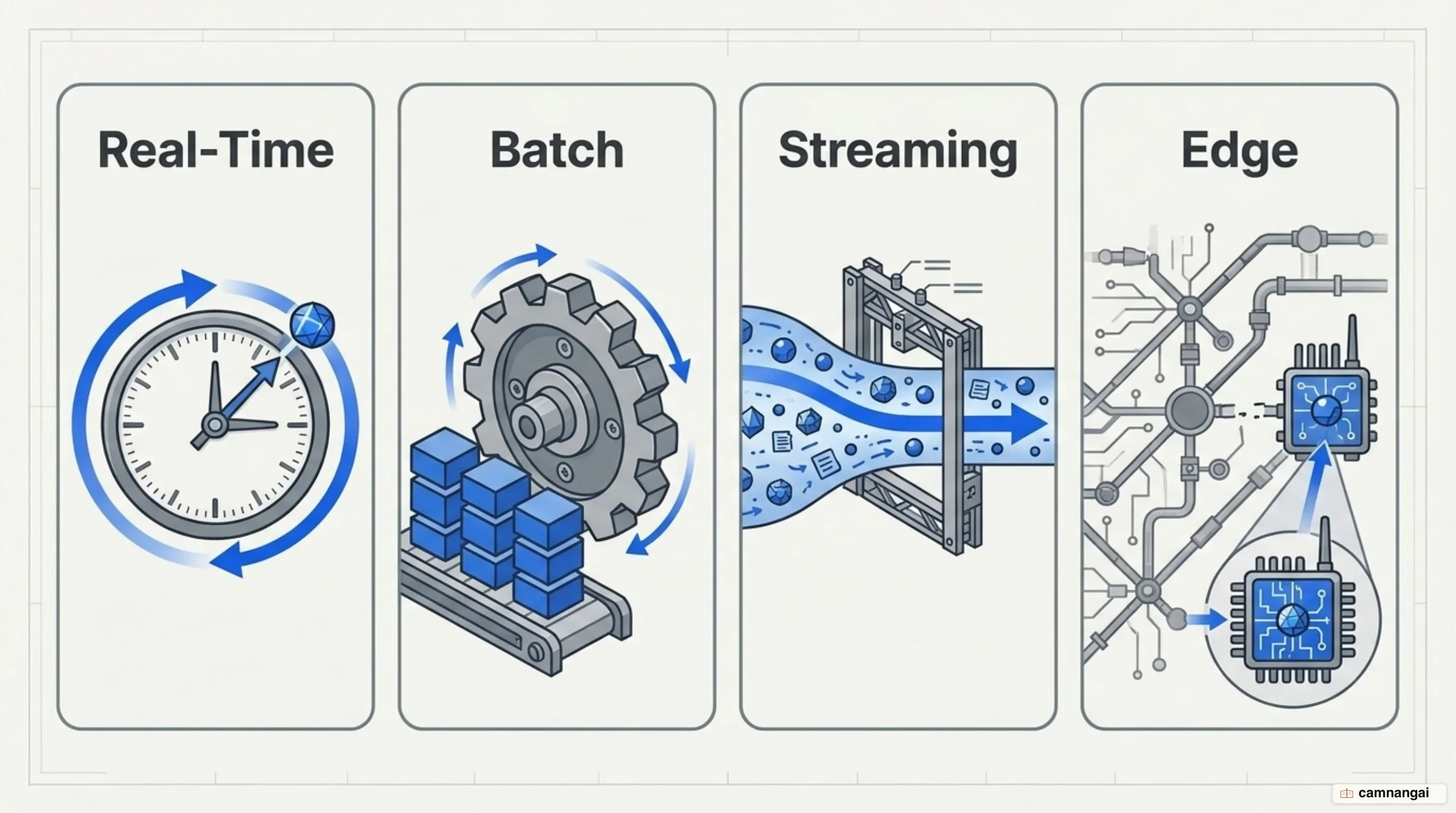
Four ways inference gets deployed: real-time, batch, streaming, and edge
Batch inference
Batch inference involves scoring large sets of records at once, typically on a set schedule or as part of a data pipeline. This mode is best for scenarios where you do not need an immediate response, such as generating demand forecasts or refreshing customer recommendation scores overnight. The architectural focus here is on throughput and job reliability: the system has to process high volumes of data within a specific window and write the results to a table for future use.
Real-time (online) inference
Real-time, or online, inference generates a prediction immediately in response to a synchronous request. When an application needs to make a split-second decision — such as authorizing a credit card transaction or ranking content for a live user session — it calls an inference endpoint. Because a system or user is waiting for the result, the infrastructure must be optimized for low latency and high concurrency, often using autoscaling to handle fluctuating traffic.
Streaming inference
Streaming inference scores data continuously as events arrive in a stream, such as log events, clickstream data, or sensor readings. Unlike batching, which waits for a collection of data, or real-time inference, which waits for a user request, streaming inference processes data in near-real-time as it flows through the system. This is frequently used for operational monitoring or risk-scoring workflows where the model output triggers an immediate review or alert.
Edge inference
Edge inference moves the model execution away from centralized servers and directly onto local devices like smartphones, vehicles, or industrial sensors. This deployment mode is used to overcome connectivity issues, reduce data transfer costs, or comply with strict privacy requirements. Because edge devices have limited memory and power, models used here are typically optimized and compressed to run within the hardware's specific constraints.
Real-time gets picked more often than it should, usually because it sounds like the modern choice, while batch is what most background work actually needs.
What makes inference fast or slow, cheap or expensive?
Your hardware and your model's complexity together set what inference costs and how fast it answers. Latency, the time it takes to return a single result, is critical for user-facing applications, while throughput is the priority for high-volume back-end tasks. For low-volume tasks, CPUs are often sufficient. However, for deep learning and large-scale workloads, specialized hardware like GPUs, TPUs, or FPGAs is required to handle the mathematical intensity of model scoring.
To reduce the operational cost and memory footprint, engineers use several optimization techniques. Quantization involves reducing numerical precision — for example, moving from 32-bit floating-point (FP32) to 8-bit integers (INT8) — to save memory, at some accuracy risk you validate against production-like data. Pruning removes redundant parameters, while knowledge distillation trains a smaller model to mimic a larger one. For large language models, techniques like KV caching (storing attention key-values from prior context) and speculative decoding (using a small draft model to propose tokens for a larger model to verify) are essential for maintaining performance.
Operational metrics decide the bill. You must monitor utilization to identify idle capacity versus saturated hardware. Feature freshness is equally vital; if your model relies on stale data, the quality drops, wasting compute on useless predictions. Finally, cold start times — the delay when loading a model into memory after inactivity — can negatively affect latency in autoscaled environments, requiring careful management of the serving layer.
Why inference spending is overtaking training
The money is moving as AI leaves the lab for production. Speaking at CES 2026, Lenovo CEO Yuanqing Yang said roughly 80% of AI spending currently goes to creating the large language models behind generative AI, with the remaining 20% going to inference. He predicted those numbers will reverse: 80% on inference, 20% on training. Treat that as a vendor's forecast rather than a settled fact, but the direction is hard to argue with. The change is driven by enterprises moving from experimentation to large-scale production, where models handle continuous, high-volume requests for the life of the application.
This economic reality has led to a surge in dedicated inference hardware. Manufacturers have launched specialized systems designed for on-premises and edge inferencing: the Lenovo ThinkSystem SR675i runs full-sized LLMs for applications in manufacturing, healthcare, and financial services; the ThinkSystem SR650i is built to be scalable and easy to deploy in existing data centers; and the ThinkEdge SE455i is a compact server for retail, telco, and industrial environments. On the chip level, the AMD Instinct MI440X is designed for on-premises inferencing for enterprise AI. By running inference on dedicated hardware, organizations can avoid the premium costs associated with public cloud services for predictable, high-volume workloads.
Strategic concerns like data sovereignty and security are also accelerating this trend. Enterprises are increasingly sensitive about keeping their data in-house rather than sending it to external providers for scoring. By deploying dedicated inference servers close to where data is generated, companies maintain strict governance, reduce latency by avoiding data transfers, and keep sensitive information inside corporate control.
Where should you start?
Start with the latency budget. Everything else follows from it: it is what picks batch over real-time, and in my experience it is the number most teams never write down before they start buying hardware. Use managed inference services, including model registries and prebuilt containers, to reduce the operational friction of hosting and versioning your models. They handle the infrastructure heavy lifting, which frees you to work on the thing that actually breaks production models: keeping your development and production pipelines in parity so training-serving skew never gets a foothold.
What buys long-term reliability is consistency, so treat inference as a production data workflow rather than an isolated response system. By keeping your inference logic and compute close to the enterprise data it depends on, you minimize data movement and keep your predictions aligned with the reality of your business.
References
- What is AI Inference? | NVIDIA Glossary
- What is AI inference? How it works and examples | Google Cloud
- What is AI inferencing? — IBM Research
- AI inference vs. training: Key differences and tradeoffs — TechTarget
- AI 101: A Guide to the Differences Between Training and Inference — Backblaze
- Get inferences beginner's guide | Google Cloud Vertex AI
- What Is Machine Learning Inference? Types & Optimization | Snowflake
- CES 2026: AI compute sees a shift from training to inference — Computerworld