Contextual prompting is the architectural practice of providing a Large Language Model (LLM) with a comprehensive brief—including situational background, specific execution parameters, and foundational data—prior to issuing a core request.
While humans rely on implicit shared experiences to fill in gaps (e.g., knowing which specific project a colleague is referencing), LLMs require explicit, grounded data to activate the precise linguistic patterns and domain-specific knowledge required for high-stakes tasks.
By providing these high-signal tokens up front, contextual prompting ensures that the model operates within the boundaries of a specific environment rather than relying on broad, generic training distributions. This approach is essential for systems where accuracy, brand alignment, and technical precision are non-negotiable.

What is contextual prompting?
Technically, contextual prompting runs on In-Context Learning (ICL). ICL is the mechanism by which a model adapts its predictive logic and behavioral patterns based solely on the information provided within the prompt itself, without requiring weight adjustments or additional training. By saturating the context window with relevant data, you narrow what the model has to guess at, which is what cuts the risk of hallucinations.

This process is governed by the "Attention Budget." Because transformer-based models have a finite capacity for processing tokens with maximum precision, every token is a resource. Providing high-signal tokens (data directly relevant to the objective) helps the model focus its predictive capabilities on a narrow, relevant domain. This represents a transition from basic zero-shot instructions (e.g., "Write a report") to layered situational briefings (e.g., "You are an auditor reviewing these specific compliance logs for an executive committee") that allow the model to move from simple text prediction to grounded, multi-step reasoning.
How contextual prompts differ from system and role prompts
Effective prompt architecture follows a strict "Chain of Command" among message roles. While terminology varies by provider—OpenAI typically uses "developer" messages while Anthropic uses "system" messages—the architectural hierarchy remains identical:

- Developer/System Messages: These establish the permanent rules, tone, and business logic. They serve as the "function definition" and take priority over other inputs in the hierarchy of authority.
- User Messages: These contain the specific inputs, arguments, or data to which the system rules are applied.
- Role vs. Context: A Role defines an identity (e.g., "You are a senior systems architect"), whereas Context defines the specific scenario (e.g., "The user is an executive reviewing internal cloud spend audits"). The role dictates the how of the communication; the context dictates the what and why.
| Role | Primary Function | Authority Level |
|---|---|---|
| Developer/System | Establishes behavioral constraints and core logic. | Primary |
| User | Provides specific data, queries, and situational context. | Secondary |
| Assistant | Generates output based on the instructions above. | Executional |
What goes into a well-contextualized prompt
A high-performing prompt is built from four essential elements: Instruction (the task), Context (supporting information), Input Data (the subject), and the Output Indicator (the format). To construct a professional project brief, engineers must integrate eight situational components: Audience, Goal, Constraint, Domain Context, Background Info, Examples, Success Criteria, and Hierarchy.
Example: educational context for photosynthesis
<hierarchy>
1. Identify target persona.
2. Establish scientific domain.
3. Apply pedagogical constraints.
4. Execute narrative output.
</hierarchy>

<domain_context>
Biology: Plant Physiology and Energy Conversion.
</domain_context>

<audience>
7-year-old primary school students with no prior chemistry knowledge.
</audience>

<goal>
Explain how plants create food so that a child can explain it back to a parent.
</goal>

<background_info>
The students know plants need water and sunlight, but do not know about cells or CO2.
</background_info>

<constraint>
Avoid words like "chemical," "molecule," or "glucose." Use analogies related to a kitchen.
</constraint>

<examples>
User: "How do plants drink?"
Assistant: "They use their roots like little straws to slurp up water from the dirt!"
</examples>

<success_criteria>
The explanation must be a story, use the "kitchen" analogy, and be under 150 words.
</success_criteria>

<instruction>
Explain the process of photosynthesis based on the parameters above.
</instruction>

<output_indicator>
Format the response as a short, engaging story.
</output_indicator>
Where to put context inside a prompt
For long-context inputs (20k+ tokens), the "Data-at-the-Top" principle is critical. Engineers should place primary documents and background data at the beginning of the prompt, positioned above the specific query.
 This improves recall and response quality; in complex, multi-document retrieval tasks, placing the query at the very end can improve performance by up to 30 percent.
Structural delineation is achieved through XML tags (e.g., <background_information>, <context>, <document>) and Markdown headers. For multi-document inputs, use nested and indexed tags:
<documents>
 <document index="1">
 <source>Internal_Audit_v1.pdf</source>
 <content>[Text]</content>
 </document>
 <document index="2">
 <source>Cloud_Spend_Q3.csv</source>
 <content>[Data]</content>
 </document>
</documents>
Common mistakes when adding context
As context windows expand, you have to manage "Context Rot." This occurs because the transformer architecture relies on an n² relationship between tokens. As volume increases, the model's attention is stretched, leading to a performance gradient where the model exhibits reduced precision for long-range reasoning and information retrieval, and the failure is quiet, which is what makes it expensive: nothing errors, the answers just get vaguer.
Other critical pitfalls include:
- Brittle Logic: Hardcoding rigid "if-else" instructions (e.g., "If the user mentions price, say X") creates fragile prompts. Instead, use flexible heuristics: "Prioritize cost-efficiency explanations unless the technical context implies a secondary priority of performance stability."
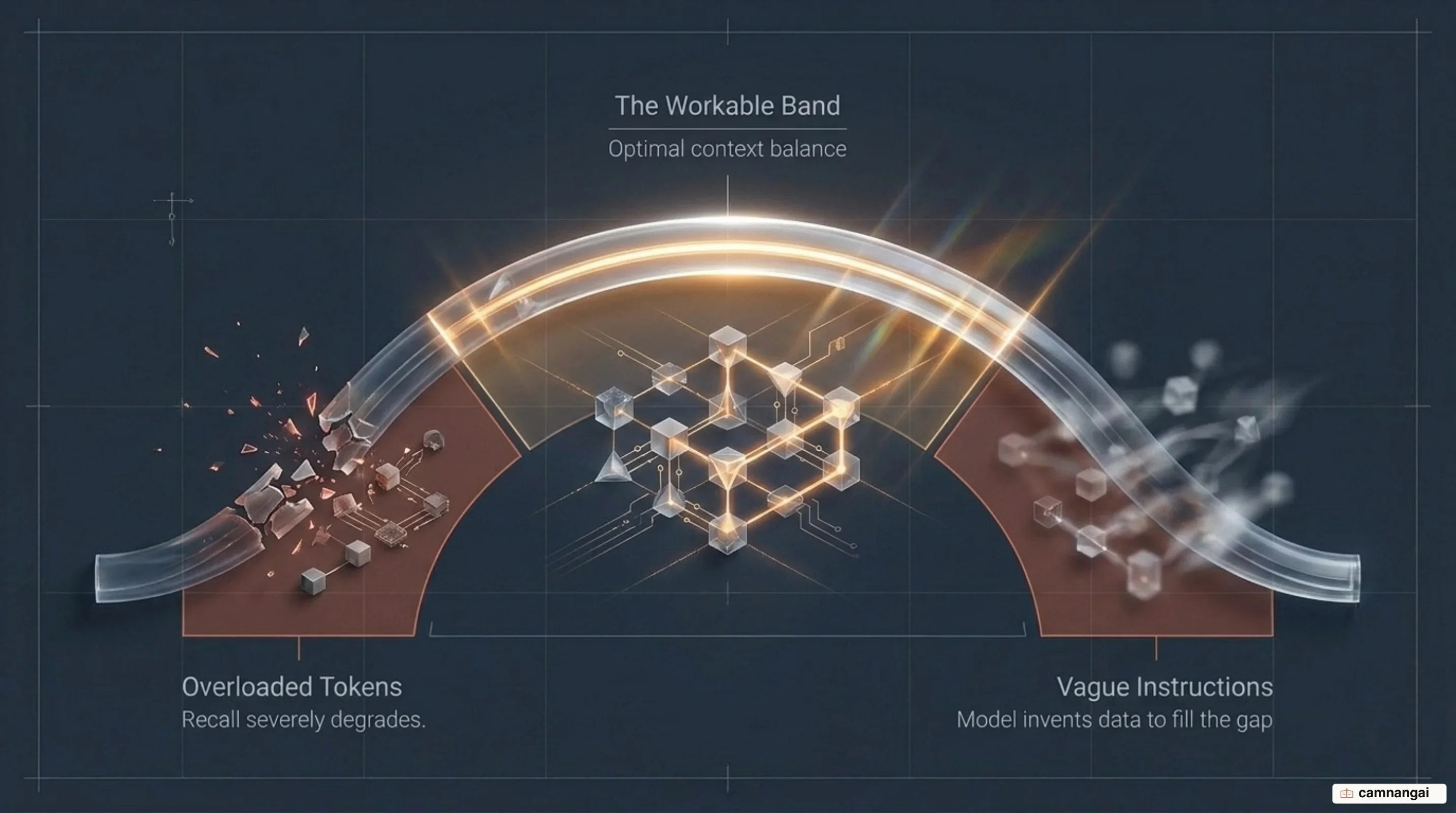
- The Goldilocks Zone: Vague prompts assume shared context that doesn't exist, while overloaded prompts deplete the attention budget with low-signal noise. Aim for the minimal set of high-signal tokens required for the task.
From contextual prompting to context engineering
In agentic systems, the focus shifts to context engineering—the iterative curation of tokens across multiple turns of inference. Newer models (Claude 4.6+) use adaptive thinking, where the effort parameter allows the model to dynamically influence its attention budget based on query complexity, replacing manual token budgets.
For long-horizon tasks, two strategies do most of the work:
- Compaction: Summarizing conversation history as the context window nears its limit. This distills critical decisions while discarding redundant tool outputs.
- Structured Note-taking (Agentic Memory): The agent maintains external files for persistence. JSON is preferred for state data and schema-heavy tracking, while Markdown is used for general progress notes and human-readable logs.
Of everything here, I find the placement rule the easiest to get wrong, because nothing about a badly-ordered prompt looks broken from the outside. Contextual prompting earns its overhead on complex, high-stakes work where accuracy, consistency, and alignment are non-negotiable; on a one-off question it is just extra typing.
References
- Prompt Engineering (Whitepaper) — Lee Boonstra, Google
- Contextual Prompting — GeeksforGeeks
- Prompting best practices — Claude Platform Docs
- Prompt engineering — OpenAI API
- Elements of a Prompt — Prompt Engineering Guide
- The Difference Between System Messages and User Messages in Prompt Engineering — PromptHub
- Effective context engineering for AI agents — Anthropic
- Context is King: How Contextual Prompting Transforms AI Outputs — DEV Community