In the architecture of autonomous agents,
context isolation is the practice of partitioning the working memory of a large language model (LLM) across distinct boundaries — such as specialized sub-agents, execution sandboxes, or state schemas — to prevent non-deterministic performance degradation.
By isolating information, you move beyond prompt engineering into the broader discipline of context engineering, where the model only ever sees the high-signal tokens that matter for the task in front of it.
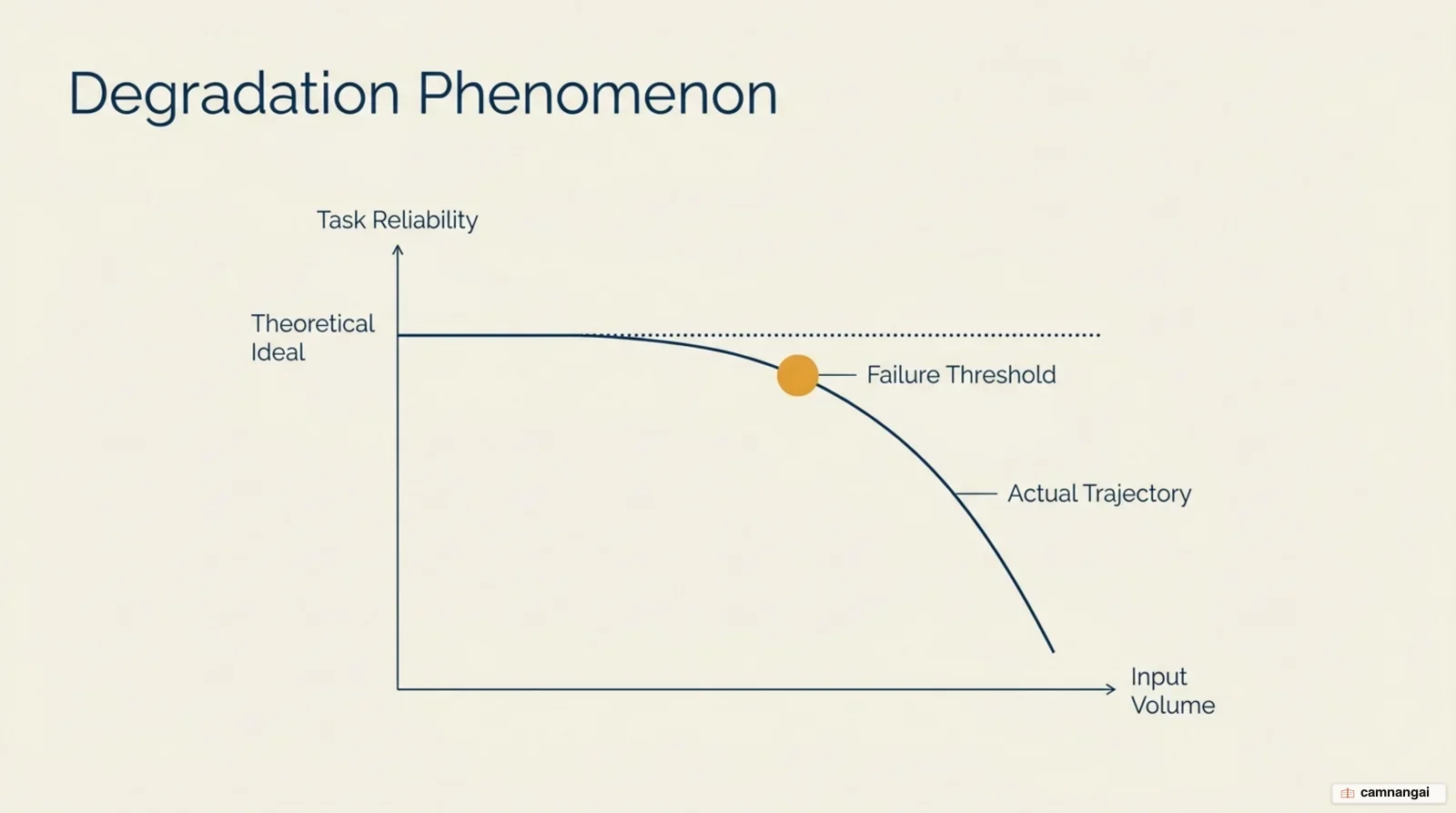
I find it more useful to treat context as a finite "attention budget" than as storage. Modern models technically support context windows in the millions of tokens, but performance across that window is not uniform; it degrades along a predictable gradient as input length grows. Every extra token raises the risk of "context rot," where the model's ability to follow complex reasoning gets stretched thin by the sheer volume of pairwise token relationships.
Building effective systems requires thinking in context, which means optimizing the configuration of the model's state rather than simply refining instructions.
Reliability comes from structure: you quarantine work inside specific environments so the system never hits a performance cliff, and so the tokens you do spend stay useful.
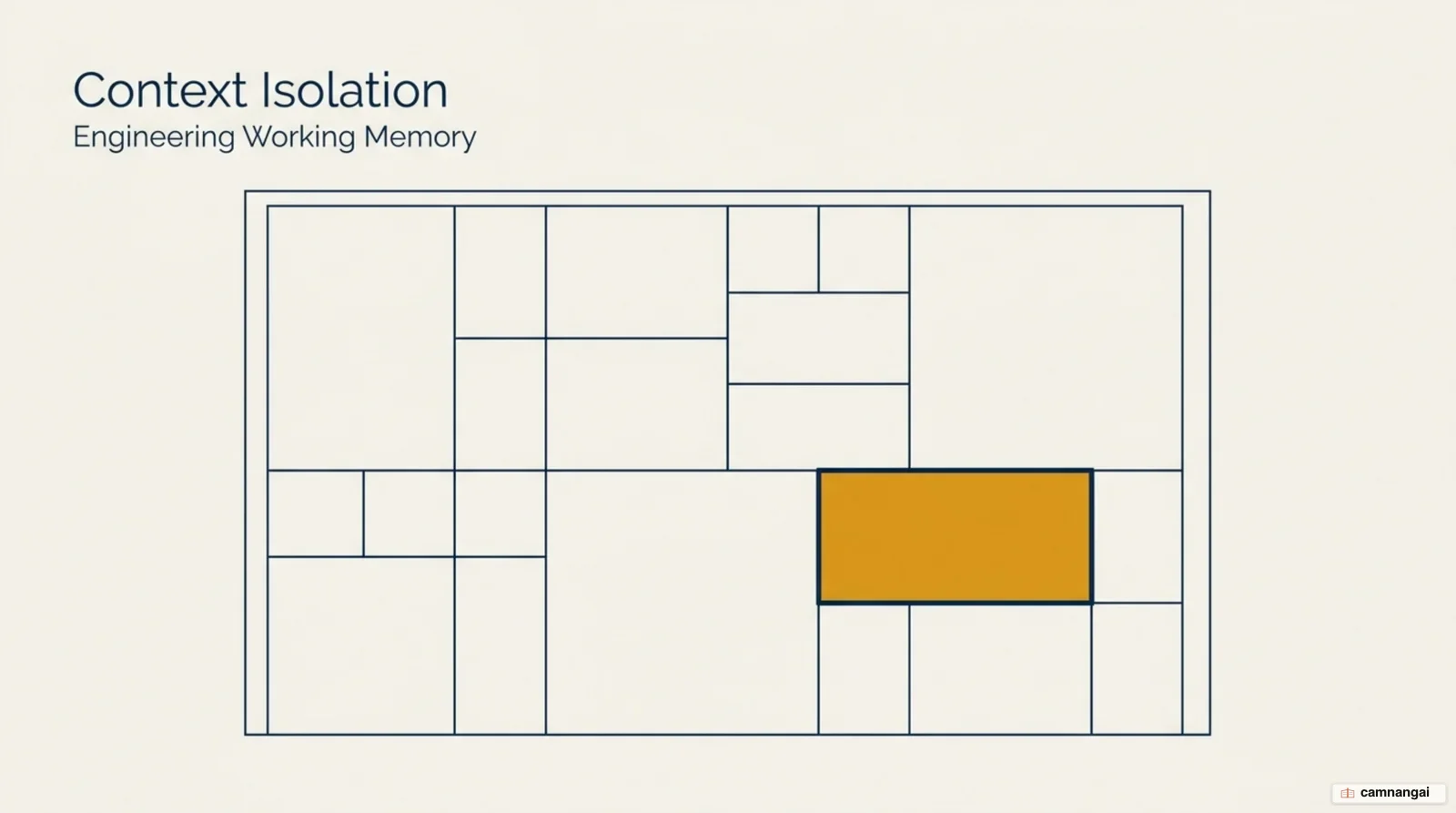
What is context isolation?
Context isolation is the structural strategy of quarantining work within sub-agents or separate execution environments to keep the main orchestrator's context clean. It is not the same thing as context window scaling. A larger window gives you more room, while isolation is about squeezing more utility out of each token against the constraints the transformer architecture imposes anyway.
The reason is arithmetic: in a transformer, n tokens produce n² pairwise relationships, and that quadratic growth stretches attention thin enough to weaken the model's grip on long-range dependencies. So isolation comes down to filling the context window with only the highest-signal tokens the next step of an AI agent trajectory actually needs. Delegate work to specialized environments and the orchestrator never sees the raw output of every tool call, which preserves its reasoning capacity for high-level coordination and cuts the noise that leads to cognitive failure.
Why a bigger context window does not fix the problem
Model performance degrades as input length increases, a phenomenon known as "context rot." Even state-of-the-art models like Claude 4 and GPT-4.1 show non-uniform performance on tasks as simple as text replication or "Repeated Words" once the context window fills. The model does not break; it just gets less reliable, and that is the worse outcome, because a hard cliff would at least show up in your logs, while a gradient hides in them.
That attention scarcity shows up as four specific failure modes in long-context agentic tasks, each one dissected at length in context failure modes:
- Context Poisoning: Hallucinations or incorrect tool outputs enter the memory and influence all subsequent reasoning.
- Context Distraction: Irrelevant data from previous turns overwhelms the model's training on specific task instructions.
- Context Confusion: Superfluous context that is topically related but irrelevant to the current step still influences the response.
- Context Clash: Disagreements between different parts of the context (e.g. conflicting instructions in different files) lead to inconsistent behavior.
Traditional benchmarks like "Needle in a Haystack" understate the problem because they test simple lexical matching. Real agentic work needs semantic reasoning and the ability to tell similar distractors apart, and precision on that drops sharply as context length grows.
Isolation is not the only answer to a long context: stuffing, retrieval and compaction are compared separately in long-context processing.
The three boundaries where context gets isolated
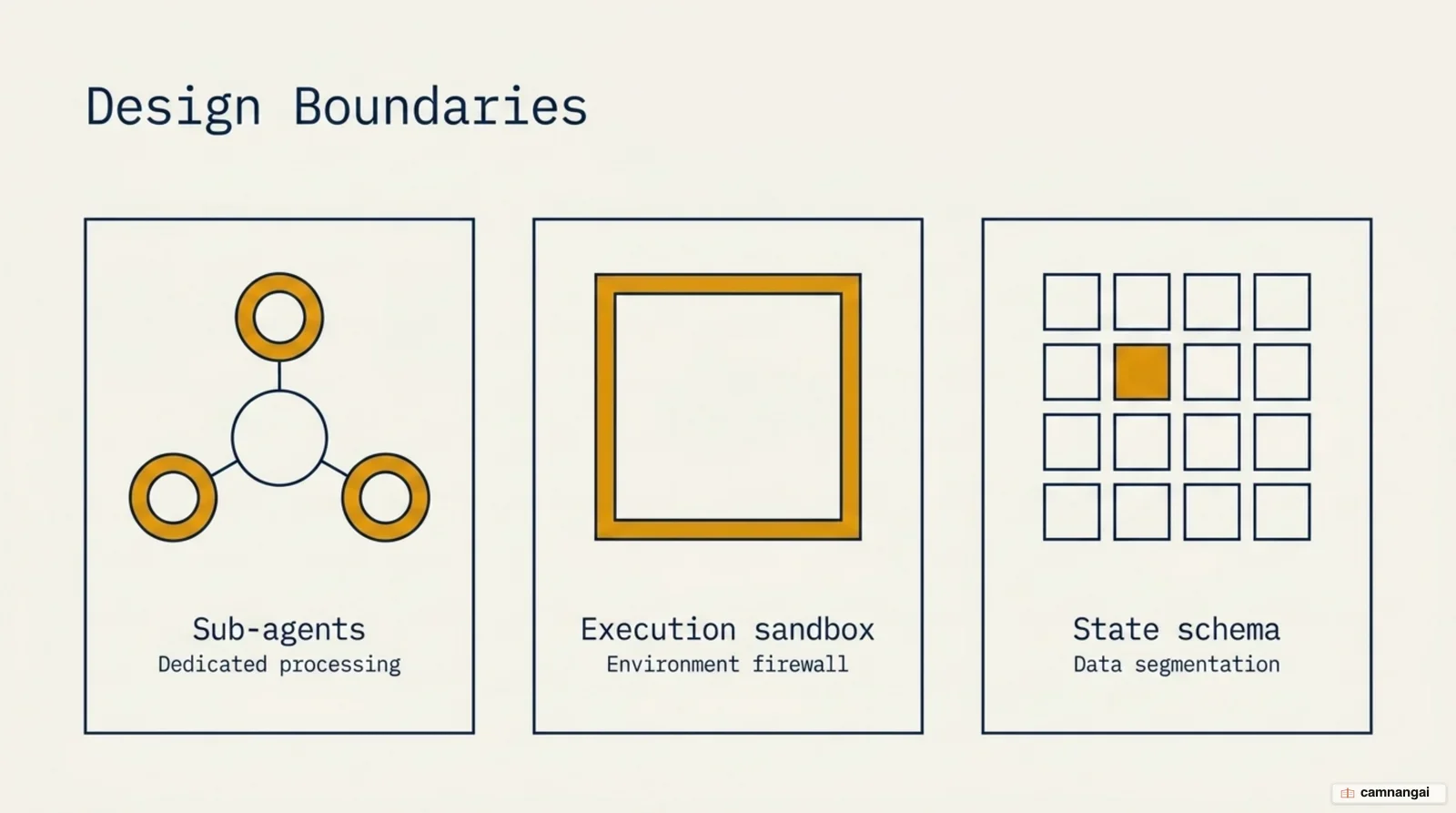
Multi-agent boundaries
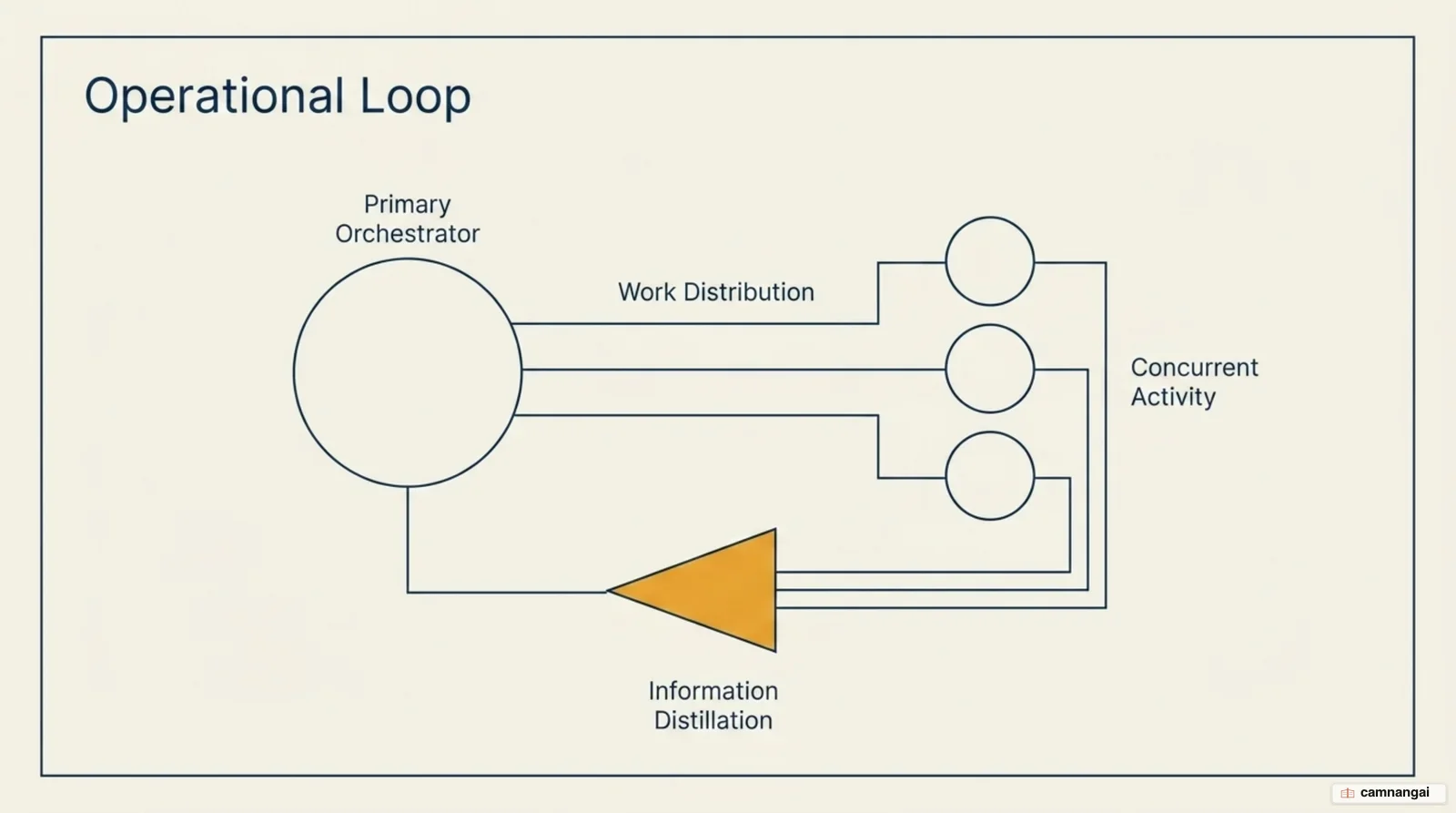
In an orchestrator-worker pattern, a lead agent hands specific tasks to specialized sub-agents. Each sub-agent works inside its own fresh, narrow context window, so the main thread never bloats. The lead agent gets back only the final, condensed report instead of the thousands of intermediate tool calls and search results that would otherwise eat the attention budget. For how this looks inside one real tool, see mastering subagents in Claude Code.
Execution environment boundaries
Sandboxes such as E2B or Pyodide exist to take content off the model's hands. Content offloading fires when a tool call's inputs or results exceed a token threshold, 20,000 by default. A code agent can run data analysis by parking the large objects — images, massive JSON results, audio — as variables inside the sandbox, where they stay reachable through tool calls but never enter the prompt, so the active context stays small and focused.
State schema boundaries
Runtime state objects use schemas to control what the model gets to see. High-performance systems
keep a DeltaChannel reducer on message lists so that checkpoint growth stays linear rather than
compounding as conversations lengthen. Define a specific state schema and you can hide fields from
the LLM at particular steps, exposing them only when a tool or a decision actually needs them.
How an isolated-context system runs
An isolated-context system often works as a capability router, or a "Smart Friend" architecture. A primary model, often smaller or faster, handles routine execution and calls out to a stronger, more expensive frontier model when a decision is hard. The frontier model's context therefore stays focused on the high-level logic, which is the whole point of the arrangement.
Operationally, these systems lean on parallel tool calling. A lead agent spins up multiple sub-agents to search different domains at the same time, and each sub-agent does its own compaction, filtering out noise, before returning a condensed report. Once a system crosses roughly 85% of its context window limit, it triggers a formal summarization that writes a structured summary of session intent and progress while retaining 10% of tokens as recent context, so the model keeps its immediate conversational flow. Frameworks like LangGraph expose these mechanics directly.
What context isolation costs
None of this is free, and the bill arrives in two currencies. The financial one is plain enough: agents typically burn 4x more tokens than standard chat, and multi-agent systems can go up to 15x more, because summarizing and handing context between agents is itself work that costs tokens.
The second currency is coordination. Because sub-agents operate in isolation, they make implicit choices that conflict: if two agents are building a Flappy Bird clone in parallel, one might choose a Super Mario aesthetic while the other builds assets for a Flappy Bird style. Without a shared primary context, those fragmented decisions turn into a context clash. Communication overhead is the other risk, and it is the one I find hardest to design around, because weaker primary models are bad at noticing when they have reached their cognitive limits, so they fail to escalate a task to a "Smart Friend" sub-agent at the moment escalation would help.
When to isolate, and when not to
Isolation is the right call for breadth-first tasks, such as comprehensive research or vulnerability scanning, where you want independent directions explored in parallel. In one vulnerability-detection run, a coordinating swarm found 266 vulnerabilities across 27 million tokens where simple parallelization found 21 across 6.5 million. The swarm cost far more, and it surfaced findings the cheaper method never reached.
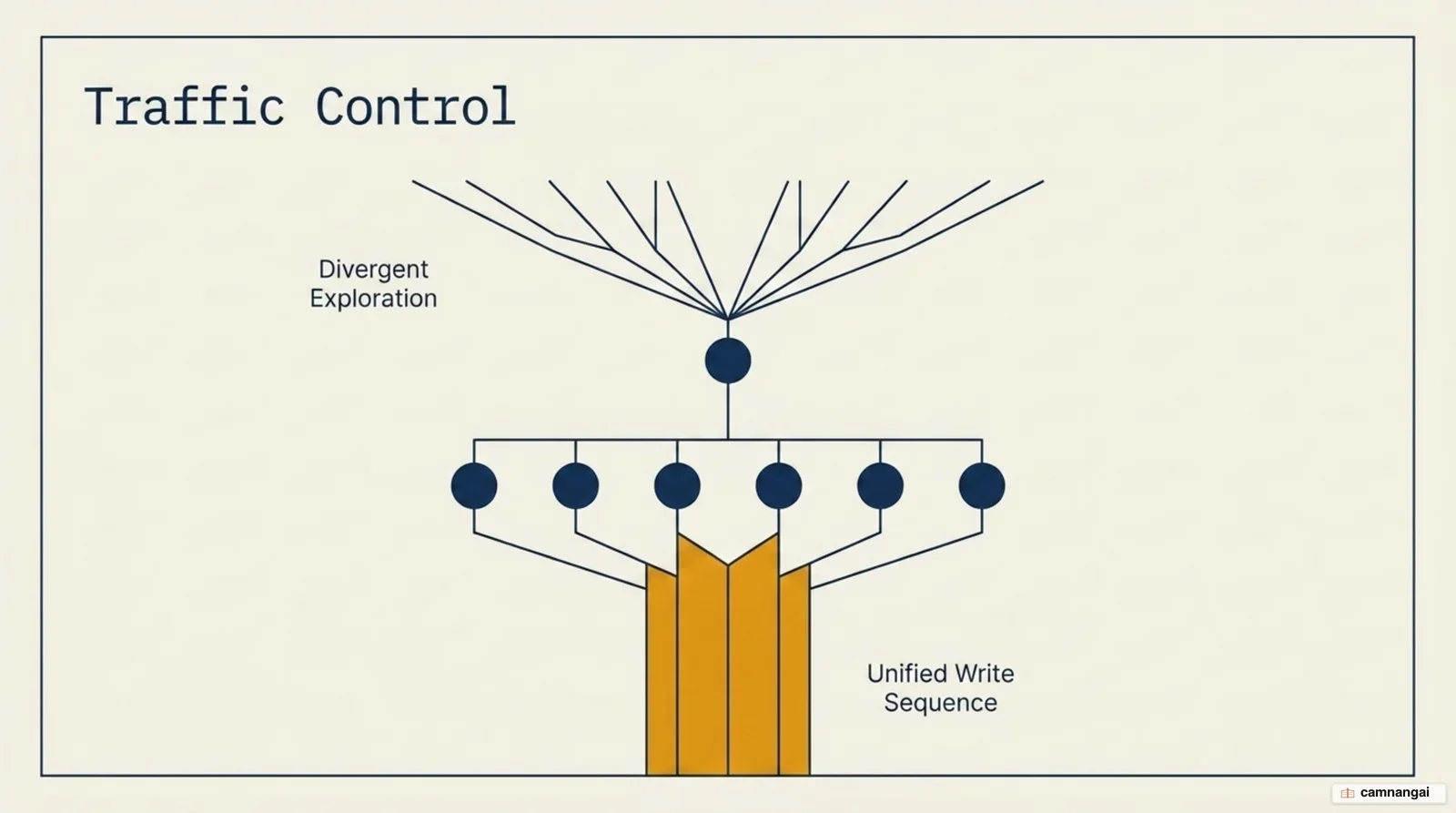
Avoid isolation for tight, sequential coding tasks with heavy dependencies, where forcing the work into separate contexts just produces conflicting implementation decisions. The principle that settles most designs: use isolation to scale intelligence through parallel discovery, but keep write actions single-threaded so decisions stay consistent across the system.
References
- Effective context engineering for AI agents — Anthropic
- Context Engineering — LangChain
- Context Rot: How Increasing Input Tokens Impacts LLM Performance — Chroma
- How we built our multi-agent research system — Anthropic
- Patterns and problems in emerging multiagent systems — Anthropic
- Don't Build Multi-Agents — Cognition
- Multi-Agents: What's Actually Working — Cognition
- Context engineering in Deep Agents — LangChain Docs