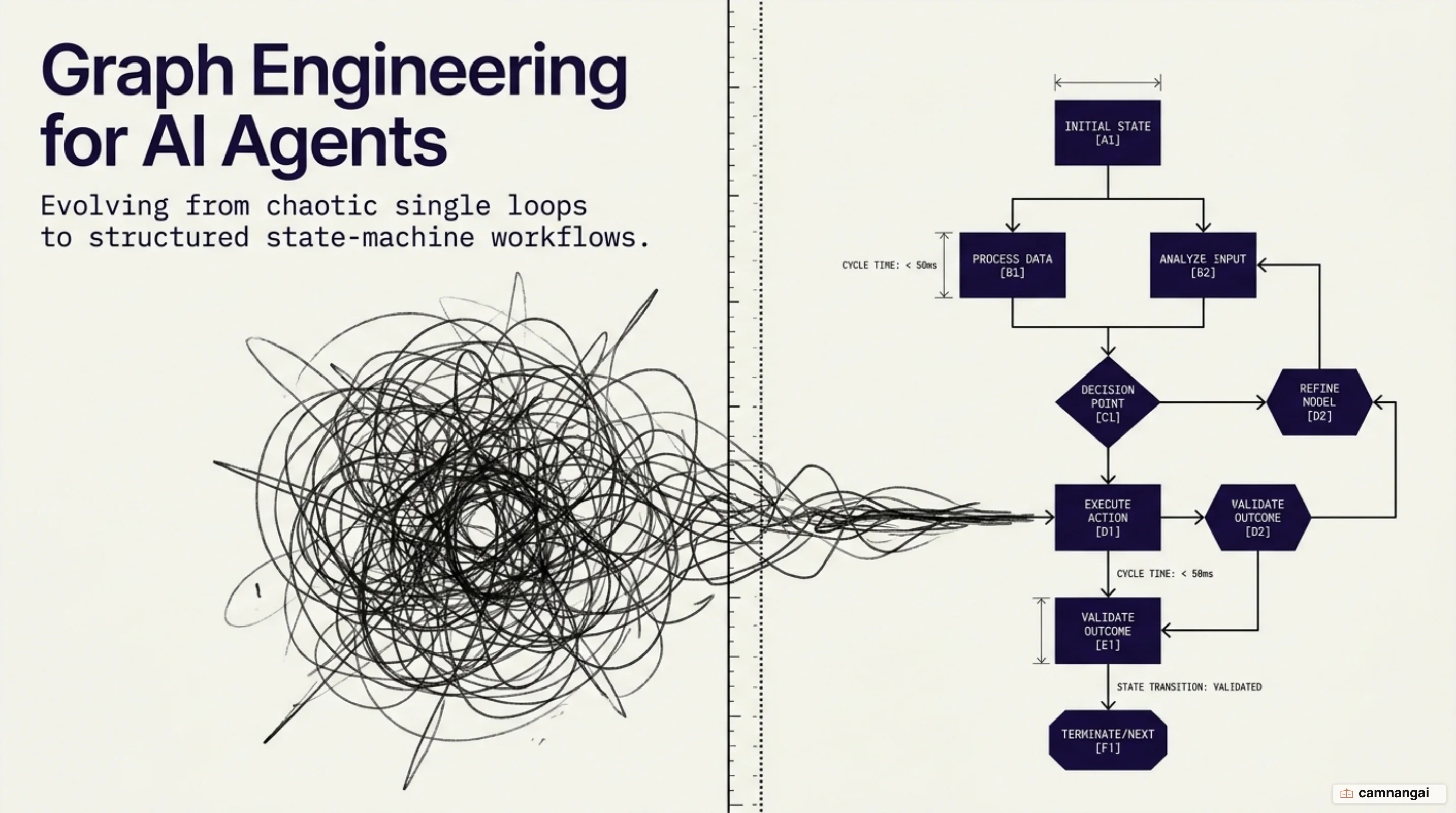
Graph engineering is the architectural practice of orchestrating multi-step agentic systems as directed graphs—or state machines—with explicit nodes, edges, state transitions, verifiers, and human-in-the-loop checkpoints, rather than relying on an unconstrained single-agent loop.
By structuring execution paths programmatically, you shift system control from probabilistic model judgment to deterministic workflow structure. This ensures that your complex AI applications execute with predictable behavior, bounded scope, and explicit state management across multi-step tasks.
This transition marks a distinct architectural progression in how you build AI infrastructure. Prompt engineering focuses on optimizing raw inputs for a single model call, while context engineering shapes the retrieved context available within that call's window. Loop engineering introduces tool calling and iterative execution within a single continuous context loop. Graph engineering advances your system architecture further by imposing explicit structural boundaries, dynamic path routing, state reduction, and isolated execution contexts across multiple nodes and subagents.
System architecture determines the ceiling of AI agent reliability, not the scale of the underlying foundation model.
Why single-agent loops break down in production
When you deploy single-agent loops, your system executes planning, evidence gathering, tool calling, execution, and self-evaluation inside a single model instance running within a continuous context window. In production, this pattern breaks down due to severe context bloat, repetition of unproductive tool calls, loss of initial system constraints, and single points of failure. Consider a scenario where you task an agent with evaluating whether to build an AI bookkeeping tool for Shopify merchants. In a single-agent loop, one model decides what to investigate, gathers market evidence, interprets its findings, recommends a strategy, and evaluates its own confidence without external verifiers or intermediary checks. This unchecked autonomy creates unvalidated assumptions and brittle operational paths.
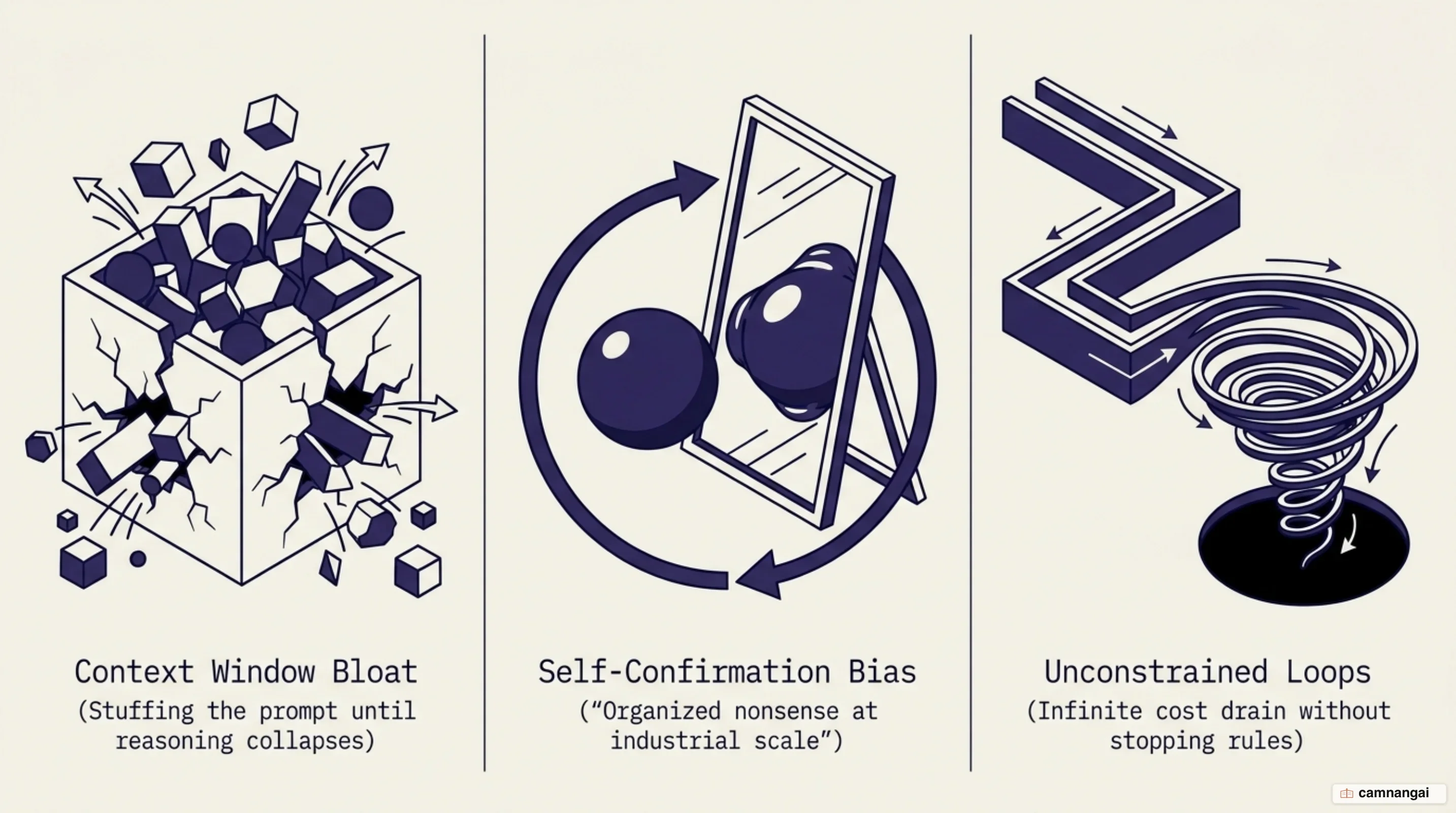
Attempting to scale single-agent loops into unconstrained multi-agent networks often compounds these failure modes, resulting in what Carlos Perez terms "organized nonsense at industrial scale." When you run multiple agents that share the same flawed context window or execute using the same base model architecture, LLM-based verifiers consistently fail. Because models inherently favor their own generated probability distributions and share identical context assumptions, homogeneous multi-agent peer review is structurally susceptible to self-confirmation bias. Rather than achieving rigorous cross-examination, your peer agents merely validate false consensus across iterations unless you apply external, deterministic checks like unit tests, execution sandboxes, or hard database constraints.
Graph engineering addresses these failure modes by shifting reliance away from LLM judgment to manage execution flow, forcing you to trust code structure to govern system pathways instead. The core engineering principle is direct: if you know a business rule, domain constraint, or operational requirement in advance, hardcode it into deterministic code or state transition boundaries rather than prompting an LLM to remember it. You should reserve LLM calls exclusively for steps requiring true semantic ambiguity resolution, qualitative interpretation, or unstructured decision-making.
Continuous single-chat windows accumulate noise, irrelevant tool outputs, and token bloat over multi-turn executions, accelerating model degradation and context drift. When you break tasks into explicit graph nodes, you enforce strict scope control. Station-to-station state handoffs strip away unnecessary context tokens and historical prompt logs, passing only the structured data required for your downstream node to execute its specific task.
Knowledge graphs vs. agent graphs: Two different roles
Knowledge graphs structure domain data by mapping explicit relationships among entities, properties, and directed edges connecting data points—such as mapping your customers to products, support tickets, and system features. Architectures like GraphRAG use knowledge graphs to enhance or replace standard vector retrieval (RAG). While standard vector retrieval locates semantically similar text chunks based on embedding proximity, knowledge graphs make multi-hop data relationships explicit across disparate documents, allowing your models to navigate complex data topologies accurately.
Agent graphs represent execution workflows that dictate how work, control, and state flow through your multi-step system. Operationally, a planner node breaks tasks down, parallel worker nodes execute independent subtasks, verifier nodes audit outputs against validation criteria, and human gates pause execution for review. Your agent graph coordinates system execution and control pathways, rather than defining underlying data storage topology.
Production architectures frequently combine both constructs within a unified pipeline. Your agent graph can query a knowledge graph as an external, structured retrieval tool or memory layer. When an agent node encounters an execution step requiring multi-hop reasoning across complex domain relationships, it queries the knowledge graph before determining downstream workflow state transitions.
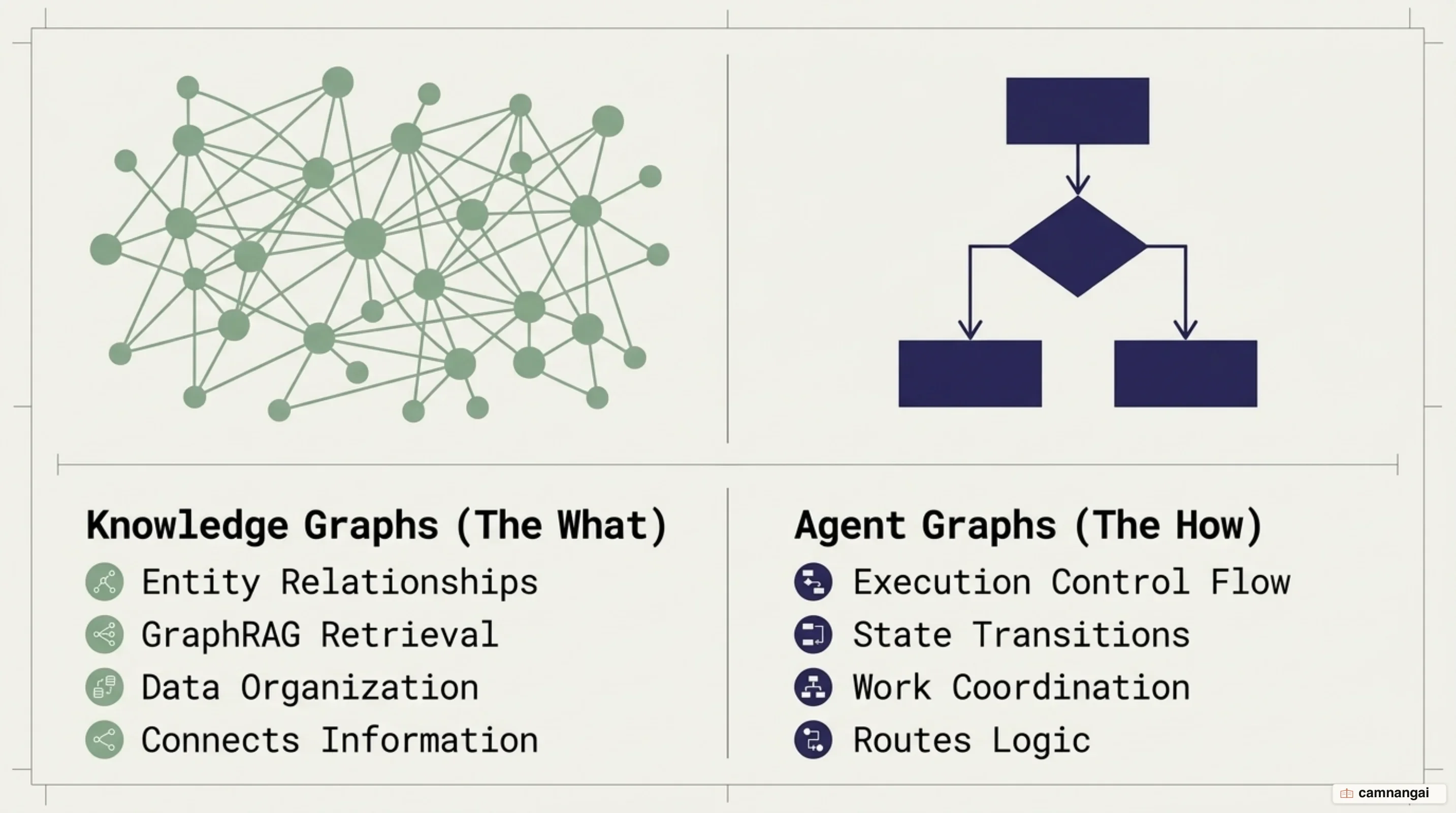
| Dimension | Knowledge Graphs | Agent Graphs |
|---|---|---|
| Core Purpose | Maps semantic relationships across connected data entities | Coordinates execution pathways and state transitions |
| Key Components | Entities, properties, and relationship edges | Nodes (code/LLMs/tools), conditional edges, shared state |
| Primary Operational Focus | Structuring multi-hop retrieval and data storage topology | Orchestrating execution logic, verifiers, and human gates |
| Representative Frameworks | GraphRAG, GQL, Neo4j | LangGraph, AutoGen GraphFlow |
Nodes, edges, and state: The building blocks of an agent graph
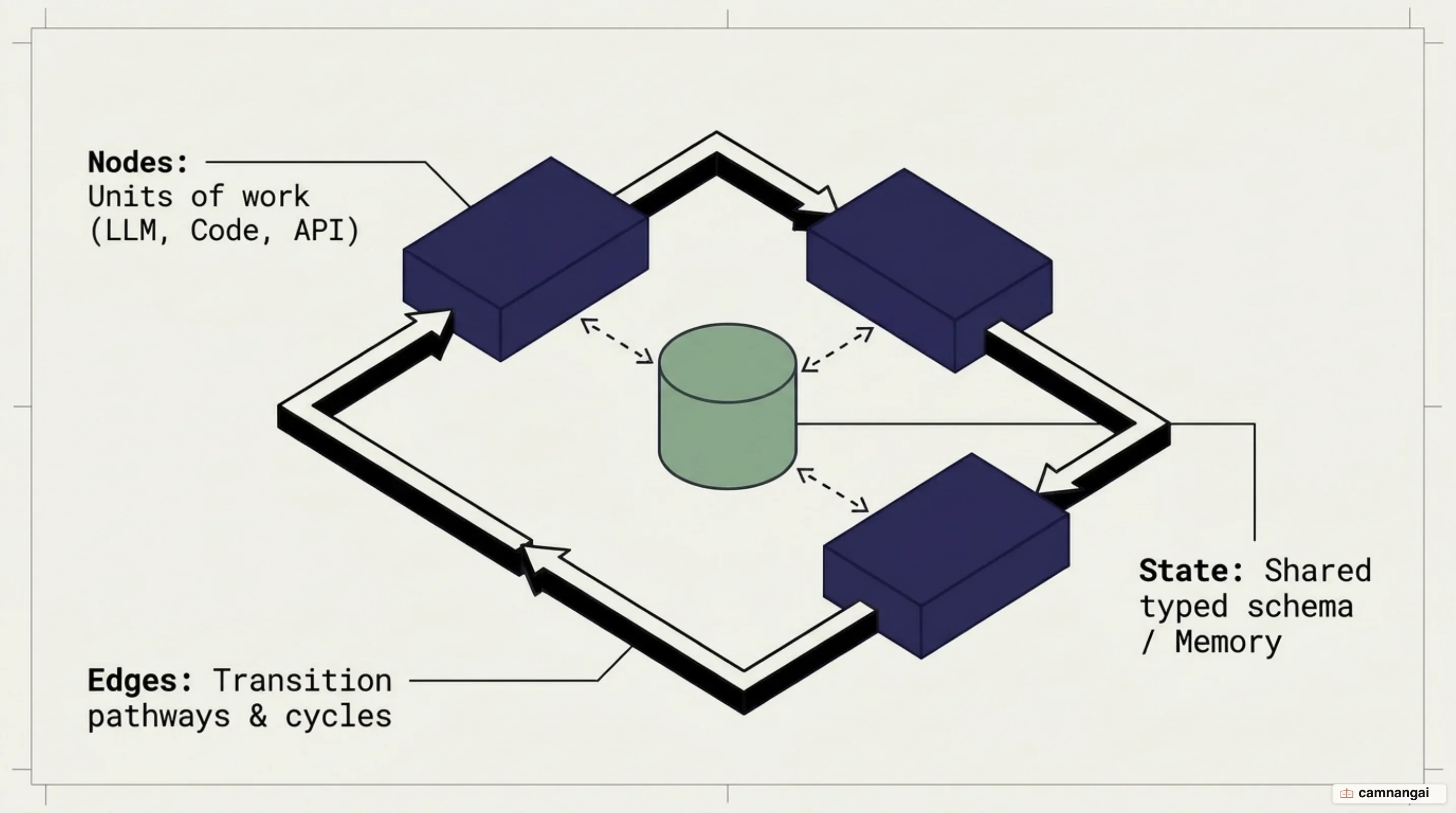
A node is a discrete unit of work within your graph execution path. Modern agent graphs support four primary node implementations: deterministic code (such as Python scripts or API calls), single LLM calls without tool access, LLM tool calls, and full subagent runs that execute internal loops (such as embedding a dedicated coding agent or deep research runner as a single node within a larger graph).
Edges define transition pathways that dictate execution flow between nodes. Your edges can be static direct connections or conditional paths evaluated against state variables or node outputs. For map-reduce patterns where workload sizing is determined at runtime, dynamic fan-out routing allows a node to dynamically instantiate and route work to a variable number of downstream worker nodes without predefining static edge connections.
You can construct workflows using several explicit edge types: Direct (sequential handoffs), Conditional (branching based on state evaluation), Parallel (fan-out execution across concurrent nodes), Looping (cycles for iterative retries), Error recovery (fallback routing), Human-controlled (interrupt gates), and Event-triggered (external webhooks or signals). In practice, including looping cycles makes agent graphs non-DAGs (Directed Acyclic Graphs). Cycles are mandatory for real-world agent systems that require retries, user feedback loops, and validation revisions.
State is the shared, typed data structure passed between nodes during execution. Your nodes read from the state to perform work and return explicit state updates rather than writing directly to global variables or dragging accumulating prompt logs through the entire system.
from typing import TypedDict, List, Optional

class AgentWorkflowState(TypedDict):
    query: str
    research_data: List[str]
    review_status: str
    iteration_count: int

def skeptic_verifier_node(state: AgentWorkflowState) -> dict:
    if state["iteration_count"] >= 2 or "APPROVED" in state["review_status"]:
        return {"review_status": "PASSED"}

    return {
        "review_status": "REJECTED",
        "iteration_count": state["iteration_count"] + 1
    }
State management in practice: Reducers, checkpoints, and interrupts
When your parallel worker nodes fan-in to converge on a single downstream step, state reducers prevent race conditions and data overwrites. If multiple concurrent workers attempt to update the same state key simultaneously, a reducer function resolves conflicting updates by appending items to a list, merging key-value pairs in dictionaries, or enforcing explicit overwrite rules.
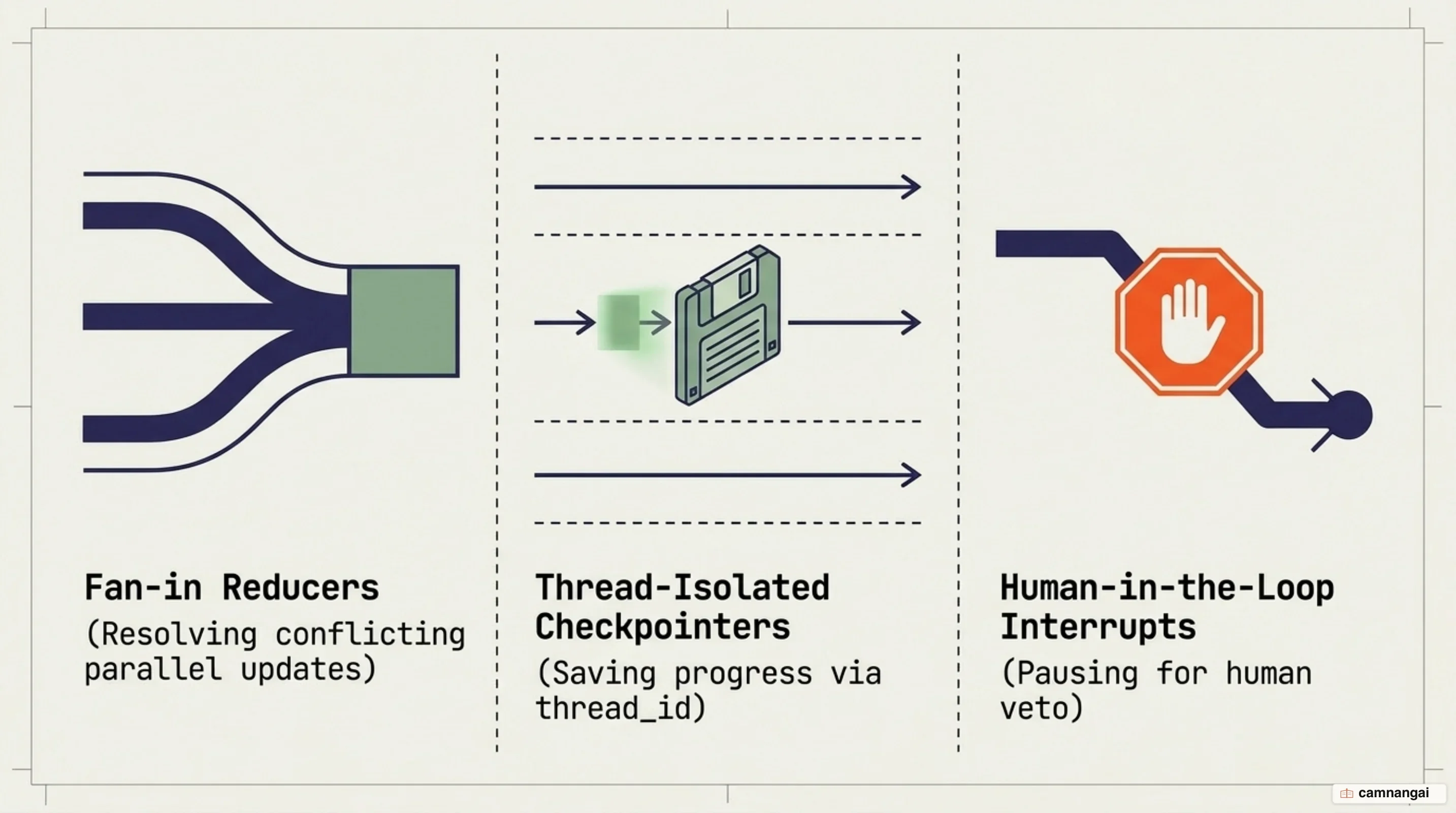
Checkpointers snapshot graph state after every super-step, isolating execution sequences through explicit thread identifiers (thread_id). Reusing a thread identifier loads its latest saved checkpoint, whereas a new identifier initializes an independent execution thread. This snapshotting mechanism provides three vital production capabilities: resilient error recovery without re-running completed nodes, state inspection for auditing, and time-travel debugging to re-execute workflows from earlier historical checkpoints.
Interrupts introduce deterministic human-in-the-loop validation gates. When execution encounters an interrupt, the graph pauses, persists its current state snapshot to the checkpointer, and yields control back to the caller. The workflow can remain safely suspended indefinitely without holding memory or compute resources. Resuming execution requires invoking the graph with the thread identifier and providing resumption payload values, allowing the workflow to pick up precisely where it stopped.
Five architectural patterns for agent workflows
Production agent graphs converge around five foundational architectural patterns. Mastering these patterns allows you to build sophisticated systems from simple, composable blocks.
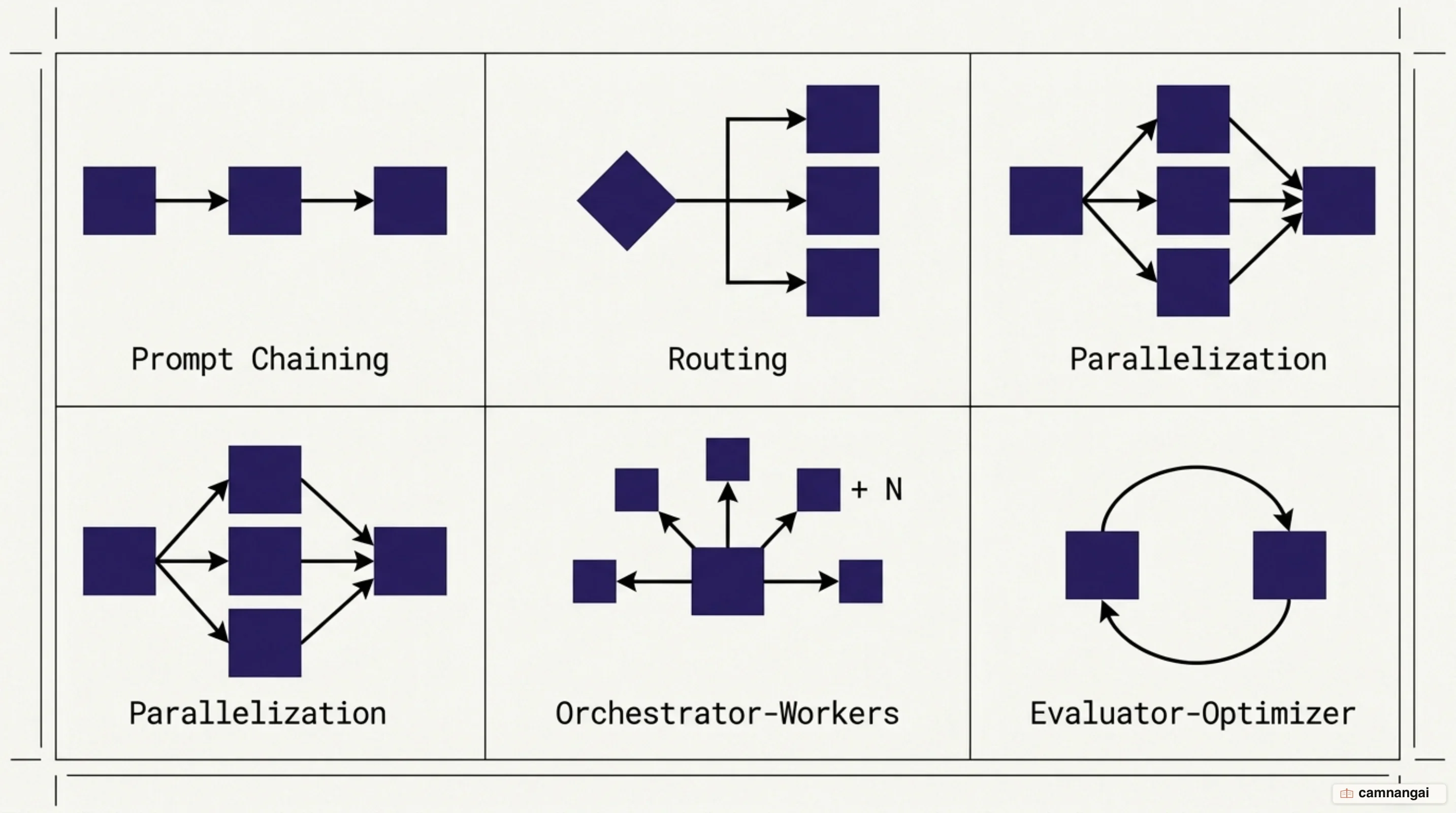
1. Prompt Chaining
Prompt Chaining decomposes a task into a sequential pipeline where each LLM call processes the output of the preceding node. Each node enforces a clean context boundary, stripping away conversational noise. A canonical recipe is the SQL repair loop: a generator node converts natural language to SQL, an execution node runs it against a test database, and an error node catches syntax failures to prompt a self-correction pass before final synthesis. Chaining fails when tasks are over-segmented, unnecessarily inflating latency without isolating context.
2. Routing
Routing classifies user input at the entry gate and directs it to a specialized downstream path or model tier. This pattern optimizes operating costs and response latency by dispatching narrow queries to small models and reserving large models for complex reasoning. The primary failure mode is misclassification: if the router sends a complex inquiry down a simple path, the system returns a confident but low-quality response. Implement confidence score thresholds to fall back to comprehensive paths whenever classification certainty is low.
3. Parallelization
Parallelization executes independent subtasks concurrently to minimize end-to-end wall-clock latency. It splits into two modalities: Sectioning (dividing a goal into discrete, parallel domains) and Voting (running identical tasks across multiple models or prompts to aggregate consensus). A production recipe is Evidence Gating in RAG: parallel nodes query databases, vector stores, and web APIs simultaneously, fanning in to a verifier node that discards irrelevant hits before final generation. Parallelization fails when tasks harbor unmodeled interdependencies.
4. Orchestrator-Workers
In an Orchestrator-Workers topology, a central orchestrator analyzes an open-ended task and dynamically instantiates a variable number of worker nodes at runtime to execute subtasks. This pattern excels at tasks where subtask scope cannot be predicted in advance, such as auditing multiple code repositories. Because workers spawn dynamically, this architecture risks runaway token spend and API rate limit exhaustion. Always enforce hard limits on maximum concurrent workers and total token budgets per run.
5. Evaluator-Optimizer
The Evaluator-Optimizer pattern creates an iterative refinement loop between a generator node and a verifier node. The generator produces a draft, and the verifier evaluates it against explicit scoring criteria, returning constructive feedback for revision until it meets acceptance thresholds. A production recipe is Human-in-the-Loop Policy Review: the loop iteratively refines a drafted document against regulatory standards, pausing at an interrupt gate for human sign-off once automated checks pass. Always enforce hard stop conditions, such as a maximum iteration count, to prevent infinite loops when outputs reach an improvement plateau.
Production realities: Durable execution and idempotent actions
Basic checkpointers act as save points by snapshotting graph state to a database after each step, but they do not provide true durable execution. A checkpointer saves state data, but relies entirely on you as the developer to detect process crashes, handle distributed locking, and manually re-invoke execution.
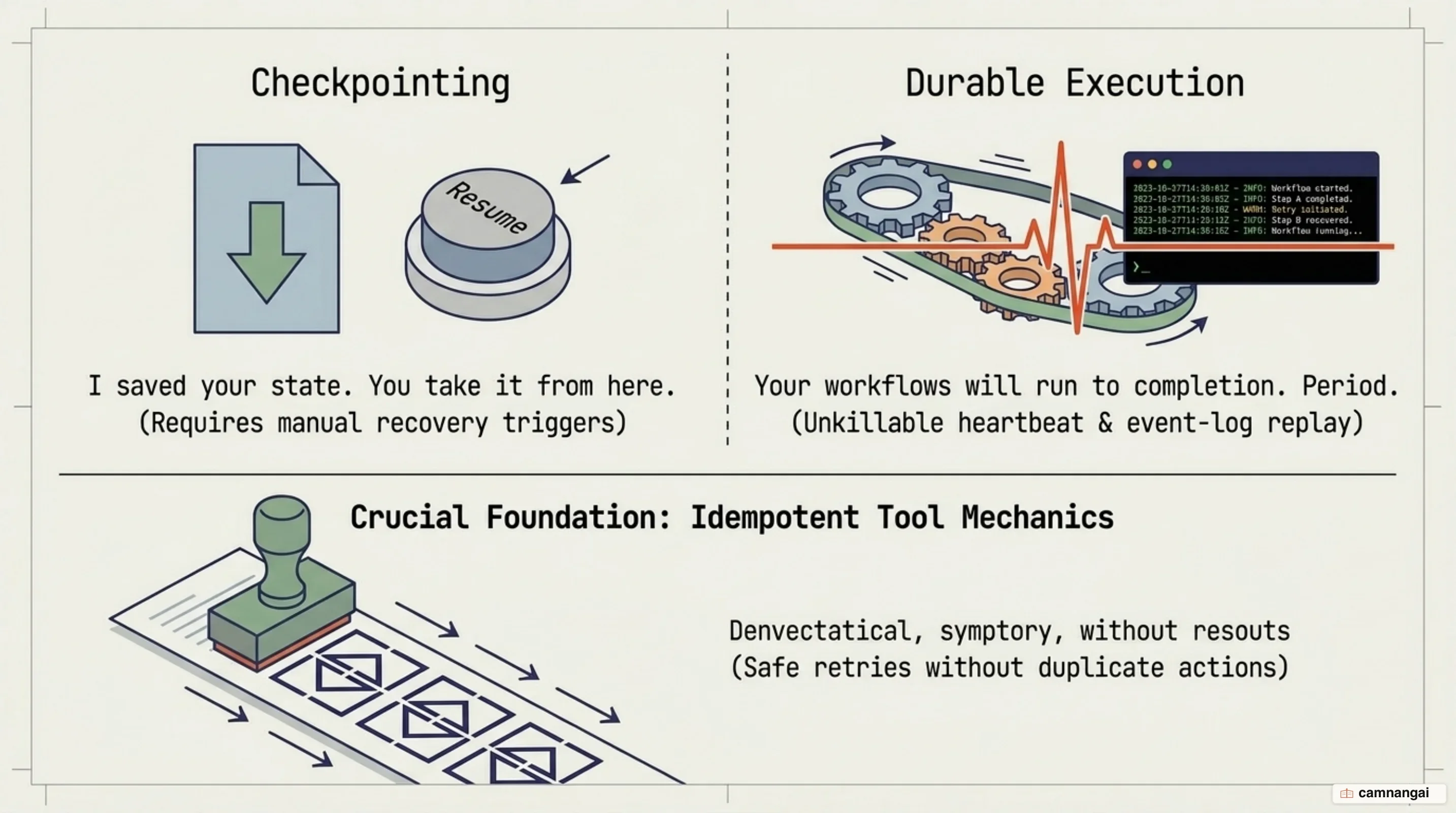
Production runtimes provide durable execution guarantees through four architectural pillars:
- Automatic Failure Detection: Watchdogs and heartbeat mechanisms detect process and infrastructure crashes automatically.
- Automatic Background Resumption: Workflows restart and resume execution from saved states without manual intervention code.
- Replay-Based Execution: Workflows replay execution from immutable event logs, returning cached results for previously completed steps.
- Distributed Execution: Workflows and activities distribute across worker pools, automatically rebalancing when cluster nodes fail.
If you operate multiple worker processes in distributed clusters without lease coordination, you introduce severe race conditions. When multiple worker nodes attempt to resume the same thread_id concurrently following a node failure, a lack of distributed locking causes duplicate executions of identical nodes, resulting in corrupted state snapshots and redundant side effects.
You must design idempotent tools across retries, crash recoveries, and interrupt resume points. If a node executes an external side effect (such as initiating an API call, modifying a database, or executing a payment) before a system failure or interrupt, re-executing that node must not duplicate the side effect. You must enforce idempotency mechanics in tool interfaces, such as requiring absolute file paths instead of relative paths in code modification tools or transmitting unique deduplication tokens during external API calls.
When to use graph engineering (and when to stick to a loop)
You should adopt graph engineering when building multi-stage workflows with predictable stages—such as compliance review pipelines, code pull-request audits, or triage-search-synthesis tasks. Graphs are necessary whenever your execution requires mandatory human-in-the-loop approval gates, dynamic fan-out coordination, or deterministic state persistence across process interruptions.
Stick to single loops or plain agent runtimes for open-ended, highly autonomous tasks where rigid predefined graph paths impair the model's ability to plan, explore, and pivot dynamically. Start with the simplest single loop paired with a deterministic verifier, and introduce graph structure only when production failure modes force you to enforce programmatic boundaries.
References
- Graph Engineering for AI Agents: From Prompts and Loops to Workflows — Towards Data Science
- Building Effective Agents — Anthropic
- 3 Years of Graph Engineering with LangGraph — LangChain
- Persistence and Human-in-the-Loop in LangGraph — LangChain Docs
- Graph-Based Agentic AI with LangGraph: Workflow Pathways for Long-Running Stateful Business Processes — arXiv
- Graph Engineering Explained: What Actually Changed — Louis Bouchard
- Checkpoints Are Not Durable Execution — Diagrid